Tele-Tessar 250mm f/4
Carl Zeiss · Hasselblad V · 1977 · Tele-Tessar (true telephoto)
Also known as: Zeiss Tele-Tessar 250mm f/4 · Carl Zeiss Tele-Tessar T* 250mm f/4 · Tele-Tessar 4/250 · Tele-Tessar 250/4 · Hasselblad 250mm f/4 · Hasselblad 250mm Tele-Tessar · Tele-Tessar F 250mm · Tele-Tessar FE 250mm · Tele-Tessar T* 4/250 FE · Hasselblad 250 FE
Variants & identification
| Variant | Mount | Years | Serial ranges | Production |
|---|---|---|---|---|
| Tele-Tessar F T* 4/250 (shutterless, 2000-series) · none — exposes through the body's focal-plane shutter | Hasselblad V (F — focal-plane bodies only) | 1977–1991 | — | — |
| Tele-Tessar F/TCC T* 4/250 · none — exposes through the body's focal-plane shutter | Hasselblad V (F/TCC — focal-plane bodies only) | 1991–1994 | — | — |
| Tele-Tessar FE T* 4/250 · none — exposes through the body's focal-plane shutter | Hasselblad V (FE — focal-plane bodies only) | 1994–2004 | — | — |
- Element and group counts, weights, exact focal lengths, closest focus and filter mount come from the Zeiss data sheets hosted by Hasselblad Historical (F250, FE250).
- The F/TCC row has no data sheet of its own; its years follow the databus transition across the whole F line (F/TCC with the 205TCC in 1991, renamed FE with the 203FE in 1994).
How to tell them apart
- There is no leaf shutter and no shutter-speed ring: this lens exposes only on a focal-plane body of the 2000- or 200-series, never on a 500-series camera
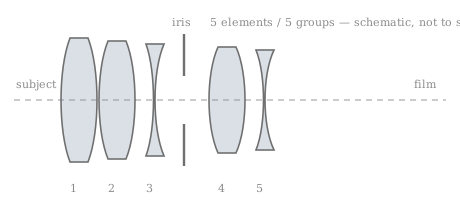
- Five elements in five groups and a true telephoto layout — the reason a 250mm lens a stop faster than the Sonnar still weighs 920 g, less than the 1000 g CF Sonnar
- Filter mount is a bayonet the Zeiss sheets write as B 77, catalogued by dealers as Hasselblad bayonet 70 — not the series 50 or 60 of the leaf-shutter 250s
- F, F/TCC and FE differ only in the databus: four contacts on the bayonet plate and two blue barrel lines from 1991, the F/TCC marking replaced by FE in 1994
Tele-Tessar F T* 4/250 (shutterless, 2000-series):
- No shutter-speed ring and no leaf-shutter lever — the barrel is a plain focusing mount with the bayonet and the automatic-diaphragm coupling
- Filter mount is a bayonet the Zeiss sheet writes as size B 77; dealers catalogue the lens under Hasselblad's bayonet 70, and it is the only 250 in the V system not taking series 50 or 60
- Zeiss data sheet: cat. no. 10 45 29, 5 elements in 5 groups, exact focal length 246.3 mm, 920 g, 2.5 m closest focus, aperture scale 4-5.6-8-11-16-22-32, smallest object field 433 × 433 mm
- Red-ink Zeiss date code inside the rear mount — from 1980 two reversed year digits and a month letter, A = January
Tele-Tessar F/TCC T* 4/250:
- Marked F/TCC; four databus contacts on the bayonet plate and two parallel blue lines on the barrel, the mark of every databus item
Tele-Tessar FE T* 4/250:
- FE engraved after the focal length; four databus contacts; the Zeiss sheet describes the mount as 'camera mount FE (bayonet for Hasselblad 200/2000 series focal-plane cameras)'
- Zeiss data sheet: cat. no. 10 45 40, 5 elements in 5 groups, exact focal length 245.6 mm, 920 g, 2.5 m, reproduction ratio 1:7.7, bayonet filter mount B 77
- Tele-Tessar F T* 4/250 (shutterless, 2000-series): The lens introduced with the 2000FC, which Zeiss's sheet names directly: 'even at full aperture the Tele-Tessar T* f/4-250 mm lens for the 2000 FC Hasselblad camera provides an excellent image quality'. The sheet stresses that it is a true telephoto — front group positive, rear group negative, so the barrel is shorter than the focal length — 'and hence very compact and relatively light', and that the fast maximum aperture opens up press, sports and stage work as well as long-range photography and portraiture.
- Tele-Tessar F/TCC T* 4/250: The 205TCC of 1991 needed lenses that could report their set aperture to the body's meter, so the F lenses were reissued with contacts as F/TCC and renamed FE when the 203FE arrived in 1994. No Zeiss data sheet for a TCC-marked 250 was consulted here; the sheets run F, then FE, and this row follows the pattern across the F line rather than a document specific to the 250.
- Tele-Tessar FE T* 4/250: Mechanically and optically the F lens with contacts: same 5/5 computation, same 920 g, same 2.5 m closest focus. The sheet's claim for it is a competitive one — 'there are not many telephoto lenses in medium format worldwide that are faster than the Tele-Tessar T* 4/250 FE lens' — and it credits the Tele-Tessar layout with keeping the weight well under 1 kg, so the lens can be used hand-held and wide open. Preferred uses given: editorial, fashion, weddings, theatrical and stage photography, portraits, scenic landscapes. Production ended with the 203FE and 205FCC in 2004.
Serial-range notes
- red-ink code inside the rear mount, 1980 onward
- Zeiss stamped a date code inside the rear of the mount; from 1980 it is two reversed year digits and a month letter, A = January, so 49C reads as March 1994. No published serial block-to-year table for the 250mm f/4 was found.
Specifications
- Formula
- Tele-Tessar (true telephoto)
- Construction
- 5 elements / 5 groups
- Aperture range
- f/4–f/32
- Shutter
- None — the F, F/TCC and FE versions carry no leaf shutter and expose through the focal-plane shutter of a 2000- or 200-series body
- Min. focus
- 2.5 m
- Weight
- 920 g
- Years manufactured
- 1977–2004
- Country
- West Germany (Carl Zeiss, Oberkochen); Germany from 1990
- Coating
- T* multicoating throughout — the family began after the T* transition of the early 1970s
What reviewers say
No reviews aggregated yet — this family is still in the research queue. Written one? We'd love to index it.
Optical formula — Tele-Tessar (true telephoto)
ⓘ What these charts mean
MTF (modulation transfer function) shows how much contrast the lens keeps at a given fineness of detail, from the center of the frame to the corner — the coarse curves track punch, the fine ones resolving power, and a gap between solid and dashed lines means astigmatism. Relative illumination (falloff) shows how much darker the corners are than the center at each aperture. Manufacturers only began publishing these for modern lenses; no 1950s maker issued them, which is why older families here cite period magazine bench tests instead.
History
The Tele-Tessar 250mm f/4 exists because of the 2000FC. When Hasselblad returned to a focal-plane shutter in 1977, the lenses for the new body could drop the leaf shutter that had constrained the 500-series line since 1957, and Zeiss used the freedom to build a long lens a full stop faster than the one it sat beside in the catalogue. The data sheet names the camera in its opening line — “even at full aperture the Tele-Tessar T* f/4-250 mm lens for the 2000 FC Hasselblad camera provides an excellent image quality” — and gives the design as five elements in five groups, an exact focal length of 246.3 mm, 920 g, 2.5 m closest focus, an aperture scale running f/4 to f/32, and a smallest object field of 433 × 433 mm.
The name is doing real work. A Tele-Tessar is a true telephoto: a positive front group and a negative rear group set so that the lens is physically shorter than its focal length, which is not true of the Sonnar type used for the leaf-shutter 250. The sheet calls it “a true tele lens and hence very compact and relatively light”, and the arithmetic bears it out — 920 g at f/4, against 930 g for the C Sonnar and 1000 g for the CF Sonnar at f/5.6. The FE sheet returns to the same point years later, crediting the Tele-Tessar layout with keeping the weight “considerably below 1 kg” so that the lens can be hand-held, and adding that “there are not many telephoto lenses in medium format worldwide that are faster”.
Its filter mount is the family’s one awkwardness. Both sheets give it as a bayonet of size B 77, a size shared with no other 250 in the system; dealers catalogue the lens under Hasselblad’s bayonet 70, as KEH does for the FE version. Whichever label is used, neither the series 50 accessories of the C lenses nor the series 60 of the CF and CFi will fit, and the difference is the fastest way to identify the lens across a shop counter.
The three versions differ only in electronics. The 205TCC of 1991 metered through the body and needed the lens to report its set aperture, so the F lenses were reissued with four databus contacts on the bayonet plate and two blue lines on the barrel, marked F/TCC; the marking became FE in 1994 when the 203FE arrived. The Zeiss FE sheet, cat. no. 10 45 40, records the same 5/5 computation, the same 920 g and the same 2.5 m minimum distance as the F, with a reproduction ratio of 1:7.7 and the mount described as “bayonet for Hasselblad 200/2000 series focal-plane cameras”. No sheet for a TCC-marked 250 was found for this entry, so that generation is carried on the pattern of the F line as a whole. The lens left the catalogue with the 203FE and 205FCC in 2004, nine years before the leaf-shutter Sonnar it was meant to outclass.
Zeiss’s own idea of who would buy it shifted over the two sheets. The 1977 text points at press, sports and stage photography alongside long-range work and portraiture; the FE sheet lists editorial, fashion, weddings, theatrical and stage photography, portraits and scenic landscapes. Both insist the lens can be used wide open, which is the whole argument for buying an f/4 rather than the cheaper f/5.6.
What remains open: no blog review of the lens was found, so this entry carries none; no list price at any date was located; production numbers are unknown, as are the serial ranges of the F/TCC transition; and no source consulted names the designer of the 250mm Tele-Tessar at Zeiss Oberkochen.
This history is AI-written, from the sources listed at the foot of the page. Where the record is silent it says so rather than filling the gap — but no human wrote these sentences.
Example photos
Sample photo wanted — shot with a Tele-Tessar 250mm f/4? We'd love to feature it (with credit).
Live listings
Asking price, USD: a median of $550 across 19 fixed-price listings on 2026-09-06 (middle half $420–$700). First day tracked.
Asking prices from the listings scanned, not sales; junk-flagged rows and auction lots excluded; other currencies are not converted.
- ZEISS Jena Tele-Tessar 25cm f/4,0 - SNr: 6026553
- hasselblad zeiss Tele-Tessar F 4/250mm T* for 200 203 205 2000 V ha1
- Carl Zeiss Tele-Tessar T* 250mm f/4 Teleobjektiv für Hasselblad V Nr 6392608
- Carl Zeiss Tele-Tessar F 1:4 / 250 mm T* TCC für Hasselblad 205 TCC mit OVP
- [TOP NEUWERTIG] Hasselblad Carl Zeiss T* Tele-Tessar FE 250mm f/4 Objektiv...
- HASSELBLAD Carl Zeiss F Tele-Tessar T* 250mm F4 Objektiv V Mount gebraucht...
- Hasselblad Zeiss Tele-Tessar 4/250 FE sehr gut
- Seltene [fast unbenutzt] Hasselblad Carl Zeiss T* Tele-Tessar 250mm F/4 FE au...
- Zeiss Tele-Tessar 4/250 250mm 1:4 für Hasselblad 2000 F Serie V-System Top nice
- Obiettivo manuale Hasselblad Zeiss Tele Tessar 250mm F4
- *NEUWERTIG* Hasselblad Carl Zeiss T* Tele-Tessar 250mm F4 FE Objektiv 203 205...
- Objectif Manuel Hasselblad Zeiss Tele Tessar 250mm F4
- Manuelles Objektiv Hasselblad Zeiss Tele Tessar 250mm F4
- Hasselblad Zeiss Tele Tessar 250mm F4 Manual Focus Lens
- Manuelles Objektiv Hasselblad Zeiss Tele Tessar 250mm F4
- Objectif Manuel Hasselblad Zeiss Tele Tessar 250Mm F4
- Hasselblad Carl Zeiss Tele-Tessar 250mm f/4 FE ✅MINT & CLEAN, 2000, 201/202/205
- Hasselblad Carl Zeiss Tele-Tessar T* 250mm F4 (für 200 2000 Series) + Deckel
- Hasselblad Carl Zeiss Tele-Tessar FE 4/250mm T* Excellent condition
- Hasselblad Carl Zeiss Tele-Tessar T 250mm F4 (pour 200 2000 Série) + Couvercles
Show 36 more listings
- Hasselblad Carl Zeiss Tele-Tessar 250mm F4 (Für 200 2000 Series) + Deckel
- Hasselblad Carl Zeiss Tele-Tessar T 250mm F4 (for 200 2000 Series) + Covers
- Hasselblad Carl Zeiss Tele-Tessar 250mm F4 (Für 200 2000 Series) + Deckel
- Hasselblad Carl Zeiss Tele-Tessar T 250mm F4 (pour 200 2000 Série) + Couvercles
- CARL ZEISS 250MM F4 TELE-TESSAR F FOR HASSELBLAD V SYSTEM + BOX 3020478 #1348
- Hasselblad FE Tele-Tessar 4/250 T* Carl Zeiss Tele Lens 250mm f/4 für F Modelle
- Hasselblad Tele-Tessar FE 4/250 mm - TOP
- Hasselblad 250mm f4 Zeiss Tele Tessar FE T* Lens #716
- Hasselblad Carl Zeiss Tele-Tessar T* 250mm f/4 F4 FE Lens [Good] 88-K08
- [FedEx]Hasselblad Tele-Tessar Carl Zeiss T* 250mm F4 Lens
- [FedEx]HASSELBLAD Carl Zeiss T* Tele-Tessar 250mm F4 Lens
- [TOP MINT] Hasselblad Carl Zeiss T* Tele-Tessar FE 250mm f/4 Lens Japan #1913P
- 【MINT】 Hasselblad Carl Zeiss Tele-Tessar T* 250mm f/4 FE Lens from JAPAN #25144
- HASSELBLAD Carl Zeiss F Tele-Tessar T* 250mm F4 Lens V Mount Used From Japan
- Used Hasselblad Carl Zeiss FE Tele-Tessar 250mm f/4 T* Lens
- Hasselblad Zeiss 250mm f4 Tele-Tessar T* F Lens (for focal plane only) [EX+]
- Rare[Almost Unused] Hasselblad Carl Zeiss T* Tele-Tessar 250mm F/4 FE From JAPAN
- Hasselblad Carl Zeiss Tele Tessar 250mm FE f/4 T* Lens Mint LN See My Full Store
- carl zeiss tele-tessar 4/250 T
- *MINT* Hasselblad Carl Zeiss T* Tele-Tessar 250mm F4 FE Lens 203 205 From JAPAN
- Hasselblad Carl Zeiss Tele Tessar FE 250mm f4
- FE Lens【 Mint 】 Hasselblad Carl Zeiss Tele-Tessar T* 250mm F/4 Lens From Japan
- EX+ Hasselblad Tele-tessar 250mm f/4 T* FE Lens 203FE 205FCC
- Hasselblad FE 250mm f4 Tele-Tessar T* Telephoto Lens [EXC+]
- Hasselblad FE Tele-Tessar 250mm F/4 T* Lens *EX+*
- CARL ZEISS 250MM F4 TELE-TESSAR F FOR HASSELBLAD V SYSTEM + BOX 3020478 #1348
- [TOP MINT] Hasselblad Carl Zeiss T* Tele-Tessar FE 250mm f/4 Lens Japan #1913P
- HASSELBLAD Carl Zeiss F Tele-Tessar T* 250mm F4 Lens V Mount Used From Japan
- Hasselblad Carl Zeiss Tele-Tessar T* 250mm f/4 F4 FE Lens [Good] 88-K08
- Hasselblad 250mm F/4 F Carl Zeiss Tele-Tessar Lens for V series (20540)
- Rare[Almost Unused] Hasselblad Carl Zeiss T* Tele-Tessar 250mm F/4 FE From JAPAN
- *MINT* Hasselblad Carl Zeiss T* Tele-Tessar 250mm F4 FE Lens 203 205 From JAPAN
- FE Lens【 Mint 】 Hasselblad Carl Zeiss Tele-Tessar T* 250mm F/4 Lens From Japan
- Carl Zeiss Tele-Tessar T* 250mm f4 FE Objektiv für Hasselblad V - Originalverpackt
- Hasselblad Carl Zeiss Tele-Tessar T* 250mm f/4 F4 FE Lens
- Hasselblad Zeiss Tele Tessar F 250mm F4 T* for 200 and 2000 mint like new
eBay links are affiliate links. If you buy through one, Glass Bodies earns a small commission from eBay at no cost to you. It does not change which listings appear, their prices or their order — those come from the search and the sort described above.
Listings updated 2026-09-05. Links go to the shop or marketplace that carries the item.