Sonnar 150mm f/2.8
Carl Zeiss · Hasselblad V · 1977 · Sonnar
Also known as: Zeiss Sonnar 150mm f/2.8 · Carl Zeiss Sonnar T* 150mm f/2.8 · Sonnar 2.8/150 · Sonnar 150/2.8 · Hasselblad 150mm f/2.8 · Hasselblad 150mm Sonnar F · Sonnar F 150mm f/2.8 · Sonnar FE 150mm f/2.8 · Sonnar T* 2.8/150 FE · Hasselblad 150mm TCC
Variants & identification
| Variant | Mount | Years | Serial ranges | Production |
|---|---|---|---|---|
| Sonnar F T* 2.8/150 (1977 baseline) · none — exposes through the body's focal-plane shutter | Hasselblad V (F — focal-plane bodies only) | 1977–1991 | — | — |
| Sonnar F/TCC T* 2.8/150 · none — exposes through the body's focal-plane shutter | Hasselblad V (TCC — focal-plane bodies only) | 1991–1994 | — | — |
| Sonnar FE T* 2.8/150 · none — exposes through the body's focal-plane shutter | Hasselblad V (FE — focal-plane bodies only) | 1994–2004 | — | — |
- Element and group counts, exact focal lengths, weights, closest focus and filter fittings are from the Zeiss data sheets hosted by Hasselblad Historical (F150, FE150). No sheet for the TCC version was consulted; its optics are taken to be the F lens's, as no source consulted describes a change.
- The F → TCC → FE sequence follows the bodies, not this lens: contacts arrived with the 205TCC in 1991, and the TCC name gave way to FE at the 203FE. Sources differ on when the renaming took effect — 'FE (former TCC)' appears in the 1994 203FE manual, while the Japanese Wikipedia product list puts it in March 1995.
How to tell them apart
- No shutter-speed ring: this family has no leaf shutter and works only on the focal-plane bodies — 2000FC, 2000FC/M, 2000FCW, 2003FCW, 205TCC, 201F, 203FE, 205FCC and 202FA. It will mount on a 500-series body but cannot expose
- The letters after the focal length are the generation: F (1977–91, no contacts), TCC (1991–94, four databus contacts and two blue lines), FE (1994–2004, the same lens renamed)
- Flash synchronises only to 1/90 s through the body's focal-plane shutter, against 1/500 for the leaf-shutter Sonnar 4/150 (Zeiss FE data sheet)
- The Zeiss sheets give the filter fitting as 'bayonet, size B 77' for both the F and the FE, while dealer listings describe a bayonet-70 mount; no source consulted reconciles the two
Sonnar F T* 2.8/150 (1977 baseline):
- No shutter-speed ring at all — the giveaway that separates every F/TCC/FE lens from a leaf-shutter C, CF or CFi
- F engraved after the focal length; no databus contacts on the bayonet plate
- Zeiss data sheet: cat. no. 101085, 5 elements in 4 groups, 151.1 mm exact, f/2.8–22, 1.4 m closest focus, 680 g
- Red-ink Zeiss date code inside the rear mount — from 1980 two reversed year digits plus a month letter, A = January
Sonnar F/TCC T* 2.8/150:
- TCC after the focal length and two parallel blue lines — the mark carried by every databus item in the TCC system, bodies, lenses, magazines and finders alike
- Four databus contacts inside the bayonet, so the 205TCC's spot meter can read at full aperture instead of stopped down
Sonnar FE T* 2.8/150:
- FE after the focal length; the same four databus contacts and blue lines as the TCC lens
- Zeiss data sheet: cat. no. 10 11 24, 5 elements in 4 groups, 151.3 mm exact, 1.4 m at 1:7.1, 680 g — the same weight as the 1977 F lens
- 'Camera mount FE (focal plane shutter, Hasselblad 200 series)' on the data sheet: flash sync to 1/90 s, not the 1/500 of a leaf-shutter lens
- Sonnar F T* 2.8/150 (1977 baseline): Introduced for the 2000FC of 1977, the first Hasselblad with a focal-plane shutter since the 1000F. Zeiss's sheet describes it as a 'fast high-performance lens of medium focal length for the Hasselblad 2000 FC with focal-plane shutter' and claims priority for the type: where the focal length is to be two or three times the format diagonal at a relatively high speed, 'Zeiss were the first to come up with lenses of this type'. The sheet's smallest object field is 400 × 400 mm.
- Sonnar F/TCC T* 2.8/150: The 205TCC of 1991 introduced a databus between body, lens and magazine, and the shutterless lenses were reissued with contacts to match. The 205TCC instruction manual describes the system mark as two blue lines on every TCC item, and its meter reads at full aperture with TCC lenses but stopped down with F, CF and C lenses. No source consulted describes an optical change; the 5/4 formula is carried over from the F.
- Sonnar FE T* 2.8/150: A renaming rather than a redesign. The 203FE instruction manual of 1994 already writes 'FE (former TCC)', while the Japanese Wikipedia product list dates the renaming to March 1995, at the launch of the 203FE — a body it nonetheless dates to 1994. The FE sheet positions the lens against its own siblings: it offers 'the same basic creative possibilities as the Sonnar T* 4/150 CFi lens', is twice as fast, and 'compared with the Planar T* 2/110 FE it offers a visibly longer focal length in the same size package'. The end year follows the 200-series bodies leaving the catalogue.
Serial-range notes
- red-ink code inside the rear mount, 1980 onward
- Every version except the first three years of the F lens postdates 1980, so the Zeiss date code inside the rear mount is two reversed year digits followed by a month letter, A = January — 19G is July 1991, 49L is December 1994. On an F lens from 1977–79 the older YY(Y)MM form applies, with the year the leading digit or digits plus 1957. Zeiss lens serials themselves are running numbers with no published block-to-year table for this focal length.
Specifications
- Formula
- Sonnar
- Construction
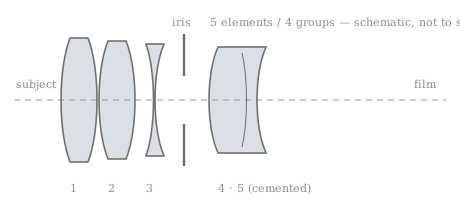
- 5 elements / 4 groups
- Aperture range
- f/2.8–f/22
- Shutter
- None — the F, TCC and FE lenses have no leaf shutter and expose through the focal-plane shutter of the 2000- and 200-series bodies; flash sync to 1/90 s
- Min. focus
- 1.4 m
- Weight
- 680 g
- Years manufactured
- 1977–2004
- Country
- West Germany, then Germany
- Coating
- T* multicoated throughout
What reviewers say
No reviews aggregated yet — this family is still in the research queue. Written one? We'd love to index it.
Optical formula — Sonnar
ⓘ What these charts mean
MTF (modulation transfer function) shows how much contrast the lens keeps at a given fineness of detail, from the center of the frame to the corner — the coarse curves track punch, the fine ones resolving power, and a gap between solid and dashed lines means astigmatism. Relative illumination (falloff) shows how much darker the corners are than the center at each aperture. Manufacturers only began publishing these for modern lenses; no 1950s maker issued them, which is why older families here cite period magazine bench tests instead.
History
In 1977 Hasselblad returned to the focal-plane shutter it had abandoned with the 1000F twenty-two years earlier, and the 2000FC needed lenses without shutters of their own to justify the change. The fast 150 was the argument. Zeiss’s data sheet calls it a “fast high-performance lens of medium focal length for the Hasselblad 2000 FC with focal-plane shutter” and gives five elements in four groups, an exact focal length of 151.1 mm, a scale from f/2.8 to f/22, closest focus at 1.4 m and 680 g (cat. no. 101085). Against the leaf-shutter Sonnar 4/150 of 1957 that is a stop and a half more light in essentially the same weight — the whole point of taking the shutter out of the barrel.
The sheet is unusually talkative about why the design works, and unusually proud. Where the focal length is to be twice or three times the diagonal of the format at a relatively high speed, it says, this lens type is especially suited to high imaging performance, and “Zeiss were the first to come up with lenses of this type.” Two geometric claims follow. At the infinity setting the exit pupil sits about 30% closer to the film than the focal length, which the sheet says keeps rays leaving the lens from being vignetted anywhere between optics, film and image corners and keeps the finder fully illuminated. And the front vertex stands no further from the film plane than the focal length itself, “permitting a remarkably compact design.” The recommended uses are sports and portraiture, hand-held work in poor light, and — at full aperture — eliminating a distracting background.
The two changes that followed were electrical, not optical. The 205TCC of 1991 put a databus between body, lens and magazine so that the new spot meter could read at full aperture; the shutterless lenses came back with four contacts inside the bayonet and two parallel blue lines on the barrel, the mark the 205TCC manual says identifies every TCC item — body, lenses, magazines and finders. With an older F, CF or C lens the same meter has to be used stopped down. Then the name changed. The 203FE instruction manual, copyright 1994, already writes “FE (former TCC),” while the Japanese Wikipedia product list dates the renaming to March 1995 at the 203FE’s launch; the two cannot both be right, and no source consulted settles it.
Zeiss’s FE sheet (cat. no. 10 11 24) is the one that places the lens in the catalogue rather than in optical theory. It offers “the same basic creative possibilities as the Sonnar T* 4/150 CFi lens,” it says, but is twice as fast, which “speeds up focusing and adds creative possibilities for blurring out unwanted background detail”; and “compared with the Planar T* 2/110 FE it offers a visibly longer focal length in the same size package, catching significantly less background area.” It also states the price of the missing leaf shutter plainly: flash synchronises to 1/90 s, against 1/500 for the CFi. Weight and closest focus are unchanged from 1977, and the exact focal length is printed as 151.3 mm against the F sheet’s 151.1 mm.
What remains open: who computed the lens, whom no source consulted names; whether the TCC version differed from the F in anything but its contacts; when the TCC-to-FE renaming actually took effect; the filter fitting, which the Zeiss sheets give as “bayonet, size B 77” while dealers describe bayonet 70; any original list price; and every production figure, which would have to come from Nordin’s compendia. No blog review of this lens was found — the writing about the 150mm Hasselblad Sonnar is almost entirely about the f/4.
This history is AI-written, from the sources listed at the foot of the page. Where the record is silent it says so rather than filling the gap — but no human wrote these sentences.
Example photos
Sample photo wanted — shot with a Sonnar 150mm f/2.8? We'd love to feature it (with credit).
Live listings
Asking price, USD: a median of $900 across 16 fixed-price listings on 2026-09-06 (middle half $640–$990). First day tracked.
Asking prices from the listings scanned, not sales; junk-flagged rows and auction lots excluded; other currencies are not converted.
- *NEAR MINT* Hasselblad Carl Zeiss Sonnar F T* 150mm F2.8 Objektiv aus JAPAN
- FE Objektiv [fast unbenutzt] Hasselblad Carl Zeiss Sonnar T* 150mm F2.8 aus...
- Hasselblad Carl Zeiss Sonnar 150mm F2.8 T* Objektiv für Mittelformat gebraucht
- Hasselblad Carl Zeiss Sonnar F 150mm f/2.8 T* for Hasselblad 2000 201 203 205
- Obiettivo manuale Hsselblad F Sonnar 150mm F2.8
- [Top NEUWERTIGE Box] Hasselblad TCC FE 150mm F2.8 T* Sonnar 1. Modell...
- HSSLEBLAD F Sonnar 150Mm F2.8 Manuelles Objektiv
- Objectif Manuel Hsselblad F Sonnar 150mm F2.8
- Hasselblad Manual Focus Hsselblad F Sonnar 150mm F2.8 Lens
- HSSLEBLAD F Sonnar 150Mm F2.8 Manuelles Objektiv
- Objectif Manuel HASSLEBLAD F Sonnar 150Mm F2.8
- Carl Zeiss Sonnar 150mm f2.8 T* blue line Objektiv Lens 96749
- Carl Zeiss / Hasselblad Sonnar FE 2,8/150 T* - FE 150mm F/2.8 T* Objektiv
- Hasselblad Zeiss FE Sonnar 2.8/150mm
- Carl Zeiss - Hasselblad FE Sonnar 150mm/F2.8 TTC Lens "1a Zustand" - RAR!
- CARL ZEISS 150MM F2.8 SONNAR FE FOR HASSELBLAD V SYSTEM 3020532 #5441
- Military Sonnar 150mm F2.8 Carl Zeiss lens 66 645 DUST MEDIUM PROJECT Fuji GFX
- Military Sonnar 150mm F2.8 Zeiss lens 66 645 DUST CRAFTY MEDIUM Fuji GFX PROJECT
- Sonnar 150mm F2.8 Carl Zeiss MEDIUM lens DUST FULL FR. Fuji GFX portrait PROJECT
- Hasselblad 150mm f2.8 Sonnar FE T* Lens #290
Show 18 more listings
- HASSELBLAD Sonnar 150mm F2.8 Carl Zeiss MINT #6064169. For 2000 FC V system
- *NEAR MINT* Hasselblad Carl Zeiss Sonnar F T* 150mm F2.8 lens From JAPAN
- Hasselblad 150mm f2.8 Sonnar FE T* Lens #961
- FE Lens [Almost Unused] Hasselblad Carl Zeiss Sonnar T* 150mm F2.8 From JAPAN
- Hasselblad Carl Zeiss Sonnar 150mm F2.8 T* Lens for Medium Format Used
- Hasselblad 150mm f2.8 FE Carl Zeiss Sonnar lens for 200, 2000 series C 2421284
- Hasselblad 150mm f2.8 Sonnar FE T* Lens
- [Almost Unused] Hasselblad Carl Zeiss Sonnar T* 150mm F/2.8 FE Lens From JAPAN
- [Top MINT Box] Hasselblad TCC FE 150mm F2.8 T* Sonnar 1st Model Lens From JAPAN
- 【MNT】Hasselblad Carl Zeiss Sonnar T* 150mm F/2.8 FE Lens From Japan
- Hasselblad Zeiss FE Sonnar 2.8/150mm
- CARL ZEISS 150MM F2.8 SONNAR FE FOR HASSELBLAD V SYSTEM 3020532 #5441
- FE Lens [Almost Unused] Hasselblad Carl Zeiss Sonnar T* 150mm F2.8 From JAPAN
- Hasselblad Carl Zeiss Sonnar 150mm F2.8 T* Lens for Medium Format Used
- [Almost Unused] Hasselblad Carl Zeiss Sonnar T* 150mm F/2.8 FE Lens From JAPAN
- Hasselblad 150mm f/2.8 fast Zeiss Sonnar FE blue stripe for 205FCC 203FE etc
- [Top MINT Box] Hasselblad TCC FE 150mm F2.8 T* Sonnar 1st Model Lens From JAPAN
- Hasselblad Zeiss FE Sonnar 2.8/150mm
eBay links are affiliate links. If you buy through one, Glass Bodies earns a small commission from eBay at no cost to you. It does not change which listings appear, their prices or their order — those come from the search and the sort described above.
Listings updated 2026-09-05. Links go to the shop or marketplace that carries the item.