Variogon 140-280mm f/5.6
Schneider-Kreuznach · Hasselblad V · 1976 · Variogon zoom
Also known as: Schneider Variogon 140-280mm f/5.6 · Schneider-Kreuznach Variogon 140-280mm f/5.6 · Variogon 140-280 · Variogon 5.6/140-280 · Hasselblad Variogon 140-280mm · Hasselblad 140-280mm f/5.6 · Hasselblad zoom 140-280 · Variogon C 140-280 · Variogon CF 140-280 · Variogon F 140-280
Variants & identification
| Variant | Mount | Years | Serial ranges | Production |
|---|---|---|---|---|
| Variogon C 140-280mm f/5.6 · Synchro-Compur between-lens shutter, 1/500–1 s and B, fully synchronized (XM) at all speeds | Hasselblad V (C — leaf shutter, any V body) | 1976 | — | — |
| Variogon F 140-280mm f/5.6 (shutterless) · none — exposes through the body's focal-plane shutter | Hasselblad V (F — focal-plane bodies only) | 1977 | — | — |
| Variogon CF 140-280mm f/5.6 · Prontor CF | Hasselblad V (CF — leaf shutter, any V body) | 1988 | — | — |
- Element and group counts, weight, length, focusing range, aperture scale, filter sizes and shutter specification all come from the single Schneider data sheet hosted by Hasselblad Historical, which was written for the C version.
- Version years follow the LENS-DB catalogue entries (C 1976, F 1977, CF 1988); no factory announcement dates were located.
- Schneider's own milestone list is coarse where the Variogon needed it to be fine: between March 1974 and December 1976 there is no intermediate row at all, so half a million numbers cover the two and a half years spanning the lens's design and launch. It cannot separate a late-1975 lens from a mid-1976 one.
- No serial block has been published for the Variogon in any of its three versions, and the C, F and CF cannot be told apart by number — the C and F were current within a year of each other and drew from the same running sequence. Barrel and shutter, not serial, are what identify the version.
- The Schneider list dates the lens, not the camera or the shutter it was fitted to; a Synchro-Compur or Prontor carries its own numbering, and the two need not agree.
How to tell them apart
- The only zoom lens ever offered in the Hasselblad V system, and the only V lens made by Schneider-Kreuznach rather than Carl Zeiss — the barrel is engraved Schneider-Kreuznach, not Carl Zeiss
- Very large but hollow: 234 mm long at infinity and 1740 g, which owners repeatedly report as lighter in the hand than the size suggests
- Filters are B+W series 9a, 93 mm diameter; the slip-on diameter for accessories is 90 mm and there is an M86×1 screw thread — none of the system's series 50, 60 or 70 accessories fit
- A macro setting supplements the 2.5 m close focus, bringing the closest subject to 0.75 m from the front element
Variogon C 140-280mm f/5.6:
- Shutter-speed ring on the barrel with the EV interlock of the C line; the shutter is automatically coupled to the body when the lens is mounted (data sheet)
- The data sheet names the bodies it was built for as the 500 C/M, 500 C, 500 EL/M and 500 EL
- Dealer listings give the article number as 20214
Variogon F 140-280mm f/5.6 (shutterless):
- No shutter-speed ring and no leaf-shutter lever — the barrel carries only the zoom, focusing and aperture controls
- Catalogued by Hasselblad as product 20443, Variogon 140–280/5.6, in the F lens list for the 2000-series bodies
Variogon CF 140-280mm f/5.6:
- CF-style controls: rubber-covered focusing ring, no EV interlock lever, and the Prontor CF shutter that replaced the Synchro-Compur across the V line from 1982
- Collector accounts describe a tripod mount fitted to the CF that the C lacks, and rate the CF the scarcer of the two
- Listed among the CF lenses in Hasselblad's 1989 catalogue for the 2003FCW
- Variogon C 140-280mm f/5.6: The launch version, and the one collectors describe as the commoner of the three. Its data sheet opens with the claim that it is "the first zoom lens in the world in series production for 6x6 cm (2 1/4 x 2 1/4 inch) format cameras", and gives the design as 17 elements in 14 groups, 1740 g and an overall length of 234 mm at infinity.
- Variogon F 140-280mm f/5.6 (shutterless): Issued with the 2000FC of 1977 as part of the shutterless F line. The Schneider data sheet, written for the C, already anticipates it: alongside the four 500-series bodies it names "a modified version" for the 2000-series focal-plane camera (the sheet prints the model designation as "2000 CF", which appears to be an error for 2000 FC). Hasselblad's F lens lists carry the Variogon through the 1985/86 catalogue for the 2000FCW; by the 1989 catalogue for the 2003FCW the zoom appears only among the CF lenses.
- Variogon CF 140-280mm f/5.6: The last version, arriving six years after the rest of the V line had gone over to the Prontor CF shutter — a lag no consulted source explains. Whether the optics were recomputed is not stated anywhere found; no separate Schneider data sheet for a CF-marked Variogon has surfaced, so the 17-element, 14-group figure here is the C sheet's.
Serial-range notes
- no published block-to-year table
- Schneider serials, not Zeiss ones: the red-ink Zeiss date code inside the rear mount that dates Oberkochen lenses for the system does not apply here, and no Schneider serial list covering the Variogon has been found.
- 12,500,000 · 13,000,000 · 13,200,000 · 13,400,000 · 13,600,000 · 13,800,000 · 14,000,000 · 14,200,000 · 14,300,000
- The rule for a Variogon, and it is the maker's own. Schneider-Kreuznach publishes a list of the dates its serial numbers reached round milestones, and a lens is dated by finding its number between two of them: 12,500,000 was reached in March 1974, 13,000,000 in December 1976, 13,200,000 in September 1977, 13,400,000 in October 1978, 13,600,000 in October 1979, 13,800,000 in January 1981, 14,000,000 in October 1983, 14,100,000 in January 1985, 14,200,000 in August 1986, 14,300,000 in November 1988 and 14,400,000 in January 1991. The intervals are years wide, so the answer is a period rather than a date — but it is a published period from the factory, which is more than the Hasselblad-system lenses from Oberkochen offer on their serials alone.
- roughly 12.9 to 13.0 million, for a C of the launch year
- What the milestones imply, and it is an implication rather than a record. The C version was announced in 1976 and Schneider's list puts 13,000,000 at December 1976, so a launch-year C should carry a number a little below 13 million; a shutterless F of 1977 falls between 13,000,000 and 13,200,000; a CF of 1988 lands near 14,300,000. No serial from an actual Variogon has been matched against the list here, so these are the positions the table predicts, not observed blocks.
- Bad Kreuznach numbers only
- The list covers lenses made by Joseph Schneider & Co. at Bad Kreuznach. Schneider's Göttingen plant — later ISCO — ran a separate sequence, and its numbers read against the Kreuznach list give a false date. The Variogon is a Bad Kreuznach lens and the list applies to it.
Specifications
- Formula
- Variogon zoom
- Construction
- 17 elements / 14 groups
- Aperture range
- f/5.6–f/45
- Shutter
- Synchro-Compur 1/500–1 s and B on the C; Prontor CF on the CF; none on the F, which exposes through the body's focal-plane shutter
- Min. focus
- 2.5 m
- Dimensions
- 234 mm long
- Weight
- 1740 g
- Filter
- 93 mm
- Years manufactured
- 1976
- Country
- West Germany (Schneider-Kreuznach, Bad Kreuznach)
- Coating
- Schneider Multicoating
What reviewers say
No reviews aggregated yet — this family is still in the research queue. Written one? We'd love to index it.
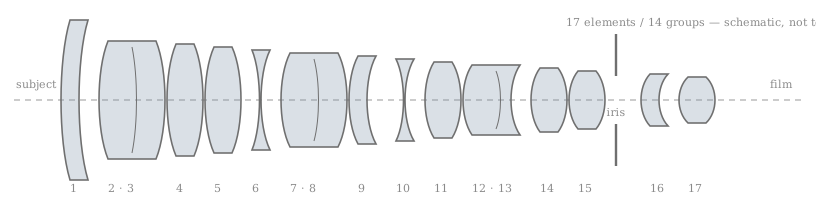
Optical formula — Variogon zoom
ⓘ What these charts mean
MTF (modulation transfer function) shows how much contrast the lens keeps at a given fineness of detail, from the center of the frame to the corner — the coarse curves track punch, the fine ones resolving power, and a gap between solid and dashed lines means astigmatism. Relative illumination (falloff) shows how much darker the corners are than the center at each aperture. Manufacturers only began publishing these for modern lenses; no 1950s maker issued them, which is why older families here cite period magazine bench tests instead.
History
The Variogon is the odd lens out in the V system twice over: it is the only zoom Hasselblad ever catalogued for the 500- and 2000-series bodies, and the only lens of the Zeiss era that Carl Zeiss did not make. Schneider-Kreuznach’s data sheet, hosted with the Zeiss sheets by Hasselblad Historical, opens by claiming the wider record as well — “this is the first zoom lens in the world in series production for 6x6 cm (2 1/4 x 2 1/4 inch) format cameras” — and gives the design as 17 elements in 14 groups, an aperture scale from f/5.6 to f/45, and an angular field shrinking from 31.2° to 16.4° across the diagonal of the 56 × 56 mm frame.
The sheet’s argument for the lens is a working one rather than an optical one. It claims performance “equal to the best fixed focal length lenses”, then puts the case that matters on set: a continuous range from 140 mm to 280 mm without altering focus, “a considerable advantage when shooting sequences from the same standpoint”. Focus runs to 2.5 m at the short end and only to 4 m at 280 mm, and a supplementary macro setting brings the closest subject to 0.75 m from the front element, where a 330 × 330 mm field fills the frame. The lens is 234 mm long at infinity and weighs 1740 g, with B+W series 9a filters of 93 mm diameter, a 90 mm slip-on accessory diameter and an M86×1 thread — no series 50, 60 or 70 accessory in the system will fit it. Owners on the Medium Format Forum make the point the specification hides: most of that bulk is air, and the lens comes up lighter in the hand than it looks, though a body with 1.7 kg hanging off the front is awkward to hold steady.
Three versions were sold, and they track the shutter history of the system rather than any change in the glass. The C of 1976 carries a Synchro-Compur running 1/500 s to 1 s and B, synchronized at every speed, coupled automatically to the body when mounted; the sheet names the 500 C/M, 500 C, 500 EL/M and 500 EL as its cameras and promises “a modified version” for the focal-plane 2000 — printed there as “2000 CF”, evidently a slip for 2000 FC. That modified version is the shutterless F of 1977, which Hasselblad’s 1985/86 catalogue lists as product 20443 among the F lenses for the 2000FCW. The CF followed in 1988 with the Prontor CF shutter, six years after the rest of the line had changed over, and appears in the 1989 catalogue for the 2003FCW; collectors report that it added a tripod mount the C never had, and that it is the harder of the two to find. LENS-DB supplies all three announcement years; no factory announcement was located for any of them.
How many were built is the least settled fact about it. Owner accounts converge on about 3,000 across the whole run, which fits its scarcity and its price, but no factory figure has been published and none of the standard references was consulted directly here. The sheet’s closing line hints at why it stayed rare: “distribution exclusively through the camera manufacturer and his appointed agents” — a Schneider lens sold only as a Hasselblad accessory, at Hasselblad prices, against fixed focal lengths that most photographers already owned.
What remains open: no list price at any date, in any currency, has been found; production is an owner estimate rather than a factory number; nothing consulted says whether the CF was recomputed or merely re-shuttered, and no CF data sheet has surfaced; the designer at Schneider-Kreuznach is unnamed in every source seen; the end of production is undated; and no blog review of the lens was found, only forum discussion, so this entry carries no reviews and no ratings.
This history is AI-written, from the sources listed at the foot of the page. Where the record is silent it says so rather than filling the gap — but no human wrote these sentences.
Example photos
Sample photo wanted — shot with a Variogon 140-280mm f/5.6? We'd love to feature it (with credit).
Live listings
Asking price, USD: a median of $850 across 21 fixed-price listings on 2026-09-11 (middle half $750–$1,200). Tracked since 2026-09-06, 2 days: unchanged from $850.
By day
| Date | Median | Middle half | Listings |
|---|---|---|---|
| 2026-09-11 | $850 | $750–$1,200 | 21 |
| 2026-09-06 | $850 | $750–$1,200 | 21 |
Asking prices from the listings scanned, not sales; junk-flagged rows and auction lots excluded; other currencies are not converted.
- Parts or Repair - Hasselblad Schneider Kreuznach Variogon 140-280mm f5.6 Lens
- 【Opt MINT】Schneider Variogon C 140-280mm f/5.6 Lens for Hasselblad V From JAPAN
- Timer Not Work 【N MINT+++】 Hasselblad Schneider C Variogon 140-280mm f/5.6 JAPAN
- Schneider-Kreuznach Variogon 140-280mm F5.6 Lens for Hasselblad Medium Format Ca
- HASSELBLAD Schneider Variogon C 140-280mm f5.6 [Near Mint] US Stock
- Schneider Variogon 5.6/140-280mm Hasselblad SCHNEIDER KREUZNACH LENS
- Hasselblad Schneider Variogon F 5.6/140-280mm for 200/2000 Series
- [MINT] Hasselblad Schneider Kreuznach C 140-280mm f5.6 Variogon Zoom Lens JAPAN
- ◆TOP MINT in Box◆ Hasselblad Variogon C 140-280mm f5.6 Lens w/ Case From JAPAN
- HASSELBLAD Schneider Variogon 140-280mm f5.6 lens - NEAR MINT CONDITION
- Hasselblad Schneider Variogon 140-280mm f5.6 Lens
- Hasselblad Schneider Kreuznach CF VARIOGON 140-280mm f5.6 MC Lens
- Hasselblad Schneider Kreuznach C 140-280mm f5.6 Variogon Zoom Lens
- Schneider-Kreuznach Variogon 140-280mm F5.6 Medium Format Lens for Konica Minolt
- Schneider Variogon 5.6/140-280mm Hasselblad V
- Schneider F. Hasselblad 5.6/140-280Mm Variogon
- Hasselblad Schneider Kreuznach C 140-280mm f5.6 Variogon 489534
- Hasselblad Schneider 5.6/140-280 mm Variogon ZOOM very clean
- [MINT in BOX] Hasselblad 140-280 Variogon Schneider- Kreuznach f. 5.6 CF Lens
- Hasselblad Schneider Variogon 140-280mm f5.6 Lens
Show 21 more listings
- Hasselblad Schneider Variogon CF 140-280mm f/5.6 Macro for 503cw 203fe 500c/m
- Schneider-Kreuznach Variogon 140-280mm f/5,6 ✅ Hasselblad C 500 V Zoom Lens
- Schneider-Kreuznach Variogon 140-280mm f/5.6 - Teleobjektiv - gut
- Schneider-Kreuznach Variogon 140-280mm f/5.6 - Telelens - goed
- Hasselblad Schneider Variogon F 5.6/140-280mm for 200/2000 Series
- ◆TOP NEUWERTIG in Box◆ Hasselblad Variogon C 140-280mm f5.6 Objektiv mit...
- Hasselblad 140-280 mm. F. 5,6 Variogon lens
- Schneider Variogon 5.6/140-280mm Hasselblad V
- Hasselblad Schneider-Kreuznack Variogon 140-280mm F5.6 for 2000 Series 200
- Hasselblad Schneider Kreuznach C 140-280mm f5.6 Variogon Objektiv gebraucht
- Hasselblad Schneider 5.6/140-280 mm Variogon ZOOM very clean
- Hasselblad Schneider-Kreuznach Variogon CF 140–280 mm f/5.6 Zoomobjektiv Top
- 【Opt MINT】Schneider Variogon C 140-280mm f/5.6 Lens for Hasselblad V From JAPAN
- Timer Not Work 【N MINT+++】 Hasselblad Schneider C Variogon 140-280mm f/5.6 JAPAN
- Schneider-Kreuznach Variogon 140-280mm F5.6 Lens for Hasselblad Medium Format Ca
- Hasselblad Schneider Variogon F 5.6/140-280mm for 200/2000 Series
- ◆TOP MINT in Box◆ Hasselblad Variogon C 140-280mm f5.6 Lens w/ Case From...
- [MINT] Hasselblad Schneider Kreuznach C 140-280mm f5.6 Variogon Zoom Lens JAPAN
- Schneider Variogon 5.6/140-280mm Hasselblad V
- Schneider-Kreuznach Variogon 140-280mm F5.6 Medium Format Lens for Konica Minolt
- Hasselblad Schneider Variogon 140-280mm f/5.6 C Zoom Lens, Suit 500C/M 503CXi
eBay links are affiliate links. If you buy through one, Glass Bodies earns a small commission from eBay at no cost to you. It does not change which listings appear, their prices or their order — those come from the search and the sort described above.
Listings updated 2026-09-11. Links go to the shop or marketplace that carries the item.