Tele-Superachromat 300mm f/2.8 IF
Carl Zeiss · Hasselblad V · 1993 · Superachromat, internal focusing
Also known as: Zeiss Tele-Superachromat 300mm f/2.8 · Carl Zeiss Tele-Superachromat T* 300mm f/2.8 · Tele-Superachromat T* 2.8/300 · Tele-Superachromat 300/2.8 · Hasselblad 300mm f/2.8 · Hasselblad 300mm Superachromat · Hasselblad FE 300mm f/2.8 · Zeiss 300mm f/2.8 FE · Telephoto Power Pack 300mm
Variants & identification
| Variant | Mount | Years | Serial ranges | Production |
|---|---|---|---|---|
| Tele-Superachromat TCC T* 2.8/300 IF · None — the lens has no shutter and exposes through the body's focal-plane shutter | Hasselblad V (TCC — focal-plane bodies; databus metering on the 205TCC) | 1993–1995 | — | — |
| Tele-Superachromat FE T* 2.8/300 IF (Telephoto Power Pack) · None — exposes through the body's focal-plane shutter | Hasselblad V (FE — focal-plane bodies only) | 1995–2004 | — | — |
- All optical and mechanical figures come from the Zeiss data sheet for the Telephoto Power Pack (FE300, cat. no. 10 45 53), which covers the lens alone and the lens with the Apo-Mutar.
- The dating is unsettled. Japanese Wikipedia places a TCC version among the 1991–94 databus lenses; Hasselblad Historical lists only 'TPP FE'; lens-db files the FE under 1999; the data sheet was printed on 25 May 2000. No factory announcement was located, and the years given here are a reading of those sources, not a documented chronology.
- The 2004 end year is the year Hasselblad Historical's model table gives for the end of 2000/200-series production, which took the shutterless lenses with it.
How to tell them apart
- 3800 g and a drop-in filter slot — no other Hasselblad V lens is built this way
- Shutterless, with databus contacts: it exposes only on a focal-plane body, and meters at full aperture only on the 200-series
- Normally found with the Apo-Mutar 1.7x E T* it was sold with; the pair makes a 503.5 mm f/4.8 that still focuses to 2.5 m
- Distinct from the CFE Tele-Superachromat 5.6/350, which is a leaf-shutter lens of the same optical family at half the weight
Tele-Superachromat TCC T* 2.8/300 IF:
- TCC engraved after the focal length; databus contacts on the bayonet plate
- Hasselblad Historical's lens index does not list a TCC 2.8/300 — it carries the lens only as 'Tele-Superachromat f/2.8 300 mm TPP FE (IF)'
Tele-Superachromat FE T* 2.8/300 IF (Telephoto Power Pack):
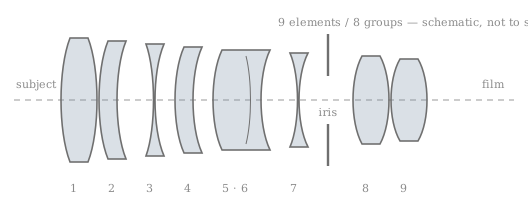
- Zeiss data sheet: cat. no. 10 45 53, 9 elements in 8 groups plus the drop-in filter, exact focal length 299.9 mm, f/2.8–22, focusing range infinity to 2.5 m at 1:6.9 (close-limit field 377 × 377 mm), 3800 g
- Drop-in filter slot in place of a front thread, with a polarizing filter that rotates in its own ball bearing supplied in the package
- Rotating tripod collar with a notch every 90°, carrying the Hasselblad system quick mount plus 1/4" and 3/8" threads
- The focusing ring travels past infinity, so the lens can be focused across a range of temperatures; all scales engraved, in metres and feet
- Sold as a package with the dedicated Apo-Mutar 1.7x E T* (cat. no. 10 43 41, 7 elements in 4 groups), which makes it a 503.5 mm f/4.8; package weight 4230 g
- Tele-Superachromat TCC T* 2.8/300 IF: Reported by Japanese Wikipedia, read in translation, which places the 2.8/300 among the TCC lenses and describes a limited run of about 300. No other source consulted names a TCC-badged 300mm, and no document consulted gives it a year; the 1993 date carried here should be treated as unconfirmed.
- Tele-Superachromat FE T* 2.8/300 IF (Telephoto Power Pack): Hasselblad Historical's index gives the lens as 'TPP FE' — the Telephoto Power Pack, lens and matched converter sold together. Lens-db files it under 1999, and the Zeiss sheet was printed on 25 May 2000; whether 1999 dates the package or the lens is not stated by anything consulted here.
Serial-range notes
- red-ink date code inside the rear mount, 1980 onward
- The lens postdates 1980 entirely, so the Zeiss stamp inside the rear mount is two reversed year digits plus a month letter, A = January: 39D is April 1993 and 99B is February 1999.
- 8801907; 9300xxx onward
- An Ostlicht auction description for a prototype 2.8/300 gives serial 8801907 and states that the production batch begins at 9300xxx. Seen only through a search extract; the auction page itself was not read, and the figures are recorded here rather than relied on.
Specifications
- Formula
- Superachromat, internal focusing
- Construction
- 9 elements / 8 groups
- Aperture range
- f/2.8–f/22
- Shutter
- None — the lens carries no shutter and exposes through the focal-plane shutter of the 2000- and 200-series bodies
- Min. focus
- 2.5 m
- Weight
- 3800 g
- Years manufactured
- 1993–2004
- Country
- Germany
- Coating
- T* multicoated
What reviewers say
No reviews aggregated yet — this family is still in the research queue. Written one? We'd love to index it.
Optical formula — Superachromat, internal focusing
ⓘ What these charts mean
MTF (modulation transfer function) shows how much contrast the lens keeps at a given fineness of detail, from the center of the frame to the corner — the coarse curves track punch, the fine ones resolving power, and a gap between solid and dashed lines means astigmatism. Relative illumination (falloff) shows how much darker the corners are than the center at each aperture. Manufacturers only began publishing these for modern lenses; no 1950s maker issued them, which is why older families here cite period magazine bench tests instead.
History
The Tele-Superachromat T* 2.8/300 is the outer limit of what Zeiss built for the Hasselblad V system. Its data sheet calls it “the fastest telephoto lens in professional medium format with an outstanding optical performance on ‘Superachromat’ level,” and the specification bears the boast out awkwardly: 9 elements in 8 groups plus a drop-in filter, an exact focal length of 299.9 mm, f/2.8 to f/22, and 3800 g — nearly twice the weight of the shutterless Tele-Tessar 4/350 and more than four times the 500-series body it could not be used on. The entrance pupil alone is 105.3 mm across. Zeiss explained the bulk in materials: “several lens elements are made of fluor crown glass with anomalous partial dispersion to provide excellent correction of chromatic aberrations even at wide open aperture,” with veiling glare “meticulously controlled.” Superachromat means the correction holds across a very wide band — Japanese Wikipedia gives 400 to 1000 nm for the type — rather than at the three wavelengths an apochromat brings together.
Moving that much glass was itself a design problem. “Especially for this lens,” the sheet says, “Carl Zeiss invented a novel mechanism for internal focusing ensuring movement of large and relatively heavy optical elements with unparalleled accuracy.” The result focuses to 2.5 m, a 1:6.9 reproduction ratio over a close-limit field of 377 × 377 mm, and keeps doing so with the converter fitted. Practical touches follow from the size: a drop-in filter slot instead of a front thread, with a polarizer that turns in its own ball bearing; a rotating tripod collar notched every 90° carrying the Hasselblad quick mount and 1/4” and 3/8” threads under the combined centre of gravity; a focusing ring that travels past infinity so the lens can be used across a range of temperatures.
It was not sold on its own. The sheet is headed “Carl Zeiss Telephoto Power Pack” and covers two items, the lens and a converter designed for it “right from the beginning” — the Apo-Mutar 1.7x E T*, catalogue number 10 43 41, 7 elements in 4 groups, which turns the pair into a 503.5 mm f/4.8 with a minimum aperture engraved 32, a maximum scale of 1:4.1 and a combined weight of 4230 g. Hasselblad Historical’s lens index accordingly lists the lens as “Tele-Superachromat f/2.8 300 mm TPP FE (IF)”.
The chronology is the weak part of the record. Japanese Wikipedia, read in translation, places a TCC-badged 2.8/300 among the databus lenses of the early 1990s and describes a limited run of about 300; Hasselblad Historical lists only the FE; lens-db files the lens under 1999; the data sheet was printed on 25 May 2000. Those cannot all be describing the same moment, and no factory announcement was located, so the TCC-then-FE reading carried here is a reconstruction rather than a documented sequence. An auction description for a prototype records serial 8801907 with the production batch said to begin at 9300xxx — consistent with an early-1990s design, if the description is right. Production ended with the bodies: Hasselblad Historical’s model table gives 2004 for the end of the 2000/200-series.
What remains open: a dated announcement for the lens and for the Telephoto Power Pack package; whether a TCC-marked 2.8/300 was in fact sold, or whether Japanese Wikipedia is describing the FE under the earlier label; the production quantity from a factory figure rather than an encyclopaedia; the serial block, from examined lenses rather than an auction extract; and any list price at all — B&H’s product page survives without one.
This history is AI-written, from the sources listed at the foot of the page. Where the record is silent it says so rather than filling the gap — but no human wrote these sentences.
Example photos
Sample photo wanted — shot with a Tele-Superachromat 300mm f/2.8 IF? We'd love to feature it (with credit).
Live listings
No current listings found — a quiet market right now (or my keyword filter needs work).
Listings updated 2026-09-04. Links go to the shop or marketplace that carries the item.