Tele-Tessar 350mm f/4 IF
Carl Zeiss · Hasselblad V · 1985 · Tele-Tessar (telephoto Tessar), internal focusing
our own findingAlso known as: Zeiss Tele-Tessar 350mm f/4 · Carl Zeiss Tele-Tessar T* 350mm f/4 · Tele-Tessar T* 4/350 · Tele-Tessar 350/4 · Hasselblad 350mm f/4 · Hasselblad 350mm Tele-Tessar F · Hasselblad 350mm Tele-Tessar FE · Tele-Tessar F 350mm f/4 · Tele-Tessar FE 350mm f/4 · Tele-Tessar TCC 350mm f/4
Variants & identification
| Variant | Mount | Years | Serial ranges | Production |
|---|---|---|---|---|
| Tele-Tessar F T* f/4 350 mm IF · None — the lens has no shutter and exposes through the body's focal-plane shutter | Hasselblad V (F — focal-plane bodies only) | 1985 | — | — |
| Tele-Tessar TCC T* 4/350 IF · None — exposes through the body's focal-plane shutter | Hasselblad V (TCC — focal-plane bodies; databus metering on the 205TCC) | 1991–1994 | — | — |
| Tele-Tessar FE T* 4/350 IF · None — exposes through the body's focal-plane shutter | Hasselblad V (FE — focal-plane bodies only) | 1994–2004 | — | — |
- All optical and mechanical figures come from the Zeiss FE data sheet (FE350, cat. no. 10 45 41). No separate sheet for the F or TCC version was consulted, and no source consulted describes an optical change across the three generations.
- The F version's 1985 date is its first documented catalogue appearance, not a launch: it is absent from the 1 January 1980 U.S. dealer list and present in the 1985–86 product catalogue.
- The 2004 end year is the year Hasselblad Historical's model table gives for the end of 2000/200-series production, which took the shutterless lenses with it; no source consulted dates this lens's own discontinuation.
How to tell them apart
- Shutterless: there is no shutter-speed ring, and the lens will only expose on a focal-plane body — the 2000- and 200-series. It cannot be used on a 500-series camera
- The letters after the focal length are the generation: F (no electronics), TCC (databus, 1991–94), FE (the TCC renamed, 1994 onward)
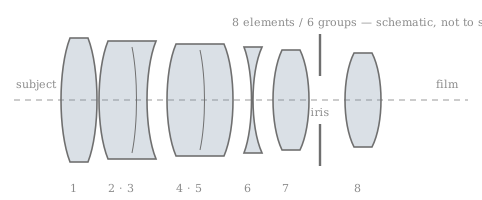
- Eight elements in six groups with internal focusing, against the four-element leaf-shutter Tele-Tessar 5.6/350 — a stop faster, 650 g heavier, and focusing to 1.9 m instead of 4.5 m
- M 96×1 filter thread with a 100 mm clip-on; the leaf-shutter 350 takes Hasselblad series 86 or 93 threads instead
Tele-Tessar F T* f/4 350 mm IF:
- F engraved after the focal length; no shutter-speed ring and no shutter — the barrel ends in the plain V bayonet with no databus contacts
- Hasselblad product number 20486 (product catalogues of the mid- and late 1980s)
- Aperture-ring push button — the EV interlock release of the 2000-series F lenses, which has no function on the later 200-series bodies
Tele-Tessar TCC T* 4/350 IF:
- TCC engraved after the focal length; databus contacts on the bayonet plate, and the blue twin lines that mark databus couplings on the 200-series
- Hasselblad Historical groups the TCC lenses with the F line rather than listing them separately
Tele-Tessar FE T* 4/350 IF:
- Zeiss data sheet: cat. no. 10 45 41, 8 elements in 6 groups, exact focal length 349.9 mm, f/4–32, focusing range infinity to 1.9 m at 1:4 (close-limit field 420 × 420 mm), 2000 g
- Filter connection M 96×1, plus a clip-on of 100 mm diameter
- FE engraved after the focal length; databus contacts on the bayonet plate; 212.7 mm between the first and last lens vertices, back focal distance 118.4 mm
- Listed in the 202FA instruction manual's lens table as one of the FE lenses from 50 to 350 mm
- Tele-Tessar F T* f/4 350 mm IF: The date is a first documented appearance, not a launch. Victor Hasselblad Inc.'s confidential U.S. dealer price list effective 1 January 1980 lists only five items under 'F Lenses w/o Shutter for 2000FC' — the Distagon 50/2.8 FLE, Planar 80/2.8, Planar 110/2, Sonnar 150/2.8 and Schneider's Variogon 140–280 — with no 350mm among them, while the 1985–86 Hasselblad product catalogue carries product number 20486 for this lens. Nothing consulted here dates the introduction inside that gap.
- Tele-Tessar TCC T* 4/350 IF: The F design rebadged with databus electronics when the 205TCC arrived in 1991. Karen Nakamura's photoethnography.com page on the 200/2000 series records the TCC lenses being renamed FE in 1994. No source consulted describes any optical change at either step.
- Tele-Tessar FE T* 4/350 IF: The renamed TCC lens. Lens-db files the FE 350mm f/4 under 1991 — the year the TCC generation began — rather than under 1994, and the two sources cannot both be describing the same event; the years here follow the TCC-to-FE renaming that photoethnography.com dates to 1994. The Zeiss sheet was printed on 6 June 2000, well into the run.
Serial-range notes
- red-ink date code inside the rear mount, 1980 onward
- Every version of this lens postdates 1980, so the Zeiss stamp inside the rear mount is two reversed year digits plus a month letter, A = January: 58F is June 1985, 19K is November 1991, 89A is January 1998.
Specifications
- Formula
- Tele-Tessar (telephoto Tessar), internal focusing
- Construction
- 8 elements / 6 groups
- Aperture range
- f/4–f/32
- Shutter
- None — the F, TCC and FE lenses carry no shutter and expose through the focal-plane shutter of the 2000- and 200-series bodies
- Min. focus
- 1.9 m
- Weight
- 2000 g
- Filter
- 96 mm
- Years manufactured
- 1985–2004
- Country
- West Germany, then Germany
- Coating
- T* multicoated
What reviewers say
No reviews aggregated yet — this family is still in the research queue. Written one? We'd love to index it.
Optical formula — Tele-Tessar (telephoto Tessar), internal focusing
ⓘ What these charts mean
MTF (modulation transfer function) shows how much contrast the lens keeps at a given fineness of detail, from the center of the frame to the corner — the coarse curves track punch, the fine ones resolving power, and a gap between solid and dashed lines means astigmatism. Relative illumination (falloff) shows how much darker the corners are than the center at each aperture. Manufacturers only began publishing these for modern lenses; no 1950s maker issued them, which is why older families here cite period magazine bench tests instead.
History
Zeiss wrote the data sheet for the Tele-Tessar T* 4/350 FE more like an argument than a specification: “The Tele-Tessar T* 4/350 FE lens is probably the most underrated lens in the Hasselblad program. Admittedly, it is big and goes heavy on the shoulder and on the budget.” The defence follows immediately — “it was never cheap or easy for a lens manufacturer to correct aberrations in long focal length lenses considerably faster than f/8 really well. A lot of glass with very special properties and high price is involved” — and ends on the claim that matters, that the correction is high enough for “stunning reproduction of fine detail” with “the maximum resolution at wide open aperture.” The figures behind it: catalogue number 10 45 41, 8 elements in 6 groups, an exact focal length of 349.9 mm, f/4 to f/32, 2000 g, and internal focusing down to 1.9 m — a 1:4 reproduction ratio across a close-limit field of 420 × 420 mm, which as the sheet points out is a face.
The lens has no shutter. It belongs to the shutterless F line Hasselblad introduced with the focal-plane 2000FC in 1977, and it will only make an exposure on a 2000- or 200-series body. When it joined that line is not documented anywhere consulted here. Victor Hasselblad Inc.’s confidential dealer price list effective 1 January 1980 has a section headed “F Lenses w/o Shutter for 2000FC” containing five items — the Distagon 50/2.8 FLE, the Planar 80/2.8, the Planar 110/2, the Sonnar 150/2.8 and Schneider’s Variogon 140–280 — and no 350mm. By the 1985–86 Hasselblad product catalogue it is there, as product number 20486. The introduction therefore falls in that five-year window, and the 1985 date carried here is the first document that shows the lens, not the year it appeared.
Two renamings followed, both electronic rather than optical. The 205TCC of 1991 brought databus communication between lens and body, and the F lenses were reissued as TCC with contacts on the bayonet plate; Karen Nakamura’s page on the 200/2000 series records the TCC lenses being renamed FE in 1994, when the 203FE and 205FCC replaced the 205TCC. The 202FA’s instruction manual, describing the system as it stood in 1998, lists FE lenses “from 50 to 350 mm” and notes that the aperture-ring push button — the EV interlock release inherited from the 2000-series F lenses — “has no function” on the newer bodies. Nothing consulted describes a change to the eight-element optical design across any of these steps.
What the design bought, against the four-element leaf-shutter Tele-Tessar 5.6/350 that ran alongside it, was a full stop of speed, a viewfinder image bright enough for “unusually quick and positive focusing,” and a minimum distance of 1.9 m instead of 4.5 m. What it cost was 650 g and the ability to be used on a 500-series camera at all. Zeiss also made a point of the background: “The tremendous background blur will instantly and easily clean up almost any location,” useful in factories and on cluttered location work, “saving time and labour, thus paying itself off pretty well.”
Production ended with the bodies. Hasselblad Historical’s model table gives 2004 as the year 2000/200-series production ceased, and the FE lenses went with them.
What remains open: an introduction year for the F version from a Hasselblad document rather than an absence-and-presence argument; whether the F, TCC and FE differ optically in any respect; how lens-db’s 1991 date for the FE is meant to be reconciled with the 1994 renaming; any list price; and every production figure, which would have to come from Nordin’s compendia.
This history is AI-written, from the sources listed at the foot of the page. Where the record is silent it says so rather than filling the gap — but no human wrote these sentences.
Example photos
Sample photo wanted — shot with a Tele-Tessar 350mm f/4 IF? We'd love to feature it (with credit).
Live listings
No current listings found — a quiet market right now (or my keyword filter needs work).
Listings updated 2026-09-04. Links go to the shop or marketplace that carries the item.