Planar 110mm f/2
Carl Zeiss · Hasselblad V · 1977 · Planar
Also known as: Zeiss Planar 110mm f/2 · Carl Zeiss Planar T* 110mm f/2 · Planar 2/110 · Planar 110/2 · Hasselblad 110mm Planar · Hasselblad 110mm f/2 · Planar T* 2/110 FE · Planar FE 110mm f/2 · Planar F 110mm f/2 · Hasselblad 110mm F 2.0 T*
Variants & identification
| Variant | Mount | Years | Serial ranges | Production |
|---|---|---|---|---|
| Planar F T* 2/110 (shutterless, 2000-series) · Planar, 7 elements in 6 groups per the F data sheet and Wildi (the later FE sheet prints 5 groups for the same lens) · none — exposes through the body's focal-plane shutter | Hasselblad V (F — focal-plane bodies only) | 1977–1991 | — | Not published by any source consulted |
| Planar F/TCC T* 2/110 (databus contacts, 205TCC) · none — exposes through the body's focal-plane shutter | Hasselblad V (F/TCC — focal-plane bodies only) | 1991–1994 | — | Not published by any source consulted |
| Planar FE T* 2/110 · none — exposes through the body's focal-plane shutter | Hasselblad V (FE — focal-plane bodies only) | 1994–2004 | — | Not published by any source consulted |
- Element counts, exact focal length, weight, closest focus and filter designation come from the Zeiss data sheets hosted by Hasselblad Historical (F110, FE110_2). The group count differs between the two sheets — see the family notes.
- The 1991 and 1994 boundaries follow the databus generations as a whole (F/TCC with the 205TCC in 1991, renamed FE with the 203FE); Japanese Wikipedia puts the renaming in March 1995. No source consulted gives a serial boundary.
How to tell them apart
- The only V-system lens faster than f/2.8, and the only 110mm — the letter after the focal length is the generation: F (1977, no contacts), F/TCC (1991, contacts, TCC engraved), FE (1994, contacts, FE engraved)
- No shutter-speed ring anywhere on the barrel: these lenses expose only on the 2000- and 200-series focal-plane bodies and will not make a picture on a 500-series camera
- Hasselblad bayonet 70 filters and the shared 40576 shade with the 150mm f/2.8 F; Zeiss's own sheets print the filter as 'B 77' instead, and the Pebble Place review describes the mount as Bay 70 adapted to 77mm
- 750 g and 0.8 m closest focus in every version
Planar F T* 2/110 (shutterless, 2000-series):
- No shutter-speed ring and no shutter lever — the aperture ring is the only exposure control on the barrel
- Hasselblad bayonet 70 filter mount, shared with the 150mm f/2.8 F: the 1 January 1980 price list has a filter group headed 'SERIES 70 f/110mm & 150mm 2.8' and a single 'Lens Shade 2.0/110 and 2.8/150 ("F")', part 40576
- Aperture scale 2 – 2.8 – 4 – 5.6 – 8 – 11 – 16; 750 g; 0.8 m closest focus for 1:5.2 (Zeiss data sheet, cat. no. 10 21 50)
- Product number 20419, listed as '110mm Planar F 2.0 T*' — T* from the start, unlike the C lenses
Planar F/TCC T* 2/110 (databus contacts, 205TCC):
- TCC engraved after the focal length; four databus contacts on the bayonet plate and two parallel blue lines on the barrel, the mark of every databus item
- Optically and mechanically the F lens — Japanese Wikipedia's product list gives the F/TCC 110mm the same 7 elements, 0.8 m closest focus and φ70 mm bayonet as the plain F
Planar FE T* 2/110:
- FE engraved after the focal length; four databus contacts and the two blue barrel lines
- Zeiss data sheet: cat. no. 10 21 88, 7 elements in 5 groups, exact focal length 110.8 mm, f/2–f/16, 750 g, 0.8 m for 1:5.2 at a working distance of 0.6 m, filter B 77, diagonal field 39°
- The FE sheet prints 5 groups where the earlier F sheet and Wildi print 6, with no note of a redesign
- Planar F T* 2/110 (shutterless, 2000-series): Introduced with the 2000FC in 1977 as one of two standard lenses for the focal-plane bodies, alongside the 80mm f/2.8 F. Zeiss's sheet is unusually explicit about why the lens could be this fast: 'The correction potential of this lens type at a focal length of 110 mm and a speed of f/2 could be fully used as no complicated installation conditions had to be met' — that is, with no leaf shutter to design around, the rear group could sit where the computation wanted it. Main applications given are sports and press work at very short exposure times, hand-held shooting in poor light, and portraits. The sheet consulted names the 2003 FCW, so it is a printing of 1984 or later even though the lens is a 1977 product. Victor Hasselblad Inc.'s dealer list effective 1 January 1980 prices it at $2,175.00, the second most expensive lens in the V line after the UV-Sonnar.
- Planar F/TCC T* 2/110 (databus contacts, 205TCC): Made for the 205TCC of 1991, whose meter reads the set aperture off the contacts. On a 2000-series body a TCC lens works as a plain F lens. The series name was F/TCC before the FE renaming; Japanese Wikipedia dates that change to the launch of the 203FE in March 1995, while this catalogue's 203FE entry follows sources giving 1994. The boundary between this variant and the FE is therefore soft by about a year.
- Planar FE T* 2/110: The lens renamed with the rest of the databus line when the 203FE arrived. Zeiss's FE sheet makes the claim the lens is remembered for: 'The Planar T* 2/110 lens is the fastest Carl Zeiss lens in 6x6 medium format … The lens is so well corrected that the full aperture can be used for picture taking. This is a result of Carl Zeiss' experience as main supplier for super speed lenses to the motion picture industry.' Preferred uses listed are executive portraits under time pressure and available light, editorial, travel and candid work, weddings, and theatrical and stage photography. Production ended with the 203FE and 205FCC in 2004; Japanese Wikipedia says only that the lens was kept in production until digitalisation stopped it.
Serial-range notes
- red-ink code inside the rear mount, pre-1980
- Zeiss stamped a date code in red ink inside the rear of the mount. Before 1980 the last two digits are the month and the leading digit or digits plus 1957 the year, so 2005 = May 1977, the lens's first year.
- red-ink code inside the rear mount, 1980 onward
- From 1980 the code is two reversed year digits followed by a month letter, A = January — so an F/TCC 110 reading 19D was made in April 1991, the year of the 205TCC. No published serial-block table for the 110mm Planar was found.
Specifications
- Formula
- Planar
- Construction
- 7 elements / 5 groups
- Aperture range
- f/2–f/16
- Shutter
- None — the 110mm exists only as a shutterless lens for the 2000- and 200-series focal-plane bodies; exposure is by the body's titanium focal-plane shutter
- Min. focus
- 0.8 m
- Weight
- 750 g
- Years manufactured
- 1977–2004
- Country
- West Germany (Carl Zeiss, Oberkochen; Germany from 1990)
- Coating
- T* multicoated from the first version — the 1980 price list already writes it '110mm Planar F 2.0 T*'
- Original price
- US$2,175.00 for the 110mm Planar F 2.0 T* on Victor Hasselblad Inc.'s dealer price list effective 1 January 1980 — more expensive than any other lens on that list except the 105mm UV-Sonnar. No launch price for 1977 and no Swedish or Japanese price has been found. (today $8,280)
What reviewers say
- Pebble Place (author not credited) (blog) — Acceptably rather than truly sharp at f/2, susceptible to veiling flare and showing more colour fringing in the out-of-focus areas than comparable lenses, but with smoother bokeh than its rivals — on anything larger than a 35mm sensor the reviewer calls it a must-have. single source, unconfirmed
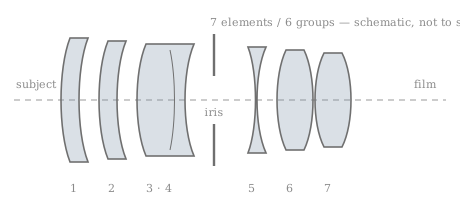
Optical formula — Planar
ⓘ What these charts mean
MTF (modulation transfer function) shows how much contrast the lens keeps at a given fineness of detail, from the center of the frame to the corner — the coarse curves track punch, the fine ones resolving power, and a gap between solid and dashed lines means astigmatism. Relative illumination (falloff) shows how much darker the corners are than the center at each aperture. Manufacturers only began publishing these for modern lenses; no 1950s maker issued them, which is why older families here cite period magazine bench tests instead.
History
The 110mm f/2 Planar exists because of a shutter that isn’t there. Every 500-series Hasselblad lens has to leave room in its middle for a Compur or Prontor leaf shutter, and that constraint sets a ceiling on how fast a medium-format lens can reasonably be corrected. When Hasselblad brought back the focal-plane body with the 2000FC in 1977, Zeiss could compute without it, and said so plainly on the data sheet: “The correction potential of this lens type at a focal length of 110 mm and a speed of f/2 could be fully used as no complicated installation conditions had to be met.” The result was seven elements, an exact focal length of 110.8 mm, f/2 to f/16, 750 g, 0.8 m closest focus for a 1:5.2 reproduction ratio — and, by the FE sheet’s own account, “the fastest Carl Zeiss lens in 6x6 medium format”, a claim Zeiss credits to its role as “main supplier for super speed lenses to the motion picture industry”.
It arrived as one of the two standard lenses of the 2000-series, the other being the shutterless 80mm f/2.8 F. Zeiss’s stated applications for it in 1977 were sports and press photography at very short exposure times, hand-held work in poor light, and portraits; by the time of the FE sheet the list had shifted almost entirely to people — executive portraits under time pressure and available light, editorial, travel, weddings, theatre and stage. Ernst Wildi’s Hasselblad Manual summarised it in 1980 as a “large aperture lens without shutter … ideal for stage, sports, press applications”. It was never cheap: Victor Hasselblad Inc.’s dealer list effective 1 January 1980 has it at $2,175.00, more than any other lens on the list except the quartz UV-Sonnar, and against $1,050.00 for the 80mm F.
Identification is straightforward because the family has only three members and they differ electrically, not optically. The 1977 lens is the plain F, with no contacts. In 1991 the 205TCC brought a meter that reads the aperture off the lens, so the 110mm gained four databus contacts on the bayonet plate and the two blue barrel lines that mark every databus item, engraved F/TCC. When the 203FE arrived the series was renamed FE — Japanese Wikipedia dates that to March 1995, while this catalogue’s 203FE entry follows sources giving 1994, so the boundary is soft by about a year. Production ended with the 203FE and 205FCC in 2004. Filters are Hasselblad’s bayonet 70, shared with the 150mm f/2.8 F: the 1980 price list has a filter group headed “SERIES 70 f/110mm & 150mm 2.8” and one shade, part 40576, covering both lenses.
Two printed specifications disagree, and neither can be dismissed. The F data sheet gives seven elements in six groups, and Wildi’s book independently prints “7 lens elements in 6 components”; the later FE sheet gives seven elements in five groups, without a word about a redesign, and the review literature follows the FE figure. Since both sheets give the same exact focal length, the same weight, the same closest focus and the same filter, a genuine recomputation is unlikely and a change in how a cemented pair was counted is the likelier explanation — but no source consulted says so. Wildi adds a second oddity: he prints the focal length as 108 mm where both Zeiss sheets say 110.8 mm. This entry follows the Zeiss sheets and records the disagreement rather than resolving it.
As a picture-maker the lens has a reputation ahead of its measurements. The Pebble Place review, testing it on digital backs and adapted bodies, finds it acceptably rather than truly sharp wide open, prone to veiling flare without a hood, and showing more colour fringing in the out-of-focus areas than comparable lenses — while judging its bokeh smoother than its rivals’ and calling it, on anything larger than a 35mm sensor, a must-have. Japanese Wikipedia’s product list is blunter and shorter: an especially fine lens, exclusive to the F bodies, kept in production until digitalisation ended it.
Open: how many were made in any version, a figure no consulted source gives; whether the five- or six-group count is correct and why the sheets differ; whether the renaming to FE happened in 1994 or March 1995; who at Oberkochen computed the lens; and whether any 110mm was ever built with a leaf shutter for the 500-series, which every source consulted implicitly denies but none states outright.
This history is AI-written, from the sources listed at the foot of the page. Where the record is silent it says so rather than filling the gap — but no human wrote these sentences.
Example photos
Sample photo wanted — shot with a Planar 110mm f/2? We'd love to feature it (with credit).
Live listings
Asking price, USD: a median of $3,400 across 9 fixed-price listings on 2026-09-11 (middle half $3,000–$4,200). Tracked since 2026-09-06, 2 days: up 3% from $3,300.
By day
| Date | Median | Middle half | Listings |
|---|---|---|---|
| 2026-09-11 | $3,400 | $3,000–$4,200 | 9 |
| 2026-09-06 | $3,300 | $3,000–$3,700 | 10 |
Asking prices from the listings scanned, not sales; junk-flagged rows and auction lots excluded; other currencies are not converted.
- Hasselblad Carl Zeiss Planar 110mm f/2 T* Lens
- FE lens [NEAR MINT] Hasselblad Carl Zeiss Planar 110mm F2 T* Lens JAPAN
- Hasselblad Carl Zeiss 110mm f/2 Planar T Medium Format
- [Top MINT+++] Hasselblad Carl Zeiss T* Planar FE 110mm f/2 Lens V From JAPAN
- Rare FE Lens [TOP MINT] Hasselblad Carl Zeiss T* Planar 110mm f/2 From JAPAN
- Hasselblad Carl Zeiss Planar 110mm FE f/2 T* Lens Mint LN See My Full Store
- Pre-Owned Hasselblad 110mm f2 Planar FE Lens #7511553
- Hasselblad FE 2/110 mm Planar automatic aperture defective for 205FE or 203 FE
- Rare FE [Unused w/Case] Hasselblad Carl Zeiss T* Planar 110mm F2 Lens From JAPAN
- Lomo 110mm F/2 Projektionslinse projector lens medium format 6X6 CINELUX Planar
- HASSELBLAD Planar T* 110mm f/2,0 Carl Zeiss FE - SNr: 6076819
- [Opt NEUWERTIG] Hasselblad FE Planar 110mm F2 T* Zeiss Objektiv mit Haube,...
- Carl Zeiss - Hasselblad Planar FE 2/110mm TCC Lens *1a Zustand / Serviced*
- Hasselblad FE 2/110 mm Planar automatic aperture defective for 205FE or 203 FE
- Seltenes FE [unbenutzt mit Etui] Hasselblad Carl Zeiss T* Planar 110mm F2...
- Hasselblad Zeiss Planar 110mm f/2 F T* Objektiv, Anzug 200/2000 Kamera - CLA Oct 25
- Rare FE Lens [TOP MINT] Hasselblad Carl Zeiss T* Planar 110mm f/2 From JAPAN
- Rare FE [Unused w/Case] Hasselblad Carl Zeiss T* Planar 110mm F2 Lens From JAPAN
- Hasselblad Carl Zeiss Planar 110mm f/2 F T* Lens, Suit 200 2000 Series
- Hasselblad Planar 110mm f/2 FE
eBay links are affiliate links. If you buy through one, Glass Bodies earns a small commission from eBay at no cost to you. It does not change which listings appear, their prices or their order — those come from the search and the sort described above.
Listings updated 2026-09-11. Links go to the shop or marketplace that carries the item.