Sonnar Superachromat 250mm f/5.6
Carl Zeiss · Hasselblad V · 1972 · Sonnar Superachromat
Also known as: Zeiss Sonnar Superachromat 250mm f/5.6 · Carl Zeiss Superachromat 250mm · Sonnar Superachromat 5.6/250 · Superachromat 250/5.6 · Hasselblad 250mm Superachromat · Hasselblad 250 SA · Sonnar SA 250mm · Superachromat CF 250mm · Sonnar Superachromat 5.6/250 CFE
Variants & identification
| Variant | Mount | Years | Serial ranges | Production |
|---|---|---|---|---|
| Sonnar Superachromat C 5.6/250 (1972 baseline) · Compur size 0 interchangeable reflex shutter with automatic iris diaphragm (Synchro-Compur, 1s–1/500 and B) | Hasselblad V | 1972–1982 | — | — |
| Sonnar Superachromat CF 5.6/250 · Prontor CF, 1s–1/500 and B | Hasselblad V | 1982–1998 | — | — |
| Sonnar Superachromat CFi 5.6/250 · Prontor CFi, 1s–1/500, B and F | Hasselblad V | 1998–2001 | — | — |
| Sonnar Superachromat CFE 5.6/250 · Prontor CFE, 1s–1/500, B and F | Hasselblad V | 2001–2013 | — | — |
- Element and group counts, weights, exact focal lengths, closest focus and filter series come from the Zeiss data sheets hosted by Hasselblad Historical (C250SA, CF250SA, CFE250SA).
- No data sheet was found for a CFi-barrel Superachromat; that row's years follow the CFi range as a whole and should be treated as provisional.
- No serial block has been published for the Superachromat in any of its versions, by Zeiss, by Hasselblad or by a collector survey. The serial tables that exist run across the whole Zeiss-for-Hasselblad sequence and cannot separate this lens from the ordinary 250mm Sonnar sharing the same number stream, which is why the date code inside the mount, not the serial, is the primary evidence here.
- The lookup utility answers 'unknown' for a good deal of the range — 6,000,000, 6,050,000, 6,150,000 and 6,600,000 all return nothing, as do 2,600,000 and 2,700,000. The tables are a list of dated blocks, not a continuous mapping, and a Superachromat whose number falls in a gap cannot be dated this way at all.
How to tell them apart
- Superachromat is engraved on the lens — without it, a 250mm f/5.6 Hasselblad lens is the ordinary four-element Sonnar, which shares the focal length, maximum aperture and f/45 minimum
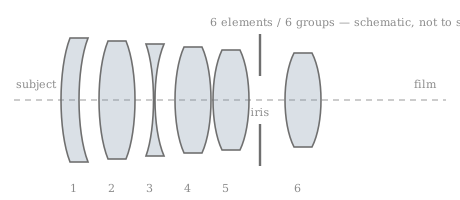
- Six elements in six groups — every element a singlet, unusual in a lens of this length, and the reason the corrected range reaches 1000 nm
- Closest focus is 2.8 m on the C and 3 m from the CF onward; the ordinary Sonnar focuses to 2.5 m in every version
- Filter mount is bayonet-50 on the C, bayonet-60 from the CF onward
- The CFE carries T rather than T* coating by design; a Superachromat marked T* is a C or CF, whose sheets do print T* in the title
Sonnar Superachromat C 5.6/250 (1972 baseline):
- Superachromat engraved after the Sonnar name — the single reliable way to tell it from the ordinary 250mm f/5.6, which shares focal length, maximum aperture, f/45 minimum and the 18° field
- Bayonet-50 filter mount; 800 g, lighter than the four-element C Sonnar's 930 g despite carrying six elements
- Closest focus 2.8 m against the ordinary Sonnar's 2.5 m; the distance ring has no infinity stop, so long-range work must be focused on the groundglass (Zeiss data sheet)
- Zeiss data sheet: cat. no. 104515, 6 elements in 6 groups, exact focal length 249.6 mm, aperture scale 5.6-8-11-16-22-32-45
Sonnar Superachromat CF 5.6/250:
- Prontor CF shutter, black barrel with rubber focusing grip, bayonet-60 filter mount
- Closest focus moves out to 3 m (reproduction ratio 0 to 1:9.6) and the weight to 985 g
- The focusing ring still has no infinity stop — the sheet prints the footnote 'no stop position for ∞'
- Zeiss data sheet: cat. no. 10 45 32, 6 elements in 6 groups, exact focal length 249.6 mm
Sonnar Superachromat CFi 5.6/250:
- CFi engraved after the focal length; bayonet-60 filter mount; no databus contacts (those come with the CFE)
Sonnar Superachromat CFE 5.6/250:
- Four databus contacts on the bayonet plate for the 200-series meters; bayonet-60 filter mount; 1010 g, the heaviest of the family
- T, not T*: Zeiss's sheet says the lens is deliberately not T*-coated because T* cuts off ultraviolet and infrared, and that a T coating is used instead for higher infrared transmission
- No infrared focusing index — none is needed — and the focusing ring rotates past infinity to allow for varying temperatures
- Zeiss data sheet: cat. no. 10 45 50, 6 elements in 6 groups, exact focal length 249.2 mm, 3 m closest focus, 1:9.6
- Sonnar Superachromat C 5.6/250 (1972 baseline): The lens as announced in 1972: the first photographic lens with superachromatic correction. The sheet claims 'a so far unachieved correction of chromatic aberrations', the secondary spectrum corrected across roughly 400 to 1000 nm, so that visual focusing in visible light gives optimum sharpness on infrared and false-colour film. Named applications are technical and scientific infrared work, aerial photography, geology, hydrology, archaeological documentation, botany, plant pathology, environmental control and multi-spectral photography.
- Sonnar Superachromat CF 5.6/250: The CF-barrel version, otherwise the same optics: the sheet repeats the 400-to-1000 nm claim and adds that the lens suits photographs intended for considerable re-enlargement. It is the version most often met second-hand.
- Sonnar Superachromat CFi 5.6/250: The least documented member of the family. No Zeiss data sheet for a Superachromat in the CFi barrel was found for this entry — the sheets consulted run C, CF, then CFE — so whether the 1998 CFi range included a Superachromat at all, or whether the lens kept the CF barrel until the CFE of 2001, is unsettled here.
- Sonnar Superachromat CFE 5.6/250: The last version, and the one whose sheet states the historical claim outright: the first photo lens on the market with superachromatic colour correction, beyond apochromatic, with the secondary spectrum corrected from 400 to 1000 nm to within the Rayleigh limit. It also says manufacture is 'extremely difficult', using a critical combination of very special optical glasses and crystals, and that central image performance is limited only by diffraction. Digital photography appears among the preferred uses.
Serial-range notes
- red-ink code inside the rear mount, pre-1980
- Zeiss stamped a date code inside the rear of the mount: before 1980 the last two digits are the month and the leading digit(s) plus 1957 the year, so 1508 reads as August 1972 — the year the Superachromat was announced.
- red-ink code inside the rear mount, 1980 onward
- From 1980 the code is two reversed year digits and a month letter, A = January. No published serial block is known for the Superachromat, which was made in far smaller numbers than the ordinary 250mm Sonnar.
- where to look for the code, and what a second one means
- Hasselblad Historical's account of the stamp adds three things a reader needs. It sits on the rear end of the mount, often on the wall of the rear baffle, and racking the lens to its close-focus limit pulls the rear element forward and out of the way of it. It is present in all but the very earliest C lenses. And where an early lens carries more than one stamp, the earliest date is the likely build date and the later ones are returns to the factory for major repair — so read the lowest, not the last.
- the serial number itself, and the tables behind it
- Zeiss serial numbers hold no coded date, so a serial dates a lens only through a table matching numbers to years, and those tables were built by collecting serials alongside the dates their owners bought them. Richard Nordin's Hasselblad System Compendium carries the standard set; Hasselblad Historical runs a lookup utility on the same data. Where the number falls between tabulated blocks the utility answers 'unknown' rather than interpolating, which is the honest behaviour and the reason a serial is the second resort after the date code.
- 5,600,000 · 5,650,000 · 5,750,000 · 6,300,000 · 6,500,000 · 6,650,000 · 6,900,000 · 7,100,000
- Anchor points returned by that utility, useful for placing a Superachromat in its version: 5,600,000 = 1972, 5,650,000 = 1973 and 5,750,000 = 1974 (the C years); 6,300,000 = 1980, 6,500,000 = 1982 and 6,650,000 = 1983 (the C-to-CF change); 6,900,000 = 1985, 7,100,000 = 1988, 7,200,000 = 1991, 7,400,000 = 1993, 7,500,000 = 1995. These are readings taken from the tool, not block boundaries — the true edges lie somewhere inside the gaps.
- 6571429
- A dated example, and the only one traced. A Sonnar Superachromat CF 5.6/250 of this number sold at Flints Auctions on 12 October 2022 for £875 including premium; Hasselblad Historical's utility places 6571429 in 1982, the year the CF barrel replaced the C across the range. Serial and version agree, which is a small confirmation that the tables are usable on this lens.
Specifications
- Formula
- Sonnar Superachromat
- Construction
- 6 elements / 6 groups
- Aperture range
- f/5.6–f/45
- Shutter
- In the lens: Synchro-Compur size 0 on the C, Prontor CF from 1982, Prontor CFE from 2001, 1s–1/500 and B, flash sync at every speed
- Min. focus
- 2.8 m
- Weight
- 800 g
- Years manufactured
- 1972–2013
- Country
- West Germany (Carl Zeiss, Oberkochen); Germany from 1990
- Coating
- T* on the C and CF versions (both sheets print T* in the title); the CFE is deliberately T-coated rather than T*, because T* cuts off ultraviolet and infrared and this lens is built to pass them
What reviewers say
- Silver in the Dark (blog) — Tack sharp with chromatic aberration correction well beyond the ordinary Sonnar — a lens aimed at high-level professionals when it was released and still priced accordingly at about $1,300 and up, so anything under $1,000 is a steal.
Optical formula — Sonnar Superachromat
- Zeiss data sheet — C T* (cross-section, MTF)
- Zeiss data sheet — CF (cross-section, MTF)
- Zeiss data sheet — CFE (cross-section, MTF)
ⓘ What these charts mean
MTF (modulation transfer function) shows how much contrast the lens keeps at a given fineness of detail, from the center of the frame to the corner — the coarse curves track punch, the fine ones resolving power, and a gap between solid and dashed lines means astigmatism. Relative illumination (falloff) shows how much darker the corners are than the center at each aperture. Manufacturers only began publishing these for modern lenses; no 1950s maker issued them, which is why older families here cite period magazine bench tests instead.
History
Announced in 1972, the Sonnar Superachromat 250mm f/5.6 was the first photographic lens sold with superachromatic correction — Zeiss’s own CFE data sheet puts it plainly as “the first photo lens on the market with superachromatic colour correction (beyond apochromatic)”. An ordinary achromat brings two wavelengths to a common focus, an apochromat three; the Superachromat corrects the secondary spectrum across the whole range from about 400 to 1000 nm, and the CFE sheet adds that the correction holds to within the Rayleigh limit. The practical consequence is stated on every sheet in the family: a lens focused visually, in visible light, is also in focus on infrared or false-colour film, so no infrared focusing index is needed and none is engraved.
The design is six elements in six groups — every element a singlet, and none cemented — against four elements in three groups for the ordinary 250mm Sonnar sold beside it. The C sheet gives an exact focal length of 249.6 mm and a weight of 800 g, which makes the Superachromat lighter than the four-element Sonnar’s 930 g, and the price of the correction shows in the closest focusing distance: 2.8 m on the C, 3 m from the CF onward, against 2.5 m for the ordinary lens. Zeiss’s own account of how it is built is unusually candid — the CFE sheet calls manufacture “extremely difficult”, depending on “a critical combination of very special optical glasses and crystals”.
Zeiss aimed the lens at work rather than at photographers. The C and CF sheets list technical and scientific infrared photography first, then aerial work, geology, hydrology, archaeological documentation from aerial photographs, botany, plant pathology, environmental control and multi-spectral photography, and note that the lens suits pictures meant to be greatly enlarged. Both sheets also carry a warning that reads oddly for a Hasselblad lens: the distance ring has no infinity stop, so focusing for long-range work has to be done on the camera’s groundglass. The CFE explains the reason — the ring is designed to rotate beyond infinity to allow for varying temperatures.
The barrel followed the rest of the V line. The 1972 lens is a C, with a Compur size 0 shutter, the EV interlock and a bayonet-50 filter mount; the CF of 1982 brought Prontor’s shutter, the rubber focusing grip and bayonet 60, at 985 g; the CFE of 2001, cat. no. 10 45 50, added the four databus contacts for the 200-series meters and reached 1010 g. One step in that sequence is not documented here: no Zeiss sheet was found for a Superachromat in the 1998 CFi barrel, and the sheets consulted jump straight from CF to CFE, so the CFi row of the variant table is provisional.
The coating tells the same story as the correction. The C and CF sheets print T* in their titles, but the CFE sheet states that this lens is deliberately not T*-coated, because T* cuts off ultraviolet and infrared; a plain T coating is used instead for higher infrared transmission. Whether that choice was made for the CFE or had been true of the earlier lenses under a T* title is not resolved by the sheets themselves. Silver in the Dark’s V-system guide, writing about the used market rather than the physics, calls the lens tack sharp and still expensive — about $1,300 and up, with anything under $1,000 a bargain.
What remains open: who at Zeiss Oberkochen computed the design, whom no source consulted names; whether the CFi Superachromat existed; what the lens cost new at any date; how many were made; and whether the C and CF lenses really carried T* multicoating or inherited the title from the standard catalogue layout.
This history is AI-written, from the sources listed at the foot of the page. Where the record is silent it says so rather than filling the gap — but no human wrote these sentences.
Example photos
Sample photo wanted — shot with a Sonnar Superachromat 250mm f/5.6? We'd love to feature it (with credit).
Live listings
Asking price, USD: a median of $1,900 across 23 fixed-price listings on 2026-09-11 (middle half $1,800–$2,600). Tracked since 2026-09-06, 2 days: unchanged from $1,900.
By day
| Date | Median | Middle half | Listings |
|---|---|---|---|
| 2026-09-11 | $1,900 | $1,800–$2,600 | 23 |
| 2026-09-06 | $1,900 | $1,800–$2,600 | 23 |
Asking prices from the listings scanned, not sales; junk-flagged rows and auction lots excluded; other currencies are not converted.
- Hasselblad Carl Zeiss Sonnar 250mm F/5.6 Superachromat Lens #64964 C6
- Hasselblad Carl Zeiss Sonnar 250mm F/5.6 Superachromat Lens #64860 C6
- [Near MINT] Hasselblad Hassel Sonnar CF 250mm F5.6 Superachromat Lens From JAPAN
- Hasselblad Carl Zeiss Sonnar 250mm F/5.6 Superachromat Lens #54171 E6
- HASSELBLAD 250MM ZEISS SONNAR SUPERACHROMAT RARE BLACK RING F5.6 C LENS +CAPS
- 【MINT w/Box】 Hasselblad Zeiss Sonnar CF 250mm f5.6 Superachromat Lens Japan
- Hasselblad Carl Zeiss Sonnar 250mm F/5.6 Superachromat Lens Used Excellent
- [US 1-Yr Warranty] Hasselblad CF Sonnar 250mm f5.6 Superachromat Telephoto Lens
- [EXCELLENT]Hasselblad Carl Zeiss Sonnar CF 250mm F/5.6 Superachromat Lens #5494
- Hasselblad Carl Zeiss Sonnar 250mm F/5.6 Superachromat Lens used
- [Almost Unused] Hasselblad Sonnar CF 250mm F5.6 Superachromat Lens From JAPAN
- ⭐️MINT⭐️ Hasselblad CF Sonnar 250mm f/5.6 Superachromat Telephoto Lens JAPAN
- Hasselblad Sonnar CF 250mm F5.6 Superachromat Lens - Excellent
- HASSELBLAD Carl Zeiss Sonnar 250mm F5.6 Superachromat C Lens
- Hasselblad Carl Zeiss Sonnar 250mm F5.6 Superachromat C 631649
- Carl Zeiss Sonnar 250mm f/5.6 Superachromat lens #8016 for Hasselblad
- Hasselblad Carl Zeiss Sonnar 250mm F/5.6 Superachromat Lens Used Optical Clarity
- Hasselblad Carl Zeiss Sonnar Superachromat C 250mm F5.6 - Black / Silver Rim
- CARL ZEISS 250MM F5.6 SONNAR SUPERACHROMAT C FOR HASSELBLAD V SYSTEM 104515 5601
- Hasselblad C 5.6/250 mm Superachromat Sonnar near MINT condition very clean
Show 25 more listings
- Hasselblad Carl Zeiss Sonnar Superachromat CFE 250mm F5.6 SA, BOXED (91-93%new)
- [TOP MINT] Hasselblad Carl Zeiss Sonnar Superachromat CFi 250mm F/5.6 Lens JAPAN
- Hasselblad CFE 250mm F5.6 Superachromat Sonnar Telephoto Lens From Japan H0813
- [US 1 Jahr Garantie] Hasselblad CF Sonnar 250mm f5.6 Superachromat Teleobjektiv
- Hasselblad Carl Zeiss Sonnar 250mm F/5.6 Superachromat Objektiv Gebraucht Top
- Hasselblad Carl Zeiss Sonnar 250mm F/5.6 Superachromat Objektiv gebraucht
- ⭐️ Mint ⭐️ Hasselblad Cf Sonnar 250mm F/5.6 Superachromat Tele Objektiv Japan
- ⭐️ Mint ⭐️Hasselblad Cf Sonnar 250mm F/5.6 Superachromat Teleobiettivo Giappone
- Hasselblad Sonnar Superachromat CF 5,6/250mm Carl Zeiss
- CARL ZEISS 250MM F5.6 SONNAR SUPERACHROMAT C FOR HASSELBLAD V SYSTEM 104515 5601
- Hasselblad C 5.6/250 mm Superachromat Sonnar near MINT condition very clean
- Hasselblad CFE 250mm F5.6 Superachromat Sonnar Teleobjektiv Festbrennweite H0813
- [Near MINT] Hasselblad Hassel Sonnar CF 250mm F5.6 Superachromat Lens From JAPAN
- Hasselblad Carl Zeiss Sonnar 250mm F/5.6 Superachromat Lens #54171 E6
- 【MINT w/Box】 Hasselblad Zeiss Sonnar CF 250mm f5.6 Superachromat Lens Japan
- [US 1-Yr Warranty] Hasselblad CF Sonnar 250mm f5.6 Superachromat Telephoto Lens
- Hasselblad C 5.6/250mm Superachromat Sonnar Near MINT Condition Very Clean
- Hasselblad Carl Zeiss Sonnar 250mm F/5.6 Superachromat Lens Used Excellent
- Hasselblad Carl Zeiss Sonnar 250mm F/5.6 Superachromat Lens used
- Hasselblad Carl Zeiss Sonnar 250mm F/5.6 Superachromat Lens Used Optical Clarity
- Hasselblad CFE 250mm F5.6 Superachromat Sonnar Telephoto Lens From Japan H0813
- Hasselblad Carl Zeiss Sonnar CF 250mm f/5.6 Superachromat Lens, V Series F5.6
- ⭐️MINT⭐️ Hasselblad CF Sonnar 250mm f/5.6 Superachromat Telephoto Lens JAPAN
- Hasselblad Carl Zeiss Sonnar Superachromat C 250mm F5.6 - Black / Silver Rim — SN 5621802
- Hasselblad Carl Zeiss Sonnar Superachromat CFE 250mm F5.6 SA — SN 8916534
eBay links are affiliate links. If you buy through one, Glass Bodies earns a small commission from eBay at no cost to you. It does not change which listings appear, their prices or their order — those come from the search and the sort described above.
Listings updated 2026-09-11. Links go to the shop or marketplace that carries the item.