Tele-Tessar 350mm f/5.6
Carl Zeiss · Hasselblad V · 1972 · Tele-Tessar (telephoto Tessar)
our own findingAlso known as: Zeiss Tele-Tessar 350mm f/5.6 · Carl Zeiss Tele-Tessar T* 350mm f/5.6 · Tele-Tessar T* 5.6/350 · Tele-Tessar 350/5.6 · Hasselblad 350mm Tele-Tessar · Hasselblad 350mm f/5.6 · Tele Tessar 350mm · Tele-Tessar C 350mm f/5.6 · Tele-Tessar CF 350mm f/5.6 · Zeiss Tele-Tessar T* 5.6/350 CF
Variants & identification
| Variant | Mount | Years | Serial ranges | Production |
|---|---|---|---|---|
| Tele-Tessar C T* f/5.6 350 mm · In the lens — Zeiss's sheet gives 'Compur interchangeable reflex shutter size 0 with automatic iris diaphragm', the Synchro-Compur of the C line | Hasselblad V | 1972–1982 | — | — |
| Tele-Tessar CF T* f/5.6 350 mm · Prontor CF, with the green F setting for open-shutter use on the focal-plane bodies | Hasselblad V | 1982–1998 | — | — |
- Every element and group count, weight, focusing distance and filter fitting here comes from the two Zeiss data sheets hosted by Hasselblad Historical (C350, CF350). No production figure for either generation was found.
- The C's start year is lens-db's; that page also reports a 1973 introduction from another source, and neither date could be confirmed against a factory document. The CF's 1982 start is the year the Prontor CF shutter replaced the Synchro-Compur across the line.
- The CF's 1998 end is the year the leaf-shutter 350 left the catalogue, the CFE Tele-Superachromat 5.6/350 having arrived in 1997; no source consulted gives a final production date for this lens on its own.
How to tell them apart
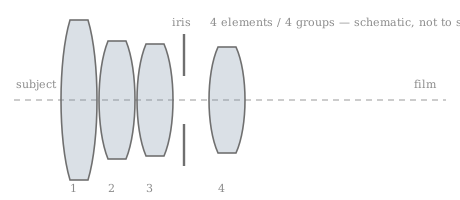
- Four elements in four groups is the giveaway: a genuinely simple lens, and the reason a 341.2 mm focal length fits into a 22.5 cm barrel weighing 1.35 kg
- C or CF after the focal length is the only generation marking — there is no CFi, CFE or CB 350mm f/5.6
- Filter fitting sorts the two: screw thread for Hasselblad series 86 on the C, series 93 on the CF
- Closest focus is engraved 5 m on the C and 4.5 m on the CF
- Not to be confused with the shutterless Tele-Tessar 4/350 for the focal-plane bodies, which is a different, eight-element internal-focusing design, or with the 9-element CFE Tele-Superachromat 5.6/350 that replaced this lens in 1997
Tele-Tessar C T* f/5.6 350 mm:
- Zeiss data sheet: cat. no. 104514, 4 elements in 4 groups, exact focal length 341.2 mm, f/5.6–45, closest focus 5 m, approx. 1350 g
- Filter fitting is a screw thread for Hasselblad series 86 — the series-93 thread belongs to the CF
- Barrel 22.5 cm long with a mount diameter of max. 9 cm (Zeiss sheet); C-style EV interlock coupling the aperture and shutter rings
- Hasselblad product number 20184 (Kamerastore's catalogue listing)
Tele-Tessar CF T* f/5.6 350 mm:
- Zeiss data sheet: cat. no. 10 45 36, 4 elements in 4 groups, 341.2 mm exact, f/5.6–45, closest focus 4.5 m at 1:10.8 (close-limit field 603 × 603 mm), approx. 1350 g
- Barrel 226.5 mm long, 90 mm maximum diameter; screw thread for Hasselblad series 93 filters — the visible change from the C's series 86
- Black barrel with the rubber focusing grip of the CF line; Prontor CF shutter; back focal distance 125.6 mm
- Hasselblad product number 20185 (Kamerastore's catalogue listing)
- Tele-Tessar C T* f/5.6 350 mm: The sheet is headed Tele-Tessar T*, and lens-db files the lens under 1972 while noting a 1973 introduction in another source; T* multicoating spread across the C line from 1973, so whether the earliest 350s left Oberkochen single-coated is not settled by anything consulted here. The optical data on this sheet — entrance pupil 325.5 mm behind the first vertex at 59.4 mm diameter, exit pupil 13.2 mm in front of the last vertex at 24.2 mm, principal plane H 173.6 mm in front of the first vertex, 168.1 mm between the first and last vertices — is repeated figure for figure on the 1982 CF sheet.
- Tele-Tessar CF T* f/5.6 350 mm: Rebarrelled with the Prontor CF shutter in the 1982 changeover that took the whole leaf-shutter line off the Synchro-Compur. The pupil positions, principal planes and 168.1 mm vertex separation printed on this sheet match the C sheet exactly; only the focusing mount, the filter thread and the closest focusing distance changed.
Serial-range notes
- red-ink date code inside the rear mount, pre-1980
- C-generation lenses carry the older Zeiss stamp: digits read YY(Y)MM with the year = code + 1957, so 1602 is February 1973 and 2011 is November 1977.
- red-ink date code inside the rear mount, 1980 onward
- From 1980 the stamp is two reversed year digits plus a month letter, A = January — 28C is March 1982, the first year of the CF, and 79G is July 1997.
Specifications
- Formula
- Tele-Tessar (telephoto Tessar)
- Construction
- 4 elements / 4 groups
- Aperture range
- f/5.6–f/45
- Shutter
- In the lens — a Compur size 0 reflex shutter with automatic iris diaphragm on the C, a Prontor CF on the CF; flash synchronizes at every speed, as on all leaf-shutter V lenses
- Min. focus
- 4.5 m
- Dimensions
- 90 × 226.5 mm
- Weight
- 1350 g
- Years manufactured
- 1972–1998
- Country
- West Germany, then Germany
- Coating
- T* multicoated
What reviewers say
- Erin Emery (Silver in the Dark), the V lenses compared (blog) — "Only appeal if you have a very specific need": reasonably priced at $300 to $1,000 for a 350, and underwhelming beside anything with image stabilisation.
Optical formula — Tele-Tessar (telephoto Tessar)
ⓘ What these charts mean
MTF (modulation transfer function) shows how much contrast the lens keeps at a given fineness of detail, from the center of the frame to the corner — the coarse curves track punch, the fine ones resolving power, and a gap between solid and dashed lines means astigmatism. Relative illumination (falloff) shows how much darker the corners are than the center at each aperture. Manufacturers only began publishing these for modern lenses; no 1950s maker issued them, which is why older families here cite period magazine bench tests instead.
History
Zeiss’s data sheet for the Tele-Tessar T* f/5.6–350 mm opens with the point of the lens: “With a length of only 22.5 cm and a diameter of the mount of max. 9 cm, this tele lens is compact and handy in spite of its long focal length.” The compactness is arithmetic. The sheet’s exact focal length is 341.2 mm, and the glass occupies just 168.1 mm from the first lens vertex to the last — a true telephoto construction that pulls the rear principal plane 173.6 mm out in front of the front element. Four elements in four groups do the work, at f/5.6 down to f/45, over a 13° diagonal field on the 56.5 × 56.5 mm negative, for approximately 1350 g. It was the lens that filled the space between the 250mm Sonnar and the 500mm Tele-Tessar in the leaf-shutter catalogue, and Zeiss recommended it for “long-range and animal photography and for picture series,” adding that like all long lenses it could be used “to separate a motive from its background or to ‘gather up’ the perspective.”
Dating the first version is less tidy than the specification. Lens-db files the C generation under 1972 while reporting a 1973 introduction from another source; Hasselblad Historical’s lens index lists the lens under C and CF without years. T* multicoating reached the C line from 1973, and the data sheet is headed with the T* mark, so whether the earliest examples were single-coated is a question no source consulted here answers. What the C is not in doubt about is its fittings: catalogue number 104514, a Compur interchangeable reflex shutter size 0 with automatic iris diaphragm, a screw thread for Hasselblad series 86 filters, and a distance scale running from infinity to 5 m. Dealer catalogues give it Hasselblad product number 20184.
The 1982 changeover to the Prontor CF shutter reached this lens as it reached the rest of the line, and the second data sheet (catalogue number 10 45 36, product number 20185) shows exactly what changed. The barrel grew a fraction longer, 226.5 mm against 225, at the same 90 mm maximum diameter and the same approximate 1350 g. Closest focus came in from 5 m to 4.5 m, a reproduction ratio of 1:10.8 across a close-limit field of 603 × 603 mm. The filter thread went up from series 86 to series 93. Everything optical stayed put: the same 4 elements in 4 groups at 341.2 mm, and — element for element — the same entrance and exit pupils, the same principal planes and the same 168.1 mm between the outermost vertices. Neither sheet states that the prescription was carried over unchanged, but the numbers admit no other reading.
The CF ran until 1998, by which time Zeiss had already replaced it at the same focal length and the same maximum aperture with something far more elaborate: the nine-element Tele-Superachromat T* 5.6/350 CFE of 1997, with internal focusing and colour correction out to 1000 nm. The old Tele-Tessar’s virtue was the opposite one — four air-spaced elements, no floating group, nothing to go out of alignment.
What remains open: the introduction year, 1972 or 1973, from a factory document rather than a database; whether the first C lenses carried T* coating; any production figure for either generation, which would have to come from Nordin’s compendia; a list price from a Victor Hasselblad Inc. dealer sheet; and the exact date the CF left the catalogue, as against the 1998 date carried here from the arrival of its Superachromat successor.
This history is AI-written, from the sources listed at the foot of the page. Where the record is silent it says so rather than filling the gap — but no human wrote these sentences.
Example photos
Sample photo wanted — shot with a Tele-Tessar 350mm f/5.6? We'd love to feature it (with credit).
Live listings
Asking price, USD: a median of $550 across 23 fixed-price listings on 2026-09-06 (middle half $370–$860). First day tracked.
Asking prices from the listings scanned, not sales; junk-flagged rows and auction lots excluded; other currencies are not converted.
- [NEUWERTIG] Hasselblad Carl Zeiss Tele-Tessar C 350mm f/5.6 T* Teleobjektiv...
- [NEUWERTIG mit Haube] Hasselblad Carl Zeiss Tele Tessar C 350mm F5.6 MF...
- Près De Mint ++ W/Capuche Hasselblad Télé Tessar C 350mm F/5.6 Lentille pour V
- Fast Neu ++ W / Kapuze Hasselblad Tele Tessar C 350mm F/5.6 Linse für V System
- Quasi Perfetto++ W/Cappuccio Hasselblad Tele Tessar C 350mm F/5.6 Lente per V
- [Top Mint] Hasselblad Tele-Tessar T* CF 350mm F5.6 für 503CW 500C/M 203FE JAPAN
- Seltenes T* 【N NEUWERTIG】 Hasselblad Carl Zeiss Tele-Tessar C 350mm f/5.6 Obj...
- [Exc + 5 mit Haube] Hasselblad Carl Zeiss Tele-Tessar CF 350mm f/5.6 T * Obje...
- [NEUWERTIG mit Etui] Hasselblad Carl Zeiss Tele Tessar C T* 350mm f/5.6 aus J...
- Hasselblad Carl Zeiss CF Tele Tessar 350mm F5.6 Tele Prime Objektiv Japan Kos...
- [NEUWERTIG Opt] Hasselblad Tele-Tessar CF 350mm F5.6 T* Carl Zeiss Objektiv m...
- Obiettivo manuale Zeiss Tele Tessar 350mm f5.6
- Obiettivo manuale Zeiss Tele Tessar 350mm f5.6
- Manuelles Zeiss Tele Tessar 350mm F5.6 Objektiv
- Objectif Manuel Zeiss Tele Tessar 350mm f5.6
- Manuelles Zeiss Tele Tessar 350mm F5.6 Objektiv
- Zeiss Tele Tessar Manual Focus Lens 350mm f/5.6
- Manuelles Zeiss Tele Tessar 350mm F5.6 Objektiv
- Hasselblad TeleTessar CF 350mm F5.6 T* Teleobjektiv gebraucht
- Hasselblad Carl Zeiss Tele-Tessar C 350mm F5.6 T*
Show 50 more listings
- Carl Zeiss Objectif Tele-Tessar T 350mm F5.6 Téléphoto Pour Hasselblad V
- Carl Zeiss Tele-Tessar T 350mm F5.6 Teleobjektiv Für Hasselblad V Bajonett
- Hasselblad Carl Zeiss Tele-Tessar C 350mm F5.6 T* Objektiv
- Hasselblad Carl Zeiss Tele-Tessar C 350mm F5.6 T* Lens
- Hasselblad Carl Zeiss Tele-Tessar C 350mm F5.6 T* Objektiv
- Hasselblad Carl Zeiss Télé-Tessar C 350Mm F5.6 T*
- Hasselblad Carl Zeiss Tele-Tessar CF 350mm F5.6 T*
- Hasselblad Carl Zeiss Tele-Tessar CF 350Mm F5.6 T*
- Hasselblad Carl Zeiss Tele-Tessar CF 350mm F5.6 T* Lens
- Hasselblad Carl Zeiss Tele-Tessar CF 350Mm F5.6 T*
- Hasselblad Carl Zeiss Télé-Tessar CF 350Mm F5.6 T*
- Carl Zeiss Tele-Tessar Cf 350mm F5.6 T avec Housse, pour Hasselblad 500 Série
- Carl Zeiss Tele-Tessar CF 350Mm F5.6 T* Mit Tasche, Für Hasselblad 500 Serie
- Carl Zeiss Tele-Tessar CF 350Mm F5.6 T* Avec Étui, Pour Hasselblad 500 Series
- Seamless Follow Focus Gear for Carl Zeiss Tele Tessar Hasselblad 350mm f5.6 Lens
- [Almost MINT] Hasselblad Carl Zeiss Tele Tessar C 350mm F5.6 Lens From JAPAN
- [Exc+5] Hasselblad Carl Zeiss Tele Tessar C T* 350mm F/5.6 US Duty Paid
- [Almost MINT] Hasselblad Carl Zeiss Tele Tessar C T* 350mm F/5.6 lens From JAPAN
- [Almost MINT] Hasselblad Carl Zeiss Tele Tessar C 350mm F5.6 Lens From JAPAN
- [MINT] Hasselblad Carl Zeiss Tele-Tessar C 350mm f/5.6 T* Telephoto Lens JAPAN
- [Top Mint] Hasselblad Tele-Tessar T* CF 350mm F5.6 for 503CW 500C/M 203FE JAPAN
- Rare T* 【N MINT】 Hasselblad Carl Zeiss Tele-Tessar C 350mm f/5.6 Lens from JAPAN
- CLA'd [MINT] Hasselblad Carl Zeiss CF Tele Tessar 350mm f/5.6 Lens from JAPAN
- [Almost Unused] Hasselblad Carl Zeiss Tele-Tessar C 350mm f/5.6 T* Lens JAPAN
- [Top MINT] HASSELBLAD Carl Zeiss Tele-Tessar CF 350mm f/5.6 Lens T* JP 3034351
- Hasselblad Carl Zeiss Tele Tessar C 350mm f/5.6 lens working + fotodiox pro Hass
- Hasselblad Carl Zeiss Tele-Tessar CF T* 350mm f/5.6 828674
- [ MINT w/ Case ] Hasselblad Carl Zeiss Tele Tessar C T* 350mm f/5.6 From JAPAN
- Hasselblad Carl Zeiss CF Tele Tessar 350mm F5.6 Telephoto Prime Lens Japan F/S
- HASSELBLAD Carl Zeiss Tele-Tessar T* CF 350mm f5.6 From Japan Fedex -Excellent-
- Hasselblad CF Tele-Tessar 350mm F/5.6 T* Lens *EX+*
- Hasselblad CF Tele-Tessar 350mm F/5.6 T* Lens *EX+*
- [Near Mint] Hasselblad CF Tele Tessar 1:5,6 f/5.6 350mm T* Carl Zeiss #276
- Carl Zeiss Tele-Tessar T 350mm F5.6 Lens for Hasselblad V Mount from Japan E0527
- 【Near MINT】Hasselblad Carl Zeiss CF Tele Tessar 350mm F5.6 Telephoto Prime Lens
- Hasselblad Carl Zeiss Tele-Tessar CF 350mm F5.6 Fully Functional Q899
- Hasselblad Carl Zeiss TELE-TESSAR CF 350mm F5.6 Lens, fully functional Q899
- Hasselblad Carl Zeiss Tele Tessar C 350mm f/5.6 AS-IS
- [Exc+5] Hasselblad Carl Zeiss Tele Tessar C T* 350mm F/5.6 US Duty Paid
- Hasselblad Tele-Tessar CF 350mm f/5.6 Carl Zeiss Lens
- [Almost MINT] Hasselblad Carl Zeiss Tele Tessar C T* 350mm F/5.6 lens From JAPAN
- [MINT] Hasselblad Carl Zeiss Tele-Tessar C 350mm f/5.6 T* Telephoto Lens JAPAN
- [Top Mint] Hasselblad Tele-Tessar T* CF 350mm F5.6 for 503CW 500C/M 203FE JAPAN
- [Almost Unused] Hasselblad Carl Zeiss Tele-Tessar C 350mm f/5.6 T* Lens JAPAN
- CLA'd [MINT] Hasselblad Carl Zeiss CF Tele Tessar 350mm f/5.6 Lens from JAPAN
- Rare T* 【N MINT】 Hasselblad Carl Zeiss Tele-Tessar C 350mm f/5.6 Lens from JAPAN
- [Top MINT] HASSELBLAD Carl Zeiss Tele-Tessar CF 350mm f/5.6 Lens T* JP 3034351
- [ MINT w/ Case ] Hasselblad Carl Zeiss Tele Tessar C T* 350mm f/5.6 From JAPAN
- Hasselblad Carl Zeiss CF Tele Tessar 350mm F5.6 Telephoto Prime Lens Japan F/S
- Carl Zeiss Tele-Tessar T 350mm F5.6 Lens for Hasselblad V Mount from Japan E0527
eBay links are affiliate links. If you buy through one, Glass Bodies earns a small commission from eBay at no cost to you. It does not change which listings appear, their prices or their order — those come from the search and the sort described above.
Listings updated 2026-09-06. Links go to the shop or marketplace that carries the item.