Tele-Apotessar 500mm f/8
Carl Zeiss · Hasselblad V · 1982 · Telephoto Tessar, apochromatic
Also known as: Zeiss Tele-Apotessar 500mm f/8 · Carl Zeiss Tele-Apotessar T* 500mm f/8 CF · Tele-Apotessar T* 8/500 CF · Tele-Apotessar 500/8 CF · Tele-ApoTessar f/8 500 mm CF · Tele Apotessar 500mm · Apo-Tessar 500mm Hasselblad · Hasselblad 500mm CF Apo · Hasselblad 500mm f/8 CF
Variants & identification
| Variant | Mount | Years | Serial ranges | Production |
|---|---|---|---|---|
| Tele-Apotessar CF T* 8/500, early (closest focus 8.5 m) · Prontor CF, 1s–1/500 and B | Hasselblad V | 1982 | — | — |
| Tele-Apotessar CF T* 8/500, later (closest focus 5 m) · Prontor CF, 1s–1/500 and B | Hasselblad V | — | — | — |
- Elements, groups, exact focal length, closest focus, reproduction ratio, filter thread and weight are from the Zeiss data sheet for the CF 500 (cat. no. 10 46 15) hosted by Hasselblad Historical; the sheet documents the 5 m lens only.
- The split between an 8.5 m and a 5 m close limit comes from dealer listings and owner reports, not from a dated Zeiss or Hasselblad document; about 1989 is the year usually given.
How to tell them apart
- Named Tele-Apotessar, not Tele-Tessar — the apochromatic correction is the whole difference in name, and Hasselblad Historical's index spells it 'Tele-ApoTessar f/8 500 mm CF'
- Internal focusing: the barrel does not extend and the balance barely shifts, unlike the C Tele-Tessar
- 1,810 g against the C lens's 2,100 g — the lighter of the two 500s despite the same 5-elements-in-3-groups count
- Carries the Hasselblad system tripod quick-coupling directly under the centre of gravity
- The only 500 mm in the CF group, and it was never reissued as a CFi or CFE
Tele-Apotessar CF T* 8/500, early (closest focus 8.5 m):
- Focusing scale stops at 8.5 m — the same close limit as the C Tele-Tessar it replaced
- Black CF barrel with rubber focusing grip, Prontor CF shutter, green F setting for open-shutter use on the focal-plane bodies, M 86×1 filter thread
Tele-Apotessar CF T* 8/500, later (closest focus 5 m):
- Focusing scale runs down to 5 m — 1:9.4 at the close limit, a 525 × 525 mm field at a working distance of 4.6 m
- Otherwise identical to the early lens: 5 elements in 3 groups, 1,810 g, M 86×1, internal focusing, Prontor CF
- Zeiss data sheet CF500: cat. no. 10 46 15, exact focal length 499.3 mm, f/8–64, field 9.0° diagonal
- Tele-Apotessar CF T* 8/500, early (closest focus 8.5 m): The launch form of the CF 500. Dealers separate it from the later lens by the close limit alone: KEH's listing for an early example is headed 'Early Version with Minimum Focusing Distance 8.5m', and the change to 5 m is generally reported to have come around 1989. No document read for this entry dates the change, and no source consulted says whether the optics were touched when the focusing travel was extended.
- Tele-Apotessar CF T* 8/500, later (closest focus 5 m): The version the Zeiss data sheet describes: closest focus 5 m, reproduction ratio 1:9.4. The sheet says 'the optic is designed with special attention to close-up performance' and that 'the focusing ring can move beyond infinity to allow use of this lens in a variety of temperature conditions'. Its start year is not documented in any source consulted here; the change is reported around 1989.
Serial-range notes
- red-ink code inside the rear mount, 1980 onward
- The whole run postdates 1980, so the Zeiss date code inside the rear mount is two reversed year digits followed by a month letter, A = January: 28E is May 1982, 09K is November 1990. Lens serials themselves are Zeiss's running numbers, and no block-to-year table for the 500 mm Tele-Apotessar was found.
Specifications
- Formula
- Telephoto Tessar, apochromatic
- Construction
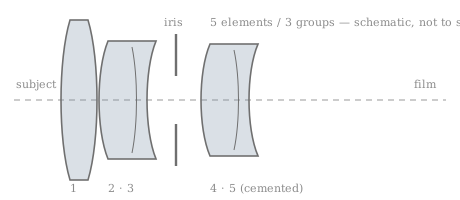
- 5 elements / 3 groups
- Aperture range
- f/8–f/64
- Shutter
- In the lens — Prontor CF, 1s–1/500 and B, flash sync at every speed; green F setting for open-shutter work on the 2000- and 200-series bodies
- Min. focus
- 5 m
- Weight
- 1810 g
- Filter
- 86 mm
- Years manufactured
- 1982
- Country
- West Germany, then Germany
- Coating
- T* multicoated
What reviewers say
- Marwan El Mozayen (SilvergrainClassics) (blog) — A completely different optical design from the Tele-Tessar it replaced and optically the better lens, with internal focusing that keeps the balance steady — but considerably more expensive on the used market, and he questions whether the premium is worth paying.
Optical formula — Telephoto Tessar, apochromatic
ⓘ What these charts mean
MTF (modulation transfer function) shows how much contrast the lens keeps at a given fineness of detail, from the center of the frame to the corner — the coarse curves track punch, the fine ones resolving power, and a gap between solid and dashed lines means astigmatism. Relative illumination (falloff) shows how much darker the corners are than the center at each aperture. Manufacturers only began publishing these for modern lenses; no 1950s maker issued them, which is why older families here cite period magazine bench tests instead.
History
The Tele-Apotessar arrived in 1982 with the Prontor CF shutter that replaced the Synchro-Compur across the Hasselblad line, and it kept the element count of the Tele-Tessar it succeeded while changing almost everything else. Zeiss’s data sheet gives five elements in three groups, catalogue number 10 46 15, an exact focal length of 499.3 mm, f/8 to f/64, a field of 9.0° on the diagonal, an M 86×1 filter thread and 1,810 g — 290 g less than the 2,100 g of the C lens. The sheet is candid about where the saving came from: the lens “is surprisingly lightweight, a merit of the Tessar lens design principle.”
The two additions that justify the new name are apochromatic correction and internal focusing. Zeiss claims that “due to its apochromatic correction, the optical performance is so high that it can not be fully utilized with hand-held shooting” — a reversal of the older sheet, which had advertised the 2 kg Tele-Tessar as hand-holdable — and describes “a very smooth internal focusing mechanism,” so the barrel neither lengthens nor shifts its balance as the distance changes. The Hasselblad system tripod quick coupling sits directly under the centre of gravity, and the sheet notes that “the lens barrel incorporates very efficient light baffling devices to control stray light” and that the focusing ring travels past infinity so the lens stays usable across a range of temperatures. Preferred uses are given as editorial and documentary work, the recording of historical monuments, nature and wildlife.
Close focus is where the run splits. The Zeiss sheet gives 5 m, a reproduction ratio of 1:9.4, a field of 525 × 525 mm at a working distance of 4.6 m, and says “the optic is designed with special attention to close-up performance.” Earlier examples do not reach that far: KEH’s listing for one is headed “Early Version with Minimum Focusing Distance 8.5m” — the same close limit as the C Tele-Tessar — and the change to 5 m is generally reported to have come around 1989. No dated Zeiss or Hasselblad document read for this entry fixes the year, and none says whether the optics were revised along with the focusing travel or only the helicoid’s range extended.
It was the end of the line in two senses. Hasselblad Historical’s index lists “Tele-ApoTessar f/8 500 mm CF” as the last entry in the CF group, and no 500 mm appears at all under CB, CFi, CFE, F or FE — so unlike the 40, 50, 80, 120, 150, 180 and 250, the 500 was never given the CFi barrel, the databus contacts of a CFE, or a shutterless version for the focal-plane bodies. Anyone wanting more reach on a V body had to go to the special-order Mirotar 1000 mm f/5.6, a mirror lens with no shutter at all. SilvergrainClassics, comparing the two 500s in 2025, calls the Tele-Apotessar “a completely different optical design,” better but considerably more expensive used, and asks whether the premium is worth paying.
What remains open: the year the close limit changed, and on whose authority; whether the change was optical or mechanical; the lens’s end year, since Hasselblad kept it in the catalogue after the CFi generation arrived in 1998 without ever updating it; any list price; the designer, who is not named on the sheet; and production quantities, which would have to come from Nordin’s compendia.
This history is AI-written, from the sources listed at the foot of the page. Where the record is silent it says so rather than filling the gap — but no human wrote these sentences.
Example photos
Sample photo wanted — shot with a Tele-Apotessar 500mm f/8? We'd love to feature it (with credit).
Live listings
- Carl Zeiss / Hasselblad Tele-Apotessar 8/500mm - Tessar APO CF 8,0/500 T*
- Hasselblad CF 500mm f8 Carl Zeiss Tele Apotessar
- [Top MINT w/Case] Hasselblad Carl Zeiss Tele ApoTessar T* CF 500mm f/8 FromJAPAN
- Hasselblad Carl Zeiss Tele Apotessar T* 500mm F8 CF Lens Hasselblad Apotessar Le
- Hasselblad 500mm f8 Tele-Apotessar CF
- Hasselblad Tele Apotessar Objektiv 500 mm f/8 T* CF
eBay links are affiliate links. If you buy through one, Glass Bodies earns a small commission from eBay at no cost to you. It does not change which listings appear, their prices or their order — those come from the search and the sort described above.
Listings updated 2026-09-11. Links go to the shop or marketplace that carries the item.