Tele-Tessar 500mm f/8
Carl Zeiss · Hasselblad V · 1960 · Tele-Tessar (true telephoto)
Also known as: Zeiss Tele-Tessar 500mm f/8 · Carl Zeiss Tele-Tessar T* 500mm f/8 · Tele-Tessar 8/500 · Tele-Tessar 500/8 · Tele Tessar 500mm · Hasselblad 500mm Tele-Tessar · Hasselblad 500mm f/8 C · Hasselblad 500mm C T* · Tele-Tessar C 500mm f/8 · Zeiss Tele-Tessar T* 8/500 C
Variants & identification
| Variant | Mount | Years | Serial ranges | Production |
|---|---|---|---|---|
| Tele-Tessar C f/8 500 mm, chrome barrel · Synchro-Compur size 0 in the lens — the Zeiss sheet calls it a 'Compur interchangeable reflex shutter size 0 with automatic iris diaphragm' | Hasselblad V | 1960 | — | — |
| Tele-Tessar C f/8 500 mm, black barrel · Synchro-Compur size 0 in the lens | Hasselblad V | 1966 | — | — |
| Tele-Tessar C T* f/8 500 mm · Synchro-Compur size 0 in the lens | Hasselblad V | 1973–1982 | — | — |
- Elements, groups, exact focal length, aperture scale, closest focus, filter fitting and weight are from the Zeiss data sheet for the C 500 (cat. no. 10 46 03) hosted by Hasselblad Historical. The sheet does not distinguish barrel finishes or coating generations.
- Generation years follow the C range's barrel and coating changes (black in the second half of the 1960s, T* from 1973) rather than any dated document for this lens; the chrome-to-black year in particular is reported, not documented.
- No serial block has been published for any of the three barrels, so the chrome, black and T* versions cannot be separated by serial number — which matters most at the chrome-to-black change, the one transition for which no documented year exists either. The date code inside the mount is the only evidence that distinguishes them by date, and it dates the lens rather than naming its version.
- The serial lookup returns 'unknown' across wide stretches — 2,600,000 and 2,700,000 both come back empty, which is precisely the 1959–1960 window in which the chrome 500 was introduced. The tables behind it are a list of dated blocks rather than a continuous mapping, and the launch year is one of the places where they do not reach.
How to tell them apart
- The longest lens in the leaf-shutter Hasselblad range — Hasselblad Historical's index ends the C list at 'Tele-Tessar f/8 500 mm C'
- Series 86 filters, screwed into the front — no bayonet-50 or bayonet-60 fitting exists for this lens
- Three points separate the versions: chrome or black barrel, and the red T* that appears from 1973
- Short for its focal length: SilvergrainClassics measures only about 15 cm from the front vertex to the film plane, and the lens weighs about 2 kg
Tele-Tessar C f/8 500 mm, chrome barrel:
- Chrome barrel, the finish used across the C range from 1957 until black replaced it in the second half of the 1960s; no T* mark
- Zeiss data sheet C500: cat. no. 10 46 03, 5 elements in 3 groups, exact focal length 500.1 mm, f/8–64, closest focus 8.5 m, screw thread for Hasselblad series 86, 2,100 g
Tele-Tessar C f/8 500 mm, black barrel:
- Black barrel, no T* mark — the black finish spread across the C range during the second half of the 1960s
- Same optics and same 2,100 g as the chrome version; series 86 filter thread; EV interlock lever between the speed and aperture rings, as on every C lens
Tele-Tessar C T* f/8 500 mm:
- Red T* after the name — Zeiss multicoating reached the C range in 1973; barrel black
- Optically and mechanically identical to the uncoated lens per SilvergrainClassics, which reports only a contrast difference under difficult light
- Tele-Tessar C f/8 500 mm, chrome barrel: The launch version, shown at Photokina 1960 according to SilvergrainClassics. The Zeiss sheet's aperture scale runs 8 - 11 - 16 - 22 - 32 - 45 - 64 and its angular field is 9° on the diagonal, 6.5° on the side. No source consulted here gives a serial block or a production figure for the chrome run, or the year it ended.
- Tele-Tessar C f/8 500 mm, black barrel: A finish change, not an optical one. The date given for the black 500 is reported rather than taken from a primary document read for this entry; the C range as a whole went black around 1969/70, and 1966 for this lens is the earlier figure in circulation. Nothing in the Zeiss sheet distinguishes the two barrels.
- Tele-Tessar C T* f/8 500 mm: The last form of the C 500, sold until the Tele-Apotessar CF replaced it in 1982. SilvergrainClassics's Marwan El Mozayen, writing about a T* example, says the earlier 500 mm without T* is 'optically and mechanically identical' but does not hold contrast as well in comparable light. Whether the glass itself was ever touched is not stated by any source consulted.
Serial-range notes
- red-ink code inside the rear mount, before 1980
- Zeiss stamped a date code in red ink inside the rear mount. On lenses made before 1980 it reads as digits, YY(Y)MM, with the year obtained by adding 1957 — so 0311 is November 1960 and 1605 is May 1973. Every version of this lens falls in that window. No serial-block table specific to the 500 mm Tele-Tessar was found.
- two digits and a letter, 1980 onward
- The last two years of this lens's life fall the other side of a change of scheme. From 1980 Zeiss stamped two digits and a letter instead: the digits are the year reversed, so 08 is 1980, 18 is 1981 and 28 is 1982, and the letter is the month with A for January. A late C T* 500 therefore carries a code that looks nothing like the one on a chrome barrel, and reading it by the pre-1980 rule turns 1982 into 2029. Some later lenses add a trailing A or B whose meaning Hasselblad Historical says is still unknown.
- finding the stamp, and reading the earliest of several
- The code sits on the rear end of the mount, often on the wall of the rear baffle; racking the lens to its close-focus limit draws the rear element forward and clears the view of it. It is present in all but the very earliest C lenses, and it may be smudged or incomplete. Where an early lens carries more than one stamp, take the earliest as the build date — the later ones record returns to the factory for major repair.
- the serial number, as a fallback
- Zeiss serial numbers contain no coded date. They date a lens only through tables built by matching collected serials to the dates their owners bought the lenses — Richard Nordin's Hasselblad System Compendium carries the standard set, and Hasselblad Historical runs a lookup utility on the same data. Readings taken from that utility that bracket this lens's life: 2,500,000 = 1958, 2,750,000 = 1961, 3,200,000 = 1962, 4,000,000 = 1965, 4,200,000 = 1966, 5,000,000 = 1970, 5,650,000 = 1973 (the T* year), 6,300,000 = 1980 and 6,500,000 = 1982 (the year the Tele-Apotessar replaced it). These are single readings, not block edges.
Specifications
- Formula
- Tele-Tessar (true telephoto)
- Construction
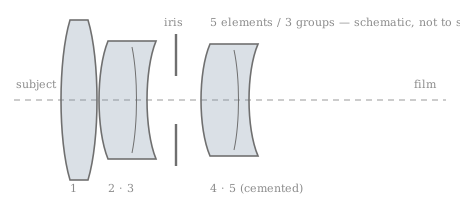
- 5 elements / 3 groups
- Aperture range
- f/8–f/64
- Shutter
- In the lens — Synchro-Compur size 0 reflex shutter with automatic iris diaphragm (Zeiss data sheet C500); flash sync at every speed, as on all leaf-shutter Hasselblad lenses
- Min. focus
- 8.5 m
- Weight
- 2100 g
- Filter
- 86 mm
- Years manufactured
- 1960–1982
- Country
- West Germany
- Coating
- Single-coated on the chrome and early black barrels; T* multicoating from 1973
What reviewers say
- Marwan El Mozayen (SilvergrainClassics) (blog) — The optical quality is really very good even at full aperture, and the lens handles surprisingly well for its 2 kg — but a sturdy tripod and a precise head are mandatory, and the much more expensive Tele-Apotessar that replaced it is a completely different design whose price premium he questions.
Optical formula — Tele-Tessar (true telephoto)
ⓘ What these charts mean
MTF (modulation transfer function) shows how much contrast the lens keeps at a given fineness of detail, from the center of the frame to the corner — the coarse curves track punch, the fine ones resolving power, and a gap between solid and dashed lines means astigmatism. Relative illumination (falloff) shows how much darker the corners are than the center at each aperture. Manufacturers only began publishing these for modern lenses; no 1950s maker issued them, which is why older families here cite period magazine bench tests instead.
History
Zeiss’s data sheet for the Tele-Tessar f/8 500 mm opens by insisting on the word telephoto: “This is a genuine tele lens consisting of a collective front component and a dispersive rear component separated by a large air space. Compared with its focal length the lens is short.” That is the whole point of the design. Five elements in three groups, catalogue number 10 46 03, an exact focal length of 500.1 mm, an aperture scale running 8 - 11 - 16 - 22 - 32 - 45 - 64, a diagonal field of 9°, closest focus at 8.5 m, a screw thread for Hasselblad series 86 filters, and 2,100 g on the scale — against which the sheet notes that “the weight of approx. 2 kg allows hand-held exposure.” SilvergrainClassics, reviewing a T* example in August 2025, dates the introduction to Photokina 1960 and puts only about 15 cm between the front vertex and the film plane.
Zeiss also claimed performance rather than mere compactness: “Even at full aperture the lens offers optimum image quality,” with landscape, wildlife, sports and press work at long range given as the intended uses. Marwan El Mozayen’s verdict sixty-five years later is close to the sheet’s — the optical quality is “really very good even at full aperture” — with the practical caveat that a heavy tripod and a head that can be nudged precisely are not optional, since at 9° across the diagonal a small movement of the head is a large movement of the frame.
The barrel changed twice, the glass apparently not at all. The chrome finish of 1957 gave way to black across the C range in the second half of the 1960s, and Zeiss’s T* multicoating arrived on the C lenses in 1973, marked in red after the name. SilvergrainClassics states plainly that the earlier 500 mm without T* is “optically and mechanically identical” to the coated lens and differs only in the contrast it holds under difficult light. The changeover year for this particular lens is the weak point of the record: no document read for this entry dates it, and the figures in circulation run from 1966 to the 1969/70 window in which the C range as a whole turned black.
Its position in the system is easy to state, because Hasselblad Historical’s lens index makes it visually: the C list ends at “Tele-Tessar f/8 500 mm C.” Nothing longer was ever fitted with a leaf shutter. Photographers who needed more reach had to leave the shutter behind — the shutterless F lenses of the 2000-series, and at the far end the special-order Mirotar 1000 mm f/5.6, a mirror lens of a wholly different kind. The Tele-Tessar’s own replacement came in 1982, when the Prontor CF shutter arrived across the line and the 500 was recomputed as the Tele-Apotessar f/8 500 mm CF, an internally focusing apochromat listed by Hasselblad Historical as the only 500 in the CF group and never carried forward into CFi or CFE.
What remains open is most of the manufacturing record. No designer is named on the Zeiss sheet or anywhere else consulted. No production figure, serial block or list price for the 500 C was found — those would have to come from Nordin’s compendia or from a period Victor Hasselblad Inc. price list. The chrome-to-black year is unsettled, and whether the T* generation carried any optical revision at all, rather than only a coating, is stated by nobody.
This history is AI-written, from the sources listed at the foot of the page. Where the record is silent it says so rather than filling the gap — but no human wrote these sentences.
Example photos
Sample photo wanted — shot with a Tele-Tessar 500mm f/8? We'd love to feature it (with credit).
Live listings
Asking price, USD: a median of $700 across 12 fixed-price listings on 2026-09-11 (middle half $380–$760). Tracked since 2026-09-06, 2 days: unchanged from $700.
By day
| Date | Median | Middle half | Listings |
|---|---|---|---|
| 2026-09-11 | $700 | $380–$760 | 12 |
| 2026-09-06 | $700 | $380–$760 | 12 |
Asking prices from the listings scanned, not sales; junk-flagged rows and auction lots excluded; other currencies are not converted.
- Hasselblad Leather Lens Case f. 8/500mm Tele-Tessar C 58084
- [Optik Top NEUWERTIG] Hasselblad Tele Tessar C 500mm f/8 Tele MF Objektiv JAPAN
- HASSELBLAD Tele-Tessar T* 500mm f/8,0 - SNr: 6214407
- Hasselblad C Tele-Tessar 8/500 Tele Lens
- [N NEUWERTIG+++ mit GEHÄUSEHAUBE] Hasselblad Tele Tessar C 500mm f/8 T*...
- Fast Neu W/Kapuze Hasselblad Tele Tessar C 500mm F/8 Objektiv für V System Von
- Près De Mint W/Capuche Hasselblad Télé Tessar C 500mm F/8 Lentille pour V
- Quasi Perfetto W/Cappuccio Hasselblad Tele Tessar C 500mm F/8 Lens per V Da JP
- Obiettivo manuale Tele Tessar 500mm F8 Hasselblad
- Hasselblad Tele Tessar 8/500 Objektiv
- [MINT] Zeiss Tele-Tessar 500mm f/8 HFT [6000]
- Obiettivo Hasselblad Tele Tessar 500mm f/8
- Manuelles Objektiv Tele Tessar 500mm F8 Hasselblad
- Objectif Manuel Tele Tessar 500mm F8 Hasselblad
- Manual Focus Lens Tele Tessar 500mm F8 Hasselblad
- Manuelles Objektiv Tele Tessar 500mm F8 Hasselblad
- Objectif Manuel Télé Tessar 500mm F8 Hasselblad
- Hasselblad Zeiss Tele-Tessar 8/500mm RED T* Chrome RARE
- Hasselblad 500mm f/8 Tele-Tessar C Lens for Hasselblad 500 Series V System
- Hasselblad 500mm f8 C Tele-Tessar Lens #125
Show 19 more listings
- [ Optics Top MINT ] Hasselblad Tele Tessar C 500mm f/8 Telephoto MF Lens JAPAN
- Hasselblad Carl Zeiss Tele Tessar 500mm F/8 C Lens For 500 C/M 503 CXi CW JAPAN
- [ Almost MINT ] Hasselblad Tele Tessar Carl Zeiss 500mm F/8 T* C Lens From JAPAN
- Hasselblad 500mm f8 Tele Tessar
- Hasselblad 500mm tele tessar, Lens with Case and Caps
- Hasselblad C T* 500mm f/8 Tele Tessar Carl Zeiss L#4242167
- Zeiss for Hasselblad 500 early Tele-Tessar 8/500mm clean glass
- Hasselblad Carl Zeiss Tele Tessar 500mm F/8 C MF Lens 362117
- Hasselblad 500mm Tele-Tessar Lens
- Hasselblad Zeiss Tele-Tessar 8/500mm RED T* Chrome RARE
- Hasselblad Carl Zeiss Tele-Tessar C 500mm F8 V Mount Fungus Slow Shutter AS-IS
- Hasselblad 500mm f8 C T* Tele-Tessar Lens *AS IS*No Return
- Hasselblad Tele-Tessar C 500mm F8 Telephoto Lens For Parts or Not Working
- [ Optics Top MINT ] Hasselblad Tele Tessar C 500mm f/8 Telephoto MF Lens JAPAN
- Hasselblad Carl Zeiss Tele Tessar 500mm F/8 C Lens For 500 C/M 503 CXi CW JAPAN
- [ Almost MINT ] Hasselblad Tele Tessar Carl Zeiss 500mm F/8 T* C Lens From JAPAN
- Hasselblad 500mm f8 Tele-Tessar T* Black Objektiv - V Series System - Top Zustand
- Hasselblad Zeiss Tele-Tessar 8/500mm RED T* Chrome RARE
- Hasselblad 500mm f/8 Tessar T* Carl Zeiss
eBay links are affiliate links. If you buy through one, Glass Bodies earns a small commission from eBay at no cost to you. It does not change which listings appear, their prices or their order — those come from the search and the sort described above.
Listings updated 2026-09-11. Links go to the shop or marketplace that carries the item.