Tele-Superachromat 350mm f/5.6 IF
Carl Zeiss · Hasselblad V · 1997 · Superachromat, internal focusing
Also known as: Zeiss Tele-Superachromat 350mm f/5.6 · Carl Zeiss Tele-Superachromat T* 350mm f/5.6 · Tele-Superachromat T* 5.6/350 · Tele-Superachromat 350/5.6 CFE · Hasselblad 350mm Superachromat · Hasselblad CFE 350mm f/5.6 · Tele Superachromat 350mm CFE · Superachromat 5.6/350
Variants & identification
| Variant | Mount | Years | Serial ranges | Production |
|---|---|---|---|---|
| Tele-Superachromat CFE T* 5.6/350 IF · Prontor CFE, with the green F setting for open-shutter use on the focal-plane bodies | Hasselblad V | 1997–2013 | — | — |
- Every figure here comes from the Zeiss CFE data sheet (cat. no. 10 45 49) unless otherwise attributed.
- The 1997 start is lens-db's date; the lens is present in the 202FA instruction manual's 1998 lens list, which is the earliest Hasselblad document consulted here that names it. The 2013 end is the year the V system closed — Wikipedia gives the 503CW's discontinuation as 29 April 2013 — not a documented discontinuation of this lens.
How to tell them apart
- Superachromat, not Tele-Tessar: nine elements in eight groups against the older leaf-shutter 5.6/350's four, and 1800 g against 1350 g, at the same focal length and the same maximum aperture
- The focusing-limiter rings are the quickest identification — no other Hasselblad V lens has adjustable end stops on the focusing travel
- M 86×1 filter thread, not one of the Hasselblad series screw threads used on the C and CF 350
- CFE after the focal length means databus contacts; the lens was never sold in any other generation
Tele-Superachromat CFE T* 5.6/350 IF:
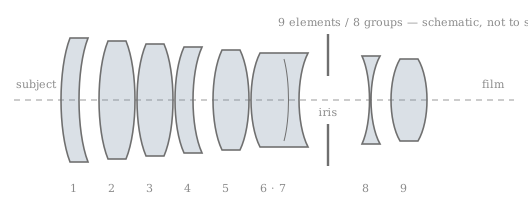
- Zeiss data sheet: cat. no. 10 45 49, 9 elements in 8 groups, exact focal length 343.1 mm, f/5.6–45, focusing range infinity to 3.75 m at 1:9.9 (close-limit field 545 × 545 mm), 1800 g
- Filter connection M 86×1; camera mount CFE, so databus contacts on the bayonet plate for the 200-series meters
- Internal focusing with user-adjustable limiters at both ends of the range — set to the same point they lock the focusing ring; no other V lens has them
- Hasselblad system tripod quick-coupling mount built into the barrel under the combined centre of gravity
- 161.5 mm between the first and last lens vertices, back focal distance 137.2 mm; working distance at the close limit 3.4 m
- Tele-Superachromat CFE T* 5.6/350 IF: The only version. Hasselblad Historical's index lists it once, under CFE and CFi, as 'Tele-Superachromat f/5.6 350 mm CFE (IF)' — there is no CF, CFi or ZV version. The Zeiss sheet was printed on 17 July 2000, some years into the run.
Serial-range notes
- red-ink date code inside the rear mount, 1980 onward
- The lens postdates 1980 entirely, so the Zeiss stamp inside the rear mount is two reversed year digits plus a month letter, A = January: 79J is October 1997, the first year of production, and 00E is May 2000.
Specifications
- Formula
- Superachromat, internal focusing
- Construction
- 9 elements / 8 groups
- Aperture range
- f/5.6–f/45
- Shutter
- In the lens — Prontor CFE, flash synchronizing at every speed, with the F setting for open-shutter working on the 2000- and 200-series bodies
- Min. focus
- 3.75 m
- Weight
- 1800 g
- Filter
- 86 mm
- Years manufactured
- 1997–2013
- Country
- Germany
- Coating
- T* multicoated
What reviewers say
- Josh Lehrer (Red Dot Forum), adapted to a Leica S2 (blog) — "The lens is quite addicting to use": contrast and fine detail that hold at 100% in night and beachfront frames, with the S2's finder making manual focus at distance precise. A sturdy tripod and cable release are not optional, and used examples were reaching $10,000.
Optical formula — Superachromat, internal focusing
ⓘ What these charts mean
MTF (modulation transfer function) shows how much contrast the lens keeps at a given fineness of detail, from the center of the frame to the corner — the coarse curves track punch, the fine ones resolving power, and a gap between solid and dashed lines means astigmatism. Relative illumination (falloff) shows how much darker the corners are than the center at each aperture. Manufacturers only began publishing these for modern lenses; no 1950s maker issued them, which is why older families here cite period magazine bench tests instead.
History
The Tele-Superachromat T* 5.6/350 CFE replaced a four-element lens with a nine-element one at the same focal length and the same maximum aperture, and Zeiss’s data sheet is candid about what that cost: the lens “incorporates considerable amounts of optical glass and metal parts of utmost precision. It is extremely difficult to manufacture.” Catalogue number 10 45 49, 9 elements in 8 groups, an exact focal length of 343.1 mm, f/5.6 to f/45, 1800 g — 450 g more than the Tele-Tessar 5.6/350 it succeeded — with a Prontor CFE shutter and databus contacts for the 200-series meters. Lens-db dates it to 1997; the earliest Hasselblad document consulted here that names it is the 202FA instruction manual, whose 1998 lens list has the CFE 5.6/350 sitting beside the FE lenses from 50 to 350 mm.
Superachromat is a specific claim, not a marketing word. An apochromat brings three wavelengths to a common focus; the Superachromats add a fourth and hold the correction across a far wider band — Japanese Wikipedia gives 400 to 1000 nm for the type. Zeiss’s practical formulation on this sheet is that the lens “incorporates special optical materials to achieve a chromatic correction so good, that even for infrared photos no special index is needed for focusing.” There is no red infrared mark on the distance scale because none is required. The design was meant “to deliver its high image quality even wide open, the way fashion photographers prefer to work,” and the listed uses run to advertising, industrial, aerospace and architectural detail work.
The mechanics are unusual for the V system. Focusing is internal, over a range from infinity to 3.75 m — a reproduction ratio of 1:9.9 across a close-limit field of 545 × 545 mm, at a working distance of 3.4 m from the front of the barrel — and the focusing ring carries user-adjustable limiters at both ends of the travel. Zeiss notes that the two can be brought together: narrowed “down to zero, which means, the focusing ring can be locked in any position,” so a chosen plane of focus can be set and held. Sports and wildlife photographers were the intended beneficiaries. The barrel also carries the Hasselblad system tripod quick-coupling mount, positioned “right under the center of gravity of camera and lens combined,” and takes M 86×1 filters rather than one of the Hasselblad series threads used on the older 350.
Only one version was ever sold. Hasselblad Historical’s lens index lists the lens once, under CFE and CFi, and there is no CF, CFi, CB or ZV variant of it — the Superachromat arrived after the CFE bayonet was established and left with the system. The end date carried here is the V system’s own: Wikipedia gives the 503CW’s discontinuation as 29 April 2013.
What remains open: a launch date from a Hasselblad or Zeiss announcement rather than a database, and whether the September 1997 date sometimes given for it refers to the announcement or to first shipments; any list price, in Deutsche Mark, dollars or Swedish kronor; the quantity built, which for a lens described by its own maker as extremely difficult to manufacture is likely to be small but is stated nowhere consulted here; and who at Oberkochen designed it — as with almost every Hasselblad Zeiss lens, no designer is named on the sheet.
This history is AI-written, from the sources listed at the foot of the page. Where the record is silent it says so rather than filling the gap — but no human wrote these sentences.
Example photos
Sample photo wanted — shot with a Tele-Superachromat 350mm f/5.6 IF? We'd love to feature it (with credit).
Live listings
Listings updated 2026-09-11. Links go to the shop or marketplace that carries the item.