UV-Sonnar 105mm f/4.3
Carl Zeiss · Hasselblad V · 1967 · UV-Sonnar (quartz and fluorite)
Also known as: Zeiss UV-Sonnar 105mm f/4.3 · Carl Zeiss UV Sonnar 4.3/105 · UV-Sonnar 4.3/105 · UV Sonnar 105/4.3 · Hasselblad 105mm UV-Sonnar · Hasselblad UV Sonnar · UV-Sonnar C 105mm f/4.3 · UV-Sonnar CF 105mm f/4.3 · Zeiss quartz fluorite 105mm Hasselblad
Variants & identification
| Variant | Mount | Years | Serial ranges | Production |
|---|---|---|---|---|
| UV-Sonnar C 4.3/105 (Synchro-Compur) · Compur interchangeable reflex shutter size 0 with automatic iris diaphragm | Hasselblad V | 1967 | 7139688–7139707 — 'the last batch of 20 lenses', issued 1988 (Leitz Photographica Auction lot AI-34-37223, serial 7139689) 5139568–5139592 — reported as the first production series in a second Leitz Photographica lot description, seen only through a search summary and not read directly | 'Total production 73 lenses for Hasselblad C' per Leitz Photographica Auction's lot description; a poster on UltravioletPhotography reports Zeiss telling him there were 'about 400 that they knew of', which may count every version and mount rather than the Hasselblad C alone. No factory figure has been found and the two claims have not been reconciled. |
| UV-Sonnar CF 4.3/105 (Prontor CF) · Prontor CF, 1s–1/500 and B | Hasselblad V | 1982 | — | Not published by any source consulted |
- Element and group counts, exact focal lengths, weights, closest focus and filter series come from the Zeiss data sheets hosted by Hasselblad Historical (C105, CF105).
- Production figures are auction and forum claims, not factory records; the two available numbers (73 and about 400) are not reconciled by any source.
How to tell them apart
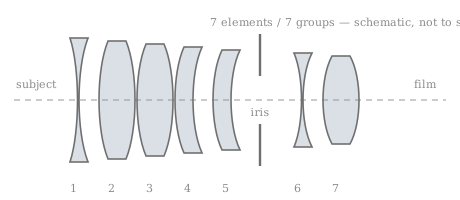
- Seven elements in seven groups — every surface an air-glass surface, and no cemented pairs, because the balsams and cements of a normal lens absorb ultraviolet
- Elements are quartz and fluorite (calcium fluoride), not optical glass; Wildi's Hasselblad Manual says the quartz transmits to about 215 nm where ordinary camera lenses stop at about 350 nm
- No T* and no multicoating marking on any Zeiss sheet or Hasselblad price list consulted — the one lens in the C block of the 1980 dealer list written without one
- Supplied with a Schott UG11 filter in a bayonet mount to fit the lens (Wildi); glass accessories such as Proxars must not be used with it, so close-ups are made with extension tubes or the bellows
- Closest focus 1.8 m in both versions, twice the 100mm Planar's, and a maximum aperture of f/4.3 that appears nowhere else in the system
UV-Sonnar C 4.3/105 (Synchro-Compur):
- All-black barrel, engraved UV-Sonnar rather than Sonnar; bayonet-50 filter mount; 1.8 m closest focus, the longest of any short V lens
- No red T* anywhere on the lens — on Victor Hasselblad Inc.'s dealer list of 1 January 1980 it is the one entry in the C-lens block written without a T*, every other lens on the page carrying one
- Aperture scale 4.3 – 5.6 – 8 – 11 – 16 – 22 – 32; the 4.3 maximum is unique in the system
- Zeiss data sheet: cat. no. 104201, 7 elements in 7 groups, exact focal length 107.2 mm, 670 g, Compur size 0, diagonal field 41°
- Product number 20133
UV-Sonnar CF 4.3/105 (Prontor CF):
- CF barrel with the rubber focusing grip and bayonet-60 filter mount; 820 g, 150 g heavier than the C and the heaviest short lens in the system
- Zeiss data sheet: cat. no. 10 42 09, 7 elements in 7 groups, exact focal length 107.5 mm, 1.8 m closest focus, diagonal field 40°
- Product number 20134; Hasselblad's own CF catalogue groups it with the Makro-Planars as a 'CF Special-purpose lens'
- UV-Sonnar C 4.3/105 (Synchro-Compur): The 1988 date on the last-batch lot matters for the family's shape: the C barrel was still being filled six years after the CF generation replaced the Synchro-Compur everywhere else in the line, so this lens was built in occasional small batches to order rather than run continuously. Victor Hasselblad Inc. listed it at $3,627.00 in April 1973 and $6,350.00 on the dealer list effective 1 January 1980 — five times the 100mm Planar and by far the most expensive item in the V catalogue.
- UV-Sonnar CF 4.3/105 (Prontor CF): The same optics in the 1982 barrel. Zeiss's CF sheet repeats the C text nearly word for word — fluorite and quartz elements, chromatic correction across both the ultraviolet and the visible, focusing in visible light with no adjustment for a UV exposure, and applications in textiles, printing forgeries, materials examination and 'extraterrestrial UV photography'. A dealer listing for a CF example is titled with a T*, which no Zeiss sheet or Hasselblad price list supports; nothing consulted here explains it.
Serial-range notes
- 7139688–7139707
- The final run of twenty C lenses, dated 1988 by Leitz Photographica Auction, which sold 7139689 from it. That a C-shuttered lens was still being made six years into the CF era is the strongest evidence that the UV-Sonnar was built to order in batches rather than stocked.
- red-ink code inside the rear mount
- Zeiss's usual dating stamp applies: before 1980 the last two digits are the month and the leading digit or digits plus 1957 the year; from 1980 two reversed year digits and a month letter, A = January. A lens from the 1988 batch should therefore read 88x in the reversed form.
Specifications
- Formula
- UV-Sonnar (quartz and fluorite)
- Construction
- 7 elements / 7 groups
- Aperture range
- f/4.3–f/32
- Shutter
- In the lens — Compur size 0 with automatic iris on the C, Prontor CF 1s–1/500 and B on the CF; flash sync at every speed
- Min. focus
- 1.8 m
- Weight
- 670 g
- Years manufactured
- 1967
- Country
- West Germany (Carl Zeiss, Oberkochen)
- Coating
- No T* and no coating stated: neither Zeiss data sheet nor either Hasselblad price list gives this lens the T* that every other C lens on the same page carries, and conventional coatings absorb in the ultraviolet. Whether the elements carry any coating at all is not stated by any source consulted.
- Original price
- US$3,627.00 on Victor Hasselblad Inc.'s suggested-retail list of April 1973 (against $715.00 for the 100mm Planar and $427.50 for the 80mm); US$6,350.00 on the dealer price list effective 1 January 1980, the highest price on that list. No launch price and no Swedish or Japanese price has been found. (today $25,630)
What reviewers say
No reviews aggregated yet — this family is still in the research queue. Written one? We'd love to index it.
Optical formula — UV-Sonnar (quartz and fluorite)
ⓘ What these charts mean
MTF (modulation transfer function) shows how much contrast the lens keeps at a given fineness of detail, from the center of the frame to the corner — the coarse curves track punch, the fine ones resolving power, and a gap between solid and dashed lines means astigmatism. Relative illumination (falloff) shows how much darker the corners are than the center at each aperture. Manufacturers only began publishing these for modern lenses; no 1950s maker issued them, which is why older families here cite period magazine bench tests instead.
History
The UV-Sonnar is the one lens in the Hasselblad V system that is not made of glass. Optical glass absorbs ultraviolet, and so do the balsams and cements that hold conventional lens groups together, so Zeiss built this one from quartz and fluorite with seven elements standing in seven separate groups — every surface an air-glass surface, nothing cemented. Ernst Wildi’s Hasselblad Manual gives the payoff in numbers: ordinary camera lenses transmit down to roughly 350 nm, the quartz UV-Sonnar to about 215 nm. Zeiss’s data sheet adds the property that makes it usable rather than merely transparent — the chromatic correction covers the ultraviolet and the visible together, so “for UV photographs, focusing can be made with visible light without any further adjustment”, which spares the operator the refocusing dance that UV work otherwise requires.
The specification is otherwise modest and slightly awkward, as scientific optics tend to be. Seven elements in seven groups, an exact focal length of 107.2 mm despite the 105 mm name, a maximum aperture of f/4.3 that appears nowhere else in the system, an aperture scale running 4.3 – 5.6 – 8 – 11 – 16 – 22 – 32, closest focus of 1.8 m — twice the 100mm Planar’s — and 670 g in the C barrel with a Compur size 0 shutter and bayonet-50 filter mount. Because glass absorbs UV, the usual close-up accessories are unusable: Wildi instructs the reader to skip Proxars entirely and use extension tubes or the bellows, and notes that each lens came with a Schott UG11 filter in a bayonet mount to cut visible light, with the Wratten 18A as an alternative. Zeiss’s own list of applications is unglamorous and specific — textiles, detection of printing forgeries, materials examination of all kinds — with one line that is not: the lens is “of special interest for extraterrestrial UV photography”.
Only two versions exist, and they are the same optics in different barrels. The C ran from the late 1960s; lens-db.com dates it to 1968 and filmphotograph.com to 1967, and this entry takes the earlier date while noting that neither Zeiss sheet nor Hasselblad Historical’s lens table carries a year. The CF followed the rest of the line into the Prontor barrel in 1982, gaining bayonet-60 filters and 150 g — at 820 g it is the heaviest short lens in the system — with catalogue number 10 42 09 and a place in Hasselblad’s brochures among the “CF Special-purpose lenses” beside the Makro-Planars. There is no CFi, no CFE and no shutterless F version; Hasselblad Historical’s table lists the UV-Sonnar in C and CF and nothing else.
The prices are the clearest measure of what the lens was. Victor Hasselblad Inc.’s April 1973 suggested-retail list has “105mm UV-Sonnar f/4.3/black” at $3,627.00 when the 100mm Planar cost $715.00 and the standard 80mm $427.50. By the dealer list effective 1 January 1980 it had reached $6,350.00 — more than four times the 100mm Planar, more than the 500 C/M body with lens and magazine, and the highest figure anywhere on that price list. It is also, on that page, the single C lens written without a T*: every other entry in the block carries the multicoating mark and this one does not, which fits a lens whose whole purpose would be defeated by a coating tuned for visible light. What coating, if any, its surfaces do carry is not stated by any source consulted.
How many were built is unsettled. Leitz Photographica Auction, selling serial 7139689 from what it calls “the last batch of 20 lenses (7139688-7139707)” issued in 1988, states a “total production 73 lenses for Hasselblad C”; a member of UltravioletPhotography reports that when he approached Zeiss about his own, “they mentioned there were about 400 that they knew of”. The two need not contradict each other if the larger number counts every UV-Sonnar Zeiss made and the smaller only the Hasselblad C mount, but no source says so. What the auction lot does establish is that a C-shuttered UV-Sonnar was still being assembled in 1988, six years after the CF barrel replaced the Synchro-Compur everywhere else — evidence that the lens was made in occasional small batches to order rather than run continuously. Prices since have been erratic: $40,000 and $21,500 asked in 2019, about €15,000 in 2021, an estimate of €16,000–18,000 unsold from an €8,000 start at Leitz, and a $30,000 CF listing that Erin Emery’s lens guide mentions and then refuses to discuss further.
Open: the introduction year, 1967 or 1968; the true production total and how the 73 and 400 figures relate; whether the C version has serial batches between the reported first series (5139568–5139592) and the 1988 final twenty, and what the first series’ date was; whether any coating is applied to the quartz and fluorite surfaces; the aperture-blade count, which appears only in a forum specification list as five; when the CF was discontinued; and whether Nordin’s compendia carry a factory figure. No written review of the lens has been found — the only assessment traced is a forum remark that it is not as sharp as the UV-Rayfact and UV-Nikkor built for the same work.
This history is AI-written, from the sources listed at the foot of the page. Where the record is silent it says so rather than filling the gap — but no human wrote these sentences.
Example photos
Sample photo wanted — shot with a UV-Sonnar 105mm f/4.3? We'd love to feature it (with credit).
Live listings
Listings updated 2026-09-11. Links go to the shop or marketplace that carries the item.