Planar 80mm f/2.8
Carl Zeiss · Hasselblad V · 1957 · Planar
Also known as: Zeiss Planar 80mm f/2.8 · Carl Zeiss Planar T* 80mm f/2.8 · Planar 2.8/80 · Planar 80/2.8 · Hasselblad 80mm Planar · Hasselblad 80mm f/2.8 · Hasselblad Zeiss 80mm · Planar T* 2.8/80 CFE · Zeiss Planar CF 80mm f/2.8 · Planar 80/2.8 CF · Planar C 80mm · Planar 80mm f2.8 C T* · Planar FE 80mm
Variants & identification
| Variant | Mount | Years | Serial ranges | Production |
|---|---|---|---|---|
| Planar C 2.8/80, chrome (1957 baseline) · Synchro-Compur, 1s–1/500 and B | Hasselblad V | 1957–1973 | — | — |
| Planar C 2.8/80, black (non-T*) · Synchro-Compur, 1s–1/500 and B | Hasselblad V | 1973 | — | — |
| Planar C T* 2.8/80 · Synchro-Compur, 1s–1/500 and B | Hasselblad V | 1973–1982 | — | — |
| Planar F T* 2.8/80 (shutterless, 2000-series) · none — exposes through the body's focal-plane shutter | Hasselblad V (F — focal-plane bodies only) | 1977–1991 | — | — |
| Planar CF T* 2.8/80 · Prontor CF, 1s–1/500 and B | Hasselblad V | 1982–1998 | — | — |
| Planar FE T* 2.8/80 (F/TCC 1991–94, FE from 1994) · none — exposes through the body's focal-plane shutter | Hasselblad V (FE — focal-plane bodies only) | 1991–2004 | — | — |
| Planar C 2.8/80 T* 'new C' (501C kit lens) · leaf shutter 1s–1/500 and B, without the F setting | Hasselblad V | 1994–1997 | — | — |
| Planar CB T* 2.8/80 (6-element) · Planar, new computation — 6 elements in 5 groups (Zeiss data sheet CB80) · Prontor CB, 1s–1/500 and B | Hasselblad V | 1997–2000 | — | — |
| Planar CFE T* 2.8/80 · Prontor CFE, 1s–1/500 and B | Hasselblad V | 1998–2013 | — | — |
- Element and group counts, weights, closest focus and filter series are from the Zeiss data sheets hosted by Hasselblad Historical (C80, CF80, CB80, CFE80, F80, FE80).
- Generation start years follow the barrel/shutter families as a whole (C 1957, F 1977, CF 1982, F/TCC 1991, CB 1997, CFE 1998); no source gives a month for the 80mm's own changeover, and old stock overlapped the new.
How to tell them apart
- The letter after the focal length is the generation: none or C (Synchro-Compur, 1957–82), F (no shutter, 1977–), CF (Prontor CF, 1982–), F/TCC then FE (no shutter, databus contacts, 1991–), CB (six-element budget lens, 1997–), CFE (Prontor CFE with contacts, 1998–)
- Filter mount is the quickest sort: bayonet-50 on every C, F and FE lens; bayonet-60 on CF, CB, CFE and the 1994 'new C'
- Red T* on the name ring from ~1973 (Geier: 1971/72); chrome barrels are always pre-T*, but early black C lenses without T* exist
- Leaf-shutter lenses that work open-shutter on a 2000/200-series body have a green F on the speed ring (CF, CFE); the 1994 'new C' and, per Zeiss's wording, the CB do not
- Only the F and FE focus to 0.6 m; every leaf-shutter version stops at 0.9 m
Planar C 2.8/80, chrome (1957 baseline):
- Satin-chrome barrel, engraved Carl Zeiss / Planar 1:2.8 f=80mm; no T* mark
- Synchro-Compur with the EV interlock — aperture and shutter-speed rings move together and separate only with the cross-coupling lever pressed
- Bayonet-50 filter mount (Zeiss data sheet: 'bayonet for Hasselblad series 50'); 0.9 m closest focus
- Red-ink Zeiss date code inside the rear mount — pre-1980 the last two digits are the month and the leading digit(s) plus 1957 the year
Planar C 2.8/80, black (non-T*):
- Black-anodised barrel with the same C-type engraving, EV interlock lever and bayonet-50 filter mount as the chrome lens
- No red T* after the Planar name — black examples without T* exist but are the minority; most black C Planars are T*
Planar C T* 2.8/80:
- Red T* on the name ring; black barrel; bayonet-50 filter mount; EV interlock lever
- Zeiss data sheet: cat. no. 102076, 7 elements in 5 groups, 465 g, 0.9 m closest focus, exact focal length 80.5 mm, Compur size 0 with automatic diaphragm
Planar F T* 2.8/80 (shutterless, 2000-series):
- No shutter-speed ring and no Synchro-Compur lever; the F designation is not engraved on the lens (2000FC instruction book)
- Bayonet-50 filter mount; helical focusing to 0.6 m (1:5.5), against 0.9 m on the C — the longer focusing throw is the point of the design (Zeiss data sheet, cat. no. 10 21 09)
- 410 g per the data sheet, the lightest of the family
Planar CF T* 2.8/80:
- Prontor CF shutter in a black barrel with rubber focusing grip; bayonet-60 filter mount (series 60 replaces the C lenses' series 50)
- Green F on the shutter-speed ring — the setting that leaves the leaf shutter open for a 2000- or 200-series body's focal-plane shutter
- EV interlock now a push-button on the aperture ring rather than the C lens's lever
- Zeiss data sheet: cat. no. 10 21 65, 7 elements in 5 groups, exact focal length 81.2 mm, 510 g, 0.9 m, reproduction ratio to 1:9
Planar FE T* 2.8/80 (F/TCC 1991–94, FE from 1994):
- Four databus contacts on the bayonet plate and two parallel blue lines on the barrel — the mark of every databus item (205TCC manual)
- Early examples marked F/TCC for the 205TCC of 1991; the lenses were renamed FE in 1994 when the 203FE arrived
- No EV interlock button (205TCC parts list); bayonet-50 filter mount; 0.6 m closest focus, 1:5.5, 410 g (Zeiss data sheet, drawing 10 2178)
Planar C 2.8/80 T* 'new C' (501C kit lens):
- Black CF-style barrel with rubber focusing grip and bayonet-60 filter mount, but no EV interlock button and no F setting on the speed ring (Jo Geier; KEH catalogues it as 'C T* Late')
- Cannot be used open-shutter on the 2000- or 200-series focal-plane bodies because the F setting is missing (Jo Geier)
- Japanese dealers list it as the 'Planar 80mm New'
Planar CB T* 2.8/80 (6-element):
- CB engraved after the focal length; the only 80mm Planar whose data sheet gives 6 elements — exact focal length 81.5 mm, 550 g, the heaviest of the family
- Bayonet-60 filter mount; rounded, glove-operable controls, a grippier shutter-speed ring and larger scale lettering than the CF; matte-black front bayonet (Zeiss data sheet, cat. no. 10 22 12)
- Zeiss's sheet names 'Hasselblad cameras of the 200 and 500 type' — the 2000-series is not listed
Planar CFE T* 2.8/80:
- CFE after the focal length; four databus contacts on the bayonet plate (the E) for the 200-series meters; F setting retained
- Bayonet-60 filter mount; 510 g; exact focal length 81.2 mm; reproduction ratio 1:9 at 0.9 m (Zeiss data sheet, cat. no. 10 22 11)
- Zeiss's sheet lists 'digital photography' among preferred uses — the only 80mm sheet to do so
- Planar C 2.8/80, chrome (1957 baseline): The lens the 500C was sold with from 1957: Mike Eckman gives $480 for the camera with the 80mm Planar in the American market at launch. The Zeiss data sheet for the later C T* version gives 7 elements in 5 groups, and a photo.net thread asks why the 80mm changed from six to seven elements — the account there and in dealer lore is that the first years' lenses were a six-element computation replaced around 1960. No Zeiss document consulted here describes the six-element version, so the claim is carried as reported, not confirmed. The chrome barrel was still the standard on Victor Hasselblad Inc.'s U.S. suggested-retail list of April 1973.
- Planar C 2.8/80, black (non-T*): When the barrel turned black is not settled: Jo Geier's model guide dates the black 80mm Planar to 1973/74, while other accounts put black C barrels from about 1970 with the 500C/M. The April 1973 U.S. list still carries the 80mm as a chrome lens (the black 500C/M kit on that list pairs the black body with the 100mm Planar instead), which favours the later date for the 80mm. The black finish and the T* multicoating arrived close together, so a black non-T* 80 marks a short transitional window; no source consulted gives its serial boundaries.
- Planar C T* 2.8/80: The T* multicoated C lens. Jo Geier has T* on the 80mm from 1971/72; the usual date for T* across the Hasselblad line is 1973, and no dated Zeiss document consulted here fixes the month. The data sheet describes the lens as the standard outfit of the 500C and 500EL alongside the Planar 100mm f/3.5. Replaced by the CF in 1982.
- Planar F T* 2.8/80 (shutterless, 2000-series): Introduced with the 2000FC in 1977. The Zeiss sheet says the optical design is the same as the 500C sister lens 'which has successfully stood the test of many NASA space flights', so the change is mechanical: no shutter, and a longer focusing mount. Victor Hasselblad Inc.'s dealer list effective 1 January 1980 has it at a suggested $1,050.00 — the only standalone list price for any 80mm Planar found here.
- Planar CF T* 2.8/80: The 1982 redesign of the barrel around Prontor's CF shutter; the optics stay the 7/5 Planar. Standard lens of the 500C/M, 503CX and early 503CW kits — the 1987 500C/M Gold Exclusive edition carried a gold-finished CF Planar — and the parent of the 1994 'new C' kit lens below. Superseded in the catalogue by the CFE in 1998.
- Planar FE T* 2.8/80 (F/TCC 1991–94, FE from 1994): The F lens with electronics: the Zeiss sheet says the optical design is the same as the 500-series sister lens and that the lens 'has been designed for the 200-series cameras'. The contacts carry the set aperture to the body's meter; on a 2000-series body it works as a plain F lens. Production ended with the 203FE and 205FCC in 2004.
- Planar C 2.8/80 T* 'new C' (501C kit lens): Supplied only in the 501C kit, catalogue number 11045 (501C instruction manual, 1994), then carried over as the first kit lens of the 501CM in 1997 before the CB and CFE replaced it. Emulsive's V-system guide calls it a slightly modified CF lens with features removed and identical optics; the barrel holds the CF's 7/5 Planar. Whether it was sold separately, and how many were made, is not stated by any source consulted.
- Planar CB T* 2.8/80 (6-element): The budget line of 1997. Zeiss's own sheet says that 'new knowledge in the mathematics of lens design and the use of novel technologies made it possible to implement this optical setup with 6 lens elements' and that scattered light was 'markedly reduced'. It was the 501CM's kit lens between the 'new C' and the CFE (Jo Geier). The CB range was short-lived; the end year given here is when the 501CM kit moved to the CFE, and no source consulted gives a discontinuation date for the CB 80 itself.
- Planar CFE T* 2.8/80: The last 80mm Planar: the CF's 7/5 optics in the 1998 CFi/CFE barrel with databus contacts. Kit lens of the 501CM and 503CW from about 2000 (Jo Geier; Hasselblad's later brochures and the 501CM/503CW manual show only the CFE). Production ended with the V system — Wikipedia gives the 503CW's discontinuation as 29 April 2013.
Serial-range notes
- red-ink code inside the rear mount, pre-1980
- Zeiss stamped a date code inside the rear of every generation: before 1980 the last two digits are the month and the leading digit(s) plus 1957 the year, so 805 = May 1965 and 1611 = November 1973. Lens serials themselves are Zeiss's running numbers and no published block-to-year table for the 80mm was found.
- red-ink code inside the rear mount, 1980 onward
- From 1980 the code is two reversed year digits and a month letter, A = January — so a CF 80 reading 48C was made in March 1984, and the 501C kit lenses should read 49x–79x.
Specifications
- Formula
- Planar
- Construction
- 7 elements / 5 groups
- Aperture range
- f/2.8–f/22
- Shutter
- In the lens on the C, CF, CB and CFE versions — Synchro-Compur (C) or Prontor (CF, CB, CFE), 1s–1/500 and B, flash sync at every speed; the F and FE versions have no shutter and expose only on the 2000/200-series focal-plane bodies
- Min. focus
- 0.9 m
- Weight
- 465 g
- Years manufactured
- 1957–2013
- Country
- West Germany
- Coating
- Single-coated until T* multicoating on the C lens (~1973; Jo Geier says 1971/72); every later generation is T*
- Original price
- No standalone launch price found: the 500C sold for $480 with the 80mm Planar in the American market in 1957 (Mike Eckman), and Victor Hasselblad Inc.'s April 1973 list has the 500C/M at $995.00 with 80mm and A12 against $567.50 with A12 alone. The earliest list price for the lens by itself is US$1,050.00 for the shutterless Planar F 2.8/80 T*, dealer list effective 1 January 1980. No Swedish or Japanese price found. (today $4,000)
What reviewers say
- Ken Rockwell, the C version (blog) — "Arguably the most important lens in photography": flawless optics in an all-metal barrel, barrel distortion invisible (+1.3 in Photoshop for scientific work), flare and ghosts "just about none," a little falloff wide open, 0.9 m minimum. His 1970 silver sample works perfectly with service — and C lenses are all old enough to need it.
- Erin Emery (Silver in the Dark), the V lenses compared (blog) — The kit lens judged against her 50, 120, 150, 250 and 350: the fastest and lightest and "the most common lens being sold on the used market" — and "not the sharpest Carl Zeiss Hasselblad lens," a title she gives the 50mm Distagon in side-by-side tests.
Optical formula — Planar
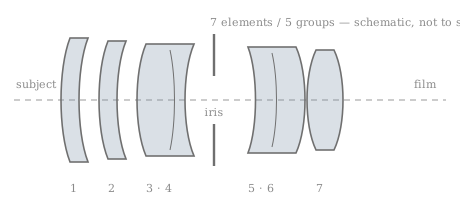
- Zeiss data sheet — C T* (cross-section, MTF)
- Zeiss data sheet — CF (cross-section, MTF)
- Zeiss data sheet — CB, 6-element (cross-section, MTF)
- Zeiss data sheet — CFE (cross-section, MTF)
- Zeiss data sheet — F (cross-section, MTF)
- Zeiss data sheet — FE (cross-section, MTF)
ⓘ What these charts mean
MTF (modulation transfer function) shows how much contrast the lens keeps at a given fineness of detail, from the center of the frame to the corner — the coarse curves track punch, the fine ones resolving power, and a gap between solid and dashed lines means astigmatism. Relative illumination (falloff) shows how much darker the corners are than the center at each aperture. Manufacturers only began publishing these for modern lenses; no 1950s maker issued them, which is why older families here cite period magazine bench tests instead.
History
The 80mm f/2.8 Planar was the lens Hasselblad chose as standard when the 500C replaced the focal-plane 1000F in 1957, and it stayed standard until the last 503CW left the catalogue on 29 April 2013 (Wikipedia). Zeiss’s data sheet for the C T* version describes it plainly: a Planar whose “anastigmatic flatness of the image field is outstanding,” with a focal length “approximately the diagonal of the 6 x 6 cm format,” sold as the standard outfit of the 500C and 500EL alongside the slower 100mm f/3.5. Seven elements in five groups, 465 g, 0.9 m closest focus, a Compur size 0 shutter with automatic diaphragm and a bayonet for Hasselblad’s series 50 filters. Mike Eckman puts the 500C with this lens at $480 in the American market at launch; no separate price for the lens has been found for 1957.
The optics of the first years are the family’s one real puzzle. A photo.net thread is titled around the question of why the 80mm changed from six to seven elements, and dealer lore repeats that the earliest chrome lenses were a six-element computation replaced around 1960. The thread could not be read for this entry and no Zeiss document consulted describes a six-element C Planar, so the claim stands as reported. What the sheets do establish is that from the C T* through the F, CF, FE and CFE the seven-in-five design did not change: both the F and FE sheets say the optical design “is the same as that of its sister lens” for the 500-series, the one that “stood the test of many NASA space flights round the earth and to the moon.”
The barrel changed far more than the glass. Chrome gave way to black and single coating to T* multicoating in the early 1970s — Jo Geier dates T* on the 80mm to 1971/72 and the black finish to 1973/74, while Victor Hasselblad Inc.’s April 1973 suggested-retail list still shows the 80mm as a chrome lens and pairs the black 500C/M kit with the 100mm Planar instead. In 1977 the 2000FC brought the shutterless F version: the same optics in a longer helical mount focusing to 0.6 m (1:5.5), 410 g, no shutter-speed ring and no F engraved on the lens (2000FC instruction book). The 1980 dealer list prices it at $1,050.00 — the only standalone list price for any 80mm Planar found here. In 1982 the CF replaced the Synchro-Compur with Prontor’s CF shutter, moved the filter mount to bayonet 60, added the rubber focusing grip and the green F setting that lets a leaf-shutter lens work on a focal-plane body; the Zeiss sheet gives 510 g and an exact focal length of 81.2 mm.
The 1990s multiplied the versions. The 205TCC of 1991 needed lenses that could report their aperture, so the F Planar gained four databus contacts and two blue lines as the F/TCC, renamed FE in 1994 when the 203FE arrived (205TCC manual; Japanese Wikipedia). The 501C of 1994 came only as a kit with a “new C” Planar — a black CF-style barrel with bayonet-60 mount but no EV interlock and no F setting, so it cannot be used open-shutter on a 2000- or 200-series body (Jo Geier; KEH lists it as “C T* Late”). In 1997 Zeiss did recompute the lens for the budget CB line: its sheet says new design mathematics and “novel technologies” allowed the Planar to be built with six elements, at 81.5 mm and 550 g, with scattered light “markedly reduced.” The CFE of 1998 returned to the seven-element CF optics with contacts added, and became the kit lens of the 501CM and 503CW from about 2000 (Jo Geier; the 501CM/503CW manual).
What remains open: whether a six-element 1957 computation existed and, if so, where its serial boundary lies; who at Zeiss Oberkochen designed the 80mm — no source consulted names anyone; the months of the T* and black changeovers; whether the CB lacked the F setting, which Zeiss’s wording (200 and 500 type cameras) suggests but does not say; whether a ZV Classic 80mm was ever sold; and every production figure, which would have to come from Nordin’s compendia.
This history is AI-written, from the sources listed at the foot of the page. Where the record is silent it says so rather than filling the gap — but no human wrote these sentences.
Example photos


.jpg)
Sample photo wanted — shot with a Planar 80mm f/2.8? We'd love to feature it (with credit).
Live listings
Asking price, USD: a median of $860 across 41 fixed-price listings on 2026-09-11 (middle half $700–$1,500). Tracked since 2026-09-06, 2 days: down 1% from $870.
By day
| Date | Median | Middle half | Listings |
|---|---|---|---|
| 2026-09-11 | $860 | $700–$1,500 | 41 |
| 2026-09-06 | $870 | $700–$1,500 | 43 |
Asking prices from the listings scanned, not sales; junk-flagged rows and auction lots excluded; other currencies are not converted.
- Carl Zeiss Planar 80mm f/2.8 lens Synchro Compur shutter LGE From JAPAN *203
- [Exc+5] Carl Zeiss Planar 80mm f2.8 Lens GRAFLEX Synchro Compur From JAPAN
- Hasselblad 80mm f/2.8 Planar Poor Condition L#1596880
- Hasselblad 80mm 2.8 Carl Zeiss Planar T* 80mm f2.8 Lens *Fair*
- Hasselblad 80mm f2.8 Zeiss Planar C T* Lens Black *Read notes #677
- "Near Mint" Hasselblad Carl Zeiss T* Planar C 80mm F/2.8 V Lens From JAPAN #5092
- Hasselblad 80mm F2.8 T* Planar F Manual Focus Medium Format Standard Prime Lens
- [Exc+5] Hasselblad Carl Zeiss C Planar 80mm f/2.8 T* Black Lens From JAPAN
- Hasselblad 80mm f2.8 Zeiss Planar C T* Lens Black #745
- [Near MINT] Hasselblad Carl Zeiss Planar C 80mm F2.8 Black Lens From JAPAN
- [Exc+5] Hasselblad Carl Zeiss C Planar 80mm f/2.8 Lens from Japan #C4324
- [Near MINT] Hasselblad Carl Zeiss Planar C 80mm f/2.8 Lens 500CM From JAPAN
- Carl Zeiss Planar f2.8 80mm T* Lens for Hasselblad Camera MINT
- Hasselblad 80mm f2.8 Chrome Zeiss Planar V-System Lens (serviced)
- CLA'd [Near MINT] Hasselblad Carl Zeiss Planar T* C 80mm F/2.8 Standard Lens 617
- [Near MINT] Hasselblad Carl Zeiss C Planar 80mm F2.8 Black Lens Chrome JAPAN
- [NEAR MINT] Hasselblad Carl Zeiss Planar T* C 80mm F2.8 Black Lens From JAPAN
- Hasselblad 80mm F/2.8 T* Black L#5660543
- Hasselblad Carl Zeiss C Planar 80mm f/2.8 Chrome
- Hasselblad 80mm f2.8 Zeiss Planar CF T* Lens *Read notes #964
Show 75 more listings
- Read [Near MINT] Hasselblad Carl Zeiss CF Planar 80mm F2.8 Black Lens From JAPAN
- Hasselblad Planar 80mm f/2.8 CF T* Medium Format Camera Lens
- Hasselblad 80mm f2.8 Zeiss Planar CF T* Lens *Read notes #450
- Hasselblad Carl Zeiss planar C 80mm F2.8 lens chrome silver
- Hasselblad 80mm f2.8 Planar T* F Lens, Very clean and sharp, Nice!
- Hasselblad Zeiss Planar 80mm f/2.8 CF T* lens
- [Excellent+5] Hasselblad Carl Zeiss Planar CF 80mm F2.8 T* MF lens From JAPAN
- Hasselblad Carl Zeiss CF Planar 80mm f/2.8 T*
- Hasselblad CF 80mm F/2.8 Planar T* Prime Lens, USA Model
- [Almost Unused in Box] Hasselblad Carl Zeiss Planar T* FE 80mm f/2.8 Lens Japan
- HASSELBLAD 500C W 80MM F/2.8 PLANAR & A12 BACK 1968 WORKS READ DESCRIPTION ISAO
- Hasselblad 500C camera w/ Planar 80mm F2.8 lens + A12 Back + TTL prism #2920
- [CLA'd Mint] Hasselblad Carl Zeiss Planar CF 80mm F2.8 T* MF Lens from Japan
- "MINT,Almost Unused in BOX"Hasselblad Carl Zeiss T* FE Planar 80mm f2.8 #5785
- Hasselblad 500cm With Carl Zeiss 80mm f/2.8 Planar Lens And Pm 5
- Hasselblad Carl Zeiss CFE 80mm f/2.8 Planar T* Lens (Excellent Condition)
- HASSELBLAD 500CM 500C/M CAMERA 80MM F2.8 A12 w/ WLF
- Hasselblad 500cm w/ 80mm f/2.8 Planar C T* A12 WLVF B#UE1223233 L#6126068 BOS
- Hasselblad 500c/m Chrome Medium Format Camera w/ 80mm f2.8 Lens A [EXC+]
- Hasselblad 501c Black Camera w/ 80mm f2.8 C T* Lens A12 Back WLF [EXC+]
- Hasselblad 503CW Millennium Edition Kit , c.2000, 500 made, Planar-CFe 80/2.8, A12 back, Winder CW, Acute Matte D screen, manual, boxes, Mint
- Hasselblad B50 / 80 Bajonett 50 für Planar C 80mm f2.8 !stark gebraucht!
- [Exc+5] Carl Zeiss Planar 80mm f2.8 Objektiv GRAFLEX Synchro Compur aus JAPAN
- Hasselblad Carl Zeiss Planar chrom C 80mm f2.8 2,8 V 500c 500cm etc
- [Near MINT] Hasselblad Carl Zeiss Planar C 80mm f/2.8 Lens 500CM From JAPAN
- [Near MINT w/ Cap] Hasselblad Carl Zeiss C Planar 80mm F2.8 T* Black From JAPAN
- Zeiss Planar 2.8/80 mm very clean! Large format
- Hasselblad Carl Zeiss Planar T* C 80mm F/2.8 Lens
- Hasselblad C Planar 2,8/80 Carl Zeiss Chrome Lens 80mm f/2.8 Standardobjektiv
- [Exzellent+5] Hasselblad Carl Zeiss Planar CF 80mm F2.8 T* MF Objektiv aus JAPAN
- Hasselblad CB Planar 2,8/80 T* Carl Zeiss Black Standard Lens f/2.8 80mm
- Hasselblad C Planar 2,8/80 T* Carl Zeiss Black Lens 80mm f/2.8 Objektiv
- Carl Zeiss Planar CF 2,8/80 T* Mittelformatobjektiv - 80mm F/2.8 CF Hasselblad
- Carl Zeiss - Hasselblad Planar CF 80mm/F2.8 T *1a Zustand/ geprüft* - TOP!
- [CLA'd Mint] Hasselblad Carl Zeiss Planar CF 80mm F2.8 T* MF Objektiv aus Japan
- USATO Hasselblad 500C/M + 80mm f/2.8
- Hasselblad CFE Planar 2,8/80 T* Carl Zeiss Lens 80mm f/2.8
- ✮ Hasselblad 2000 FC/M mit Planar 80mm f/2.8 T* #RV1515513 || vom Händler!
- Hasselblad 500C/M Kamera Zeiss Planar 80mm f2.8 T* lens 99650 top
- Hasselblad Planar T* 80mm f/2.8 CFe Latest Version - 1 Year Warranty, Excellent
- Hasselblad 501C Planar 80mm f2.8 C T* near mint 98589
- Carl Zeiss Planar 80mm f/2.8 lens Synchro Compur shutter LGE From JAPAN *203
- [Exc+5] Carl Zeiss Planar 80mm f2.8 Lens GRAFLEX Synchro Compur From JAPAN
- Hasselblad Carl Zeiss 80mm F2.8 T* Planar Standard Prime Lens for V System
- [Near MINT] Hasselblad Carl Zeiss Planar C 80mm f/2.8 Lens 500CM From JAPAN
- Hasselblad Carl Zeiss C Planar 80mm f/2.8 Chrome
- [Exc+5] Hasselblad Carl Zeiss C Planar 80mm f/2.8 Lens from Japan #C4324
- [ Near MINT w/ Cap] Hasselblad Carl Zeiss C Planar 80mm F2.8 T* Black From JAPAN
- [Top MINT] Hasselblad Carl Zeiss Planar C 80mm f/2.8 T * Black Lens From JAPAN
- [Excellent+5] Hasselblad Carl Zeiss Planar CF 80mm F2.8 T* MF lens From JAPAN
- 【Top MINT】 Hasselblad Carl Zeiss Planar T* CF 80mm f/2.8 Lens for 500CM CX...
- Hasselblad 80mm F2.8 Planar C Lens STK 43473
- Hasselblad 500C w/ Zeiss Planar 80mm f/2.8 Lens - Beautiful, Film Tested, Read!
- [ MINT in BOX ] Hasselblad Carl Zeiss Planar CF 80mm F2.8 T* Lens From JAPAN
- [MINT] Hasselblad Carl Zeiss Planar T* CFE 80mm f2.8 Lens 503CW 501 from JAPAN
- [MINT+++] Hasselblad 500C, Zeiss Planar 80mm f/2.8 Lens, A12 Back From JAPAN
- HASSELBLAD 500CM WLF A12 PLANAR CF 80MM F2.8
- ▶️[MINT] Hasselblad 500C/M 500CM Medium Format C Planar T 80mm F2.8 Lens...
- *Near Mint* Hasselblad 503CX Film Camera Crome w/ CF Planar 80mm F2.8 From JAPAN
- [UNUSED in Box] Hasselblad 500CM C/M Planar C 80mm F/2.8 Lens A12 II Film Back
- Hasselblad Planar C 80mm f/2.8 T* Black Carl Zeiss
- Hasselblad Carl Zeiss Planar C 80mm f2.8 T* Black Lens
- Hasselblad Carl Zeiss Planar T* CF 80mm F/2.8 Lens Silver for 500C/M
- Hasselblad 500C Zeiss Planar C 80mm F/2.8 Lens silver + A12 Film Back #94188
- Hasselblad 500C/M 500cm Chrome Camera + Carl Zeiss Planar 80mm f/2.8 T* lens
- Hasselblad 500C/M 500cm with Carl Zeiss Planar C 80mm f/2.8 T* Black Lens
- Hasselblad 500C/M 500cm with 80mm f/2.8, A12 film back
- Hasselblad 501CM Film Camera + CF 80mm F2.8 Lens A12 + Acute Matte
- Hasselblad 500C/M 500cm Chrome + Carl Zeiss Planar 80mm f/2.8 T* lens
- Hasselblad 501CM Film Camera & Carl Zeiss Planar 80mm f/2.8 T* Lens
- Hasselblad 503CW Film Camera & Carl Zeiss Planar 80mm f/2.8 T* Lens
- Hasselblad 80mm f2.8 Zeiss Planar T*
- Hasselblad 80mm f2.8 Zeiss Planar T*
- Hasselblad 80mm f2.8 Zeiss CF Planar - cl'a January 2025
- Hasselblad H1 w/ 80mm f2.8
eBay links are affiliate links. If you buy through one, Glass Bodies earns a small commission from eBay at no cost to you. It does not change which listings appear, their prices or their order — those come from the search and the sort described above.
Listings updated 2026-09-11. Links go to the shop or marketplace that carries the item.