Tessar 80mm f/2.8 (1600F/1000F)
Carl Zeiss · Hasselblad 1600F · 1951 · Tessar
Also known as: Zeiss Tessar 80mm f/2.8 · Tessar 2.8/80 · Zeiss-Opton Tessar 80mm · Hasselblad 1000F Tessar
Variants & identification
| Variant | Mount | Years | Serial ranges | Production |
|---|---|---|---|---|
| Zeiss-Opton T (early) | Hasselblad 1600F (M60×6 three-start thread) | 1951 | — | — |
| Carl Zeiss (later) | Hasselblad 1600F (M60×6 three-start thread) | — | — | — |
How to tell them apart
- M60×6 three-start thread, not a bayonet — the 1600F and 1000F mount is its own thing and takes nothing from the later V system
Zeiss-Opton T (early):
- Engraved Zeiss-Opton with the red T of the early coating
Carl Zeiss (later):
- Engraved Carl Zeiss, after the Oberkochen naming settled — no source consulted dates the changeover, so no years are given here
Serial-range notes
- red ink inside the rear mount
- Zeiss stamped a date code in red ink on the rear baffle wall. Before 1980 it is three or four digits: the last two are the month, and the year is the remaining figure plus 1957.
Specifications
- Formula
- Tessar
- Construction
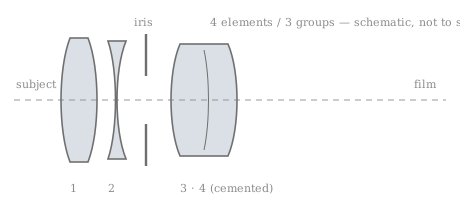
- 4 elements / 3 groups
- Aperture range
- f/2.8–f/22
- Min. focus
- 0.5 m
- Dimensions
- 71.5 × 47.5 mm
- Weight
- 250 g
- Country
- Germany
What reviewers say
No reviews aggregated yet — this family is still in the research queue. Written one? We'd love to index it.
Optical formula — Tessar
History
The standard lens of the 1000F, and the one that replaced Kodak as Hasselblad’s optical supplier. The 1600F had launched in 1948 on Kodak Ektars; by 1951 Zeiss Oberkochen was building this Tessar for the camera, and the Ektars faded out.
It is a Tessar in the ordinary sense — four elements in three groups, the rear pair cemented — computed by Lange and Richter at Oberkochen, with a German patent filed on 12 June 1951 and lanthanum glasses in the design. Zeiss’s factory data sheet gives the true focal length as 80mm within a millimetre, the true aperture as f/2.81, and the back focal distance as 64.71mm; the lens weighs 250g, is 47.5mm long and 71.5mm across, focuses to 0.5m and covers 52°.
The mount is the part that catches people out. The 1600F and 1000F take an M60×6 three-start thread, and it has nothing to do with the bayonet Hasselblad adopted for the 500C in 1957. No lens crosses between the two systems in either direction, which is why the pre-1957 cameras are collected as a closed set.
Marco Cavina’s survey of the early Zeiss lenses counts roughly 10,600 of these made in six batches between 1951 and 1957, which makes it much the commonest lens of the pre-1957 era — the run of both cameras together was smaller than that, so many were sold as spares or with outfits. Early examples are engraved Zeiss-Opton with the red T of the first coating; later ones read Carl Zeiss.
Dating one is possible without a serial table. Zeiss stamped a date code in red ink inside the rear mount, usually on the baffle wall and visible with the lens racked to close focus: before 1980 the last two digits are the month and the year is what remains plus 1957.
This history is AI-written, from the sources listed at the foot of the page. Where the record is silent it says so rather than filling the gap — but no human wrote these sentences.
Example photos
Sample photo wanted — shot with a Tessar 80mm f/2.8 (1600F/1000F)? We'd love to feature it (with credit).
Live listings
Asking price, USD: a median of $280 across 30 fixed-price listings on 2026-09-11 (middle half $180–$470). Tracked since 2026-09-06, 2 days: unchanged from $280.
By day
| Date | Median | Middle half | Listings |
|---|---|---|---|
| 2026-09-11 | $280 | $180–$470 | 30 |
| 2026-09-06 | $280 | $180–$470 | 29 |
Asking prices from the listings scanned, not sales; junk-flagged rows and auction lots excluded; other currencies are not converted.
- Zeiss Ikon Opton Tessar 80mm f2.8 T Lens for Super Ikonta B #G167
- Zeiss Ikon Opton Tessar 80mm f2.8 T Lens for Super Ikonta B #G193
- Zeiss Ikon Opton Tessar 80mm f2.8 T Lens for Super Ikonta B #G165
- Reflex-Korelle IIa w/80mm F2.8 Tessar c' 1937 defects detected, vg cosmetics
- EXC4+ Carl Zeiss Jena Tessar 8cm 80mm F2.8 for Reflex-Korelle From JP #o12626
- CARL ZEISS Jena TESSAR 80mm f/2.8 (8cm) Medium Format Vintage Lens Reflex Korell
- ZEISS OPTON 80MM F/2.8 TESSAR F W COMPUR SHUTTER FOR SUPER IKONTA FOLDING CAMERA
- Carl Zeiss Jena Tessar 80mm f/2.8 Manual Focus M41 Reflex Korelle Lens
- Carl Zeiss Jena Tessar 80mm f/2.8 M55 Manual Prime Lens (Good)
- Carl Zeiss Jena Tessar 80mm F2.8 Pentacon Six Medium Format Lens
- Lens Zeiss Tessar 2.8/80mm#4461187 for Pentacon Six
- Carl Zeiss Tessar 80mm f/2.8 Lens for Hasselblad 1000F, 1600F Tessar Opton
- Zeiss Ikon Super Ikonta 533/16 Tessar 8cm 80mm f/2.8 Rangefinder
- Carl Zeiss Jena Tessar 80mm F2.8 Pentacon Six Medium Format Lens
- Zeiss Tessar 80mm F2.8 and Kilfit 180mm F4.5 lenses for Hasselblad 1000F
- 【MINT】 ZEISS IKON Super Ikonta 532/16 Tessar 80mm F/2.8 Film Camera From Japan
- Zeiss Ikon Super Ikonta II B 531/16 6x6 Med Format Camera w Tessar 80mm f/2.8
- [Near MINT+++] Hasselblad Carl Zeiss Tessar 80mm F2.8 for 1000F 1600 FROM JAPAN
- Carl Zeiss Jena tessar 80mm f2.8 T
- CLA’d | Zeiss Ikon Super Ikonta 533/16 w/ 80mm f/2.8 Tessar
Show 28 more listings
- CARL ZEISS TESSAR 80/2.8 80MM F2.8 LENS for HASSELBLAD 1000F 1600F
- Hasselblad Carl Zeiss 80mm f/2.8 Tessar Chrome Lens for 1000F 1600F Cameras V15
- ZEISS IKON Super Ikonta Camera Carl Zeiss Tessar 80mm f/2.8 Medium Format
- Rare Zeiss Ikon 6x6 B2 w/Zeiss Jena Tessar 80mm f/2.8
- Carl Zeiss Jena Tessar 80mm f/2.8 M41 Lens for Reflex Korelle Germany
- Carl ZEISS Jena TESSAR T 80 80mm f/2.8 'silver' lens w/ ARRI Arriflex PL mount
- Hasselblad 1000F Camera + Carl Zeiss Tessar 80mm f2.8 Lens with 120 Film Back
- Hasselblad 1000F Camera + Carl Zeiss Tessar 80mm f2.8 Lens with 120 Film Back
- Hasselblad 1000F camera w. Zeiss Opton Tessar 2.8/80mm shutter blocked
- Hasselblad 1000F 6x6 Medium Format Camera Black w/ Carl Zeiss Tessar 80mm f/2.8
- Carl Zeiss Jena Tessar 80mm f2.8 8cm Objektiv Reflex Korelle Mount
- Carl Zeiss Jena Tessar 80mm f2.8 8cm Objektiv Reflex Korelle Mount
- EXC4+ Carl Zeiss Jena Tessar 8cm 80mm F2.8 for Reflex-Korelle From JP #o12626
- Carl Zeiss Jena Tessar 80mm f/2.8 Manual Focus M41 Reflex Korelle Lens
- Carl Zeiss Jena Tessar 80mm f/2.8 M55 Manual Prime Lens (Good)
- Zeiss Ikon Super Ikonta 533/16 Folding Camera Tessar 80mm F/2.8 #2908003
- ZEISS IKON SUPER IKONTA 532 / 16 with ZEISS-OPTON 80mm F2.8 TESSAR (0.20110)
- 【MINT】 ZEISS IKON Super Ikonta 532/16 Tessar 80mm F/2.8 Film Camera From...
- [Near MINT+++] Hasselblad Carl Zeiss Tessar 80mm F2.8 for 1000F 1600 FROM JAPAN
- Zeiss Ikon Super Ikonta 533 16 with Zeiss-Opton Tessar 80mm f 2.8 Film Camera
- Zeiss Ikon Super Ikonta Zeiss-Option Tessar 80mm F2.8 T 533 16 Film Camera
- Carl Zeiss Jena Tessar 2.8/80mm Pentacon Six P6 6x6 Standard Lens
- Zeiss Ikon Super Ikonta 533/16 Tessar 8cm 80mm f/2.8 Rangefinder
- Zeiss Opton Tessar 2.8/80mm RED T f/2.8 80mm Shutter Compur No.536276 READ
- [Near MINT+++] Hasselblad Carl Zeiss Tessar 80mm F2.8 for 1000F 1600 FROM JAPAN
- Zeiss Tessar 80mm f2.8 red T Objektiv Lens Exa Anschluss 97904 near mint RARE
- Zeiss Ikon Super Ikonta 532/16 with Zeiss Opton Tessar 2,8/80mm T*
- Hasselblad 80mm f2.8 Carl Zeiss Tessar Chrome Lens for 1000F 1600F cameras
eBay links are affiliate links. If you buy through one, Glass Bodies earns a small commission from eBay at no cost to you. It does not change which listings appear, their prices or their order — those come from the search and the sort described above.
Listings updated 2026-09-11. Links go to the shop or marketplace that carries the item.