Planar 100mm f/3.5
Carl Zeiss · Hasselblad V · 1968 · Planar
Also known as: Zeiss Planar 100mm f/3.5 · Carl Zeiss Planar T* 100mm f/3.5 · Planar 3.5/100 · Planar 100/3.5 · Hasselblad 100mm Planar · Hasselblad 100mm f/3.5 · Planar T* 3,5/100 CFi · Zeiss Planar CF 100mm f/3.5 · Planar 100/3.5 CF · Planar C 100mm · Planar 100mm f3.5 C T*
Variants & identification
| Variant | Mount | Years | Serial ranges | Production |
|---|---|---|---|---|
| Planar C 3.5/100 (single-coated, 1968 baseline) · Synchro-Compur, 1s–1/500 and B | Hasselblad V | 1968–1973 | — | — |
| Planar C T* 3.5/100 · Synchro-Compur, 1s–1/500 and B | Hasselblad V | 1974–1982 | — | — |
| Planar CF T* 3.5/100 · Prontor CF, 1s–1/500 and B | Hasselblad V | 1982–1998 | — | — |
| Planar CFi T* 3.5/100 · Prontor CFi, 1s–1/500, B and F | Hasselblad V | 1998–2013 | — | — |
| Planar 3.5/100 MK (MK70 photogrammetric camera) | Hasselblad V (MK — MK70 photogrammetric body only) | — | — | — |
- Element and group counts, exact focal lengths, weights, closest focus and filter series come from the Zeiss data sheets hosted by Hasselblad Historical (C100, CF100, CFi100).
- Generation start years follow the barrel/shutter families as a whole (C 1968, CF 1982, CFi 1998); no source consulted gives a month for the 100mm's own changeovers, and old stock overlapped the new.
How to tell them apart
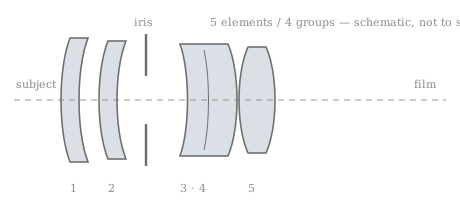
- Five elements in four groups in every generation — the lightest and simplest of the V-system standard lenses, and the only Planar in the line that Zeiss recommends over the 80mm for detail and freedom from distortion
- Filter mount is the quickest sort: bayonet 50 on the C and C T*, bayonet 60 on the CF and CFi
- The letter after the focal length is the generation: C or none (Synchro-Compur, 1968–82), CF (Prontor CF, 1982–98), CFi (Prontor CFi, 1998–2013). There is no CFE, no CB and no F or FE 100mm — the focal length exists only as a leaf-shutter lens
- Closest focus is 0.9 m in every version; the 100mm was never given the longer focusing mount that the shutterless F lenses got
Planar C 3.5/100 (single-coated, 1968 baseline):
- Black barrel with a chrome filter-bayonet ring at the front — unlike the 80mm Planar, which was still a chrome lens in 1973, the 100mm was black from the start (Victor Hasselblad Inc.'s April 1973 suggested-retail list calls it '100mm Planar f/3.5/black'; KEH catalogues the type as 'Black with Chrome Filter Ring, Bayonet 50')
- No red T* on the name ring — the same April 1973 list gives the 100mm no T* while the 1 January 1980 list writes it '100mm Planar C 3.5 T*', so the changeover falls between those two dates
- Bayonet-50 filter mount; Synchro-Compur with the EV cross-coupling lever, as on every C lens
- Product number 20125
Planar C T* 3.5/100:
- Red T* after the Planar name; otherwise the same black barrel, chrome filter ring, bayonet-50 mount and EV interlock lever as the earlier C
- Listed as '100mm Planar C 3.5 T*', product number 20125, at $1,530.00 on Victor Hasselblad Inc.'s dealer price list effective 1 January 1980
- Shares the Lens Shade 100–250 ('C') and the Quick Focusing Handle I (38/50/60/80/100/105) with the other small C lenses (1980 price list)
Planar CF T* 3.5/100:
- CF after the focal length; black barrel with the rubber focusing grip, and the filter mount moved to bayonet 60
- Green F on the shutter-speed ring — the open-shutter setting for a 2000- or 200-series focal-plane body
- Zeiss data sheet: cat. no. 10 21 66, 5 elements in 4 groups, exact focal length 100.3 mm, 605 g, 0.9 m, reproduction ratio to 1:6.9
- Product number 20126
Planar CFi T* 3.5/100:
- CFi after the focal length and no databus contacts — this is the one focal length in the CFi/CFE generation that was never given the E electronics (Hasselblad Historical's lens table lists a Planar f/3.5 100 mm CFi only)
- Zeiss data sheet: cat. no. 10 22 17, 5 elements in 4 groups, exact focal length 101.3 mm, 600 g, 0.9 m, bayonet 60, Prontor CFi 1s–1/500 s, b, f
- Outline on the sheet: 71 mm long, 83 mm in diameter, 74.9 mm to the film plane
- Product number 20127
Planar 3.5/100 MK (MK70 photogrammetric camera):
- Fixed-focused at infinity, with no focusing helical — Hasselblad's own lens guide lists it with the 60mm MK Biogon as being 'for the MK70 photogrammetric camera only' and notes that a special body was needed for the MK lenses
- Planar C 3.5/100 (single-coated, 1968 baseline): The first version. Zeiss's C data sheet (cat. no. 102111) gives 5 elements in 4 groups, an exact focal length of 100.3 mm, 610 g, 0.9 m closest focus, a Compur size 0 interchangeable reflex shutter with automatic iris and a bayonet for Hasselblad series 50 filters — figures Ernst Wildi repeats in The Hasselblad Manual, which adds the entrance-pupil data (32.9 mm behind the first vertex, 28.7 mm across). The April 1973 list prices it at $715.00 against $427.50 for the 80mm Planar. 1968 is the introduction year given by lens-db.com's catalogue entry; no Zeiss document consulted here is dated, and Hasselblad Historical's lens table carries no years at all.
- Planar C T* 3.5/100: Multicoated C lens. The T* start year of 1974 used here follows the generation split in the sources consulted rather than a dated document: the April 1973 US list still has no T* on the 100mm, and the January 1980 list does. The optics do not change — every Zeiss sheet for this family, C through CFi, gives 5 elements in 4 groups.
- Planar CF T* 3.5/100: The 1982 rebarrelling around Prontor's CF shutter; the glass is unchanged. Zeiss's CF sheet repeats the C text almost word for word — image quality at full aperture and moderately stopped down 'superior to that of the 80 mm Planar', and distortion correction called out for architecture and for surveying.
- Planar CFi T* 3.5/100: The last version. Its data sheet, printed 29 May 2000, is the one that states the case most directly: 'It is not just a standard Planar lens with 25% more focal length. It is optimized to deliver virtually zero distortion and at the same time extremely well defined image details — sharpness — over the entire frame, and all this even at full aperture', a result Zeiss credits to its experience in microdocumentation and aerial mapping. Preferred uses listed include architecture, documentation, art reproduction above one square metre, aerials shot wide open, and digital photography. The 2013 end date is the close of the V system as a whole and is not separately documented for this lens.
- Planar 3.5/100 MK (MK70 photogrammetric camera): A calibrated version for the MK70 metric camera, sold alongside the 60mm f/5.6 MK Biogon. No introduction year, price, production figure or serial range for it has been found, and no MK70 delivered with the 100mm rather than the 60mm has been traced; the variant is recorded here because Hasselblad's lens guide lists it as a product.
Serial-range notes
- red-ink code inside the rear mount, pre-1980
- Zeiss stamped a date code in red ink inside the rear of the mount. Before 1980 the last two digits are the month and the leading digit or digits plus 1957 the year, so 1103 = March 1968 and 1710 = October 1974. Lens serials themselves are Zeiss's running numbers; no published block-to-year table for the 100mm Planar was found.
- red-ink code inside the rear mount, 1980 onward
- From 1980 the code is two reversed year digits followed by a month letter, A = January — so a CF 100 reading 28F was made in June 1982, the first year of the CF barrel.
Specifications
- Formula
- Planar
- Construction
- 5 elements / 4 groups
- Aperture range
- f/3.5–f/22
- Shutter
- In the lens throughout — Synchro-Compur (C, C T*) or Prontor (CF, CFi), 1s–1/500 and B, flash sync at every speed; the CF and CFi add the F setting that holds the leaf shutter open for a focal-plane body
- Min. focus
- 0.9 m
- Weight
- 610 g
- Years manufactured
- 1968–2013
- Country
- West Germany (Carl Zeiss, Oberkochen; Germany from 1990)
- Coating
- Single-coated at launch; T* multicoating between April 1973 and January 1980, on the evidence of the two Victor Hasselblad Inc. price lists — every CF and CFi is T*
- Original price
- US$715.00 (today $5,050) for the black C lens on Victor Hasselblad Inc.'s suggested-retail list of April 1973 (against $427.50 for the 80mm Planar); US$1,530.00 for the 100mm Planar C 3.5 T* on the dealer price list effective 1 January 1980. No launch price for 1968 and no Swedish or Japanese price has been found.
What reviewers say
- Erin Emery (Silver in the Dark) (blog) — Optically superior to the 80mm, but most users find the difference negligible next to the price gap — unless you are making large prints, showing in galleries or have cash to spare, the 80mm will do.
Optical formula — Planar
- Zeiss data sheet — C T* (cross-section, MTF)
- Zeiss data sheet — CF (cross-section, MTF)
- Zeiss data sheet — CFi (cross-section, MTF)
ⓘ What these charts mean
MTF (modulation transfer function) shows how much contrast the lens keeps at a given fineness of detail, from the center of the frame to the corner — the coarse curves track punch, the fine ones resolving power, and a gap between solid and dashed lines means astigmatism. Relative illumination (falloff) shows how much darker the corners are than the center at each aperture. Manufacturers only began publishing these for modern lenses; no 1950s maker issued them, which is why older families here cite period magazine bench tests instead.
History
The 100mm f/3.5 Planar is the lens Zeiss recommended when the 80mm was not good enough. Both the C and the CF data sheets say so in the same words: at full aperture and moderately stopped down its image quality is “superior to that of the 80 mm Planar”, so it “is recommended as a standard lens where demands for detail recognition and brilliance are high”. The reason is the design brief rather than the manufacture. Five elements in four groups, an exact focal length of 100.3 mm, a maximum aperture two-thirds of a stop slower than the 80mm’s — the correction budget that a faster lens spends on speed went instead into flatness of field and, above all, into distortion. Zeiss’s sheets name architecture and surveying as the applications, and Ernst Wildi’s Hasselblad Manual adds aerial mapping. The lens is 610 g in its C form, focuses to 0.9 m, and takes Hasselblad’s series 50 bayonet filters.
Its introduction date is the weakest fact on this page. lens-db.com’s catalogue gives 1968 for the first single-coated version; Hasselblad Historical’s lens table lists the Planar f/3.5 100 mm in C, CF and CFi without a single year, and none of the three Zeiss data sheets carries a date beyond the CFi’s “Printed in Germany 29.05.2000”. What can be dated are the price lists. Victor Hasselblad Inc.’s April 1973 suggested-retail list has “100mm Planar f/3.5/black” at $715.00, against $427.50 for the 80mm — and the description is worth pausing on, because in the same list the 80mm is still a chrome lens. The 100mm was black from the beginning, with a chrome ring around the front filter bayonet, which is how KEH still catalogues the type. That makes finish useless for dating this lens and coating the thing to look at instead: the 1973 list gives the 100mm no T*, while the dealer list effective 1 January 1980 writes it “100mm Planar C 3.5 T*” and prices it at $1,530.00. The multicoating therefore arrived somewhere in those seven years; nothing consulted here narrows it further.
After that the story is barrels. In 1982 the whole V line moved from Synchro-Compur to Prontor’s CF shutter, and the 100mm went with it: bayonet 60 in place of bayonet 50, a rubber focusing grip, the green F setting that lets a leaf-shutter lens be held open for a focal-plane body, 605 g, catalogue number 10 21 66. In 1998 the CFi barrel replaced it — Prontor CFi, 600 g, an exact focal length now printed as 101.3 mm, 71 mm long and 83 mm across. The glass never moved. Every sheet from 1968 to 2000 gives five elements in four groups, and the CFi sheet’s boast is about optimisation, not redesign: “It is not just a standard Planar lens with 25% more focal length. It is optimized to deliver virtually zero distortion and at the same time extremely well defined image details — sharpness — over the entire frame, and all this even at full aperture,” which Zeiss attributes to its work in microdocumentation and aerial survey.
Two absences define the family as much as its versions. There is no CFE: Hasselblad Historical’s table lists a Planar f/3.5 100 mm CFi and stops, so this is the focal length that never received the databus contacts, and a 200-series body meters it the old way. And there is no F or FE — no shutterless 100mm was ever built, which is why the fast portrait lens for the 2000-series bodies had to be a different focal length altogether, the 110mm f/2. The only other 100mm Planar is a special: Hasselblad’s lens guide lists a “Planar 3.5/100 MK”, fixed-focused at infinity, for the MK70 photogrammetric camera only, alongside the 60mm MK Biogon that gave that camera its name.
Erin Emery’s V-system lens guide gives the collector’s counter-argument: the 100mm is optically the better lens, but most users find the difference negligible against the price, and unless large prints or gallery walls are involved the 80mm will do. The 1973 list makes the same point in period money — the 100mm cost two-thirds again as much as the standard lens.
Open: the introduction year, which rests on one catalogue entry; the month or year the T* arrived, bracketed here only between April 1973 and January 1980; whether the CFi ran to the V system’s 2013 close or stopped earlier; who at Oberkochen computed the lens, whom no source names; every production figure, which would have to come from Nordin’s compendia; and when the MK version was made, how many, and whether any MK70 left the factory with one.
This history is AI-written, from the sources listed at the foot of the page. Where the record is silent it says so rather than filling the gap — but no human wrote these sentences.
Example photos
Sample photo wanted — shot with a Planar 100mm f/3.5? We'd love to feature it (with credit).
Live listings
Asking price, USD: a median of $1,500 across 38 fixed-price listings on 2026-09-11 (middle half $1,200–$1,800). Tracked since 2026-09-06, 2 days: unchanged from $1,500.
By day
| Date | Median | Middle half | Listings |
|---|---|---|---|
| 2026-09-11 | $1,500 | $1,200–$1,800 | 38 |
| 2026-09-06 | $1,500 | $1,200–$1,800 | 38 |
Asking prices from the listings scanned, not sales; junk-flagged rows and auction lots excluded; other currencies are not converted.
- Hasselblad Carl Zeiss Planar 100mm CF f/3.5 T* Lens Rear Inner Lens Group
- Hasselblad 100mm f3.5 Zeiss Planar C Lens Black #884
- Hasselblad Carl Zeiss Planar C 100mm F3.5 Black From Japan [Exc+++] #A
- Silver Rim! [Near MINT] Hasselblad Carl Zeiss Planar C 100mm f/3.5 Lens from JPN
- Hasselblad 100mm F/3.5 Planar (Silver Rim) Lens for Hasselblad V-Mount
- Hasselblad Carl Zeiss Planar 100mm F3.5 NEAR MINT with Case and Lens Cover
- Silver Rim T* [MINT] Hasselblad Carl Zeiss Planar C T* 100mm F/3.5 From JAPAN
- 【Near MNT】HASSELBLAD Planar C 100mm F3.5 Lens From Japan
- 【N MINT 】Hasselblad Carl Zeiss Planar C 100mm f3.5 Lens Black Fm JAPAN #5628
- [Silver Rim] Hasselblad Carl Zeiss Planar C 100mm f/3.5 Non T*Lens
- SilverRim T* [Top MINT] Hasselblad Carl Zeiss Planar C 100mm f/3.5 T* From JAPAN
- HASSELBLAD C Planar 100mm F3.5 T V Mount Lens from Japan A0303
- [Silver Rim] Hasselblad Carl Zeiss Planar C 100mm f/3.5 Non T*Lens from Japan
- Rare Non T* C Black 100mm F3.5[TOP MINT] Hasselblad Carl Zeiss Planar Lens JAPAN
- HASSELBLAD C Planar 100mm F3.5 T* *Hasselblad Planar* 11014
- Hasselblad Planar C 100mm F3.5 T* Lens Medium Format MF from Japan D0329
- Hasselblad Carl Zeiss Planar C 100mm F3.5 T Lens for V System from Japan E0511
- Hasselblad Carl Zeiss Planar C 100mm f/3.5 T* Silver Rim Lens [Near Mint] #12162
- Carl Zeiss Planar 100mm F3.5 Camera Lens Used Fastest
- Great Value!! [Near MINT+++] Hasselblad Carl Zeiss Planar T* CF 100mm f/3.5 Lens
Show 74 more listings
- [MINT] Hasselblad Carl Zeiss Planar T* C 100mm F3.5 Lens From Japan
- [Excellent] Hasselblad Zeiss Planar 100mm f/3.5 Prime Lens Hasselblad Mount from
- HASSELBLAD Carl Zeiss C Planar 100mm F3.5 T* White Front Rare Mountain Planar
- Hasselblad Carl Zeiss Planar C 100mm F3.5 Lens Silver Rim Used Japan
- Hasselblad Zeiss Planar 100mm f3.5 White Tip V Mount Used Compact
- Hasselblad Planar C 100mm F3.5 T* Lens White Tip Used Grade B
- Hasselblad Carl Zeiss Planar 100mm F/3.5 MF Camera Lens Guaranteed Used
- "NEAR MINT"Hasselblad Carl Zeiss CF Planar T* 100mm f/3.5 Lens
- Hasselblad Zeiss Planar-C 100mm f3.5 T* BLACK Lens SILVER ring. Case. Box
- [Top Mint] HASSELBLAD Carl Zeiss Planar CF 100mm F/3.5 T* MF Lens From Japan
- Hasselblad Carl Zeiss Planar C T 100mm F/3.5 MF Lens 389238
- [Unused] Hasselblad Carl Zeiss Planar T* CF 100mm F/3.5 Camera Lens From JAPAN
- Hasselblad Carl Zeiss Planar C T* 100mm F/3.5 Lens for Hasselblad Used
- Carl Zeiss Planar T* 100mm f/3.5 CFi Manual Lens for Hasselblad V Mount
- Hasselblad Carl Zeiss Planar T* 100mm f/3.5 CFi Lens with Both Caps Excellent
- Hasselblad Carl Zeiss Planar T* 100mm f/3.5 CFi Lens
- Hasselblad Carl Zeiss Planar T* 100mm f/3.5 CFi late production W/Box US Stock
- CARL ZEISS 100MM F3.5 PLANAR CFI T* FOR HASSELBLAD V SYSTEM 3020127 #5783
- Hasselblad 100mm f/3.5 C Carl Zeiss Planar T* - zeer goed
- Usato Hasselblad 100mm f3.5
- [Silberrand] Hasselblad Carl Zeiss Planar C 100mm f/3.5 Non T*Objektiv
- SilverRim T* [Top MINT] Hasselblad Carl Zeiss Planar C 100mm f/3.5 T* aus JAPAN
- HASSELBLAD C Planar 100mm F3.5 T V-Mount Objektiv Aus Japan A0303
- [Silberrand] Hasselblad Carl Zeiss Planar C 100mm f/3.5 Non T*Objektiv aus Japan
- Carl Zeiss T* Planar 100mm F/3.5 f. Hasselblad
- Obiettivo manuale Zeiss CF 100mm Planar F3.5 T*
- Hasselblad Carl Zeiss, Planar 100mm f/3.5 T*
- Hasselblad Planar C 100mm F3.5 T* Objektiv Mittelformat MF Manuell Teleobjektiv
- Carl Zeiss Planar 100mm F3.5 Kamera Objektiv am schnellsten gebraucht
- Zeiss CF 100mm Planar F3.5 T* Manuelles Objektiv
- Objectif Manuel Zeiss Cf 100mm Planar F3.5 T
- Hasselblad Carl Zeiss, Planar 100mm f/3.5 T*
- Zeiss CF Manual Focus 100mm Planar F3.5 T* Lens
- Zeiss CF 100mm Planar F3.5 T* Manuelles Objektiv
- Objectif Manuel Zeiss Cf 100mm Planar F3.5 T
- Hasselblad Carl Zeiss Planar C 100mm F3.5 T Teleobjektiv f. V System manuell
- Hasselblad Carl Zeiss Planar C 100mm F3.5 Objektiv Silberrand Gebraucht Japan
- Hasselblad Zeiss Planar 100mm f3.5 White Tip V Mount gebraucht kompakt
- Carl Zeiss - Hasselblad Planar C 100mm/f3.5 "1a Zustand/ CLA Service" - TOP!
- Carl Zeiss - Hasselblad Planar C 100mm/f3.5 "Top Zustand/CLA serviced" - RAR
- Hasselblad Planar C 100mm F3.5 T* Objektiv weiße Spitze gebraucht Grade B
- [Unbenutzt] Hasselblad Carl Zeiss Planar T* CF 100mm F/3.5 Kameraobjektiv aus...
- Hasselblad 500C/M + 100mm F3.5 Planar T*
- [Top NEUWERTIG + mit Haube] Hasselblad Carl Zeiss Planar T * CF 100mm f3.5...
- Hasselblad Carl Zeiss Planar C T* 100mm F/3.5 Objektiv für Hasselblad gebraucht
- Hasselblad Carl Zeiss 100mm f/3.5 Planar T* CFi - sehr gut
- Hasselblad Carl Zeiss 100mm f/3.5 Planar T* CFi - zeer goed
- Hasselblad 503 CX mit Zeiss Planar C 100mm f/3.5 - Rücken 12 - komplett überholt
- Hasselblad Carl Zeiss Planar T* 100mm f/3.5 CFi Late Production W/Box US Stock
- hasselblad 503 CW with 100mm planar F3.5 & A12 magazine
- CARL ZEISS 100MM F3.5 PLANAR CFI T* FOR HASSELBLAD V SYSTEM 3020127 #5783
- CARL ZEISS PLANAR T* 100mm F/3.5 LENS FOR HASSELBLAD 500C/M 503CW 503CX
- Hasselblad Carl Zeiss Planar C 100mm F3.5 Black From Japan [Exc+++] #A
- Silver Rim! [Near MINT] Hasselblad Carl Zeiss Planar C 100mm f/3.5 Lens from JPN
- Silver Rim T* [MINT] Hasselblad Carl Zeiss Planar C T* 100mm F/3.5 From JAPAN
- SilverRim T* [Top MINT] Hasselblad Carl Zeiss Planar C 100mm f/3.5 T* From JAPAN
- HASSELBLAD C Planar 100mm F3.5 T V Mount Lens from Japan A0303
- Rare Non T* C Black 100mm F3.5[TOP MINT] Hasselblad Carl Zeiss Planar Lens JAPAN
- Hasselblad Planar C 100mm F3.5 T Lens Medium Format MF from Japan D0329
- Carl Zeiss Planar 100mm F3.5 Camera Lens Used Fastest
- Hasselblad Carl Zeiss Planar C 100mm F3.5 T Lens for V System from Japan E0511
- Great Value!! [Near MINT+++] Hasselblad Carl Zeiss Planar T* CF 100mm f/3.5 Lens
- Hasselblad Carl Zeiss Planar C 100mm F3.5 Lens Silver Rim Used Japan
- Hasselblad Carl Zeiss Planar 100mm F/3.5 MF Camera Lens Guaranteed Used
- Hasselblad Carl Zeiss Planar C 100mm f/3.5 T* Silver Rim Lens [Near Mint] #12162
- Hasselblad Zeiss Planar 100mm f3.5 White Tip V Mount Used Compact
- Hasselblad Planar C 100mm F3.5 T* Lens White Tip Used Grade B
- [Top Mint] HASSELBLAD Carl Zeiss Planar CF 100mm F/3.5 T* MF Lens From Japan
- [Unused] Hasselblad Carl Zeiss Planar T* CF 100mm F/3.5 Camera Lens From JAPAN
- Hasselblad Carl Zeiss Planar C T* 100mm F/3.5 Lens for Hasselblad Used
- Hasselblad Carl Zeiss Planar T* 100mm f/3.5 CFi late production W/Box US Stock
- Carl Zeiss Planar 100mm f/3.5 T* Lens
- Hasselblad C Planar 100mm f/3.5 Steel Rim
- Hasselblad Planar 100mm f/3.5 T* Steel Rim
eBay links are affiliate links. If you buy through one, Glass Bodies earns a small commission from eBay at no cost to you. It does not change which listings appear, their prices or their order — those come from the search and the sort described above.
Listings updated 2026-09-11. Links go to the shop or marketplace that carries the item.