Kodak Ektar 80mm f/2.8
Kodak · Hasselblad 1600F · 1948 · Ektar (Heliar type)
via machine translation — corrections welcomeAlso known as: Kodak Ektar 80mm f/2.8 · Kodak Ektar 80mm f2.8 · Ektar 80mm f/2.8 · Kodak Ektar 1:2.8 F=80mm · Kodak Ektar 80mm Hasselblad · Hasselblad Kodak Ektar 80mm · Ektar 2.8/80 · コダック エクター 80mm
Variants & identification
| Variant | Mount | Years | Serial ranges | Production |
|---|---|---|---|---|
| Kodak Ektar 80mm f/2.8 (1600F / 1000F) | Hasselblad 1600F (combined screw-and-bayonet fitting, 82.1mm flange — no V-system body accepts it) | 1948–1953 | Two-letter CAMEROSITY prefix plus digits — ET (1949), EY (1950), EC (1951) are the codes actually seen on 1600F outfits | ≈3,000–3,641. Marco Cavina's account gives roughly 3,000 Kodak lenses supplied to Hasselblad in all, the majority of them 80mm; the higher figure circulates for the 80mm alone. No factory ledger for Kodak's Hasselblad output has been published. |
- Element and group counts are contested: Cavina and US 2,279,384 give five elements in three groups; English Wikipedia's lens list gives four in three, and lens-db.com reports both a 4/3 and a 5/3 version in circulation. Nothing consulted here demonstrates two distinct computations.
How to tell them apart
- No shutter of any kind — the 1600F and 1000F expose with a focal-plane shutter in the body, so a Kodak Ektar for Hasselblad has a bare rear mount where a Compur would sit on a later C lens
- Chrome barrel with knurled black focusing grip; the name ring reads Kodak, never Carl Zeiss — the visible way to tell an early 1600F outfit from a 1952-onward Zeiss-Opton one
Kodak Ektar 80mm f/2.8 (1600F / 1000F):
- Engraved Kodak Ektar 1:2.8 F=80mm, with an encircled L for Lumenized — Kodak's single-layer coating
- Pre-set aperture: a separate setting knob and a stopping-down knob, not an automatic diaphragm; the 1600F has no body coupling to drive one
- Focusing mount marked 0.5 m to infinity in metres and feet; Kodak Series VII drop-in filters, not a threaded ring
- The rear element is a thorium-oxide glass (Cavina gives nD ≈ 1.744, vD ≈ 45.7), so aged examples are faintly radioactive and often visibly yellowed — the tint clears under prolonged UV
- Kodak Ektar 80mm f/2.8 (1600F / 1000F): The standard lens of the 1600F from the camera's introduction and of the early 1000F, displaced by the Zeiss-Opton Tessar 80mm f/2.8 from about 1952–53. Cavina dates series production 1949–1953.
Serial-range notes
- ET, EY, EC …
- Kodak stamped a two-letter year code read through CAMEROSITY (C=1, A=2, M=3, E=4, R=5, O=6, S=7, I=8, T=9, Y=0), so ET = 1949, EY = 1950, EC = 1951. Q.G. de Bakker's dating page on Hasselblad Historical notes that Victor Hasselblad copied the idea for his own bodies, where the key is VHPICTURES instead.
Specifications
- Formula
- Ektar (Heliar type)
- Designed by
- Altman Fred E. — optical design; the corresponding patent, US 2,279,384, was filed in January 1941 and assigned to Eastman Kodak
- Construction
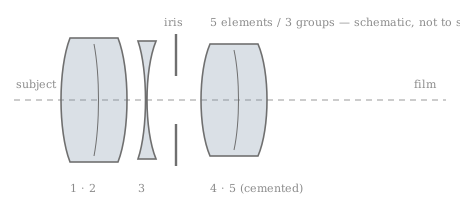
- 5 elements / 3 groups
- Aperture range
- f/2.8–f/22
- Min. focus
- 0.5 m
- Years manufactured
- 1948–1953
- Country
- United States
- Coating
- Lumenized — Kodak's single-layer anti-reflection coating, marked by an encircled L
What reviewers say
- Dan Cuny (blog) — Shooting FP4 through a 75-year-old 1600F outfit, he found the Ektar 80mm focused fluidly, the pre-set aperture simple to work, and the picture quality better than he had expected.
Optical formula — Ektar (Heliar type)
History
When Victor Hasselblad showed his first civilian camera in New York in October 1948, the lens on the front of it was American. Göteborg had no optical works, and the German industry was still in pieces, so the standard lens of the 1600F was Kodak’s: an Ektar 80mm f/2.8, Lumenized, focusing from half a metre to infinity, and made in Rochester. The 1949 Swedish factory brochure prices the whole outfit — camera, this lens, a roll-film magazine and a strap — at kr 1,850, and the 1951 English brochure calls it a critical-definition lens of the highest quality, which is sales copy but also the only technical description the factory published.
The design is Fred E. Altman’s. The corresponding Eastman Kodak patent, no. 2,279,384, was filed in January 1941, and Marco Cavina reads the result as a five-element arrangement in three groups with a cemented doublet at either end — the architecture of the Voigtländer Apo-Lanthar, itself a Heliar derivative. That count is not universally agreed. English Wikipedia’s Hasselblad lens list gives four elements in three groups; lens-db.com goes further and reports both a 4/3 and a 5/3 version in circulation. No source consulted here shows two distinct computations, and the likeliest explanation is a count copied wrong and then repeated, but the disagreement is real and worth stating.
What is not in doubt is the glass. Cavina identifies the rear element as a thorium-oxide crown of roughly nD 1.744 and vD 45.7 — the same family of radioactive glasses Kodak used across the postwar Ektar line — which is why aged examples read faintly hot on a counter and are often visibly yellow. The tint is a colour centre, not a coating fault, and clears under sustained ultraviolet light. The rest of the barrel is plain: a pre-set aperture with a setting knob and a stopping-down knob rather than an automatic diaphragm, since the 1600F offers no coupling to drive one; Kodak Series VII drop-in filters; and no shutter at all, because exposure is the body’s stainless-steel focal-plane curtain.
Dating one is easy. Kodak stamped a two-letter year code read through CAMEROSITY — C=1, A=2, M=3, E=4, R=5, O=6, S=7, I=8, T=9, Y=0 — so ET is 1949, EY 1950, EC 1951. Q.G. de Bakker’s dating page on Hasselblad Historical points out that Victor Hasselblad liked the trick enough to build his own version of it, VHPICTURES, for the camera bodies. Quantities are softer: Cavina puts roughly 3,000 Kodak lenses of all types into Hasselblad’s hands, most of them 80mm, and a figure of 3,641 for the 80mm alone circulates from the same article. Neither number comes from a surviving factory ledger.
The end came from accountancy. Cavina’s explanation, and the one that fits the dates, is that postwar exchange rates made Kodak optics prohibitively expensive to sell in Europe despite their quality; from about 1952 the Zeiss-Opton Tessar 80mm f/2.8 took the standard-lens slot, and by the 1000F of 1953 the Kodak line was gone. What survives is a short, well-made lens that only fits an orphan mount: the 1600F bayonet sits 82.1mm from the film against the V system’s 74.9mm, so nothing later will take it.
Open questions. The element count remains genuinely unsettled, and it would take a disassembly or a period Kodak data sheet to close it. Neither weight nor barrel dimensions appear in any source consulted. No separate American list price for the lens alone has been found, only the Swedish outfit price. And the serial range is known only by its year letters — no start and end numbers have been published.
This history is AI-written, from the sources listed at the foot of the page. Where the record is silent it says so rather than filling the gap — but no human wrote these sentences.
Example photos
.jpg)
.jpg)
Sample photo wanted — shot with a Kodak Ektar 80mm f/2.8? We'd love to feature it (with credit).
Live listings
Asking price, USD: a median of $1,300 across 8 fixed-price listings on 2026-09-11 (middle half $1,000–$1,800). Tracked since 2026-09-06, 2 days: unchanged from $1,300.
By day
| Date | Median | Middle half | Listings |
|---|---|---|---|
| 2026-09-11 | $1,300 | $1,000–$1,800 | 8 |
| 2026-09-06 | $1,300 | $1,000–$1,800 | 8 |
Asking prices from the listings scanned, not sales; junk-flagged rows and auction lots excluded; other currencies are not converted.
- - RARE KODAK EKTAR 80MM F2.8 LENS FOR HASSELBLAD 1000F, 1600F CAMERAS
- Kodak Ektar 80mm f/2.8 Hasselblad 1000 Mount
- Kodak Ektar 80mm F2.8 Standard Lens for Hasselblad 1600F 1000
- Kodak Ektar 80mm F2.8 Standard Lens for Hasselblad 1600F 1000
- [Near MINT] Kodak Ektar 80mm F2.8 Standard Lens for Hasselblad 1600F 1000 JAPAN
- Kodak Ektar 80mm f/2.8 Lens RY 241 for Hasselblad 1600F and 1000F -LENS ONLY-
- Kodak Ektar 80mm f/2.8 Lens Used with some wear and scratches
- Hasselblad 1000F + Kodak Ektar 80mm F/2.8 Lens #52533 E5
- Hasselblad 1000F + Kodak Ektar 80mm F/2.8 Lens #52533 E5
- Kodak Ektar 80mm f/2.8 Lens Used with some wear and scratches
- Kodak Ektar 80mm f/2.8 Objektiv gebraucht mit einigen Gebrauchsspuren und...
eBay links are affiliate links. If you buy through one, Glass Bodies earns a small commission from eBay at no cost to you. It does not change which listings appear, their prices or their order — those come from the search and the sort described above.
Listings updated 2026-09-11. Links go to the shop or marketplace that carries the item.