Distagon 60mm f/3.5
Carl Zeiss · Hasselblad V · 1975 · Distagon (retrofocus)
Also known as: Zeiss Distagon 60mm f/3.5 · Carl Zeiss Distagon T* 60mm f/3.5 · Distagon 3.5/60 · Distagon 60/3.5 · Hasselblad 60mm Distagon · Hasselblad 60mm f/3.5 · Hasselblad Zeiss 60mm · Distagon T* 3.5/60 CFi · Zeiss Distagon CF 60mm f/3.5 · Distagon 60/3.5 CF · Distagon C 60mm T* · Distagon 60mm f3.5 C T* · Distagon CB 60mm
Variants & identification
| Variant | Mount | Years | Serial ranges | Production |
|---|---|---|---|---|
| Distagon C T* 3.5/60 · Synchro-Compur, 1s–1/500 and B | Hasselblad V | 1975–1982 | — | — |
| Distagon CF T* 3.5/60 · Prontor CF, 1s–1/500 and B | Hasselblad V | 1982–1998 | — | — |
| Distagon CB T* 3.5/60 · Prontor CB, 1s–1/500 and B — no F setting | Hasselblad V | 1997–2000 | — | — |
| Distagon CFi T* 3.5/60 · Prontor CFi, 1s–1/500, B and F | Hasselblad V | 1998–2013 | — | — |
- Element and group counts, weights, closest focus, reproduction ratios and filter fittings are from the Zeiss data sheets hosted by Hasselblad Historical (C60, CF60, CB60, CFi60).
- Generation start years follow the barrel/shutter families as a whole (CF 1982, CB 1997, CFi 1998); the C T* start is 1975 per Japanese Wikipedia and lens-db, 1977 per Cavina. No source gives a month for any changeover, and old stock overlapped the new.
How to tell them apart
- The letter after the focal length is the generation: C (Synchro-Compur, Series 63 filter adapter, 1975–82), CF (Prontor CF, bayonet 60, 1982–), CB (Prontor CB, no F setting, 1997–), CFi (Prontor CFi, 1998–). Every version is T*; no F, FE or CFE 60 was made
- All four generations share one optical design — 7 elements in 7 groups, 60.2 mm exact focal length, 0.6 m closest focus — so the barrel, not the glass, is what distinguishes them (Zeiss data sheets)
- The C lens is the light one at 645 g; the CF, CB and CFi are all listed at 680 g
- A 60mm Distagon in chrome, or marked 1:5.6 or 1:4, belongs to one of the two earlier families
Distagon C T* 3.5/60:
- Black barrel with red T* after the Distagon name; C-type EV interlock lever on the Synchro-Compur
- Filter by adapter ring for Hasselblad Series 63 — the last 60 on the Series 63 system; the CF and later take bayonet 60 (Zeiss data sheet C60)
- Zeiss data sheet: cat. no. 104852, 7 elements in 7 groups, 645 g, 0.6 m closest focus, exact focal length 60.2 mm, Compur size 0 with automatic diaphragm, angular field 66° diagonal
Distagon CF T* 3.5/60:
- Prontor CF shutter in a black barrel with rubber focusing grip; bayonet-60 filter mount replaces the C lens's Series 63 adapter ring
- Green F on the shutter-speed ring for open-shutter use on 2000/200-series focal-plane bodies; EV interlock now a push-button
- Zeiss data sheet: cat. no. 104869, 7 elements in 7 groups, approx. 680 g, 0.6 m, reproduction ratio to 1:7.3 (close-limit field 417 × 417 mm), back focal distance 71.1 mm
Distagon CB T* 3.5/60:
- CB engraved after the focal length; rounded controls and larger scale lettering than the CF; no F setting on the speed ring, so it cannot work open-shutter on a 2000/200-series body (Japanese Wikipedia)
- Zeiss data sheet: cat. no. 10 49 40, 7 elements in 7 groups, 680 g, 0.6 m, reproduction ratio 1:7.0, Series 60 bayonet filter
Distagon CFi T* 3.5/60:
- CFi after the focal length; F setting retained; no databus contacts (the 60 was never issued as a CFE)
- Zeiss data sheet: cat. no. 10 49 57, 7 elements in 7 groups, 680 g, 0.6 m, reproduction ratio 1:7 with a 0.4 m working distance; sheet printed 29.05.2002
- Hasselblad product number 20209 (B&H listing)
- Distagon C T* 3.5/60: Introduced 1975 per Japanese Wikipedia and lens-db; Cavina gives 1977. Zeiss's data sheet says the lens was developed "in response to repeated requests" and surpasses its predecessor, the Distagon f/4 60 mm, "in performance and speed ... even without an increase in optical sophistication through the use of most modern computers". Arriving two years after T* became standard on the C line, it should be T* throughout; Emulsive's guide nevertheless says it was available in both C and C T* designations, and no source consulted shows a non-T* example.
- Distagon CF T* 3.5/60: The 1982 barrel around Prontor's CF shutter; the optics are unchanged — the CF sheet repeats the C sheet's pupil positions, principal planes and 75.3 mm vertex length to the decimal. Zeiss's text calls it "a fast, light and compact wide-angle lens" whose object field is "approx. 80% larger than that of the 80 mm Planar T* f/2.8", and again pairs it with the Sonnar 150 as the standard two-lens outfit. Superseded by the CFi in 1998.
- Distagon CB T* 3.5/60: The budget line of 1997. Unlike the CB Planar 80, whose sheet announces a new six-element computation, the CB 60's sheet makes no design statement and keeps the 7/7 count: the saving is in the barrel and shutter alone. Zeiss positions it as an "interior specialist" for environmental portraits and indoor wedding groups where the Planar 80 is too long and the Distagon 50 "may distort heads near the frame edge", and calls it "very favourable value for money". The end year is when the CB range faded from the catalogue; no source consulted gives a discontinuation date for the CB 60 itself.
- Distagon CFi T* 3.5/60: The 1998 CFi barrel — Zeiss's sheet lists "digital photography" among preferred uses, the only 60 sheet to do so. The last of the family, still on dealer shelves as Hasselblad no. 20209 into the 2000s; production is taken to have ended with the V system, whose last body, the 503CW, Wikipedia records as discontinued on 29 April 2013. No source consulted gives a separate discontinuation date for the lens.
Serial-range notes
- red-ink code inside the rear mount, pre-1980
- Zeiss stamped a date code inside the rear of the C T* lenses: the last two digits are the month and the leading digits plus 1957 the year, so 1809 = September 1975 and 2204 = April 1979. Lens serials themselves are Zeiss's running numbers and no block-to-year table for the 60 was found.
- red-ink code inside the rear mount, 1980 onward
- From 1980 the code is two reversed year digits and a month letter, A = January — so a CF 60 reading 58F was made in June 1985, and the CB and CFi lenses read 79x or 0xx onward.
Specifications
- Formula
- Distagon (retrofocus)
- Construction
- 7 elements / 7 groups
- Aperture range
- f/3.5–f/22
- Shutter
- In the lens on every version — Synchro-Compur (C T*) or Prontor (CF, CB, CFi), 1s–1/500 and B, flash sync at every speed; CF and CFi add the F setting for open-shutter use on 2000/200-series focal-plane bodies
- Min. focus
- 0.6 m
- Dimensions
- 85 mm long
- Weight
- 645 g
- Years manufactured
- 1975–2013
- Country
- West Germany
- Coating
- T* multicoated on every generation — the lens arrived after T* became standard
What reviewers say
- Erin Emery (Silver in the Dark) (blog) — A buyer's-guide entry rather than a hands-on test — she does not own the 60 — placing it as harder to find, heavier (645 g) and $200–300 more than a comparable 80mm, closer-focusing at 0.6 m, and relaying the common view that it beats the 80 as a sole lens if found at a fair price, with the caveats that owning both is unnecessary and that it will not be wide enough for anyone wanting a true wide-angle.
Optical formula — Distagon (retrofocus)
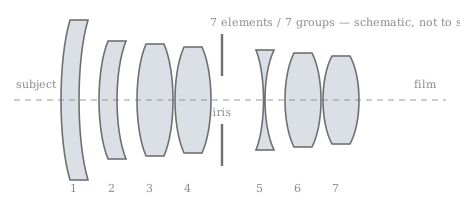
- Zeiss data sheet — C (cross-section, MTF)
- Zeiss data sheet — CF (cross-section, MTF)
- Zeiss data sheet — CB (cross-section, MTF)
- Zeiss data sheet — CFi (cross-section, MTF)
ⓘ What these charts mean
MTF (modulation transfer function) shows how much contrast the lens keeps at a given fineness of detail, from the center of the frame to the corner — the coarse curves track punch, the fine ones resolving power, and a gap between solid and dashed lines means astigmatism. Relative illumination (falloff) shows how much darker the corners are than the center at each aperture. Manufacturers only began publishing these for modern lenses; no 1950s maker issued them, which is why older families here cite period magazine bench tests instead.
History
The Distagon 60mm f/3.5 is the third and longest-lived of Zeiss’s 60mm wide-angles for the 500-series bayonet, and the only one to pass through every leaf-shutter generation from C T* to CFi. Zeiss’s data sheet for the C version, catalogue number 104852, explains the origin in one sentence: the lens was developed “in response to repeated requests” and “surpasses its predecessor, the Distagon f/4 - 60 mm, in performance and speed”, a gain the sheet attributes to “the use of most modern computers” rather than to more glass — seven elements in seven groups, every element standing alone. Japanese Wikipedia and lens-db date the introduction to 1975; Marco Cavina gives 1977; no month is stated anywhere, and the sheet itself is undated.
The 1975 lens is the light one of the family: 645 g against 680 g for every later version, 0.6 m closest focus, exact focal length 60.2 mm, a 66° diagonal field, and a Compur size-0 shutter with automatic diaphragm. Its filter fitting is a detail worth checking on an example in hand — the sheet gives “adapter ring for Hasselblad series 63”, the drop-in system of the older C lenses, so the C 60 does not share the bayonet-50 mount of the C Planar 80. Because T* multicoating had been standard on the C line since 1973, the lens should be T* from its first day; Emulsive’s C-lens guide lists it as available in both C and C T* form, but no source consulted here shows a non-T* example, and the claim is carried as reported.
Zeiss’s sheets make the family’s continuity unusually easy to demonstrate. The CF sheet of 1982 (cat. no. 104869) repeats the C sheet’s entrance-pupil position of 32.2 mm, exit pupil of 22.7 mm, principal planes at 53.8 and 11.0 mm and vertex length of 75.3 mm to the decimal: the Prontor CF shutter, rubber grip, bayonet-60 filter and green F setting are new, the glass is not. The CB sheet (10 49 40) and the CFi sheet (10 49 57, printed 29 May 2002) keep the 7/7 count and the 60.2 mm focal length. This distinguishes the CB 60 from the CB Planar 80, whose sheet announces a new six-element computation; the CB 60’s sheet makes no design statement, and the budget saving lies in the barrel and in a Prontor CB shutter without the F setting, which Japanese Wikipedia notes rules out open-shutter use on the 2000- and 200-series bodies. No FE, F or CFE 60 was ever made; on a focal-plane body the CF or CFi is the only 60 that works.
Zeiss’s marketing language shifted over the years even as the optics stood still. The C and CF sheets call the 60 “almost a universal lens” that many owners would carry with the Sonnar 150 as their standard pair, and the CF text quantifies the appeal — an object field “approx. 80% larger than that of the 80 mm Planar T* f/2.8”. By the CB and CFi sheets it had become an “interior specialist” for environmental portraits and indoor wedding groups, where the Planar 80 is too long and the Distagon 50 “may distort heads near the frame edge”, with low-altitude aerial work and industrial documentation as secondary uses and, on the CFi sheet alone, “digital photography”. Emulsive’s guide echoes the same positioning: a lens that “does not create an exaggerated perspective”, favoured for groups and landscapes.
The end of the run is inferred rather than recorded. The CFi 60 was sold as Hasselblad no. 20209 (B&H) through the 2000s, and Wikipedia gives 29 April 2013 as the discontinuation of the 503CW, the last V-system body; no source consulted gives the lens its own final date. Nor was a list price found in any currency or year — the only figures are second-hand ones, Erin Emery’s guide putting a used 60 at $200–300 above a comparable 80.
Still open: a Zeiss or Hasselblad document fixing the C T* introduction month; whether a non-T* C 60 exists; the CB 60’s discontinuation date; any list price; and whether a serial-block or date-code table for the 60 survives beyond the red-ink codes described above.
This history is AI-written, from the sources listed at the foot of the page. Where the record is silent it says so rather than filling the gap — but no human wrote these sentences.
Example photos
Sample photo wanted — shot with a Distagon 60mm f/3.5? We'd love to feature it (with credit).
Live listings
Asking price, USD: a median of $910 across 18 fixed-price listings on 2026-09-11 (middle half $750–$1,600). Tracked since 2026-09-06, 2 days: unchanged from $910.
By day
| Date | Median | Middle half | Listings |
|---|---|---|---|
| 2026-09-11 | $910 | $750–$1,600 | 18 |
| 2026-09-06 | $910 | $750–$1,600 | 18 |
Asking prices from the listings scanned, not sales; junk-flagged rows and auction lots excluded; other currencies are not converted.
- 【NEAR MINT】 Hasselblad Carl Zeiss Distagon T* C 60mm F3.5 Objektiv aus JAPAN
- [NEUWERTIG] Hasselblad Carl Zeiss Distagon T* C 60mm F3.5 schwarzes...
- Hasselblad Carl Zeiss Distagon C 60mm f/3.5 T* Objektiv V System aus Japan...
- Hasselblad C Distagon 3,5/60 T* Carl Zeiss Lens 60mm f/3.5
- [Nahezu MINT] Hasselblad Carl Zeiss Distagon 60mm f/3.5 C Aus JAPAN
- Hasselblad C Distagon 3,5/60 T* Carl Zeiss Lens 60mm f/3.5 Objektiv
- Hasselblad Distagon T* 60mm f/3.5 Objectif Grand Angle à Monture V, MF Noir
- Hasselblad C Distagon T* 60mm F3.5 Schwarzes Objektiv für V-System MF
- Obiettivo Hasselblad Distagon T 60mm f3.5 CB
- Objectif Hasselblad CF Distagon T* f/3.5 - 60mm. #7043330.
- Objectif Hasselblad Distagon T 60mm f3.5 CB
- Hasselblad Distagon T 60Mm F3.5 CB
- Hasselblad Distagon T 60mm f/3.5 CB Lens
- Hasselblad Distagon T 60Mm F3.5 CB
- Objectif Hasselblad Distagon T 60Mm F3.5 CB
- mit Haube [fast unbenutzt] Hasselblad CF Carl Zeiss Distagon T * 60mm f3.5...
- [Fast unbenutzt] Hasselblad CF Carl Zeiss Distagon T* 60mm f3.5 Objektiv aus ...
- Hasselblad Carl Zeiss Distagon T* 60mm F/3.5 C Objektiv, Box
- CFi [Top NEUWERTIG / Box] Hasselblad Carl Zeiss Distagon 60mm F3.5 T* Objekti...
- Hasselblad Distagon T* 60mm f/3.5 Lens PARTS FOR REPAIR ONLY NO GLASS! /1226
Show 36 more listings
- 【NEAR MINT】 Hasselblad Carl Zeiss Distagon T* C 60mm F3.5 Lens From JAPAN
- [ MINT ] Hasselblad Carl Zeiss Distagon T* C 60mm F3.5 Black Lens From JAPAN
- [Near Mint] Hasselblad Carl Zeiss Distagon 60mm f/3.5 T* C Black Lens from Japan
- Hasselblad Zeiss Distagon C 60mm f/3.5 T* Lens Hasselblad V 67mm MF
- [Near MINT] Hasselblad Carl Zeiss Distagon T* C 60mm F3.5 Black Lens From JAPAN
- [Near MINT] Hasselblad Carl Zeiss Distagon T* C 60mm F/3.5 Lens From JAPAN
- [Near MINT] Hasselblad Carl Zeiss Distagon 60mm f/3.5 C From JAPAN
- Hasselblad Carl Zeiss Distagon C 60mm f/3.5 T* Lens V System From Japan Used
- Hasselblad C Distagon T* 60mm F3.5 Black Lens V System MF from Japan E0810
- Hasselblad Carl Zeiss Distagon T* 60mm F/3.5 C Lens With Box #38192 L9
- [Top MINT] Hasselblad CF Carl Zeiss Distagon T* 60mm f/3.5 Lens From JAPAN
- [Almost Unused] Hasselblad CF Carl Zeiss Distagon T* 60mm f3.5 Lens From JAPAN
- [EXCELLENT]Hasselblad Carl Zeiss Distagon T* 60mm F/3.5 CFi Lens #5253
- Hasselblad Carl Zeiss Distagon T* 60mm F/3.5 C Lens, Box
- CFi [Top MINT / Box] Hasselblad Carl Zeiss Distagon 60mm F3.5 T* Lens From JAPAN
- CARL ZEISS 60MM F3.5 DISTAGON CB JAPANESE STAR 3020208 #3858
- Hasselblad 500c/m 500cm Black Camera 60mm T* F3.5 Lens A12 WLF [EXC+]
- 【NEAR MINT】 Hasselblad Carl Zeiss Distagon T* C 60mm F3.5 Lens From JAPAN
- [ MINT ] Hasselblad Carl Zeiss Distagon T* C 60mm F3.5 Black Lens From JAPAN
- [Near Mint] Hasselblad Carl Zeiss Distagon 60mm f/3.5 T* C Black Lens from Japan
- [Near MINT] Hasselblad Carl Zeiss Distagon T* C 60mm F3.5 Black Lens From JAPAN
- [Near MINT] Hasselblad Carl Zeiss Distagon T* C 60mm F/3.5 Lens From JAPAN
- Hasselblad Carl Zeiss Distagon C 60mm f/3.5 T* Lens V System From Japan Used
- [Near MINT] Hasselblad Carl Zeiss Distagon 60mm f/3.5 C From JAPAN
- Hasselblad C Distagon T 60mm F3.5 Black Lens V System MF from Japan E0810
- Hasselblad 60mm f3.5 CF Zeiss T* Distagon Lens and caps
- Hasselblad 60mm f/3.5 CF T* Carl Zeiss Distagon Lens
- Hasselblad Carl Zeiss Distagon T* 60mm F/3.5 C Lens With Box #38192 L9
- [Top MINT] Hasselblad CF Carl Zeiss Distagon T* 60mm f/3.5 Lens From JAPAN
- [Almost Unused] Hasselblad CF Carl Zeiss Distagon T* 60mm f3.5 Lens From JAPAN
- Hasselblad Carl Zeiss Distagon T* 60mm F/3.5 C Lens, Box
- CFi [Top MINT / Box] Hasselblad Carl Zeiss Distagon 60mm F3.5 T* Lens From JAPAN
- Hasselblad 60mm f3.5 Zeiss Distagon CF T* Lens
- Hasselblad Carl Zeiss Distagon 60mm f/3.5 T* C Wide Angle Lens
- Hasselblad Carl Zeiss Distagon CF 60mm f3.5 T*Lens
- Hasselblad 60mm f3.5 Zeiss Distagon T* - Black
eBay links are affiliate links. If you buy through one, Glass Bodies earns a small commission from eBay at no cost to you. It does not change which listings appear, their prices or their order — those come from the search and the sort described above.
Listings updated 2026-09-11. Links go to the shop or marketplace that carries the item.