Distagon 50mm f/2.8
Carl Zeiss · Hasselblad V · 1977 · Distagon (retrofocus), floating element
Also known as: Zeiss Distagon 50mm f/2.8 · Carl Zeiss Distagon T* 50mm f/2.8 · Distagon 2.8/50 · Distagon 50/2.8 · Hasselblad 50mm f/2.8 · Hasselblad 50mm f2.8 Distagon · Distagon T* 2.8/50 FE · Distagon FE 50mm · Distagon F 50mm · Distagon 50mm f2.8 F · Distagon 50mm FE FLE
Variants & identification
| Variant | Mount | Years | Serial ranges | Production |
|---|---|---|---|---|
| Distagon F T* 2.8/50 (shutterless, 2000-series) · none — exposes through the body's focal-plane shutter | Hasselblad V (F — focal-plane bodies only) | 1977–1991 | — | — |
| Distagon F/TCC T* 2.8/50 (205TCC, 1991–94) · none — exposes through the body's focal-plane shutter | Hasselblad V (F/TCC — focal-plane bodies only) | 1991–1995 | — | — |
| Distagon FE T* 2.8/50 (200-series) · none — exposes through the body's focal-plane shutter | Hasselblad V (FE — focal-plane bodies only) | 1994–2004 | — | — |
- Element and group counts, weight, closest focus, exact focal length and filter thread are from the Zeiss data sheets hosted by Hasselblad Historical (F50, FE50).
- Generation years follow the shutterless line as a whole (F 1977 with the 2000FC, F/TCC 1991 with the 205TCC, FE 1994 with the 203FE — or March 1995 per Japanese Wikipedia); no source gives a month for this lens's own changeovers.
How to tell them apart
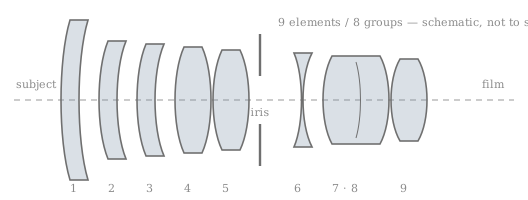
- One optical design throughout: 9 elements in 8 groups with a floating middle group, 0.32 m closest focus — the closest-focusing wide-angle in the V system and a full stop faster than the f/4 Distagon
- No leaf shutter, no shutter-speed ring: the lens exposes only on a 2000- or 200-series focal-plane body. It mounts on a 500-series body but cannot take a picture there
- Databus contacts and two blue lines mean F/TCC or FE (1991 on); a bare bayonet plate means the 1977–91 F
- Filter front is a thread, not the CF-style bayonet — M86 × 1 per both Zeiss sheets; dealer descriptions of a bayonet-93 FE are unreconciled
- Every version is T* multicoated; there was never a single-coated or chrome 50/2.8
Distagon F T* 2.8/50 (shutterless, 2000-series):
- No shutter-speed ring and no Synchro-Compur lever; the F designation is not engraved on the lens (2000FC instruction book)
- Filter mount is an M86 × 1 screw thread per the Zeiss data sheet, not a Hasselblad bayonet; the front rotates with focusing (lens-db notes the FE's non-rotating front as a change)
- About 1240 g, ø 90 mm, about 112 mm long; focuses to 0.32 m for 1:2.5 (data sheet, cat. no. 104854)
- Red-ink Zeiss date code inside the rear mount — pre-1980 digits YY(Y)MM with year = code + 1957; from 1980 two reversed year digits and a month letter
Distagon F/TCC T* 2.8/50 (205TCC, 1991–94):
- Four databus contacts on the bayonet plate and two parallel blue lines on the barrel — the mark of every databus item (205TCC manual)
- Marked TCC rather than FE; same 9/8 FLE optics, 0.32 m and 1240 g as the F
Distagon FE T* 2.8/50 (200-series):
- FE engraved after the focal length; four databus contacts and the two blue lines
- Zeiss data sheet (cat. no. 10 49 09): 9 elements in 8 groups, 51.7 mm, 75.5°, 0.32 m and 1:2.5, approx. 1240 g, 'Shutter: –'; filter given as M86 × 1 thread, though dealers (KEH) describe the FE with a bayonet-93 front — unconfirmed
- Non-rotating front and revised mechanics against the F, per lens-db (search-result summary; page not reachable)
- Distagon F T* 2.8/50 (shutterless, 2000-series): Introduced with the 2000FC in 1977 (camera-wiki; the 1980 dealer list groups it under 'F Lenses w/o Shutter for 2000FC'). Zeiss's sheet says the lens was 'especially developed for the Hasselblad 2000 FC' and that 'because the camera has a focal-plane shutter the speed could be increased to f/2.8'. 9 elements in 8 groups, exact focal length 51.7 mm, diagonal field 75.5°, f/2.8–22.
- Distagon F/TCC T* 2.8/50 (205TCC, 1991–94): The F lens with electronics for the 205TCC of 1991, the first metered Hasselblad body. The contacts carry the set aperture to the meter; on a 2000-series body the lens works as a plain F. Renamed FE when the 203FE arrived — 1994 in most chronologies, March 1995 per Japanese Wikipedia. No separate Zeiss sheet for the TCC marking was found; the FE sheet covers it.
- Distagon FE T* 2.8/50 (200-series): Zeiss's FE sheet says the lens 'has been designed for use with the 200-series cameras' and repeats the F sheet's design account almost word for word — the optics did not change. Its spec block adds 'aberration correction for close range by floating element'. Production ended with the 203FE and 205FCC in 2004; Hasselblad Historical lists it as 'Distagon f/2.8 50 mm FE (FLE)'.
Serial-range notes
- red-ink code inside the rear mount, pre-1980
- F lenses carry no shutter but the same red-ink Zeiss date stamp inside the rear mount as C lenses: before 1980 the last two digits are the month and the leading digit(s) plus 1957 the year, so 2009 = September 1977.
- red-ink code inside the rear mount, 1980 onward
- From 1980 the code is two reversed year digits and a month letter, A = January — an F 50 reading 38J was made in October 1983; TCC-marked lenses should read 19x–49x, FE lenses 49x onward.
Specifications
- Formula
- Distagon (retrofocus), floating element
- Construction
- 9 elements / 8 groups
- Aperture range
- f/2.8–f/22
- Min. focus
- 0.32 m
- Dimensions
- 90 × 112 mm
- Weight
- 1240 g
- Years manufactured
- 1977–2004
- Country
- West Germany
- Coating
- T* multicoated from the start (1977)
What reviewers say
No reviews aggregated yet — this family is still in the research queue. Written one? We'd love to index it.
Optical formula — Distagon (retrofocus), floating element
ⓘ What these charts mean
MTF (modulation transfer function) shows how much contrast the lens keeps at a given fineness of detail, from the center of the frame to the corner — the coarse curves track punch, the fine ones resolving power, and a gap between solid and dashed lines means astigmatism. Relative illumination (falloff) shows how much darker the corners are than the center at each aperture. Manufacturers only began publishing these for modern lenses; no 1950s maker issued them, which is why older families here cite period magazine bench tests instead.
History
The 50mm f/2.8 Distagon exists because of a shutter that is not in it. When Hasselblad launched the 2000FC in 1977 with a titanium focal-plane shutter (camera-wiki), Zeiss no longer had to fit a Compur behind the rear group, and its data sheet for the new lens (cat. no. 104854) says so plainly: the lens was “especially developed for the Hasselblad 2000 FC” and “because the camera has a focal-plane shutter the speed could be increased to f/2.8” — a full stop over the leaf-shutter 50mm f/4, and, the FE sheet adds, “an extremely high value for a medium-format wide-angle”. It shares the V bayonet with every C and CF lens and will sit on a 500C/M, but with no leaf shutter it can only expose on the 2000- and later 200-series bodies.
The optics were new rather than a stretched f/4. The sheet gives 9 elements in 8 groups, exact focal length 51.7 mm, diagonal field 75.5°, an aperture scale from f/2.8 to f/22, and a back focus the sheet notes “must be about 35% longer than the focal length” to clear the mirror — yet the design is “remarkably compact” for its speed, at ø 90 mm, about 112 mm long and approximately 1240 g. Its other distinction is the floating element, the first on any Hasselblad lens and five years ahead of the 40mm CF FLE: “the middle components change position in relation to each other when focusing”, so that at the 0.32 m limit (1:2.5, a 144 × 144 mm field) image quality “is about the same as at 1:10 without compensation”. No other V-system wide-angle focuses so close. The filter front is a screw thread, M86 × 1 on both the F and FE sheets, rather than a Hasselblad bayonet.
The barrel changed twice with the bodies. The 205TCC of 1991 was the first Hasselblad with a built-in meter, and its lenses needed to report their aperture: the F Distagon gained four databus contacts on the bayonet plate and the two parallel blue lines that mark every TCC item (205TCC manual), sold as F/TCC. When the 203FE arrived the lenses were renamed FE — 1994 in most chronologies, March 1995 according to Japanese Wikipedia’s product list. Zeiss’s FE sheet (cat. no. 10 49 09) repeats the F sheet’s description almost word for word, prints “Shutter: –”, and says the lens “has been designed for use with the 200-series cameras”; the optical figures are identical, so the FE is the F with electronics. lens-db’s entry adds a non-rotating front and revised mechanics for the FE, but that page could not be reached and the claim is carried from a search summary only. Hasselblad Historical lists the lens as “Distagon f/2.8 50 mm F (FLE)” and “FE (FLE)”, and nothing else: no C, CF or CFi version was ever made, and the F lens was never sold single-coated or in chrome. Production ended with the 203FE and 205FCC in 2004.
What remains open: who at Zeiss Oberkochen computed the 1977 design — no source consulted names anyone; the list price, which the 1 January 1980 American dealer list should carry under “F Lenses w/o Shutter for 2000FC” but which could not be read here; the exact month of the TCC-to-FE renaming; the filter front of the FE, given as an M86 thread by Zeiss and as a bayonet 93 by dealers; whether the F and F/TCC overlapped in the catalogue; and every production figure, which would have to come from Nordin’s compendia.
This history is AI-written, from the sources listed at the foot of the page. Where the record is silent it says so rather than filling the gap — but no human wrote these sentences.
Example photos
Sample photo wanted — shot with a Distagon 50mm f/2.8? We'd love to feature it (with credit).
Live listings
Asking price, USD: a median of $1,200 across 17 fixed-price listings on 2026-09-11 (middle half $1,000–$1,700). Tracked since 2026-09-06, 2 days: unchanged from $1,200.
By day
| Date | Median | Middle half | Listings |
|---|---|---|---|
| 2026-09-11 | $1,200 | $1,000–$1,700 | 17 |
| 2026-09-06 | $1,200 | $1,000–$1,700 | 17 |
Asking prices from the listings scanned, not sales; junk-flagged rows and auction lots excluded; other currencies are not converted.
- HASSELBLAD Distagon F 50mm f/2,8 T* - SNr: 6365511
- Carl Zeiss Distagon F 2,8/50mm #5902296 für Hasselblad -CLA-werkstattgeprüft T*
- Carl Zeiss Distagon 2.8/50mm T* / f.Hasselblad / 7140333
- Hasselblad Carl Zeiss T* Distagon 50mm f/2.8 - zeer goed
- Hasselblad 50mm f2.8 F Distagon Lens CARL ZEISS for Hasselblad 200 2000 Series
- Hasselblad Carl Zeiss Distagon FE 2,8/50 mm T* Databus V-System letzte Bauserie
- Carl zeiss 50mm distagon FE objectief F2.8 for Hasselblad 201F , 205 TCC,..
- Hasselblad 20516 - Zeiss Distagon FE 2.8/50mm T* "200er Reihe/mint" - TOP!
- Hasselblad 20516 - Zeiss Distagon FE 2.8/50mm T* "200er Reihe/mint" - TOP
- 【 Fast unbenutzt 】 Hasselblad Carl Zeiss T* Distagon FE 50mm f2.8 Objektiv...
- Hasselblad Carl Zeiss Distagon 50mm f/2.8 F T* Objektiv. Sehr Guter Zustand
- Hasselblad Zeiss Distagon F 2.8/50mm for 200/2000 Series
- Objektiv Hasselblad Zeiss Distagon T 50mm f 2.8 FE Superzustand!
- Hasselblad Carl Zeiss Distagon FE 2.8/50mm T _ 20516
- Hasselblad FE 2.8/50mm Distagnon MINT boxed 3020517
- FE [unbenutzt in Box] Hasselblad Carl Zeiss T* Distagon 50mm f2.8 Objektiv...
- Hasselblad 20516 Zeiss Distagon FE 2.8/50mm 50mm F2.8 (FLE) pro 200/2000 Series
- Hasselblad 20516 Zeiss Distagon Fe 2.8/50mm F2.8 (Fle ) für 200/2000 Series
- Hasselblad 20516 Zeiss Distagon Fe 2.8/50mm F2.8 (Fle) pour 200/2000 Série
- Hasselblad 20516 Zeiss Distagon Fe 2.8/50mm F2.8 ( Fle ) for 200/2000 Series
Show 34 more listings
- Hasselblad 20516 Zeiss Distagon Fe 2.8/50mm F2.8 (Fle ) für 200/2000 Series
- Hasselblad 20516 Zeiss Distagon FE 2.8/50Mm 50Mm F2.8 (FLE) Pour 200/2000 Séries
- Hasselblad Carl Zeiss Distagon 50mm f2.8 Objektiv mit Schutzfilter gebraucht
- Hasselblad Carl Zeiss Distagon T* 50mm f/2.8 Manual Focus Lens
- Carl Zeiss f. Hasselblad 2000 Distagon 2.8/50mm T* F Lens
- [MINT+++] Hasselblad Carl Zeiss T* Distagon FE 50mm f2.8 Lens From JAPAN
- FE Lens [MINT] Hasselblad Carl Zeiss Distagon T* 50mm F/2.8 Lens From Japan
- Hasselblad Carl Zeiss Distagon 50mm FE f/2.8 T* Lens Exc++++ Mint glass
- 【TOP Mint】Hasselblad Carl Zeiss T* Distagon FE 50mm f2.8 Lens 7345#J0602F
- Rare FE [ TOP MINT ] Hasselblad Carl Zeiss Distagon T* 50mm f/2.8 FE Lens Japan
- Hasselblad Zeiss Distagon 50mm f/2.8 F T* lens black, for 200/2000 series, E+
- FE Lens [MINT] Hasselblad Carl Zeiss Distagon T* 50mm F/2.8 Lens From JAPAN
- Pre-Owned Hasselblad 50mm f2.8 Distagon FE #7990779
- Used Hasselblad Carl Zeiss FE Distagon 50mm f/2.8 T* Lens
- 【 Almost Unused 】 Hasselblad Carl Zeiss T* Distagon FE 50mm f2.8 Lens From JAPAN
- 【Near MNT】Hasselblad Carl Zeiss T* Distagon 50mm f/2.8 Lens From Japan
- Hasselblad Zeiss Distagon F 2.8/50mm for 200/2000 Series
- FE [ Unused in Box ] Hasselblad Carl Zeiss T* Distagon 50mm f2.8 Lens From JAPAN
- HASEELBLAD 201F with Distagon FE 50mm F2.8 T*, E12 back
- [FedEx]Hasselblad 2003FCW + Carl Zeiss Distagon 50mm F2.8 + Winder+A24
- Hasselblad Distagon 50mm F2.8 F Lens -Inner Element Shattered- [AS-IS]
- Hasselblad Distagon 50mm F2.8 F Lens -Inner Element Shattered- [AS-IS]
- Carl Zeiss Distagon T* 50mm f2.8 F Weitwinkel Festbrennweite Objektiv für Hasselblad V
- Carl Zeiss Distagon T* 50mm f2.8 F Weitwinkel Festbrennweite Objektiv für Hasselblad V
- FE Lens [MINT] Hasselblad Carl Zeiss Distagon T* 50mm F/2.8 Lens From Japan
- [MINT+++] Hasselblad Carl Zeiss T* Distagon FE 50mm f2.8 Lens From JAPAN
- Carl Zeiss Distagon T* 50mm f2.8 F Weitwinkel Festbrennweite Objektiv für Hasselblad V
- Carl Zeiss 50mm F/2.8 Distagon F T* For 200 Series -VM 8023- BB
- FE Lens [MINT] Hasselblad Carl Zeiss Distagon T* 50mm F/2.8 Lens From JAPAN
- 【 Almost Unused 】 Hasselblad Carl Zeiss T* Distagon FE 50mm f2.8 Lens From...
- Hasselblad Zeiss Distagon F 2.8/50mm for 200/2000 Series
- FE [ Unused in Box ] Hasselblad Carl Zeiss T* Distagon 50mm f2.8 Lens From JAPAN
- Hasselblad 50mm F2.8 Distagon „Carl Zeiss“ Cine Mod!
- Hasselblad Carl Zeiss Distagon FE 50mm F/2.8 Lens
eBay links are affiliate links. If you buy through one, Glass Bodies earns a small commission from eBay at no cost to you. It does not change which listings appear, their prices or their order — those come from the search and the sort described above.
Listings updated 2026-09-11. Links go to the shop or marketplace that carries the item.