Kodak Ektar 254mm f/5.6
Kodak · Hasselblad 1600F · 1948 · Triplet with cemented centre
Also known as: Kodak Ektar 254mm f/5.6 · Ektar 5.6/254 · Ektar 10 inch Hasselblad
Variants & identification
| Variant | Mount | Years | Serial ranges | Production |
|---|---|---|---|---|
| Prototype / near-nil production | Hasselblad 1600F (M60×6 three-start thread) | 1948 | EI0002 — the only serial found in the sources consulted here; its EI prefix reads 1948, and 0002 suggests it is the second example made | Prototypes; Cavina describes it as having reached the market only symbolically |
- No serial list has been published for this lens, and none exists to be published: Kodak issued no serial-number tables for its lenses, the run was prototypes, and a single serial has been recorded in the whole literature. The CAMEROSITY prefix is the only part of a number that carries meaning.
How to tell them apart
Prototype / near-nil production:
- A known example carries the serial EI0002, dating it to 1948 by the CAMEROSITY key
Serial-range notes
- the two letters before the digits
- The rule for dating one. Kodak stamped its US-made lenses with a two-letter prefix giving the last two digits of the year, read off the key word CAMEROSITY: C is 1, A 2, M 3, E 4, R 5, O 6, S 7, I 8, T 9 and Y 0. EI is therefore 48, and the one recorded example was made in 1948. An encircled L beside the code means Lumenized, Kodak's single-layer coating. The code gives the year and nothing finer, and the digits after it are not a published series.
- EI0002
- The only serial cited by Marco Cavina, and the only one located here. Its low four digits fit his account of a lens that reached the market only symbolically, though Kodak's numbering within a year has never been documented, so reading 0002 as the second one built is inference and not evidence.
Specifications
- Formula
- Triplet with cemented centre
- Designed by
- Altman Fred E. — co-designer · McIntyre — co-designer
- Construction
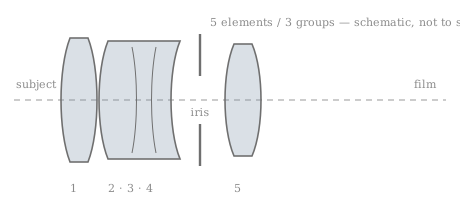
- 5 elements / 3 groups
- Aperture range
- f/5.6–f/22
- Min. focus
- 2.2 m
- Country
- United States
- Coating
- Lumenized (single layer)
What reviewers say
No reviews aggregated yet — this family is still in the research queue. Written one? We'd love to index it.
Optical formula — Triplet with cemented centre
History
Ten inches of Kodak glass for a camera that sold in the hundreds. The 254mm Ektar is listed among the lenses offered for the 1600F, and Cavina — who has counted the others carefully — says it reached the market only symbolically: prototypes and a handful of examples, one of them serial EI0002, which the CAMEROSITY key dates to 1948.
The patent behind it is titled for astronomy rather than photography. Altman and McIntyre’s 1946 filing describes an objective of five elements in three groups, with a biconcave element cemented between two positive menisci at the centre and a single positive element on each side — a triplet whose middle member has become a cemented trio. The front element uses a lanthanum and thorium glass, normal for the period and slightly radioactive.
Its back focal distance is 187.2mm, which on a camera with a focal-plane shutter and a 6×6 mirror is ample, and it focuses to 2.2m. What it lacked was a reason to exist in quantity: Zeiss’s 250mm Sonnar arrived for the same mount around 1951 at a stop faster and half the length, and the market for a ten-inch lens on a hand-held reflex was small to begin with.
Anyone who finds one has found something genuinely rare, and should expect no literature at all. There is no serial range, no price, no production figure, and the drawing here is from the patent because no photograph of the optics has surfaced.
This history is AI-written, from the sources listed at the foot of the page. Where the record is silent it says so rather than filling the gap — but no human wrote these sentences.
Example photos
Sample photo wanted — shot with a Kodak Ektar 254mm f/5.6? We'd love to feature it (with credit).
Live listings
The listings collector hasn't run for this family yet — check back soon, or search the marketplaces directly meanwhile.