Kodak Ektar 135mm f/3.5
Kodak · Hasselblad 1600F · 1949 · Modified triplet
Also known as: Kodak Ektar 135mm f/3.5 · Ektar 3.5/135 · Hasselblad 1600F Ektar 135
Variants & identification
| Variant | Mount | Years | Serial ranges | Production |
|---|---|---|---|---|
| 1600F/1000F thread mount | Hasselblad 1600F (M60×6 three-start thread) | 1949–1957 | — | 1,787 — 1,512 in 1949 and 275 in 1957, per Marco Cavina |
- Kodak published no serial-number list for these lenses, and none has been reconstructed. The CAMEROSITY prefix is the whole of what can be read from a serial; the numeric part is opaque. Victor Hasselblad took the same device to Göteborg, where the key word became VHPICTURES.
How to tell them apart
1600F/1000F thread mount:
- Preset diaphragm with a quick-close ring, twelve blades
- Kodak date code by the CAMEROSITY key, and an encircled L for Lumenized coating
Serial-range notes
- Kodak letter codes
- Kodak dated its lenses with the keyword CAMEROSITY, each letter standing for a digit from one to zero: ET reads as 1949. An encircled L beside it means Lumenized — Kodak's single-layer coating.
- the two letters before the digits
- The rule, set out in full. Kodak stamped its US-made lenses with a two-letter prefix giving the last two digits of the year, read off the key word CAMEROSITY: C is 1, A 2, M 3, E 4, R 5, O 6, S 7, I 8, T 9 and Y 0. ET is therefore 49 and the lens was made in 1949. The code gives the year and nothing finer — no month, no batch — and the digits that follow it are not a published series, so a serial cannot be placed within its year.
- ET, and the RS that should exist
- Cavina's two batches imply two date codes. The 1,512 lenses of 1949 read ET; the 275 of 1957 should, by the same key, read RS. No RS-marked example has been recorded in any source consulted, so the second batch's code is a deduction from the scheme rather than an observation.
Specifications
- Formula
- Modified triplet
- Designed by
- Altman Fred E. — computed the design
- Construction
- 4 elements / 4 groups
- Aperture range
- f/3.5–f/22
- Diaphragm blades
- 12
- Min. focus
- 1 m
- Country
- United States
- Coating
- Lumenized (single layer)
What reviewers say
No reviews aggregated yet — this family is still in the research queue. Written one? We'd love to index it.
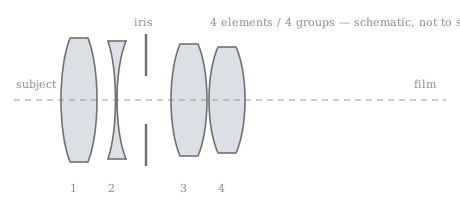
Optical formula — Modified triplet
History
The telephoto of the 1600F outfit, and the second-commonest of the four Kodak lenses Hasselblad sold — Cavina’s count gives 1,787 made, in two widely separated batches of 1,512 in 1949 and 275 in 1957, the later group appearing after Zeiss had already taken over the system.
Fred Altman’s design is a triplet with the middle element split: four elements, all air-spaced, in four groups, where the classic Cooke triplet has three. The attribution rests on Cavina’s dating of a patent Altman filed on 11 May 1942 and received in March 1944, and it should be treated as probable rather than settled — Cavina’s own page for the lens elsewhere says no optical data was located, and two Altman patents share that filing date. The other is a five-element f/1.9 design and is certainly not this lens.
In use it has a preset diaphragm with a quick-close ring and twelve blades, focuses to a metre, and takes Kodak’s Series VII filters. Like all the Kodak lenses for these cameras it is Lumenized — Kodak’s single-layer coating, marked by an encircled L near the serial.
Dating one needs no table. Kodak encoded the year in letters using the keyword CAMEROSITY, C standing for one through Y for zero, so a lens marked ET was made in 1949. Victor Hasselblad borrowed the same trick for his cameras, using the word VHPICTURES instead — he had learned it at Kodak.
This history is AI-written, from the sources listed at the foot of the page. Where the record is silent it says so rather than filling the gap — but no human wrote these sentences.
Example photos
Sample photo wanted — shot with a Kodak Ektar 135mm f/3.5? We'd love to feature it (with credit).
Live listings
Asking price, USD: a median of $1,000 across 5 fixed-price listings on 2026-09-06 (middle half $920–$1,200). First day tracked.
Asking prices from the listings scanned, not sales; junk-flagged rows and auction lots excluded; other currencies are not converted.
- HASSELBLAD 135mm F3.5 KODAK EKTAR TELEPHOTO LENS for 1600 1000F CAMERAS GENUINE
- Kodak Ektar 3.5/135mm Lens Hasselblad Mount 1000 1600
- Mint Kodak Ektar 135mm f3.5 Lens for Hasselblad 1600F 1000F Rare From Japan
- KODAK Ektar 135mm F3.5 * HASSELBLAD * Kodak Ektar * 11480
- KODAK Ektar 135mm F3.5 * HASSELBLAD * Kodak Ektar * 11480
- Kodak Ektar 3.5/135mm Lens Hasselblad Mount 1000 1600
eBay links are affiliate links. If you buy through one, Glass Bodies earns a small commission from eBay at no cost to you. It does not change which listings appear, their prices or their order — those come from the search and the sort described above.
Listings updated 2026-09-05. Links go to the shop or marketplace that carries the item.