Kodak Wide Field Ektar 55mm f/6.3
Kodak · Hasselblad 1600F · 1948 · Topogon-type symmetrical wide-angle
Also known as: Kodak Wide Field Ektar 55mm · Widefield Ektar 6.3/55 · Ektar 55mm f/6.3
Variants & identification
| Variant | Mount | Years | Serial ranges | Production |
|---|---|---|---|---|
| Prototype (Photokina 1948) | Hasselblad 1600F (M60×6 three-start thread) | 1948–1948 | — | Prototypes only — never sold |
- Prototype (Photokina 1948): Shown at Photokina in 1948 and listed by Hasselblad Historical among the pre-1957 lenses, but Marco Cavina states it was never commercialised. Its back focal distance of 49.64mm is short enough that the reflex mirror had to be locked up and an external finder used, which is the likeliest reason it went no further.
Specifications
- Formula
- Topogon-type symmetrical wide-angle
- Designed by
- Reiss Max — computed the design
- Construction
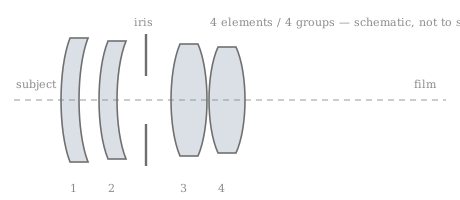
- 4 elements / 4 groups
- Aperture range
- f/6.3–f/45
- Min. focus
- 1 m
- Country
- United States
What reviewers say
No reviews aggregated yet — this family is still in the research queue. Written one? We'd love to index it.
Optical formula — Topogon-type symmetrical wide-angle
History
This lens was never sold. It was shown at Photokina in 1948 alongside the new 1600F, it appears on Hasselblad Historical’s list of pre-1957 lenses, and Cavina’s survey of the Kodak glass states plainly that it was not commercialised — so it belongs here as a documented prototype rather than as a lens anyone could buy.
The design is Max Reiss’s, patented for Kodak in 1950 on a 1946 filing: four air-spaced meniscus elements arranged in two facing pairs about the diaphragm, the Topogon idea, giving roughly 70° of coverage at a modest f/6.3. It should not be confused with the large-format Wide Field Ektars, which are a different and much better-known family.
Why it stopped is visible in one number. The back focal distance is 49.64mm, and the 1600F’s reflex mirror needs more room than that. Using it meant locking the mirror up and composing with an external finder — the same compromise Hasselblad would accept a few years later for the Biogon, but only by building the Supreme Wide Angle as a separate camera with no mirror at all. On a reflex body sold as a system camera it was a harder sell.
Nothing else about it is documented: no serial range, no count of how many prototypes were built, no surviving price. The drawing here comes from the patent rather than from an example, and there may be no example to draw from.
This history is AI-written, from the sources listed at the foot of the page. Where the record is silent it says so rather than filling the gap — but no human wrote these sentences.
Example photos
Sample photo wanted — shot with a Kodak Wide Field Ektar 55mm f/6.3? We'd love to feature it (with credit).
Live listings
The listings collector hasn't run for this family yet — check back soon, or search the marketplaces directly meanwhile.