Sonnar 180mm f/4
Carl Zeiss · Hasselblad V · 1990 · Sonnar
Also known as: Zeiss Sonnar 180mm f/4 · Carl Zeiss Sonnar T* 180mm f/4 · Sonnar 4/180 · Sonnar 180/4 · Hasselblad 180mm Sonnar · Hasselblad 180mm f/4 · Sonnar CF 180mm f/4 · Sonnar CFi 180mm f/4 · Sonnar T* 4/180 CFE · Hasselblad 180mm CF
Variants & identification
| Variant | Mount | Years | Serial ranges | Production |
|---|---|---|---|---|
| Sonnar CF T* 4/180 (1990 baseline) · Prontor CF, 1s–1/500 and B, plus F setting | Hasselblad V | 1990–1998 | — | — |
| Sonnar CFi T* 4/180 · Prontor CFi, 1s–1/500 and B, plus F setting | Hasselblad V | 1998–2001 | — | — |
| Sonnar CFE T* 4/180 · Prontor CFE, 1s–1/500, B and F | Hasselblad V | 2001–2013 | — | — |
| Sonnar T* 4/180 ZV Classic · Not named on the Zeiss ZV data sheet — the ZV Classic trio was sold for the focal-plane 2000- and 200-series bodies | Hasselblad V (ZV Classic) | 2006 | — | — |
- Element and group counts, exact focal lengths, weights, closest focus and filter fittings are from the Zeiss data sheets hosted by Hasselblad Historical (CF180, CFE180, ZV180). No sheet for the CFi 180 was consulted; its optics are taken to be the CF's, which the CFE sheet still repeats.
- Generation start years follow the barrel and shutter families as a whole (CF 1990, CFi late 1998, CFE about 2001, ZV 2006 or 2008); no source consulted gives a month for the 180mm's own changeovers, and old stock overlapped the new.
How to tell them apart
- The letters after the focal length are the generation: CF (Prontor CF, 1990–98), CFi (1998–2001), CFE (databus contacts, about 2001–2013), ZV (Zeiss-branded reissue, 2006 or 2008)
- There was never a C or a CB 180 — the family begins with the CF barrel, which is why every 180 has the bayonet-60 filter mount and the rubber focusing grip
- The ZV sorts itself out by weight and filter: 1130 g and a 67 mm thread inside the series-60 bayonet, against 1075–1080 g and bayonet only on the CF, CFi and CFE
- Longer and heavier than the 150 at every stage — 128 mm and 1075 g against 785 g for the CF 150 — which is the practical trade for the extra 30 mm
Sonnar CF T* 4/180 (1990 baseline):
- Black barrel with rubber focusing grip, Prontor CF shutter and the green F on the speed ring for open-shutter use on the 2000/200-series bodies
- Bayonet-60 filter mount — the same fitting as the CF 150, so filters carry over
- Zeiss data sheet: cat. no. 10 11 28, 5 elements in 4 groups, 179.4 mm exact, f/4–32, 24° diagonal field, 1.55 m closest focus at 1:6.6, 1075 g, 128 mm long at infinity
- Red-ink Zeiss date code inside the rear mount — two reversed year digits plus a month letter, A = January
Sonnar CFi T* 4/180:
- CFi engraved after the focal length; no databus contacts on the bayonet plate; bayonet-60 filter mount; F setting retained
- Same 5/4 optics and 179.4 mm exact focal length as the CF — the change is barrel and shutter only
Sonnar CFE T* 4/180:
- CFE after the focal length; four databus contacts on the bayonet plate for the 200-series meters
- Zeiss data sheet: cat. no. 10 11 32, 5 elements in 4 groups, 179.4 mm exact, 1.55 m at 1:6.6, 1080 g, series-60 bayonet, Prontor CFE 1s–1/500, b, f
Sonnar T* 4/180 ZV Classic:
- Zeiss-branded ZV Classic barrel with half-stop aperture clicks, headed 'The High Performance Telephoto Lens' on its data sheet
- A 67 mm filter thread (E67) inside an outer series-60 bayonet — no other 180 has the thread
- 1130 g, the heaviest version of the family; ø 80 mm, 128.4 mm long; 5 elements in 4 groups, 179.4 mm exact, 1.55 m at 1:6.6 (close-range coverage 361 × 361 mm)
- Sonnar CF T* 4/180 (1990 baseline): The lens arrived late in the V system's life, in 1990, to sit between the 150 and the 250. Zeiss's sheet says exactly that: it gives the photographer greater possibilities in portraiture, sport, landscape and animal photography and is 'the ideal complement to the 150 mm Sonnar f/4 and 250 mm Sonnar f/5.6', with superb image quality throughout the range from infinity to 1.55 m and a length of 128 mm at infinity described as very compact for a 180. The sheet mentions no special glass, apochromatic correction, aspheric surface or floating element.
- Sonnar CFi T* 4/180: The CFi barrel of late 1998, with the reworked Prontor shutter and revised controls that arrived across the V line. No Zeiss sheet for a CFi 180 was consulted; the optics are taken to be the CF's, which the CFE sheet still gives as 5 elements in 4 groups at 179.4 mm. The end year is the arrival of the CFE version rather than a documented discontinuation.
- Sonnar CFE T* 4/180: The databus version. Its sheet makes two claims the CF sheet does not: the optics, 'although optimized for infinity, were designed with special attention to close-up performance', to a correction high enough 'for demanding product shots that need a focal length clearly longer than the Makro-Planar T* 4/120 CFE offers'; and the glass chosen makes the lens 'very unsusceptible to thermal fluctuations', so it can be used in radiant heat — the sheet names heavy-industry furnaces, jet propulsion test beds and rocket launch sites. The 2001 date is the year databus contacts were added to several CF-shutter lenses and is carried as reported; the end year is that of the V system.
- Sonnar T* 4/180 ZV Classic: Zeiss's own late reissue, one of three V-mount lenses — Distagon 50, Makro-Planar 120, Sonnar 180 — brought back under the ZV Classic name. The sheet promises 'exceptionally high performance over the entire frame and through the entire aperture range, at all distances from infinity to the close-focus limit' in an 'extremely durable all-metal precision barrel'. It does not name a shutter, which leaves open whether this version carries a Prontor or, like the rest of the ZV trio, relies on the body's focal-plane shutter. The line is usually dated 2006; the Japanese Wikipedia product list instead gives an announcement of May 2008 with 1,000 units per model, and no source consulted reconciles the two. No end year is documented.
Serial-range notes
- red-ink code inside the rear mount, 1980 onward
- Every version of this lens postdates 1980, so the Zeiss date code inside the rear mount is two reversed year digits followed by a month letter, A = January — 09C is March 1990, 10F is June 2001. Zeiss lens serials themselves are running numbers, and no block-to-year table for the 180mm Sonnar was found.
Specifications
- Formula
- Sonnar
- Construction
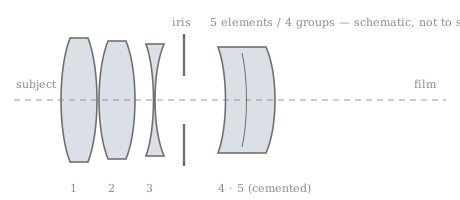
- 5 elements / 4 groups
- Aperture range
- f/4–f/32
- Shutter
- In the lens on the CF, CFi and CFE versions — Prontor, 1s–1/500 and B with an F setting, flash sync at every speed; the ZV Classic data sheet names no shutter
- Min. focus
- 1.55 m
- Dimensions
- 128 mm long
- Weight
- 1075 g
- Years manufactured
- 1990–2013
- Country
- Germany
- Coating
- T* multicoated throughout
What reviewers say
- Erin Emery (Silver in the Dark) (blog) — The choice lens among portrait photographers and, by many accounts, the sharpest in the Hasselblad lineup — about a 100mm equivalent in 35mm terms, popular and easy to find used, though it costs roughly twice what a 150mm Sonnar does.
- Photo Artworks (unbylined, 8 March 2024) (blog) — Tack sharp in the centre and corners even wide open at f/4 and at its best by f/5.6–f/8, with only about 1 EV of corner darkening at full aperture and smooth, round rendering of out-of-focus areas — but a specialty lens, and most photographers adapting it to digital would get better value from native medium-format glass. single source, unconfirmed
Optical formula — Sonnar
- Zeiss data sheet — CF (cross-section, MTF)
- Zeiss data sheet — CFE (cross-section, MTF)
- Zeiss data sheet — ZV Classic (cross-section, MTF)
ⓘ What these charts mean
MTF (modulation transfer function) shows how much contrast the lens keeps at a given fineness of detail, from the center of the frame to the corner — the coarse curves track punch, the fine ones resolving power, and a gap between solid and dashed lines means astigmatism. Relative illumination (falloff) shows how much darker the corners are than the center at each aperture. Manufacturers only began publishing these for modern lenses; no 1950s maker issued them, which is why older families here cite period magazine bench tests instead.
History
The 180mm Sonnar is the newcomer of the Hasselblad telephotos. Where the 150 dates from the launch of the 500C in 1957 and the 250 from the same era, the 180 appears only in 1990 — LENS-DB dates the CF version to that year — and Zeiss’s data sheet is candid about the reason for its existence. The lens gives the photographer greater possibilities in portraiture, sport, landscape and animal work, the sheet says, and is “the ideal complement to the 150 mm Sonnar f/4 and 250 mm Sonnar f/5.6.” It was made to fill a gap in a catalogue that was already more than thirty years old.
The specification is straightforwardly Sonnar: five elements in four groups, an exact focal length of 179.4 mm, a scale from f/4 to f/32, a 24° diagonal field, closest focus at 1.55 m for a reproduction ratio of 1:6.6, and 1075 g in a barrel 128 mm long at the infinity setting — a length the sheet calls very compact for a 180 (cat. no. 10 11 28). It promises superb image quality across the whole focusing range and, notably, claims nothing exotic: no special glass types, no apochromatic correction, no aspheric surface, no floating element. Because the family began in the CF era there was never a chrome C 180 or a budget CB one; every example has the rubber focusing grip, the green F setting for open-shutter work on a focal-plane body, and the bayonet-60 filter mount.
The versions that followed changed the barrel. The CFi shutter and controls arrived across the V line at the end of 1998, and around 2001 Hasselblad added databus contacts to several CF-shutter lenses, producing the CFE. That sheet (cat. no. 10 11 32) is more forthcoming than the CF’s. The optics, “although optimized for infinity, were designed with special attention to close-up performance,” to a correction high enough “for demanding product shots that need a focal length clearly longer than the Makro-Planar T* 4/120 CFE offers.” And the glass itself was chosen to make the lens “very unsusceptible to thermal fluctuations,” so that it can be used in radiant heat — the sheet’s own list runs from direct summer sunshine to heavy-industry furnaces, jet propulsion test beds and rocket launch sites. Weight is 1080 g, five grams up on the CF.
The last chapter belongs to Zeiss rather than to Hasselblad. The ZV Classic reissue of three V-mount lenses — Distagon 50, Makro-Planar 120 and Sonnar 180 — put the 180 back on sale in an all-metal barrel with half-stop aperture clicks, a 67 mm filter thread inside the outer series-60 bayonet, and 1130 g on the scale; the sheet is headed “The High Performance Telephoto Lens” and claims exceptionally high performance over the entire frame and aperture range at all distances. Its date is contested: the line is usually given as 2006, while the Japanese Wikipedia product list has an announcement in May 2008 and a limit of 1,000 units per model. The ZV sheet also declines to name a shutter, which leaves the version’s relationship to the focal-plane bodies unresolved here.
Reviewers rate it above its shorter sibling. Erin Emery’s V-system guide calls the 180 the choice lens among portrait photographers and reports that many consider it the sharpest lens in the Hasselblad lineup, at roughly twice a 150’s used price. An unbylined 2024 review at Photo Artworks, testing it adapted to digital, finds centre and corners tack sharp even wide open, best between f/5.6 and f/8, with about 1 EV of corner darkening at f/4 and smooth out-of-focus rendering — while concluding that it is a specialty lens for V-system owners rather than a general recommendation.
What remains open: who computed the lens; whether a CFi 180 data sheet exists and whether it differs from the CF’s; a primary, dated source for the CFE’s 2001 arrival; the ZV Classic’s true date, unit count and shutter; any original list price; and every production figure, which would have to come from Nordin’s compendia.
This history is AI-written, from the sources listed at the foot of the page. Where the record is silent it says so rather than filling the gap — but no human wrote these sentences.
Example photos

Sample photo wanted — shot with a Sonnar 180mm f/4? We'd love to feature it (with credit).
Live listings
Asking price, USD: a median of $730 across 39 fixed-price listings on 2026-09-11 (middle half $540–$1,200). Tracked since 2026-09-06, 2 days: unchanged from $730.
By day
| Date | Median | Middle half | Listings |
|---|---|---|---|
| 2026-09-11 | $730 | $540–$1,200 | 39 |
| 2026-09-06 | $730 | $540–$1,200 | 39 |
Asking prices from the listings scanned, not sales; junk-flagged rows and auction lots excluded; other currencies are not converted.
- Hasselblad Brochures: 500 Classic, 553ELX, 180mm f/4 Sonnar CF
- Hasselblad Carl Zeiss CF Sonnar 180mm f/4 T*
- [Exc+5] Hasselblad Lens Carl Zeiss Sonnar CF Telephoto 180mm F4 T* From JAPAN
- [Mint] Hasselblad Sonnar 180mm f/4 CF Carl Zeiss T* MF Lens From JAPAN
- [Exc+5] Hasselblad Carl Zeiss Sonnar T* 180mm F/4 CF Lens From JAPAN
- Hasselblad Carl Zeiss Sonnar CF 180mm f/4 T* Lens for V-System 500 Series B60
- "Optics Mint"Hasselblad SONNAR CF 180mm f/4 For HASSELBLAD from JAPAN #5008
- Hasselblad Carl Zeiss Sonnar T* 180mm F/4 CF Lens #65653 C6
- Hasselblad Carl Zeiss Sonnar T* 180mm F/4 CF Telephoto Lens From JAPAN MINT
- [Exc+5] Hasselblad Carl Zeiss Sonnar T* 180mm F/4 CF Lens From JAPAN
- Hasselblad Carl Zeiss Sonnar T* 180mm F/4 CF Lens #54338 E6
- Hasselblad Carl Zeiss Sonnar T* CF 180mm f/4 [Near MINT] Portrait Lens Tested
- PRICE DOWN-"Mint"Hasselblad SONNAR CF 180mm f/4 For HASSELBLAD from JAPAN #5085
- [MINT w/box] Hasselblad Sonnar CF 180mm F4 From JAPAN
- "Near Mint in Box"Hasselblad SONNAR CF 180mm f/4 For HASSELBLAD fm JAPAN #5773
- [Top MINT] Hasselblad Carl Zeiss Sonnar T* 180mm F/4 CF Portrait Lens From JAPAN
- Hasselblad CF 180mm F/4 L#7287319 BOS
- [Near MINT +++ W/Case] Hasselblad Carl Zeiss Sonnar T* 180mm F/4 CF Lens JAPAN
- 【Near MNT】Hasselblad Carl Zeiss Sonnar T* 180mm F/4 Lens From Japan
- [Almost Unused in Box] Hasselblad Carl Zeiss Sonnar CF 180mm F4 T* Lens JAPAN
Show 61 more listings
- Hasselblad Carl Zeiss Sonnar T* CF 180mm f/4 [MINT] Portrait Lens #7424564
- Hasselblad Carl Zeiss Sonnar CF f/4 180mm T* Lens
- HASSELBLAD Carl Zeiss Sonnar T* CF 180mm F4 Lens for V System from Japan E0514
- Hasselblad 180mm f/4 Sonnar T* CF LN
- [EXCELLENT]Hasselblad Carl Zeiss Sonnar T* CFi 180mm F/4 Lens #6153
- Blue Line [Top MINT] Hasselblad CFE 180mm f/4 Zeiss Sonnar T Lens From JAPAN
- Rare CFE [Top MINT] Hasselblad Carl Zeiss Sonnar 180mm F/4 T Lens JAPAN #721
- Carl Zeiss For Hasselblad 500 CF Sonnar 4/180Mm T* With Box
- Rare [Almost Unused] Hasselblad Zeiss Sonnar CFi 180mm f4 Camera lens From JAPAN
- Sonnar 4/180 CF Zeiss Hasselblad medium format camera lens f/4 f=180mm T*
- [Top Mint] Hasselblad Carl Zeiss Sonnar T* CFE 180mm f/4 Telephoto Lens Japan
- Zeiss for Hasselblad CFi Sonnar 4/180mm T* lens clean condition
- Hasselblad Carl Zeiss Sonnar T* CFi 180mm F/4 Lens Used Excellent Condition
- CARL ZEISS 180MM F4 SONNAR CFI FOR HASSELBLAD V SYSTEM 3020073 #5832
- Hasselblad CFi Sonnar 180mm f4 Camera Lens Used Simple Clear Condition
- Hasselblad CFE 4/180mm Sonnar very clean made in Germany
- CARL ZEISS 180MM F4 SONNAR CFE FOR HASSELBLAD V SYSTEM + BOX 3020074 #2690
- Rare Limited 1000 [Top MINT] Carl Zeiss Classic Sonnar 180mm f/4 ZV From JAPAN
- Zeiss Sonnar T* 4/180mm Classic ZV 180/1000 Hasselblad V RARE
- Zeiss Sonnar 4,8/180mm large format lens Zeiss WEST
- Linhof Zeiss Sonnar 4,8/180mm Large Format
- Carl Zeiss Linhof Sonnar 4,8/180mm Lens 180mm f4,8 Objekiv auf 7,5 x 8cm Platte
- Hasselblad Zeiss Sonnar CF T* 4/ 180mm SUPER !!!!
- HASSELBLAD Sonnar T* 180mm f/4,0 CF - SNr: 7185513
- USATO Hasselblad 180mm F4
- Zeiss Sonnar CF 180mm f/4 T Hasselblad V - für z.B. 500CM 503CW Mittelformat*
- [Fast unbenutzt in Box] Hasselblad Carl Zeiss Sonnar CF 180mm F4 T*...
- Hasselblad Carl Zeiss Sonnar T* CF 180mm F4 Objectif Téléobjectif V Manuel
- Hasselblad Carl Zeiss Objektiv Sonnar T Cf 180mm F4 für V System Aus Japan E0514
- NEUWERTIG Hasselblad 180mm f4 CF T* Sonnar 120mm Objektiv #2859
- Obiettivo manuale Zeiss Hasselblad 180mm Sonnar CF F4
- Objectif Manuel Zeiss Hasselblad 180mm Sonnar CF F4
- Manuelles Objektiv Zeiss Hasselblad 180mm Sonnar CF F4
- Manual Focus Zeiss Hasselblad 180mm Sonnar CF F4 Lens
- Manuelles Objektiv Zeiss Hasselblad 180mm Sonnar CF F4
- Objectif Manuel Zeiss Hasselblad 180mm Sonnar CF F4
- Seltenes [fast unbenutztes] Hasselblad Zeiss Sonnar CFi 180mm f4...
- Hasselblad Carl Zeiss Sonnar CFI 4/180mm T* OVP Top Zustand
- Zeiss for Hasselblad CFi Sonnar 4/180mm T* lens clean condition
- Hasselblad Carl Zeiss Sonnar T* CFi 180mm F/4 Objektiv Gebraucht Top Zustand
- Hasselblad CFi Sonnar 180mm f4 Kamera Objektiv Gebraucht Einfach Klar Zustand
- Hasselblad CFE 4/180mm Sonnar very clean made in Germany
- [Mint] Hasselblad Sonnar 180mm f/4 CF Carl Zeiss T* MF Lens From JAPAN
- [Exc+5] Hasselblad Carl Zeiss Sonnar T* 180mm F/4 CF Lens From JAPAN
- Hasselblad Carl Zeiss Sonnar T* 180mm F/4 CF Telephoto Lens From JAPAN MINT
- Hasselblad Carl Zeiss Sonnar T* 180mm F/4 CF Lens #54338 E6
- Hasselblad Carl Zeiss Sonnar T* CF 180mm f/4 [Near MINT] Portrait Lens Tested
- [MINT w/box] Hasselblad Sonnar CF 180mm F4 From JAPAN
- Hasselblad Carl Zeiss Sonnar T* CF 180mm F4
- HASSELBLAD Mittelformat Kamera Objektiv CF SONNAR 180mm F4 gebraucht
- [Top MINT] Hasselblad Carl Zeiss Sonnar T* 180mm F/4 CF Portrait Lens From JAPAN
- Hasselblad Carl Zeiss Sonnar T* CF 180mm f/4 [MINT] Portrait Lens #7424564
- [Almost Unused in Box] Hasselblad Carl Zeiss Sonnar CF 180mm F4 T* Lens JAPAN
- HASSELBLAD Carl Zeiss Sonnar T CF 180mm F4 Lens for V System from Japan E0514
- Hasselblad 180mm F4 CF Zeiss Sonnar T* Lens - STK: 42671
- Hasselblad CF 180mm f4 Sonnar Objektiv, super Zustand!
- Rare CFE [Top MINT] Hasselblad Carl Zeiss Sonnar 180mm F/4 T Lens JAPAN #721
- Rare [Almost Unused] Hasselblad Zeiss Sonnar CFi 180mm f4 Camera lens From JAPAN
- Hasselblad Carl Zeiss Sonnar T* CFi 180mm F/4 Lens Used Excellent Condition
- Hasselblad CFi Sonnar 180mm f4 Camera Lens Used Simple Clear Condition
- HASSELBLAD Medium Format Camera Lens CF SONNAR 180mm F4 Used
eBay links are affiliate links. If you buy through one, Glass Bodies earns a small commission from eBay at no cost to you. It does not change which listings appear, their prices or their order — those come from the search and the sort described above.
Listings updated 2026-09-11. Links go to the shop or marketplace that carries the item.