Sonnar 150mm f/4
Carl Zeiss · Hasselblad V · 1957 · Sonnar
Also known as: Zeiss Sonnar 150mm f/4 · Carl Zeiss Sonnar T* 150mm f/4 · Sonnar 4/150 · Sonnar 150/4 · Hasselblad 150mm Sonnar · Hasselblad 150mm f/4 · Sonnar C 150mm f/4 · Sonnar CF 150mm f/4 · Sonnar T* 4/150 CFi · Hasselblad 150mm CF · Zeiss Sonnar 150mm f4 C T*
Variants & identification
| Variant | Mount | Years | Serial ranges | Production |
|---|---|---|---|---|
| Sonnar C 4/150, chrome (1957 baseline) · Synchro-Compur, 1s–1/500 and B | Hasselblad V | 1957–1969 | — | — |
| Sonnar C 4/150, black (non-T*) · Synchro-Compur, 1s–1/500 and B | Hasselblad V | 1969–1973 | — | — |
| Sonnar C T* 4/150 · Synchro-Compur, 1s–1/500 and B | Hasselblad V | 1973–1982 | — | — |
| Sonnar CF T* 4/150 · Prontor CF, 1s–1/500 and B, plus F setting | Hasselblad V | 1982–1998 | — | — |
| Sonnar CFi T* 4/150 · Prontor CFi, 1s–1/500 and B, plus F setting | Hasselblad V | 1998–2013 | — | — |
- Element and group counts, exact focal lengths, weights, closest focus and filter fittings are from the Zeiss data sheets hosted by Hasselblad Historical (C150, CF150, CFi150). No separate sheet exists for the chrome or black C lens; their figures are those of the C T* sheet, which describes the same optics.
- Generation start years follow the barrel and shutter families as a whole (C 1957, black from about 1969/70, T* 1973, CF 1982, CFi late 1998); no source consulted gives a month for the 150mm's own changeovers, and old stock overlapped the new.
How to tell them apart
- The letters after the focal length are the generation: none or C (Synchro-Compur, 1957–82), CF (Prontor CF, 1982–98), CFi (1998–2013). There is no CFE 150 and no CB 150 — a databus-equipped fast 150 is the shutterless FE f/2.8, a different family
- Filter mount sorts the eras at a glance: bayonet-50 on every C version, bayonet-60 on CF and CFi
- Only the CF and CFi carry the green F setting that allows open-shutter use on a 2000- or 200-series body
- Weight climbs steadily across the run — 710 g (C), 785 g (CF), 850 g (CFi) per the Zeiss sheets — while the optical formula never changes
Sonnar C 4/150, chrome (1957 baseline):
- Satin-chrome barrel engraved Carl Zeiss / Sonnar 1:4 f=150mm; no red T*; single coating
- Synchro-Compur with the EV interlock lever — aperture and shutter-speed rings move together until the cross-coupling lever is pressed
- Bayonet for Hasselblad series 50 filters, the standard C fitting (Zeiss data sheet)
- Red-ink Zeiss date code inside the rear mount; before 1980 the last two digits are the month and the leading digit(s) plus 1957 the year
Sonnar C 4/150, black (non-T*):
- Black-anodised barrel with the same C engraving, EV interlock lever and bayonet-50 filter mount as the chrome lens; no red T*
- Same 5/3 optics and 710 g as the chrome lens — the change is finish only
Sonnar C T* 4/150:
- Red T* after the Sonnar name; black barrel; bayonet-50 filter mount; EV interlock lever retained
- Zeiss data sheet: cat. no. 101025, 5 elements in 3 groups, 151.2 mm exact, f/4–32, 1.4 m closest focus, 710 g, Compur size 0 reflex shutter with automatic iris diaphragm
Sonnar CF T* 4/150:
- Black barrel with a rubber focusing grip, Prontor CF shutter and a green F on the speed ring for open-shutter use on the 2000/200-series bodies; EV interlock becomes a push-button
- Bayonet-60 filter mount replaces the C lens's bayonet 50 — the quickest way to sort a CF from a C
- Zeiss data sheet: cat. no. 10 11 14, 5 elements in 3 groups, 151.2 mm exact, 1.4 m at 1:7.1, 785 g
Sonnar CFi T* 4/150:
- CFi engraved after the focal length; no databus contacts on the bayonet plate — there was no CFE 150
- Bayonet-60 filter mount; F setting retained; 850 g, the heaviest version of the family
- Zeiss data sheet: cat. no. 10 11 36 - 9901, 5 elements in 3 groups, 151.5 mm exact, 1.4 m at 1:7.1
- Sonnar C 4/150, chrome (1957 baseline): The 150mm Sonnar was in the catalogue from the launch of the 500C in 1957 and stayed there, in one barrel or another, until the V system ended. The optics are 5 elements in 3 groups, an exact focal length of 151.2 mm, a diagonal field of 29° and a scale running f/4 to f/32 (Zeiss data sheet C150, cat. no. 101025). The end year here is the chrome-to-black changeover, which no source consulted dates for this focal length — 1969/70 is the usual figure for the C line as a whole.
- Sonnar C 4/150, black (non-T*): A transitional finish between the chrome barrel and the T* lens; the optics are unchanged from 1957. Start and end years follow the C line as a whole (black from about 1969/70, T* from 1973), not a documented changeover for the 150. No serial boundary is published.
- Sonnar C T* 4/150: The multicoated C lens, optically unchanged from 1957. Its data sheet opens by saying that 'many photographers consider the Sonnar T* f/4 - 150 mm the most important supplementary lens for the Hasselblad camera', and credits the compact Sonnar layout with 'excellent corner-to-corner illumination of the image field'. Zeiss dated T* on the Hasselblad line to 1973.
- Sonnar CF T* 4/150: The 1982 barrel change, with the Prontor CF shutter that replaced the Synchro-Compur across the line. The optics did not move: the CF sheet repeats the C sheet almost verbatim, still calling the lens the most important supplementary lens for the Hasselblad SLR system. Weight rose from 710 g to 785 g.
- Sonnar CFi T* 4/150: The last version. Its sheet drops the 'most important supplementary lens' line for a different claim — 'the Sonnar T* 4/150 CFi lens has been the classical portrait lens in the Hasselblad system' — and notes that with a focal length about twice the frame diagonal it gives 'the ideal perspective for classic head and shoulder portraits', flash-synchronising to 1/500 s. The exact focal length is given as 151.5 mm against the C and CF sheets' 151.2 mm, a difference no source explains. The end year is that of the V system rather than a documented discontinuation of this lens.
Serial-range notes
- red-ink code inside the rear mount, before 1980
- Zeiss stamped a date code in red ink inside the rear mount. On the chrome, black and C T* lenses it reads YY(Y)MM, with the year the leading digit or digits plus 1957 — so 1105 is May 1968. This is the practical way to date a C-generation 150, since Zeiss lens serials are running numbers with no published block-to-year table for this focal length.
- red-ink code inside the rear mount, 1980 onward
- From 1980 the code is two reversed year digits followed by a month letter, A = January: 28E is May 1982, 89K is November 1998. This covers the whole CF and CFi run.
Specifications
- Formula
- Sonnar
- Construction
- 5 elements / 3 groups
- Aperture range
- f/4–f/32
- Shutter
- In the lens on every version — Synchro-Compur on the C (1957–82), Prontor CF then CFi from 1982, 1s–1/500 and B, flash sync at every speed
- Min. focus
- 1.4 m
- Weight
- 710 g
- Years manufactured
- 1957–2013
- Country
- West Germany, then Germany
- Coating
- Single-coated on the chrome and black C lenses; T* multicoated from 1973
What reviewers say
- Daren (Learn Film Photography) (blog) — The one lens in his Hasselblad kit he would not sell — sharp corner to corner with very little vignetting or chromatic aberration wide open, well-controlled flare from the T* coating, and subject separation equivalent to about f/2.2 in 35mm terms; the 1.4 m closest focus and the modest f/4 are the real limitations.
- Erin Emery (Silver in the Dark) (blog) — The most common and most affordable portrait lens in the V system, and the one most portrait photographers should buy — very sharp, though not quite as crisp as her 50mm Distagon, and beaten for outright sharpness by the 180mm.
Optical formula — Sonnar
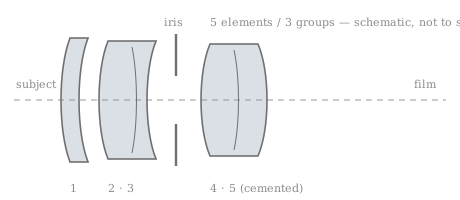
- Zeiss data sheet — C T* (cross-section, MTF)
- Zeiss data sheet — CF (cross-section, MTF)
- Zeiss data sheet — CFi (cross-section, MTF)
ⓘ What these charts mean
MTF (modulation transfer function) shows how much contrast the lens keeps at a given fineness of detail, from the center of the frame to the corner — the coarse curves track punch, the fine ones resolving power, and a gap between solid and dashed lines means astigmatism. Relative illumination (falloff) shows how much darker the corners are than the center at each aperture. Manufacturers only began publishing these for modern lenses; no 1950s maker issued them, which is why older families here cite period magazine bench tests instead.
History
The 150mm Sonnar was there at the beginning. It appears in the Hasselblad catalogue alongside the 500C of 1957 and left it only when the V system itself ended, and across those fifty-six years the glass inside never changed: five elements in three groups, an exact focal length of 151.2 mm, a diagonal field of 29°, an aperture scale running f/4 to f/32 and a closest focus of 1.4 m, all as given on Zeiss’s data sheet for the lens (cat. no. 101025). What changed was everything around the glass — the finish, the coating, the shutter, the filter mount — which is why the family reads as a history of Hasselblad’s barrels rather than of its optics.
Zeiss was in no doubt about the lens’s place in the system. Its C-generation sheet opens by saying that “many photographers consider the Sonnar T* f/4 - 150 mm the most important supplementary lens for the Hasselblad camera,” notes that “even at full aperture the lens covers the entire 6 x 6 cm format,” and credits the compact Sonnar layout — few glass-to-air surfaces, short overall length — with “excellent corner-to-corner illumination of the image field.” The uses it lists are portraiture, press, sports and stage work. Twenty-five years later the CF sheet repeats those sentences almost verbatim; the argument had not needed revising.
The visible history runs in four steps. The 1957 lens is satin chrome with a Synchro-Compur shutter, single coating and the EV interlock lever that ties the aperture and speed rings together until the cross-coupling lever is pressed. A black-anodised version followed around 1969/70 with the same optics and the same 710 g. Multicoating arrived in 1973, marked by the red T* after the Sonnar name — Zeiss dated T* on the Hasselblad line to that year, and no source consulted fixes the month for this focal length specifically. In 1982 the Prontor CF shutter replaced the Synchro-Compur across the whole line: the CF 150 gains a rubber focusing grip, a push-button EV release, a green F setting for open-shutter use on the focal-plane bodies, and a bayonet-60 filter mount in place of the old bayonet 50. Weight goes to 785 g (cat. no. 10 11 14).
The last version came with the CFi barrels at the end of 1998. Its sheet abandons the “most important supplementary lens” formula for a narrower claim — “the Sonnar T* 4/150 CFi lens has been the classical portrait lens in the Hasselblad system” — and explains why: at roughly twice the frame diagonal the focal length gives “the ideal perspective for classic head and shoulder portraits,” with flash synchronisation to 1/500 s. The lens is now 850 g, and its exact focal length is printed as 151.5 mm rather than the 151.2 mm of the two earlier sheets, a discrepancy no source consulted accounts for. There was never a CFE or CB 150: buyers who wanted databus metering at this focal length bought the shutterless f/2.8.
Reviewers have been consistent about it. Daren of Learn Film Photography, using a black T* lens, calls it the one lens in his Hasselblad kit he would not sell, finding it sharp corner to corner with very little vignetting or chromatic aberration wide open and flare well held by the T* coating; his complaints are the 1.4 m closest focus and the modest maximum aperture. Erin Emery’s V-system guide describes it as the most common and affordable portrait lens in the system and the one most portrait photographers should buy, while noting that those chasing outright sharpness go to the 180.
What remains open: who at Zeiss Oberkochen computed the lens, whom no source consulted names; the months of the chrome-to-black and T* changeovers and any serial boundary marking them; whether the CFi sheet’s 151.5 mm reflects a real change or a re-measurement; any original list price, in dollars or kronor, from a dated price list; and every production figure, which would have to come from Nordin’s compendia.
This history is AI-written, from the sources listed at the foot of the page. Where the record is silent it says so rather than filling the gap — but no human wrote these sentences.
Example photos

Sample photo wanted — shot with a Sonnar 150mm f/4? We'd love to feature it (with credit).
Live listings
Asking price, USD: a median of $350 across 53 fixed-price listings on 2026-09-11 (middle half $230–$480). Tracked since 2026-09-06, 2 days: unchanged from $350.
By day
| Date | Median | Middle half | Listings |
|---|---|---|---|
| 2026-09-11 | $350 | $230–$480 | 53 |
| 2026-09-06 | $350 | $230–$480 | 54 |
Asking prices from the listings scanned, not sales; junk-flagged rows and auction lots excluded; other currencies are not converted.
- Hasselblad 150mm f4 Zeiss Sonnar C Lens Chrome *Fair*
- Hasselblad 150mm f4 Zeiss Sonnar C Lens Black #420
- Hasselblad 150mm f4 Zeiss Sonnar C T* Lens Black *Read #471
- [Exc+5] Hasselblad Carl Zeiss Sonnar T* 150mm f/4 C MF Lens From JAPAN
- Hasselblad 150mm f/4 Sonnar C Lens for Hasselblad 500 Series V {Bayonet 50}
- [Near MINT] Hasselblad Carl Zeiss Sonnar T* 150mm f/4 C MF Lens From JAPAN
- Hasselblad 150mm f/4 Sonnar C Lens for Hasselblad 500 Series V System
- Hasselblad 150mm f4 Zeiss Sonnar C T* black Lens 150/4 Chrome
- Hasselblad 150mm f/4 Sonnar C Lens for Hasselblad 500 Series V System Bayonet 50
- Hasselblad Carl Zeiss Sonnar T* 150mm f/4 C MF Black Lens *Excellent* #6117
- Hasselblad Carl Zeiss Sonnar C 150mm f4 Chrome MF Lens from JAPAN [Vintage]
- Hasselblad 150mm f/4 Sonnar C Lens for HB 500 Series V System {Bayonet 50}
- Hasselblad 150mm f/4 Sonnar C Lens for Hasselblad 500 Series V System, Chrome
- Hasselblad 150mm f4 Zeiss Sonnar C T* Lens Chrome #676
- [Near MINT] Hasselblad Carl Zeiss Sonnar C 150mm f/4 MF Lens Black From JAPAN
- [Mint] Hasselblad Carl Zeiss Sonnar C 150mm f/4 T* Black MF Lens from JAPAN
- Hasselblad Carl Zeiss Sonnar T* CF 150mm f4 LENS Parts/Repair
- Hasselblad Carl Zeiss Sonnar T* 150mm f/4 C MF Lens Excellent +5 #3271
- Hasselblad 150mm f4 Zeiss Sonnar CF T* Lens
- Zeiss Sonnar 150mm f/4 Lens Hasselblad Synchro Compur – Tested 0426L0726R
Show 110 more listings
- Hasselblad Carl Zeiss Sonnar 150mm f/4 "Cased Near Mint" 9024 Black Lens Germany
- Hasselblad Carl Zeiss Sonnar 150mm f/4 "Near Mint" 8027 Black Compur Shutter
- Hasselblad 150mm f4 Zeiss Sonnar C T* Lens 150/4 black
- [Exc+4 w/ Cap] Hasselblad Carl Zeiss T* Sonnar 150mm f4 CF Lens From JAPAN
- [Top MINT] Hasselblad Carl Zeiss Sonnar T* C 150mm f/4 MF Lens Black From JAPAN
- [MINT+++] Hasselblad Carl Zeiss T* Sonnar C 150mm f/4 Portrait Lens From JAPAN
- Hasselblad C 150mm f/4 Sonnar L#5083123 Abe
- Hasselblad 150mm f/4 Sonnar CF T* Lens for Hasselblad 500 Series V System, Black
- Hasselblad 150mm f/4 Sonnar CF T* Lens for Hasselblad 500 Series V System, Black
- [Near MINT w/Cap] Hasselblad Carl Zeiss T* Sonnar 150mm F/4 CF Lens From JAPAN
- Hasselblad 150mm f4 Sonnar Chrome Telephoto Portrait Prime Lens [EXC]
- [Near MINT] Hasselblad Carl Zeiss T* Sonnar 150mm F/4 CF Lens From JAPAN
- [Almost Unused] Hasselblad Carl Zeiss Sonnar 150mm f/4 C MF Lens From JAPAN
- NEAR MINT Hasselblad Carl Zeiss T Sonnar 150mm f4 CF Lens From JAPAN
- [Near MINT] Hasselblad Carl Zeiss T* Sonnar 150mm f/4 CF Lens From JAPAN
- Hasselblad 150mm f4 Zeiss Sonnar CF T* Lens #508
- *Near Mint* Hasselblad Carl Zeiss T Sonnar 150mm F4 CF Telephoto Lens From JAPAN
- [MINT] Hasselblad Carl Zeiss T* CF Sonnar 150mm f4 MF Lens From JAPAN
- Hasselblad CF 150mm f/4 Sonnar L#7040012 BOS
- Hasselblad Carl Zeiss Sonnar CF 150mm f4 T* Lens
- Hasselblad Carl Zeiss Sonnar CF 150mm f4 T* Lens black
- Hasselblad Carl Zeiss Sonnar T* CF 150mm f/4 [Near MINT] Portrait Lens #7119744
- Hasselblad Carl Zeiss Sonnar 150mm C f/4 T* Lens Exc++++ Mint glass
- [MINT] Hasselblad Carl Zeiss T* 150mm f/4 CF Sonnar From JAPAN
- CLA'd【MINT】 Hasselblad Carl Zeiss CF Sonnar T* 150mm F4 MF Lens For 500 503
- [MINT] Hasselblad Carl Zeiss T* Sonnar 150mm F/4 CF Lens From JAPAN
- NoShip2US [MINT+ w/ Caps] Hasselblad Sonnar 150mm f/4 CFi from Japan Lv99
- Mint Hasselblad 150mm f/4 CFi ZEISS Sonnar T* Lens - V Mount - #30 20062
- CFi [ Near MINT- ] Hasselblad Carl Zeiss Sonnar 150mm f/4 T* Lens from JAPAN
- [UNUSED in Box] Hasselblad T* Sonnar 150mm F/4 CF Carl Zeiss Lens from JAPAN
- Hasselblad Carl Zeiss Sonnar 150mm CFI f/4 T* Lens Exc++++ Mint glass
- CFI [Top MINT+++] Hasselblad Carl Zeiss Sonnar T* Cfi 150mm f/4 Lens From JAPAN
- Hasselblad Carl Zeiss T* Sonnar 150mm f4 CFi Lens
- Carl Zeiss Sonnar T 4 / 150mm , silber f. Hasselblad
- Hasselblad Carl Zeiss Sonnar T* 150mm f/4 C MF Black Objektiv *TOP* #6117
- HASSELBLAD Sonnar 150mm f/4,0 - SNr: 4590884
- Hasselblad Zeiss Sonnar 150mm f4 chrome Synchro Compur #4974222 js067
- USATO Hasselblad 150mm F4
- HASSELBLAD Sonnar T* 150mm f/4,0 - SNr: 8178155
- Hasselblad Carl Zeiss Sonnar 150mm f/4 "Cased Near Mint" 9024 Black Lens Germany
- Hasselblad Zeiss Sonnar 150mm f4 T* 5760082 Black jh034
- Hasselblad / Carl Zeiss Sonnar C 4,0/150mm Chrom
- Zeiss Sonnar 150mm f4 für Hasselblad, Nr. 3460742, mit Film getestet
- Hasselblad Carl Zeiss Sonnar 150mm f/4
- Carl Zeiss Sonnar 150mm f/4 C T Hasselblad V-System Synchro-Compur – Exzellent
- Hasselblad Carl Zeiss Sonnar T* 150mm f/4 C MF Objektiv Excellent +5 #3271
- Hasselblad Carl Zeiss C Sonnar 4/150mm Chrom
- Hasselblad Carl Zeiss Sonnar CF 150mm f/4 T* Teleobjektiv Festbrennweite
- Hasselblad Carl Zeiss Sonnar 150mm f/4 "Near Mint" 8027 Black Compur Shutter
- [Top NEUWERTIG] Hasselblad Carl Zeiss Sonnar T* C 150mm f/4 MF Objektiv...
- Carl Zeiss Sonnar T* 150mm f/4 Hasselblad V C Compur Teleobjektiv schwarz -66912
- Hasselblad Carl Zeiss Sonnar 150mm f4 T* schwarz Compur 5761532 jc027
- 【NEUWERTIG】 Hasselblad Carl Zeiss Sonnar T* 150mm f/4 C Objektiv schwarz...
- HASSELBLAD C T* Sonnar 4/150 150mm F4 Zeiss 500 2000 V-System tested mint
- Hasselblad Sonnar C 150mm f4 T* 20060 Zeiss Lens 99653 near mint
- Hasselblad Carl Zeiss Sonnar 4/150 Hasselblad V-Mount Chrom Tele Lens 150mm f/4
- Wie NEU+++ Scheint UNBENUTZT Hasselblad CarlZeiss Sonnar T* 150mm f4 SynchroCompur
- [MINT] Zeiss Sonnar 150mm f/4 HFT [6000]
- Hasselblad Sonnar 4/150 Carl Zeiss Chrom Tele Lens 150mm f/4 Teleobjektiv
- Carl Zeiss T* Sonnar 150mm F4 CF f. Hasselblad
- 【NEAR MINT】Hasselblad Carl Zeiss T* Sonnar 150mm F/4 CF Objektiv aus JAPAN
- HASSELBLAD Sonnar T* 150mm f/4,0 CF - SNr: 7038060
- [NEUWERTIG] Hasselblad Carl Zeiss T Sonnar CF 150mm f/4 Mittelformat...
- Chrom 【Opt NEUWERTIG】 Hasselblad Carl Zeiss Sonnar C 150mm f/4 MF Objektiv...
- Hasselblad 150mm f4 CF T* Sonnar 150mm Objektiv #2874
- Carl Zeiss - Hasselblad Sonnar CF 4/150mm T* "1a Zustand / geprüft" - TOP!
- CFI [Top NEUWERTIG+++] Hasselblad Carl Zeiss Sonnar T* Cfi 150mm f/4...
- Hasselblad 150mm f/4 Sonnar T* Carl Zeiss Telephoto Lens for V-Series
- [Exc+5] Hasselblad Carl Zeiss Sonnar T* 150mm f/4 C MF Lens From JAPAN
- [Near MINT] Hasselblad Carl Zeiss Sonnar T* 150mm f/4 C MF Lens From JAPAN
- Hasselblad Carl Zeiss Sonnar T* 150mm f/4 C MF Black Lens *Excellent* #6117
- Hasselblad Carl Zeiss Sonnar T* 150mm f/4 C MF black Lens From JAPAN #3032848
- Hasselblad Carl Zeiss Sonnar 150mm F4 C T* Lens
- Hasselblad Carl Zeiss Sonnar C 150mm f4 Chrome MF Lens from JAPAN [Vintage]
- [Near MINT] Hasselblad Carl Zeiss Sonnar C 150mm f/4 MF Lens Black From JAPAN
- Hasselblad Carl Zeiss Sonnar 150mm F4 T* Lens
- Carl Zeiss 150mm f4 Sonnar TELE LENS for Hasselblad 500 CM Nr 5913457 BLACK
- [Mint] Hasselblad Carl Zeiss Sonnar C 150mm f/4 T* Black MF Lens from JAPAN
- Hasselblad Carl Zeiss Sonnar 150mm f/4 "Cased Near Mint" 9024 Black Lens Germany
- Hasselblad Carl Zeiss Sonnar 150mm f/4 T* Lens
- Hasselblad Carl Zeiss Sonnar T* 150mm f/4 C MF Lens Excellent +5 #3271
- Hasselblad Carl Zeiss Sonnar CF 150mm f/4 T
- Hasselblad Carl Zeiss Sonnar 150mm f/4 "Near Mint" 8027 Black Compur Shutter
- Hasselblad 150mm f/4 Sonnar Carl Zeiss Lens ***READ CONDITION***
- [Top MINT] Hasselblad Carl Zeiss Sonnar T* C 150mm f/4 MF Lens Black From JAPAN
- [Exc+4 w/ Cap] Hasselblad Carl Zeiss T* Sonnar 150mm f4 CF Lens From JAPAN
- Hasselblad ZEISS Sonnar C 150mm f/4 T* Manual Focus Lens 20060 in ex condition
- [Near MINT w/Cap] Hasselblad Carl Zeiss T* Sonnar 150mm F/4 CF Lens From JAPAN
- [Near MINT] Hasselblad Carl Zeiss T* Sonnar 150mm f/4 CF Lens From JAPAN
- *Near Mint* Hasselblad Carl Zeiss T Sonnar 150mm F4 CF Telephoto Lens From JAPAN
- 【NEAR MINT】Hasselblad Carl Zeiss T* Sonnar 150mm F/4 CF Lens From JAPAN
- Chrome 【Opt MINT】 Hasselblad Carl Zeiss Sonnar C 150mm f/4 MF Lens From...
- Hasselblad Carl Zeiss Sonnar T* CF 150mm f/4 [Near MINT] Portrait Lens #7119744
- Hasselblad 150mm f4 Sonnar CF, stunning optics + caps optics clear fully tested
- [MINT] Hasselblad Carl Zeiss T* 150mm f/4 CF Sonnar From JAPAN
- [MINT] Hasselblad Carl Zeiss T* Sonnar 150mm F/4 CF Lens From JAPAN
- Hasselblad Sonnar C 150mm f4 for 500C/M 501CM 503CW 553ELX 503CXi 555ELD 500C
- [ Top Mint in Box ] Hasselblad Carl Zeiss T* Sonnar 150mm F/4 CF Lens From JAPAN
- Hasselblad 150mm f4 Sonnar T*
- Hasselblad 150mm f/4 CFi Zeiss Sonnar T* Lens V-Series 500 20062 (0537BL)
- Hasssablade 500cm, Carl Zeiss Sonnar 150mm f4 lens. w/finder A12 back 120 film
- Hasselblad 150mm f4 T*
- Hasselblad 150mm f4 T *
- Hasselblad Carl Zeiss Sonnar CF 150mm f/4 T
- Hasselblad 150mm f4 T*
- Hasselblad 150mm f4 Zeiss Sonnar Black
- Hasselblad 150mm f4 Zeiss Sonnar Black
- Hasselblad 150mm f4 Zeiss Sonnar CF
- Hasselblad Sonnar 150mm f/4
- Hasselblad Carl Zeiss T* Sonnar 150mm F/4 CF Lens
eBay links are affiliate links. If you buy through one, Glass Bodies earns a small commission from eBay at no cost to you. It does not change which listings appear, their prices or their order — those come from the search and the sort described above.
Listings updated 2026-09-11. Links go to the shop or marketplace that carries the item.