Makro-Planar 120mm f/4
Carl Zeiss · Hasselblad V · 1982 · Makro-Planar (near-symmetrical macro Planar)
Also known as: Zeiss Makro-Planar 120mm f/4 · Carl Zeiss Makro-Planar T* 120mm f/4 · Makro-Planar 4/120 · Makro-Planar 120/4 · Makro Planar 120mm · Macro-Planar 120mm f/4 · Hasselblad 120mm Makro-Planar · Hasselblad 120mm f/4 · Hasselblad 120mm Macro · Makro-Planar CF 120mm · Makro-Planar T* 4/120 CFE · Makro-Planar CFi 120mm f/4
Variants & identification
| Variant | Mount | Years | Serial ranges | Production |
|---|---|---|---|---|
| Makro-Planar CF T* 4/120 (1982 baseline) · Prontor CF, 1s–1/500 and B | Hasselblad V | 1982–1998 | — | — |
| Makro-Planar CB T* 4/120 · Prontor CB, 1s–1/500 and B | Hasselblad V | 1998–2000 | — | — |
| Makro-Planar CFi T* 4/120 · Prontor CFi, 1s–1/500 and B | Hasselblad V | 1998–2001 | — | — |
| Makro-Planar CFE T* 4/120 · Prontor CFE, 1s–1/500 and B | Hasselblad V | 2001–2013 | — | — |
| Makro-Planar T* 4/120 ZV Classic (shutterless) · none — exposes through the body's focal-plane shutter | Hasselblad V (ZV — focal-plane bodies only) | 2006 | — | — |
- Element and group counts, weights, closest focus and filter fittings are from the Zeiss data sheets hosted by Hasselblad Historical (CF120, CFi120, ZV120); no sheet for the CB or CFE 120 was consulted, and their optics are taken to be the CF's.
- Generation start years follow the barrel/shutter families as a whole (CF 1982, CB 1997/98, CFi late 1998, CFE ~2001, ZV 2006 or 2008); no source gives a month for the 120mm's own changeover, and old stock overlapped the new.
How to tell them apart
- The letters after the focal length are the generation: CF (Prontor CF, 1982–98), CB (budget barrel, no F setting, 1997/98–2000), CFi (1998–), CFE (databus contacts, ~2001–2013), ZV (no shutter, 2006/08–)
- Every version takes bayonet-60 filters — there is no bayonet-50 Makro-Planar 120; a bayonet-50 120mm macro is the f/5.6 S-Planar, a different family — and the ZV additionally has a 67 mm thread
- Only the CB lacks the green F setting; only the ZV lacks a shutter altogether
- Weight sorts the ZV at once: 890 g against 695 g for the leaf-shutter versions (Zeiss sheets)
Makro-Planar CF T* 4/120 (1982 baseline):
- Black barrel with rubber focusing grip, Prontor CF shutter, bayonet-60 filter mount; green F on the speed ring for open-shutter use on 2000/200-series bodies; EV interlock as a push-button
- Zeiss data sheet: cat. no. 10 78 36, 6 elements in 4 groups, exact focal length 120.9 mm, f/4–32, 0.8 m closest focus at 1:4.5, 695 g, 36.6° diagonal field
Makro-Planar CB T* 4/120:
- CB engraved after the focal length; bayonet-60 filter mount; the rounded, glove-operable CB-style controls
- Japanese Wikipedia: the simplified version without the F-setting button, so not usable open-shutter on the focal-plane bodies
Makro-Planar CFi T* 4/120:
- CFi after the focal length; no databus contacts on the bayonet plate; bayonet-60 filter mount; F setting retained
- Zeiss data sheet: cat. no. 10 78 84, 6 elements in 4 groups, 120.9 mm exact, f/4–32, 0.8 m, 695 g; close-limit field size 254 × 254 mm
Makro-Planar CFE T* 4/120:
- CFE after the focal length; four databus contacts on the bayonet plate for the 200-series meters; otherwise the CFi barrel — bayonet 60, F setting, 0.8 m
- Japanese Wikipedia: electronic contacts for the 200-series bodies
Makro-Planar T* 4/120 ZV Classic (shutterless):
- No shutter-speed ring; Zeiss-branded ZV Classic barrel with half-stop aperture clicks
- Zeiss data sheet: 67 mm filter thread (E67) inside an outer series-60 bayonet, 890 g — the heaviest of the family; 0.8 m, 1:4.5, 6 elements in 4 groups, 120.9 mm exact
- Makro-Planar CF T* 4/120 (1982 baseline): The 1982 replacement for the S-Planar C 5.6/120. Zeiss's sheet says the f/4 aperture 'doubles the brightness of the screen image compared with the f/5.6 lens' and that the Hasselblad extension tube 32 takes the macro range to 1:2; as before, extension tubes rather than supplementary lenses are recommended below the shortest marked distance. Emulsive's CF guide gives the same 6/4, B60, 695 g and 80 cm figures.
- Makro-Planar CB T* 4/120: The budget line's macro lens. Hasselblad Historical's index lists a Makro-Planar f/4 120 mm CB alongside the Distagon 60, Planar 80 and Tessar 160 CB. Unlike the CB Planar 80, no Zeiss sheet consulted describes a recomputation — the optics are taken to be the CF's 6/4. The CB range as a whole began in 1997; whether the 120 CB followed in 1997 or 1998 is not stated by any source consulted, and the end year is the point at which the CB line left the catalogue, not a documented discontinuation of this lens.
- Makro-Planar CFi T* 4/120: Japanese Wikipedia dates the CFi lenses 'progressively from the end of 1998'. The Zeiss CFi sheet says the design 'maintains its performance characteristics very constantly over a wide range of reduction ratios, from half life-size (1:2) to infinity' and that the built-in helicoid is 'deliberately limited' as a safety measure since most Hasselblad SLRs lack TTL metering, pointing to extension rings or the bellows Makro-Planar 5.6/135 for 1:1. Its field-size figure of 254 × 254 mm works out to about 1:4.5 at closest focus, the same as the CF.
- Makro-Planar CFE T* 4/120: Hasselblad Historical's index lists the lens as 'Makro-Planar f/4 120 mm CFi & CFE'. The CFE version is generally dated to about 2001, when Hasselblad added databus contacts to three more CF-shutter lenses; the trade report of that announcement could not be read for this entry, so the year is carried as reported. The end year is that of the V system: Wikipedia gives the 503CW's discontinuation as 29 April 2013.
- Makro-Planar T* 4/120 ZV Classic (shutterless): Zeiss's own late reissue of three V-mount lenses (Distagon 50, Makro-Planar 120, Sonnar 180) for the focal-plane 2000- and 200-series bodies, the ZV sheet calling this one 'the best proven macro lens for medium format photography in decades'. The date is contested: the ZV Classic line is usually dated 2006, while Japanese Wikipedia gives an announcement of May 2008 and a limit of 1,000 units per model — possibly the Japanese release; no source consulted reconciles the two. No end year is documented.
Serial-range notes
- red-ink code inside the rear mount, 1980 onward
- Every generation of this lens postdates 1980, so the Zeiss date code inside the rear mount is two reversed year digits and a month letter, A = January — 48C is March 1984, 99H is August 1999. Lens serials are Zeiss's running numbers; no block-to-year table for the 120mm Makro-Planar was found.
Specifications
- Formula
- Makro-Planar (near-symmetrical macro Planar)
- Construction
- 6 elements / 4 groups
- Aperture range
- f/4–f/32
- Shutter
- In the lens on the CF, CB, CFi and CFE versions — Prontor, 1s–1/500 and B, flash sync at every speed; the ZV Classic has no shutter and exposes only on the 2000/200-series focal-plane bodies
- Min. focus
- 0.8 m
- Weight
- 695 g
- Years manufactured
- 1982–2013
- Country
- West Germany, then Germany
- Coating
- T* multicoated throughout
What reviewers say
- Erin Emery (Silver in the Dark), the V lenses compared (blog) — Very sharp at close range even wide open, and usable as a portrait lens — where she finds it wants f/8 to match the others.
- Eric L. Woods, CFi on a Fuji GFX via focal reducer (blog) — An adapter test with the 120 as the subject: "Very sharp. Great colors. Very pleasing bokeh. Wonderful rendering" — and at $1,300 he would buy a Pentax 67 165mm f/2.8 instead.
Optical formula — Makro-Planar (near-symmetrical macro Planar)
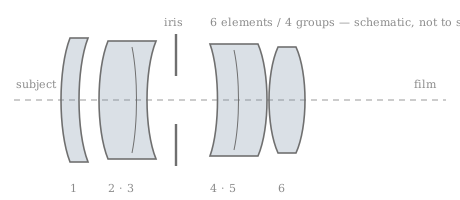
- Zeiss data sheet — CF (cross-section, MTF)
- Zeiss data sheet — CFi (cross-section, MTF)
- Zeiss data sheet — ZV Classic (cross-section, MTF)
ⓘ What these charts mean
MTF (modulation transfer function) shows how much contrast the lens keeps at a given fineness of detail, from the center of the frame to the corner — the coarse curves track punch, the fine ones resolving power, and a gap between solid and dashed lines means astigmatism. Relative illumination (falloff) shows how much darker the corners are than the center at each aperture. Manufacturers only began publishing these for modern lenses; no 1950s maker issued them, which is why older families here cite period magazine bench tests instead.
History
The Makro-Planar 120mm f/4 arrived in 1982 with the Prontor CF shutter that replaced the Synchro-Compur across the Hasselblad line, and Zeiss’s data sheet for it reads almost as a note on its predecessor. “Like its predecessor, the 120 mm S-Planar T* f/5.6 lens, the new lens consists of 6 elements in 4 groups which are arranged almost symmetrically to the iris diaphragm,” it says, and it credits “a major achievement on the part of the designer that the initial aperture of the new Makro-Planar lens could be increased to f/4 compared with the f/5.6 of its predecessor without exceeding the optical dimensions of the f/5.6 lens or making any concessions on the image quality.” The sheet’s figures: catalogue number 10 78 36, an exact focal length of 120.9 mm, f/4 to f/32, closest focus 0.8 m at 1:4.5, a bayonet for series 60 filters and 695 g. The designer is not named.
Zeiss explained the point of the extra stop plainly. Macro work is done at small apertures, but “the maximum aperture of f/4 doubles the brightness of the screen image compared with the f/5.6 lens, and the shallower depth of field makes it easier to recognize the plane of sharpness.” The lens “performs best in the region of slightly reduced imaging of the subject”; the Hasselblad extension tube 32 takes it to 1:2, and Zeiss repeated the S-Planar’s rule that “only extension tubes and no supplementary lenses should be used for close-ups below the shortest marked distance.” Emulsive’s CF guide gives the same 6/4, B60, 695 g and 80 cm figures and describes the lens as an upgrade from the S-Planar C.
The barrel then followed every turn of the 1990s catalogue while the glass stood still. Hasselblad Historical’s lens index lists the Makro-Planar f/4 120 mm under CF, under CB, under “CFi & CFE” and under ZV Classic. Japanese Wikipedia describes the CB as the simplified version without the F-setting button — so, unlike every other version, it cannot be used open-shutter on the focal-plane bodies — and dates the CFi lenses “progressively from the end of 1998.” The Zeiss CFi sheet (catalogue number 10 78 84) keeps the six-in-four optics at 695 g and 0.8 m, adds that the Planar type “is also the basis for the ultra-high-resolution S-Planar (Starlith) microlithography lenses,” and says the helicoid is “deliberately limited” as a safety measure “since most Hasselblad SLRs lack TTL metering,” pointing users who need 1:1 to extension rings or to the bellows Makro-Planar 5.6/135. The CFE, with databus contacts for the 200-series meters, is generally dated to about 2001; the trade report of that announcement could not be read for this entry, so the year is carried as reported.
The last version dropped the shutter altogether. Zeiss’s ZV Classic reissue of three V-mount lenses — Distagon 50, Makro-Planar 120, Sonnar 180 — was made for the 2000- and 200-series focal-plane bodies; the ZV data sheet gives a 67 mm filter thread inside an outer series-60 bayonet, half-stop aperture clicks and 890 g, and calls the lens “the best proven macro lens for medium format photography in decades – an established industry standard.” The ZV line is usually dated 2006, but Japanese Wikipedia gives an announcement of May 2008 and a limit of 1,000 units per model, and no source consulted reconciles the two. Leaf-shutter production ended with the V system; Wikipedia gives the 503CW’s discontinuation as 29 April 2013.
What remains open: who at Zeiss Oberkochen recomputed the S-Planar to f/4; the 120 CB’s own start year (1997 or 1998) and whether its optics were touched; the CFE’s launch date from a readable primary source; the ZV Classic’s date and whether the 1,000-unit figure is a Japanese allocation or a world total; any list price — Victor Hasselblad Inc.’s American price lists of the 1980s exist as large scans and were not read here; and every production figure, which would have to come from Nordin’s compendia.
This history is AI-written, from the sources listed at the foot of the page. Where the record is silent it says so rather than filling the gap — but no human wrote these sentences.
Example photos

Sample photo wanted — shot with a Makro-Planar 120mm f/4? We'd love to feature it (with credit).
Live listings
Asking price, USD: a median of $670 across 28 fixed-price listings on 2026-09-11 (middle half $570–$1,100). Tracked since 2026-09-06, 2 days: unchanged from $670.
By day
| Date | Median | Middle half | Listings |
|---|---|---|---|
| 2026-09-11 | $670 | $570–$1,100 | 28 |
| 2026-09-06 | $670 | $570–$1,100 | 28 |
Asking prices from the listings scanned, not sales; junk-flagged rows and auction lots excluded; other currencies are not converted.
- Hasselblad 120mm f4 Makro-Planar CF T* Lens *Read notes #913
- Hasselblad 120mm f4 Makro-Planar CF T* Lens *Inoperable #375
- [Exc+5] Hasselblad Carl Zeiss Makro Planar T* CF 120mm f4 Lens From JAPAN #24121
- Hasselblad Makro Planar T* CF 120mm F/4 Carl Zeiss Macro Lens [EXC+5] From JAPAN
- Hasselblad Carl Zeiss Makro-Planar T CF 120mm f/4 Lens*
- [Excellent+++++5] Hasselblad Carl Zeiss Makro Planar T* CF 120mm F/4 Lens JAPAN
- Hasselblad 120mm f4 Makro-Planar CF T* Lens #729
- Hasselblad 120mm f4 Makro-Planar CF T* Lens #528
- [Near MINT+++] Hasselblad Carl Zeiss Makro Planar T* CF 120mm F4 Lens From JAPAN
- [Mint] Hasselblad Carl Zeiss Makro Planar T* CF 120mm f/4 Macro Lens
- [Exc+5] Hasselblad Carl Zeiss Makro Planar T* CF 120mm f/4 Macro Lens From JAPAN
- ◆CLA'd / OPT MINT◆ Hasselblad Carl Zeiss Makro Planar T* CF 120mm f4 Lens JAPAN
- 【A MINT】Hasselblad Carl Zeiss Makro Planar T* CF 120mm f4 From JAPAN
- [NEAR MINT] Hasselblad Carl Zeiss Makro Planar T* CF 120mm F/4 From JAPAN #330
- [MINT] Hasselblad Carl Zeiss T* Makro Planar CF 120mm f/4 Macro Lens From JAPAN
- MINT: Hasselblad Carl Zeiss Makro Planar CF 120mm f/4 Macro Lens with Caps Japan
- "MINT+++" Hasselblad Carl Zeiss Makro Planar T* CF 120mm f/4 Macro Lens JAPAN
- Hasselblad CF 120mm F/4 Makro-Planar L#7408237 BOS
- Hasselblad CF 120mm f/4 Makro Planar Carl Zeiss T* L#6992264
- Hasselblad Carl Zeiss CF Makro-Planar T 120mm F4 for V System from Japan E0705
Show 52 more listings
- Hasselblad 120mm f4 Makro Planar CFi medium format lens
- Hasselblad CF Makro-Planar T* 120mm F4 Macro Lens for V System from Japan E0605
- [Almost Unused in Box] Hasselblad Carl Zeiss Makro-Planar CF 120mm f/4 T* Japan
- CFi [Unused Box ] Hasselblad Carl Zeiss T* Makro-Planar 120mm f4 Lens From JAPAN
- CFE [Near MINT] Hasselblad Carl Zeiss Makro Planar T* 120mm f/4 Lens From JAPAN
- CFE [Top MINT] Hasselblad Carl Zeiss Makro Planar T* 120mm f/4 Lens From JAPAN
- Hasselblad 500C/M Makro-Planar 120mm F4[Near Mint] US STOCK
- Zeiss Makro-Planar 4/120mm ZV Classic 203/1000 Hasselblad V RARE
- A Rolliei 120mm f/4 Carl Zeiss Makro-Planar PQS HFT Macro Camera Lens as-is #1
- ◆CLA'd / OPT MINT◆ Hasselblad Carl Zeiss Makro Planar T* CF 120mm f4 Objektiv...
- [NEAR MINT] Hasselblad Carl Zeiss Makro Planar T* CF 120mm f/4 Makrolinsen Japan
- [Exc+5] Hasselblad Carl Zeiss Makro Planar T* CF 120mm f/4 Macro Objektiv...
- 【A NEUWERTIG】Hasselblad Carl Zeiss Makro Planar T* CF 120mm f4 aus JAPAN
- [NEAR MINT] Hasselblad Carl Zeiss Makro Planar T* CF 120mm F/4 From JAPAN #330
- [NEUWERTIG] Hasselblad Carl Zeiss T* Makro Planar CF 120mm f/4 Macro...
- Carl Zeiss Makro-Planar CF 120mm f/4 for Hasselblad V-System
- Objectif Macro Hasselblad Carl Zeiss CF Makro-Planar T 120mm F4 V System
- Hasselblad Carl Zeiss CF Makro-Planar T 120mm F4 Für V System Manuell Linse
- Carl Zeiss Hasselblad Makro-Planar CF 120mm F/4 T* - #20053
- Carl Zeiss / Hasselblad Makro-Planar CF 120mm F/4 T* - #20053
- Hasselblad CB 120mm f4 Zeiss Makro Planar
- Hasselblad CF Makro-Planar 4/120 T* Carl Zeiss Makro Lens 120mm f/4 Makro
- [Unbenutzt mit Haube] Hasselblad Carl Zeiss Makro Planar T* CF 120mm f/4...
- HASSELBLAD Makro-Planar T* 120mm f/4,0 Carl Zeiss CFi - SNr: 8849765
- Hasselblad CF Makro-Planar T* 120mm f/4 Makro Objektiv für V-Bajonett E0605
- [Fast unbenutzt in Box] Hasselblad Carl Zeiss Makro-Planar CF 120mm f/4 T* Japan
- Hasselblad CB Makro-Planar 4/120 T* Carl Zeiss Black Lens Macro Lens 120mm f/4
- CFi [unbenutzte Box] Hasselblad Carl Zeiss T* Makro-Planar 120mm f4 Objektiv ...
- Hasselblad CFE Makro-Planar 4/120 T* Carl Zeiss Makro Lens 120mm f/4
- Hasselblad CF T* Makro-Planar 120mm F4 Macro Lens As-Is Used From Japan
- Hasselblad Makro Planar T* CF 120mm F/4 Carl Zeiss Macro Lens [EXC+5] From JAPAN
- [Near MINT+++] Hasselblad Carl Zeiss Makro Planar T* CF 120mm F4 Lens From JAPAN
- ◆CLA'd / OPT MINT◆ Hasselblad Carl Zeiss Makro Planar T* CF 120mm f4 Lens JAPAN
- [NEAR MINT] Hasselblad Carl Zeiss Makro Planar T CF 120mm f/4 Macro Lens JAPAN
- 【A MINT】Hasselblad Carl Zeiss Makro Planar T* CF 120mm f4 From JAPAN
- [Exc+5] Hasselblad Carl Zeiss Makro Planar T* CF 120mm f/4 Macro Lens From JAPAN
- [NEAR MINT] Hasselblad Carl Zeiss Makro Planar T* CF 120mm F/4 From JAPAN #330
- [MINT] Hasselblad Carl Zeiss T* Makro Planar CF 120mm f/4 Macro Lens From JAPAN
- Hasselblad Carl Zeiss CF Makro-Planar T 120mm F4 for V System from Japan E0705
- [Almost Unused in Box] Hasselblad Carl Zeiss Makro-Planar CF 120mm f/4 T* Japan
- Hasselblad 120mm f/4 CFi Makro-Planar T* Macro Objektiv Late for V-Series Boxed
- Hasselblad CF Makro-Planar T 120mm F4 Macro Lens for V System from Japan E0605
- Hasselblad 120mm f/4 CFi Makro-Planar T* Macro Lens Late for V-Series
- Hasselblad Carl Zeiss Makro-Planar 120mm f/4 CFi T* Objektiv - Hasselblad V Mount...
- CFi [Unused Box ] Hasselblad Carl Zeiss T* Makro-Planar 120mm f4 Lens From JAPAN
- CFE [Top MINT] Hasselblad Carl Zeiss Makro Planar T* 120mm f/4 Lens From JAPAN
- Hasselblad 500C/M Makro-Planar 120mm F4[Near Mint] US STOCK
- Hasselblad CF T* Makro-Planar 120mm F4 Macro Lens As-Is Used From Japan
- Hasselblad CF Carl Zeiss Macro Planar T* 120mm f/4 Lens
- Hasselblad Cfi CF Carl Zeiss Marko-Planar T* f/4 120mm Lens
- Hasselblad 120mm f4 CF
- [NEAR MINT] Hasselblad Carl Zeiss Makro Planar T CF 120mm f/4 Macro Lens JAPAN
eBay links are affiliate links. If you buy through one, Glass Bodies earns a small commission from eBay at no cost to you. It does not change which listings appear, their prices or their order — those come from the search and the sort described above.
Listings updated 2026-09-11. Links go to the shop or marketplace that carries the item.