S-Planar / Makro-Planar 135mm f/5.6 (bellows)
Carl Zeiss · Hasselblad V · 1968
Also known as: Zeiss S-Planar 135mm f/5.6 · Carl Zeiss S-Planar T* 135mm f/5.6 · S-Planar 5.6/135 · S-Planar 135/5.6 · Hasselblad 135mm S-Planar · Hasselblad 135mm f/5.6 bellows · Hasselblad 135mm Makro-Planar · Makro-Planar 5.6/135 · Makro-Planar 135/5.6 · Makro Planar 135mm · Macro-Planar 135mm f/5.6 · Zeiss Makro-Planar CF 135mm f/5.6 · Hasselblad bellows lens 135
Variants & identification
| Variant | Mount | Years | Serial ranges | Production |
|---|---|---|---|---|
| S-Planar C 5.6/135, chrome (1968 baseline) · Synchro-Compur, 1s–1/500 and B | Hasselblad V | 1968–1970 | — | — |
| S-Planar C 5.6/135, black (non-T*) · Synchro-Compur, 1s–1/500 and B | Hasselblad V | 1970–1974 | — | — |
| S-Planar C T* 5.6/135 · Synchro-Compur, 1s–1/500 and B | Hasselblad V | 1974–1982 | — | — |
| Makro-Planar CF T* 5.6/135 (renamed, same optics) · Prontor CF, 1s–1/500 and B | Hasselblad V | 1982–1998 | — | — |
- Element and group counts, weights, aperture range, closest focus and filter series are from the Zeiss data sheets hosted by Hasselblad Historical (C135 for the pre-T* C lens, CF135 for the Makro-Planar CF); no separate sheet for the C T* was found and its optics are the C's.
- Generation boundaries follow the V-system conventions (chrome to black ~1969/70, T* ~1973/74, CF 1982, CF line ended 1998); no source gives the month of the 135's own changeovers.
How to tell them apart
- No focusing ring on any version — the lens is a shutter, iris and optical cell for the Hasselblad bellows extension (or the variable extension tube), and cannot be used on a body alone
- S-Planar on the name ring means a C lens (Synchro-Compur, EV lever, bayonet 50); Makro-Planar means the CF (Prontor CF, push-button interlock, green F, bayonet 60) — the optics are the same 7/5 throughout
- Chrome barrels are single-coated; black C barrels usually T*, with a black non-T* transitional lens between
- Not to be confused with the helical-focusing 120mm S-Planar/Makro-Planar, nor with the 1600F/1000F Sonnar 135mm f/3.5
S-Planar C 5.6/135, chrome (1968 baseline):
- Short satin-chrome barrel with no focusing ring or distance scale — the lens has no helicoid and mounts on the Hasselblad bellows extension
- Engraved Carl Zeiss / S-Planar 1:5.6 f=135mm; no T* mark; Synchro-Compur with EV interlock lever; bayonet-50 filter mount
S-Planar C 5.6/135, black (non-T*):
- Black-anodised barrel, same engraving, EV interlock lever and bayonet-50 mount; no red T*
S-Planar C T* 5.6/135:
- Red T* on the name ring; black barrel; bayonet-50 filter mount; EV interlock lever; still no focusing ring
- Emulsive: 7 elements in 5 groups, B50, 560 g, 85 mm long, f/45 minimum
Makro-Planar CF T* 5.6/135 (renamed, same optics):
- Name ring now reads Makro-Planar; Prontor CF shutter with push-button EV interlock and green F setting; bayonet-60 filter mount; still no focusing ring
- Zeiss data sheet: cat. no. 10 78 24, 7 elements in 5 groups, 137.1 mm exact, f/5.6–45, 1:1 at 0.54 m on the bellows, 620 g
- S-Planar C 5.6/135, chrome (1968 baseline): Japanese Wikipedia dates the S-Planar C 135mm F5.6 'bellows macro lens' to 1968, four or five years after the helical-focusing 120. The Zeiss sheet for the pre-T* lens (catalogue number 107711) gives 7 elements in 5 groups, an exact focal length of 137.1 mm, f/5.6–45 and 560 g. The chrome-to-black boundary follows the V-system convention of ~1969/70; no source dates it for this lens.
- S-Planar C 5.6/135, black (non-T*): Emulsive's guide has black-anodised C barrels from 1969 and single coating on all C lenses until 1974, so a black non-T* 135 belongs to the ~1970–74 window. No serial boundaries are published.
- S-Planar C T* 5.6/135: The multicoated C lens. Japanese Wikipedia puts T* marks on the Hasselblad lenses from around 1974; Emulsive has Zeiss starting T* in 1973. The optics are unchanged from the chrome lens.
- Makro-Planar CF T* 5.6/135 (renamed, same optics): The 1982 rename that came with the CF barrel: Zeiss's CF sheet lists the same 7 elements in 5 groups and the same 137.1 mm focal length as the C sheet, and Emulsive's CF guide calls it optically identical to the S-Planar C 135 (Emulsive's '7 elements in 4 groups' is the outlier against both Zeiss sheets). The only bellows lens Hasselblad Historical lists for the CF generation; no CB, CFi or CFE 135 appears in its index, so the lens is taken to have left the catalogue with the CF line in 1998. KEH catalogues it 'for use with bellows, or variable extension tube'.
Serial-range notes
- red-ink code inside the rear mount, pre-1980
- Zeiss's date code inside the rear mount: before 1980 the last two digits are the month and the leading digit(s) plus 1957 the year, so 1106 = June 1968 and 1702 = February 1974. Lens serials are Zeiss's running numbers; no block-to-year table for the 135 was found.
- red-ink code inside the rear mount, 1980 onward
- From 1980 two reversed year digits and a month letter, A = January — a CF 135 reading 58K was made in October 1985.
Specifications
- Formula
- S-Planar (macro Planar, no focusing mount — for the bellows extension)
- Construction
- 7 elements / 5 groups
- Aperture range
- f/5.6–f/45
- Shutter
- In the lens on every version — Synchro-Compur (C) or Prontor CF (CF), 1s–1/500 and B, flash sync at every speed; focusing by the bellows extension, not the lens
- Min. focus
- 0.54 m
- Weight
- 560 g
- Years manufactured
- 1968–1998
- Country
- West Germany
- Coating
- Single-coated (chrome and early black barrels); T* multicoated from ~1973/74 and on every CF lens
What reviewers say
- プラナーに映る影と光 (Shibaura Island), C non-T* (blog) — A mentor's favourite macro tool for "the resolution of Hasselblad macro lenses," reaching 1.15 m to infinity on the variable extension tube. No helicoid of its own, so it needs bellows or a tube, and 「絞りはプレビューボタンを押さないと絞れないので注意」— the aperture only stops down with the preview button. single source, unconfirmed via machine translation — corrections welcome
Optical formula — S-Planar (macro Planar, no focusing mount — for the bellows extension)
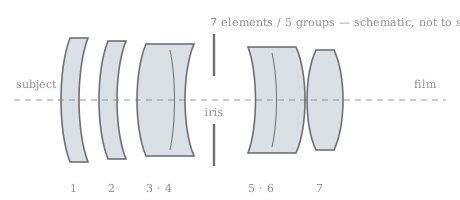
ⓘ What these charts mean
MTF (modulation transfer function) shows how much contrast the lens keeps at a given fineness of detail, from the center of the frame to the corner — the coarse curves track punch, the fine ones resolving power, and a gap between solid and dashed lines means astigmatism. Relative illumination (falloff) shows how much darker the corners are than the center at each aperture. Manufacturers only began publishing these for modern lenses; no 1950s maker issued them, which is why older families here cite period magazine bench tests instead.
History
The 135mm f/5.6 is the one Hasselblad V lens that cannot be focused on its own. Zeiss’s data sheet for the C version puts it in the first sentence: “The S-PLANAR f/5.6 - 135 mm is designed for use with a bellows extension, so it has no worm-wheel drive for focusing.” On the Hasselblad bellows “the focusing range of the lens is continuous from infinity to scale 1 : 1,” which the sheet places at 0.54 m. The rest of the sheet — catalogue number 107711, seven elements in five groups, an exact focal length of 137.1 mm, an aperture scale from f/5.6 to f/45, a Compur size 0 shutter with automatic diaphragm, a bayonet for series 50 filters, 560 g — describes a leaf-shuttered macro cell rather than a lens in the usual sense. Japanese Wikipedia dates its release to 1968, four or five years after the helical-focusing S-Planar 120mm f/5.6 it was built to complement.
Zeiss positioned it exactly as it had the 120. “Like the S-PLANAR f/5.6 - 120 mm, the S-PLANAR f/5.6 - 135 mm is optimally corrected for close-range work,” the sheet says, and “owing to its relatively constant correction over a broad scale range, the lens can also be used successfully for distance if it is stopped down slightly more than a normal lens.” Emulsive’s guide to the C lenses gives the same 7/5, B50 and 560 g, an 85 mm length, and notes the lens’s adaptability to landscape and portraiture despite its purpose. The barrel followed the C line’s finishes: chrome first, black anodising available from 1969 per Emulsive, and T* multicoating from 1973/74 — Emulsive has all C lenses single-coated until 1974, and Japanese Wikipedia has T* marks appearing “from around 1974, progressively.” No source dates the 135’s own changeovers, and Zeiss’s red-ink date code inside the rear mount is the only way to place an individual lens.
In 1982 the lens changed name without changing glass. The CF barrel brought the Prontor CF shutter, a push-button EV interlock, the green F setting for the focal-plane bodies and a bayonet-60 filter mount, and the name ring now read Makro-Planar — Zeiss’s blanket renaming of its Hasselblad S-Planars at the CF changeover. The CF sheet (catalogue number 10 78 24) lists the same seven elements in five groups and the same 137.1 mm focal length, at 620 g, and Emulsive’s CF guide calls the CF optically identical to the S-Planar C (its “7 elements in 4 groups” is the outlier against both Zeiss sheets). Zeiss now sold the pairing harder: with the bellows “the photographer has a camera that can quickly focus from infinity down to life size without any further accessories,” with “a fast central shutter, offering flash synchronisation to 1/500 s” — “this high performance combination is unique in medium format.” That is why the two names sit in one family here: the rename was a label, not a redesign.
The lens did not survive the CF line. Hasselblad Historical’s index lists the S-Planar f/5.6 135 mm under C and the Makro-Planar f/5.6 135 mm under CF, and nothing under CB, CFi or CFE, so 1998 — the end of the CF generation — is taken as its end. Zeiss’s CFi sheet for the 120mm Makro-Planar still pointed to “the Makro-Planar 5,6/135 CF with bellows” as the route to 1:1, so the lens was on sale, or at least in stock, into the CFi era. KEH catalogues it “for use with bellows, or variable extension tube,” and Emulsive names the discontinued Variable Extension Tube 64–85 as the alternative to the bellows.
What remains open: the 1968 date rests on Japanese Wikipedia alone, and one lens database gives a much earlier year that neither Zeiss sheet supports; who at Zeiss Oberkochen designed the lens; the serial or date-code boundaries of the chrome, black and T* barrels; a documented discontinuation date rather than an inferred one; any list price — Victor Hasselblad Inc.’s 1973 and 1980 American price lists exist as large scans and were not read here; and production figures, which would have to come from Nordin’s compendia.
This history is AI-written, from the sources listed at the foot of the page. Where the record is silent it says so rather than filling the gap — but no human wrote these sentences.
Example photos
Sample photo wanted — shot with a S-Planar / Makro-Planar 135mm f/5.6 (bellows)? We'd love to feature it (with credit).
Live listings
- Hasselblad 135mm f5.6 CF Makro-planar
- Hasselblad C Carl Zeiss 5.6/135mm S-Planar for Bellow w. caps and case
- Hasselblad CF 135mm F/5.6 Makro-Planar L#6783903 BOS
Listings updated 2026-09-11. Links go to the shop or marketplace that carries the item.