S-Planar 120mm f/5.6
Carl Zeiss · Hasselblad V · 1964 · S-Planar (near-symmetrical macro Planar)
Also known as: Zeiss S-Planar 120mm f/5.6 · Carl Zeiss S-Planar T* 120mm f/5.6 · S-Planar 5.6/120 · S-Planar 120/5.6 · Hasselblad 120mm S-Planar · Hasselblad 120mm f/5.6 · Hasselblad 120mm C Planar · Planar-S 120mm f/5.6 · Planar S 120mm · S-Planar C 120mm · S-Planar 120mm f5.6 C T*
Variants & identification
| Variant | Mount | Years | Serial ranges | Production |
|---|---|---|---|---|
| S-Planar C 5.6/120, chrome (1964 baseline) · Synchro-Compur, 1s–1/500 and B | Hasselblad V | 1964–1970 | — | — |
| S-Planar C 5.6/120, black (non-T*) · Synchro-Compur, 1s–1/500 and B | Hasselblad V | 1970–1974 | — | — |
| S-Planar C T* 5.6/120 · Synchro-Compur, 1s–1/500 and B | Hasselblad V | 1974–1982 | — | — |
- Element and group counts, weight, closest focus, aperture range and filter series are from the Zeiss data sheet for the C T* version (C120) hosted by Hasselblad Historical; no separate sheet for the chrome or black non-T* lens was found.
- Generation boundaries follow the V-system barrel conventions (chrome to black ~1969/70, T* ~1973/74, CF from 1982); no source gives the month of the 120mm's own changeovers, and old stock overlapped the new.
How to tell them apart
- Every version is a C lens with a Synchro-Compur, EV interlock lever and bayonet-50 filter mount — there was no CF, F or FE S-Planar; the CF-era macro lens is the f/4 Makro-Planar, a different family
- Chrome barrels are always single-coated; black barrels are usually T* but a black non-T* transitional lens exists
- Aperture scale ends at f/45 on the T* lens (Zeiss sheet); Emulsive reports early lenses stopping at f/32
- The name ring reads S-Planar; dealers often write 'Planar-S' or 'Planar S'
S-Planar C 5.6/120, chrome (1964 baseline):
- Satin-chrome barrel engraved Carl Zeiss / S-Planar 1:5.6 f=120mm; no T* mark
- Synchro-Compur with the EV interlock lever — aperture and speed rings move together until the cross-coupling lever is pressed
- Bayonet-50 filter mount; helical focusing to 0.95 m (Zeiss data sheet: 'bayonet for Hasselblad series 50')
- Emulsive's C-lens guide reports an early version stopping down to f/32 and a later one to f/45; the Zeiss sheet for the C T* gives f/45
S-Planar C 5.6/120, black (non-T*):
- Black-anodised barrel with the same S-Planar 1:5.6 f=120mm engraving, EV interlock lever and bayonet-50 mount as the chrome lens
- No red T* after the name — the transitional black single-coated lens
S-Planar C T* 5.6/120:
- Red T* on the name ring; black barrel; bayonet-50 filter mount; EV interlock lever
- Zeiss data sheet: cat. no. 10 77 03, 6 elements in 4 groups, exact focal length 121 mm, f/5.6–45, 0.95 m closest focus, 640 g, Compur size 0 with automatic diaphragm, 36° diagonal field
- S-Planar C 5.6/120, chrome (1964 baseline): The first macro lens for the 500-series. The launch year is thin: Japanese Wikipedia dates the S-Planar C 120mm to 1963, while dealer and database listings give 1964, and no Zeiss or Hasselblad document consulted here fixes it. When the chrome barrel gave way to black is likewise unfixed for this lens; the V-system convention is ~1969/70, which is the boundary used here.
- S-Planar C 5.6/120, black (non-T*): Emulsive's guide has black-anodised C barrels available from 1969 and states that all C lenses were single-coated until 1974, so a black S-Planar without T* is expected in the ~1970–1974 window. No source consulted gives serial boundaries or a month for the 120mm's own changeover, and old stock overlapped.
- S-Planar C T* 5.6/120: The multicoated final form. Japanese Wikipedia puts T* marks on the Hasselblad lenses 'from around 1974, progressively'; Emulsive says Zeiss began T* in 1973 and that C lenses were single-coated until 1974. Replaced in 1982 by the Makro-Planar CF 4/120, whose Zeiss sheet names this lens as its predecessor and says the new f/4 aperture was achieved 'without exceeding the optical dimensions of the f/5.6 lens'.
Serial-range notes
- red-ink code inside the rear mount, pre-1980
- Zeiss stamped a date code inside the rear of every C lens: the last two digits are the month and the leading digit(s) plus 1957 the year, so 705 = May 1964 and 1803 = March 1975. Lens serials are Zeiss's running numbers; no block-to-year table for the 120mm S-Planar was found.
- red-ink code inside the rear mount, 1980–82
- The last C T* lenses carry the post-1980 form — two reversed year digits and a month letter, A = January — so a late 120mm reading 18F was made in June 1981.
Specifications
- Formula
- S-Planar (near-symmetrical macro Planar)
- Construction
- 6 elements / 4 groups
- Aperture range
- f/5.6–f/45
- Shutter
- Synchro-Compur in the lens on every version, 1s–1/500 and B, flash sync at every speed
- Min. focus
- 0.95 m
- Dimensions
- 86.5 mm long
- Weight
- 640 g
- Years manufactured
- 1964–1982
- Country
- West Germany
- Coating
- Single-coated (chrome and early black barrels); T* multicoated from ~1973/74
What reviewers say
- Ikuru Suto (ストックホルムの空を見上げて), C non-T* on a 203FE (blog) — Shallow-focus frames of a child on a swing on 400VC, and with a Proxar 0.5 m close-up lens resolution to spare for near-macro work; unexpectedly good against the light even without a hood. Late-1960s single coating, not T*. via machine translation — corrections welcome
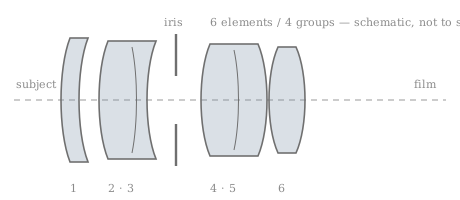
Optical formula — S-Planar (near-symmetrical macro Planar)
ⓘ What these charts mean
MTF (modulation transfer function) shows how much contrast the lens keeps at a given fineness of detail, from the center of the frame to the corner — the coarse curves track punch, the fine ones resolving power, and a gap between solid and dashed lines means astigmatism. Relative illumination (falloff) shows how much darker the corners are than the center at each aperture. Manufacturers only began publishing these for modern lenses; no 1950s maker issued them, which is why older families here cite period magazine bench tests instead.
History
The S-Planar 120mm f/5.6 was the first lens Zeiss built for the Hasselblad 500-series that was corrected for close range rather than for infinity. Its Zeiss data sheet is explicit about what the letter means: “As indicated by the designation ‘S’, the S-Planar T* f/5.6-120 mm is a special lens,” corrected for close-range work “such as drawing reproductions and technical subjects where the standards of image quality and freedom from distortion are much higher than for pictorial photography.” The same sheet gives the hard figures — six elements in four groups, an exact focal length of 121 mm, an aperture scale from f/5.6 to f/45, a Compur size 0 shutter with automatic diaphragm, a bayonet for Hasselblad’s series 50 filters, 0.95 m closest focus and 640 g. When it arrived is less firm: Japanese Wikipedia dates the S-Planar C 120mm to 1963, dealer and database listings give 1964, and no Zeiss or Hasselblad document consulted here settles it.
Zeiss was candid about the trade-off. The S-Planar’s correction, the sheet says, “is relatively invulnerable to changes in image scale” and so the lens “can therefore be used successfully for distance shots, too, but should be stopped down somewhat further than a ‘normal’ lens of comparable focal length.” Below 0.95 m Zeiss wanted extension tubes or the bellows, not close-up lenses: “the use of Proxars has an unfavorable effect on the S-Planar’s T* correction.” Emulsive’s guide to the C lenses repeats the practical reading — best correction at f/11, technical macro first, landscapes when stopped down — and adds the one barrel-level detail no sheet gives, that early lenses stopped down only to f/32 and later ones to f/45.
The barrel followed the rest of the C line. Chrome satin was the original finish; Emulsive has black-anodised C barrels available from 1969 and states that “from 1959 until 1974 all C lenses were single coated,” with Zeiss beginning T* multicoating in 1973. Japanese Wikipedia puts T* marks on the Hasselblad lenses “from around 1974, progressively.” So a chrome S-Planar is always single-coated, a black one is usually T*, and a black lens without the red T* marks the short transition between. No source consulted gives the month of the 120mm’s own changeovers or a serial boundary, and Zeiss’s red-ink date code inside the rear mount — pre-1980, the last two digits the month and the leading digits plus 1957 the year — is the only dating tool for an individual lens.
The S-Planar’s end is documented by its successor. Zeiss’s sheet for the Makro-Planar CF 4/120 of 1982 says the new lens, “like its predecessor, the 120 mm S-Planar T* f/5.6 lens,” consists of six elements in four groups “arranged almost symmetrically to the iris diaphragm,” and calls it “a major achievement on the part of the designer” that the aperture could be opened to f/4 “without exceeding the optical dimensions of the f/5.6 lens.” Hasselblad Historical’s lens index lists the S-Planar f/5.6 120 mm under the C generation only; there was never a CF, F or FE S-Planar, and the S-Planar name itself passed to Zeiss’s microlithography lenses, as the later CFi Makro-Planar sheet notes. Its bellows-only sibling, the S-Planar 135mm f/5.6, shared the naming and the fate.
What remains open: the launch year (1963 or 1964); which Zeiss designer computed the lens — no source names one; the serial or date-code boundaries of the chrome-to-black and single-to-T* transitions and of the f/32-to-f/45 aperture-scale change; any list price — Victor Hasselblad Inc.’s 1973 and 1980 American price lists exist as large scans and were not read for this entry; and production figures, which would have to come from Nordin’s compendia.
This history is AI-written, from the sources listed at the foot of the page. Where the record is silent it says so rather than filling the gap — but no human wrote these sentences.
Example photos

Sample photo wanted — shot with a S-Planar 120mm f/5.6? We'd love to feature it (with credit).
Live listings
Asking price, USD: a median of $450 across 12 fixed-price listings on 2026-09-11 (middle half $400–$500). Tracked since 2026-09-06, 2 days: unchanged from $450.
By day
| Date | Median | Middle half | Listings |
|---|---|---|---|
| 2026-09-11 | $450 | $400–$500 | 12 |
| 2026-09-06 | $450 | $400–$500 | 12 |
Asking prices from the listings scanned, not sales; junk-flagged rows and auction lots excluded; other currencies are not converted.
- 【Exc+5】 Hasselblad Carl Zeiss T* S Planar 120mm f/5.6 C Lens for 500 From JAPAN
- Carl Zeiss S-Planar 120mm f/5.6 C + Hasselblad Ext Tubes 21 + 55 (Fungus)
- Carl Zeiss 120mm f5.6 S-Planar Lens
- [MINT] Hasselblad Carl Zeiss T* S Planar 120mm f/5.6 C lens From JAPAN
- Hasselblad 120mm F/5.6 S-Planar L#4787008 JBRetro
- Hasselblad Zeiss S-Planar C 120mm f/5.6 Macro Lens. Chrome. 2 Proxars. Ext. tube
- Hasselblad S-Planar 120mm f/5.6 C L0061
- Carl Zeiss S Planar 120mm f/5.6 Large Format Lens No Shutter PLEASE READ RA99
- Carl Zeiss S-Planar T* 5.6/120mm f/5.6 120mm Black for Hasselblad No.5790214
- * Lens Carl Zeiss f Hasselblad 500 C S-Planar 5.6/120mm T* Black No6129756 Mint
- Carl Zeiss S-Planar 120mm f/5.6 lens # 4872734
- Zeiss f. Lihnhof 5.6/120 mm S-Planar
- Carl Zeiss S-Planar 120mm F5.6 black Lens for Hasselblad 500 501CM 120/5.6 As Is
- 【Exc+5】 Hasselblad Carl Zeiss T* S Planar 120mm f/5.6 C Objektiv für 500 aus ...
- Hasselblad S-Planar 5,6/120 Carl Zeiss Chrome Tele Lens 120mm f/5.6 Teleobjektiv
- Hasselblad Carl Zeiss S-Planar T* 120mm F5.6 für Hasselblad V-Series #6349842
- Hasselblad S-Planar 5,6/120 chrom Carl Zeiss Lens 120mm 5.6 Tele
- Hasselblad S-Planar 5,6/120 chrom Carl Zeiss Lens 120mm 5.6
- Hasselblad S-Planar C 5,6/120 chrom Carl Zeiss Lens 120mm 5.6
- Hasselblad 500 C/M Silver mit Carl Zeiss S-Planar 120mm. f/5.6. Kamera 6x6.
Show 9 more listings
- 【Exc+5】 Hasselblad Carl Zeiss T* S Planar 120mm f/5.6 C Lens for 500 From JAPAN
- Hasselblad S-Planar 120mm f5.6 Carl Zeiss Chrome Tele/ Close up Objektiv. V Serie
- [Opt Mint] Hasselblad Carl Zeiss S Planar 120mm f/5.6 C Lens Chrome From JAPAN
- [MINT] Hasselblad Carl Zeiss T* S Planar 120mm f/5.6 C lens From JAPAN
- Hasselblad 120mm f5.6 Zeiss S-Planar Chrome
- Hasselblad 120mm f5.6 Planar-S
- Hasselblad 120mm f5.6 Planar-S Black - cl'a May 2023
- Hasselblad 120mm f5.6 T*
- [Very Good] Hasselblad Carl Zeiss S Planar 120mm f/5.6 C Lens Chrome
eBay links are affiliate links. If you buy through one, Glass Bodies earns a small commission from eBay at no cost to you. It does not change which listings appear, their prices or their order — those come from the search and the sort described above.
Listings updated 2026-09-11. Links go to the shop or marketplace that carries the item.