Nikkor-P(·C) 8.5cm f/2
Nippon Kogaku · Nikon S + LTM + Contax RF · 1948 · Sonnar
Also known as: Nikkor 8.5cm f/2 · Nikkor 85mm f/2 · Nikkor-P·C 8.5cm f/2 · Nikkor-P.C 8.5cm f/2 · Nikkor-PC 8.5cm f2 · Nikkor-P 8.5cm f/2 · Nikkor-P·C 85mm f/2 · Nikkor-P 85mm f/2 · Nippon Kogaku 8.5cm f/2 · Nikkor P.C 8.5cm F2.0 · 8.5cm f2
Variants & identification
| Variant | Mount | Years | Serial ranges | Production |
|---|---|---|---|---|
| Nikon S, chrome (1948 baseline) | Nikon S | 1948 | 801102–801295 (295, May 1949 — MIOJ, two-piece rim, 435g)¹ 903025–903506 (1950 — MIOJ on the barrel, triangle index) 903547–904093 (1,093 — MIOJ on the focus cam, dot index) 286483–288436 (1951 — MIOJ, sometimes MIJ) 288616–289513 (aperture to f/16) 289505–296800 (10,318 — aperture to f/32) 396388–404576 (8,276 — 380g; black and chrome mixed from 4000xx) | ~21,500 family total across mounts and finishes (sum of five recorded serial-block quantities 295 + 1,093 + 10,318 + 8,276 + 1,512 — span-derived arithmetic; no published total exists) |
| Black paint over brass | Nikon S | — | 396388–404576, black and chrome mixed from 4000xx — a black example below 4000xx is unusual but not impossible, and a chrome one above it is normal¹ | — |
| Black anodized aluminum (final) | Nikon S | 1956 | 496xxx–497xxx | <2,000 made |
| Leica screw mount | LTM | — | — | — |
| Contax RF | Contax RF | — | — | — |
How to tell them apart
Nikon S, chrome (1948 baseline):
- Chrome-over-brass barrel; early examples have no filter thread — the hood is friction-fit — and some early aperture rings are click-less
- 10 rounded aperture blades keep the opening circular when stopped down
Black paint over brass:
- Black paint over brass, same barrel as late chrome
- Black and chrome OVERLAP in the 399–404k block — serial alone doesn't date the finish
Black anodized aluminum (final):
- Black anodized aluminum barrel — the 1956 aluminum change; the family's final form
- Black paint over brass: No per-mount split is published for the black finishes; a final-type all-black example in Leica screw mount is documented (Kasyapa), so the Nikon S mount here reflects the primary market, not an exclusive attribution.
- Black anodized aluminum (final): As with the black-paint variant, no per-mount split is published; Kasyapa's all-black final-type sample lens is Leica screw mount.
- Leica screw mount: The mount Duncan and FORTUNE's Bristol bought Nikkors in on the spot after the Ohi plant projection tests (official Chronicle; Kasyapa echoes the story in brief). Kasyapa's modern sample set was shot with an LTM example — the all-black final type — on a Leica M9-P. No per-mount production figure exists.
- Contax RF: Nikon modified this lens's rangefinder coupling for LIFE photographer Carl Mydans's Contax — the origin of all Contax-mount Nikkors. No per-mount production figure exists.
Serial-range notes
- 287050 · 289279
- Chrome examples offered by Fotopia (Hong Kong), 2026 — 287050 sits in the 1951 MIOJ block, 289279 in the f/16 block.
- 399979
- A chrome example inside 396388–404576, which is where Vink records black and chrome running together; a silver barrel at 399xxx is expected, not anomalous.
- earliest blocks, May 1949 onward
- First recorded serials date to May 1949, against the March 1948 launch date; the Nikon Chronicle groups the lens only 'by 1949'.
- 399510 · 401126
- Two Contax-mount examples marked C, recorded from the owner's own observation (2026-09-04): 399510 on a silver barrel, 401126 on a black barrel. Both sit inside the 399–404k block where chrome and black overlap, which is the point — 1,600 serials apart, and the finish flipped.
- 399xxx–403xxx
- Black paint over brass, on the same barrel as late chrome — but black and chrome overlap through the 399–404k block, so serial alone doesn't date the finish.
- 496xxx–497xxx
- Final black anodized aluminum version, <2,000 made; the aluminum change came in 1956.
Specifications
- Formula
- Sonnar
- Construction
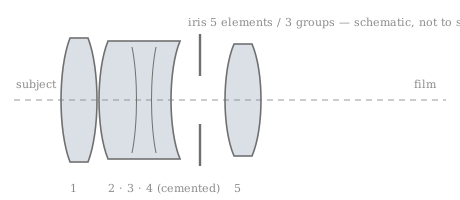
- 5 elements / 3 groups
- Aperture range
- f/2
- Diaphragm blades
- 10
- Min. focus
- 1 m
- Weight
- 425 g
- Filter
- 48 mm
- Years manufactured
- 1948
- Country
- Japan
What reviewers say
- BastianK (phillipreeve.net) (blog) — Soft and hazy wide open but sharpening well from f/2.8, with unexpectedly high contrast, near-nonexistent distortion, and build tolerances tighter than the Jupiter-9's — though the bokeh is a mixed bag and cheaper legacy SLR 85s leave its price premium a question only the buyer can answer.
- Richard Haw (blog) — Already pretty sharp wide open with almost no chromatic aberration, mild well-controlled spherical aberration that lends a moody glow, and smooth Sonnar bokeh — a legendary first-generation Nikkor, still visibly leaning on its Zeiss inspiration, that he rates a great portrait lens.
- Kasyapa (MAP CAMERA staff) (blog) — On a Leica M9-P the focus plane is impressively keen even at f/2 with vivid contrast and color, flare and blooming surface in tough light wide open, and stopping down brings astonishing resolution and lifelike texture — a two-faced character the author finds central to its appeal. via machine translation — corrections welcome
- aremo-koremo (カメラが欲しい、レンズが欲しい、あれもこれも欲しい) (blog) — Shot on a Nikon S2 with SFX200, it shrugged off harsh coastal backlight with no noticeable ghosting — credited to the Sonnar's few air-glass surfaces — and delivered satisfying stopped-down sharpness, though the bokeh can turn busy in the classic Sonnar way. via machine translation — corrections welcome
Optical formula — Sonnar
History
Few lenses can claim to have changed a company’s fortunes as directly as the Nikkor-P·C 8.5cm f/2. Launched in March 1948 (per Japanese Wikipedia; Nikon’s own Chronicle groups it only “by 1949”), it was a five-element, three-group Sonnar derived from the Zeiss 85mm f/2, newly computed after the war by Saburo Murakami (村上三郎) — working, as Nikon’s house history relates, with log tables, hand-cranked calculators, and abacuses. In June 1950, photographer Jun Miki (三木淳) borrowed this lens and snapped LIFE’s David Douglas Duncan; the sharpness of the enlargement so impressed Duncan that he visited Nippon Kogaku’s Ohi plant, watched projection tests pit his own lenses against Nikkors, and left a convert. That visit — triggered by this lens — is what made Nikkor’s Western reputation.
The familiar lore does need one correction: Duncan did not take the 8.5cm f/2 to war. When he left to cover Korea, he carried Leicas fitted with the Nikkor 5cm f/1.5 and 13.5cm f/4 — the 8.5/2 was the trigger of the story, not his Korea lens. The episode seeded a second lineage too: Nikon modified this lens’s rangefinder coupling to fit LIFE photographer Carl Mydans’s Contax, and every Contax-mount Nikkor that followed traces back to that job. The optical design itself had legs — Richard Haw notes the same five-in-three Sonnar layout became the basis of the beloved Nikkor-P·C 10.5cm f/2.5 — and Nikon’s essay credits it with high contrast and little coma flare even wide open, which is much of why the Duncan enlargement looked the way it did.
Production is best estimated at ~21,500 — the sum of the five recorded serial-block quantities (295 + 1,093 + 10,318 + 8,276 + 1,512), span-derived arithmetic in the absence of any published total — with the first recorded serials appearing in May 1949, a year after the launch date. The lens itself is a dense 425g of chrome-over-brass and glass, with a 48mm filter, ten rounded aperture blades, and a 1.0m minimum focus. The barrel evolved over the run: chrome gave way to black paint over brass in the 399xxx–403xxx serials — though black and chrome overlap through the 399–404k block, so serial alone won’t date a finish — and finally, with the 1956 change to aluminum, to a black anodized version in the 496xxx–497xxx range, of which fewer than 2,000 were made.
This history is AI-written, from the sources listed at the foot of the page. Where the record is silent it says so rather than filling the gap — but no human wrote these sentences.
Example photos

More sample photos elsewhere
- Flickr tag "Nikkor-P.C 1:2 f=8.5cm" — 30+ genuine samples by multiple photographers (portraits, street, florals; marc.l'esperance, Claude Allaert, Brian Chu, others)
- ♫ marc.l'esperance's 16-photo album — 1953 Nikkor P-C 1:2 f=8.5cm LTM adapted to Sony full-frame, all rights reserved (Flickr)
- dourbalistar's 29-photo album — Nikkor-P.C 8.5cm f/2 LTM (Type IV, c. 1951), mostly film scans shot with the lens (Flickr)
These photographers keep all rights to their work — enjoy it at the source.
Sample photo wanted — shot with a Nikkor-P(·C) 8.5cm f/2? We'd love to feature it (with credit).
Live listings
Asking price, USD: a median of $460 across 34 fixed-price listings on 2026-09-11 (middle half $300–$630). Tracked since 2026-09-06, 2 days: unchanged from $460.
By day
| Date | Median | Middle half | Listings |
|---|---|---|---|
| 2026-09-11 | $460 | $300–$630 | 34 |
| 2026-09-06 | $460 | $300–$630 | 34 |
Asking prices from the listings scanned, not sales; junk-flagged rows and auction lots excluded; other currencies are not converted.
- "NEAR MINT" Nippon Kogaku Nikkor P.C 8.5cm 85mm f/2 Lens For S Mount From JAPAN
- Nikon NIKKOR-P.C 8.5cm 85mm F/2 Lens S Mount 2933
- [Exc+++++] Nikon Nippon Kogaku Nikkor-P C 85mm 8.5cm f/2 Lens S Mount From JAPAN
- Nikkor-P.C 8.5cm 85mm f/2 L39 LTM camera lens Japan seller
- Nikon RF Nikkor 8.5cm/2 #401749, c.1955, chrome, C , Ex
- [Almost MINT] Nikon Nikkor-P.C 8.5cm 85mm f/2 Portrait MF Lens for S Mount JAPAN
- Nikon Nikkor-P.C 8.5cm f/2 Lens Nippon Kogaku Japan
- [Near MINT] Nikon NIKKOR-P.C 8.5cm 85mm F/2 Nippon Kogaku For S Mount From JAPAN
- Early Nikon Nikkor-P.C 8.5cm F2 Tokyo 903 MIOJ Rangefinder Lens S Mount
- [MINT] Nikon Nikkor P C 8.5cm f2 85mm Lens L39 Screw Mount from JAPAN #3996
- Nikon 8,5cm f2 Nikkor-P.C Nippon Kogaku Silver Lens Nr.403343 Mint-
- [Exc+5] Nikon NIKKOR-P.C 8.5cm f/2 MF Lens S Mount From Japan #6561
- Nikon NIKKOR P.C 85mm f/2 S Mount Portrait Lens w/ Caps Mint Japan
- Nikon NIKKOR-P.C 8.5cm 85mm f/2 S Mount Portrait Lens w/ Caps From Japan MINT
- Rare "C" Black [TOP MINT] Nippon Kogaku Nikkor-P.C 8.5cm F2 Lens Contax JAPAN
- Nikon 8.5cm F/2 Nikkor-P.C L#291910 S Mount
- Excellent++ Nikon NIKKOR-P.C 8.5cm 85mm f2 Lens for Nikon S Mount #4871
- Nikon 8.5cm F2 Nikkor P.C. Nippon Kogaku Japan RF Lens W/ Leather Case
- Rare!! "C" CLA'd[TOP MINT] Nikon Nikkor P.C PC 85mm f/2 Lens For CONTAX RF Mount
- Leotax f, Showa Optical Works Leica iiif Clone Nikkor P.C 8.5cm f/2
Show 40 more listings
- Nikon NIKKOR P.C 8.5cm 85mm F2 Manual Focus Lens S Mount Good Condition
- MIOJ Nippon Kogaku Tokyo Nikkor P. C 8.5cm f2 LTM Leica SM Mount Lens (S#2865xx)
- Nikon Nikkor P C 8.5cm f2 85mm Lens Leica LTM Screw Mount from US
- Nikon Nippon Kogaku Tokyo NIKKOR-P C 8.5cm F2 Fully Functional K486
- Rare "Tokyo" CLA'd[TOP MINT] Nikon Nikkor P.C PC P C 85mm f/2 Lens S Mount JAPAN
- Nikon Nippon Kogaku Nikkor-P.C 8.5cm 85mm F/2 Lens for Contax RF *EX+*
- [Near Mint] Nikon Nikkor-P.C 8.5cm 85mm f/2 Black S Mount RF Lens Japan 202
- Nikon Nikkor-P.C 8.5cm 85mm f2 S Mount Rangefinder Lens [GOOD]
- Nikon Nikkor-P.C 8.5cm 85mm f2 S Mount Rangefinder Lens [EXC-]
- Black [Near MINT] Nikon Nikkor-P.C 8.5cm 85mm f/2 Portrait Lens for S From JAPAN
- [Top Mint] Nikon Nikkor P.C PC 85mm f/2 black lens Contax Mount From JAPAN
- Nikon Nikkor-P.C 8.5cm 85mm f2 S Mount Rangefinder Lens [GOOD]
- Nikon Nikkor-P.C 8.5cm 85mm f2 S Mount Rangefinder Lens [EXC-]
- Nikon Nippon Kogaku 8.5cm 85mm f2 P.C Black LTM M39 lens
- AS-IS Nippon Kogaku Chrome Nikkor - P. C 8.5cm f2 RF S#: 294xxx Marked 'C'
- Nikon NIKKOR-P.C 8.5cm 85mm F/2 Lens S Mount 2933
- [Exc+++++] Nikon Nippon Kogaku Nikkor-P C 85mm 8.5cm f/2 Lens S Mount From JAPAN
- [Near MINT] Nikon NIKKOR-P.C 8.5cm 85mm F/2 Nippon Kogaku For S Mount From JAPAN
- [Almost MINT] Nikon Nikkor-P.C 8.5cm 85mm f/2 Portrait MF Lens for S Mount JAPAN
- [Exc+5] Nikon NIKKOR-P.C 8.5cm f/2 MF Lens S Mount From Japan #6561
- Nikkor-P C Objektiv 8,5 cm f/2 LTM L39 Schraubmontage
- Nikon NIKKOR-P.C 8.5cm 85mm f/2 S Mount Portrait Lens w/ Caps From Japan MINT
- Nikon NIKKOR P.C 85mm f/2 S Mount Portrait Lens w/ Caps Mint Japan
- Rare "C" Black [TOP MINT] Nippon Kogaku Nikkor-P.C 8.5cm F2 Lens Contax JAPAN
- Rare!! "C" CLA'd[TOP MINT] Nikon Nikkor P.C PC 85mm f/2 Lens For CONTAX RF Mount
- Rare "Tokyo" CLA'd[TOP MINT] Nikon Nikkor P.C PC P C 85mm f/2 Lens S Mount JAPAN
- Black [Near MINT] Nikon Nikkor-P.C 8.5cm 85mm f/2 Portrait Lens for S From JAPAN
- [Exc+++++] Nikon Nippon Kogaku Nikkor-P C 85mm 8.5cm f/2 Objektiv S Mount...
- [Fast neuwertig] Nikon NIKKOR-P.C 8,5cm 85mm F/2 Nippon Kogaku für S Mount...
- [Fast NEUWERTIG] Nikon Nikkor-P.C 8,5 cm 85 mm f/2 Portrait MF Objektiv für...
- [Exc+5] Nikon NIKKOR-P.C 8.5cm f/2 MF Objektiv S Mount aus Japan #6561
- Nippon Kogaku Nikkor-P.C 85mm 8,5cm f/2 Nikon S Objektiv - Gut! Chrome
- Nikon Nippon Kogaku Nikkor P.C 8.5cm f/2 converted to Leica M-mount
- Nikkor-P.C 8.5 cm F/2 R A R E
- Nikkor-P. C 8.5cm f2 LTM
- Nippon Kogaku Nikkor-P.C 85mm F2 - Silver / Nikon S Mount — SN 289279
- Nippon Kogaku Nikkor-P.C 85mm F2 - Silver / Nikon S Mount — SN 287050
- Nippon Kogaku Nikkor-P.C 85mm F2 - Silver / Contax RF — SN 399979
- Nikon Nippon Nikkor P.C 8.5cm 85mm f2 LTM Screw Mount Lens L39 M39 Rangefinder
- Nikon NIKKOR-P.C 8.5cm F2 [S] ビューファインダー付
eBay links are affiliate links. If you buy through one, Glass Bodies earns a small commission from eBay at no cost to you. It does not change which listings appear, their prices or their order — those come from the search and the sort described above.
Listings updated 2026-09-11. Links go to the shop or marketplace that carries the item.