Nikkor 85mm f/1.8
Nippon Kogaku · Nikon F · 1964 · Double Gauss, then redesigned
our own findingAlso known as: Nikkor-H Auto 85mm f/1.8 · Nikkor-H·C Auto 85mm f/1.8 · Nikkor-H.C Auto 85mm f/1.8 · Nikkor-HC 85mm f1.8 · Nikkor 85mm f/1.8 K · New Nikkor 85mm f/1.8 · AF Nikkor 85mm f/1.8 · AF Nikkor 85mm f/1.8D · Nikon 85mm f/1.8 · NIKKOR-H Auto 1:1.8 f=85mm · ニッコール 85mm F1.8
Variants & identification
| Variant | Mount | Years | Serial ranges | Production |
|---|---|---|---|---|
| Nikkor-H Auto 85mm f/1.8 — pre-AI · Double Gauss, 6 elements in 4 groups — lanthanum glass in the first and sixth elements | Nikon F (pre-AI, meter prong) | 1964–1972 | 188001 – 188003 (3) — prototypes, May 1964, chrome barrel with the lens data on the focus ring 188011 – 195184 (7,174) — from August 1964; data engraved inside the filter thread, feet or metres, 430g 205001? – 210308 (5,308) — 1967–68; data moves to the barrel 219901 – 247423 (27,523) — 1969–71; 420g, takes Ai conversion kit 38 250001? – 284781 (34,781) — 1971–72; front ring engraved NIKON rather than NIPPON KOGAKU JAPAN | ~74,789 across the recorded blocks (3 + 7,174 + 5,308 + 27,523 + 34,781 — arithmetic, not a published total)¹ |
| Nikkor-H·C Auto 85mm f/1.8 — multicoated · Double Gauss, 6 elements in 4 groups — the H optics, multicoated | Nikon F (pre-AI, meter prong) | 1972–1975 | 390001 – 402690 (12,690) — 1972 to April 1975 | 12,690 |
| Nikkor 85mm f/1.8 (K) · Double Gauss, 6 elements in 4 groups — unchanged from the H | Nikon F (pre-AI, meter prong) | 1975–1977 | 410001 – 443163 (33,163) — March 1975 to February 1977 | 33,163 — the largest single manual-focus block, and the last |
| AF Nikkor 85mm f/1.8 — new optical design · 6 elements in 6 groups — a wholly separate computation with rear-group focusing, sharing only the focal length and the aperture | Nikon F (AF) | 1987–1994 | 200001 – 311119 (111,119) — December 1987 to April 1994 | 111,119 |
| AF Nikkor 85mm f/1.8D · 6 elements in 6 groups — the 1987 optics, with distance information added to the mount | Nikon F (AF-D) | 1994–2020 | 400001 – 506533 (106,533) — March 1994 to 2005, Japan 600001 – 677523 (77,523) — 2006–09, Japan 2000001 – 2052181 (52,181) — 2010–12, Thailand 2100001 – 2107777 (7,777) — 2013–20, Japan | ~244,014 across four blocks (106,533 + 77,523 + 52,181 + 7,777 — arithmetic)¹ |
- Vink's quantity column is derived from serial numbers collected rather than factory records. Checked against his own start and end numbers, each quantity is the inclusive serial span, so it assumes no numbers went unused. The block sums — ~74,789 pre-AI, ~120,642 manual focus in total, ~355,133 autofocus — are arithmetic performed here, and no published total exists for any of them.
- There is no Ai and no Ai-S 85mm f/1.8. The Ai changeover of 1977 replaced this lens with the slower Ai Nikkor 85mm f/2, a separate design. Nikon's own essay on the f/1.8 records a colleague being "greatly disappointed" by the loss of speed — a third of a stop, from f/1.8 to f/2.
- The 1987 autofocus lens shares the name and nothing else: six elements in six groups against six in four, 62mm filters against 52mm, nine blades against six, f/16 against f/22. It is carried here as a variant because the nameplate is continuous, not because the lens is.
- Nikon dates the release to August 1964 and the design report to May 1962; Vink's first production block also begins in August 1964, with prototypes three months earlier. The two sources agree, which is worth saying where so often they do not.
- No list price has been found for any version of this lens, in yen or dollars, in the sources consulted.
How to tell them apart
- The H in Nikkor-H is Nikon's element-count code (Hex, six); the ·C that joins it in 1972 marks multicoating. Both letters disappear in 1975, when Nikon stopped putting the count on the barrel
- Every manual-focus version takes 52mm filters and the HN-7 hood; every autofocus version takes 62mm and the HN-23
- The manual lens is 72mm across and 62mm long in a straight chrome-ringed barrel; the autofocus lens is 71mm across and 58.5mm long in black plastic. Weight separates them too: 430g against 380–415g
Nikkor-H Auto 85mm f/1.8 — pre-AI:
- Scalloped metal focus ring; 52mm filter; six aperture blades; minimum aperture f/22
- Close focus 1m and about 180° of focus throw — the K that follows does 0.85m in 215°
- Five slotted mount screws (Vink)
Nikkor-H·C Auto 85mm f/1.8 — multicoated:
- ·C after the H: multicoated, same six elements, same barrel
- Five cross-head mount screws where the single-coated H has slotted ones (Vink)
Nikkor 85mm f/1.8 (K):
- Rubber focus grip in place of the metal scallops
- Close focus 0.85m and a 215° throw — the only manual version that focuses that close
- 70mm barrel diameter against 72mm on the earlier versions
- Takes Ai conversion kit 37; the pre-AI H takes kit 38
AF Nikkor 85mm f/1.8 — new optical design:
- 62mm filter, not 52mm; nine aperture blades, not six; minimum aperture f/16, not f/22
- Twist-type aperture lock at the minimum-aperture setting
- 415g and only 58.5mm long — shorter and lighter than the manual lens it does not descend from
AF Nikkor 85mm f/1.8D:
- Sliding aperture lock in place of the AF's twist lock
- 380g — 35g lighter than the AF, on the same optics
- The 2010–12 block is the only one made in Thailand; every other block is Japanese
- AF Nikkor 85mm f/1.8 — new optical design: Not the same lens. Vink separates it from the manual-focus run with his heaviest rule, the one he reserves for a different optical design, and the specifications agree at every point that matters.
Serial-range notes
- 188001 – 188003
- Three prototypes from May 1964, chrome-barrelled with the lens data engraved on the focus ring rather than inside the filter thread.
- 188152
- Richard de Stoutz records this lens as the 142nd built, counting from 188011: 1964, feet-only scale from 3.5ft, black front ring, LENS MADE IN JAPAN in white on the focus ring.
- 250001 onward
- The front ring engraving changes from NIPPON KOGAKU JAPAN to NIKON. Optics unchanged; it is a branding change, and it is the fastest way to date a pre-AI barrel to 1971 or later.
- 219901 – 247423
- Vink records 420g for this block against 430g earlier and 430g again on the K — a 10g dip in the middle of the run that no source explains.
- 443163 → 200001
- The gap that matters. The manual-focus lens stops at 443163 in February 1977 and no 85mm f/1.8 is built again until the autofocus lens starts at 200001 in December 1987. In between, the fastest 85mm Nikkor short of the f/1.4 was the Ai 85mm f/2.
Specifications
- Formula
- Double Gauss, then redesigned
- Construction
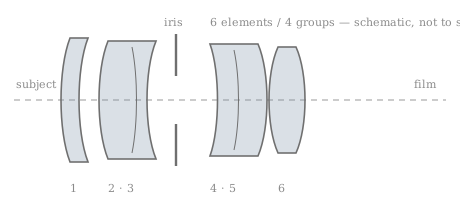
- 6 elements / 4 groups
- Aperture range
- f/1.8–f/22
- Diaphragm blades
- 6
- Min. focus
- 1 m
- Dimensions
- 72 × 62 mm
- Weight
- 430 g
- Filter
- 52 mm
- Years manufactured
- 1964–2020
- Country
- Japan
- Coating
- Single-coated to 1972; multicoated from the H·C
What reviewers say
- Nikon — NIKKOR: The Thousand and One Nights, Tale 96 (blog) — Nikon's own assessment is unflattering and specific: residual astigmatism, higher-order spherical aberration and coma at full aperture, giving flare and soft edges wide open that clear from f/4 to f/5.6, against "very little distortion or lateral chromatic aberration" — a high-performance lens for its time, stopped down.
- Casual Photophile (blog) — Soft in the centre and at the edges at f/1.8, effectively gone by f/4 and comparable to modern lenses at f/5.6; slight fringing on high-contrast edges wide open, bokeh that blends rather than distracts, and a tendency to flare dramatically in the wrong light.
Optical formula — Double Gauss, then redesigned
History
The Nikon F went on sale in April 1959 with a 10.5cm and a 13.5cm in the catalogue and no 85mm at all. The gap lasted five years, and Nikon’s own account of the lens explains why: the longer telephotos could be carried over from rangefinder practice, but at 85mm the back focus is short enough that the mirror dictates a new design. Saburo Murakami (村上三郎), who had computed the 8.5cm f/2 that brought LIFE’s photographers to the Ohi plant in 1950, started work around 1961 and filed his report in May 1962. The Nikkor-H Auto 85mm f/1.8 was released in August 1964. It was the last lens he worked on.
The design is a conventional double Gauss — six elements in four groups, with newly developed lanthanum glass in the first and sixth — and Nikon’s essay is unusually blunt about what it does not do. Residual astigmatism, higher-order spherical aberration and coma are all present at f/1.8, and the corners stay soft until f/4 or f/5.6. What it does have is a nearly flat field, very little distortion, and almost no lateral colour error. Reviewers sixty years later reach the same verdict by a different route: soft and flare-prone wide open, indistinguishable from modern glass by f/5.6.
For thirteen years it was the only fast 85mm Nikon made. Roughly 74,789 pre-AI lenses were built between 1964 and 1972 by the arithmetic of Vink’s blocks, another 12,690 as the multicoated H·C, and 33,163 as the rubber-gripped K that ran to February 1977 — about 120,642 in all, and the K is both the biggest block and the best of them mechanically, focusing to 0.85m where the earlier barrels stop at 1m.
Then Nikon discontinued it. The Ai changeover of 1977 brought an 85mm f/2 instead, and Nikon’s essay preserves a colleague’s reaction to that decision — “greatly disappointed”, at a third of a stop. No Ai 85mm f/1.8 exists, and no Ai-S. The name went out of production for ten years and ten months.
What came back in December 1987 is a different lens wearing the same badge: six elements in six groups, focusing by moving a rear group, 62mm filters, nine blades, f/16 at the small end. Vink separates it from the manual run with the heaviest rule in his table, the one reserved for a new optical design. It sold enormously — 111,119 as the AF, another 244,014 or so as the AF-D through 2020, in Japan and for two years in Thailand — which is nearly three autofocus lenses for every manual one Nippon Kogaku ever made. The nameplate then passed to an AF-S G design in 2012 and a Z-mount design in 2019, each new again.
What is missing is money. No list price for any version of this lens, at any point across fifty-six years, has turned up in the sources consulted — not in yen, not in dollars — so the one question a buyer in 1964 would have asked first is the one the record does not answer.
This history is AI-written, from the sources listed at the foot of the page. Where the record is silent it says so rather than filling the gap — but no human wrote these sentences.
Example photos
.jpg)
.jpg)
Sample photo wanted — shot with a Nikkor 85mm f/1.8? We'd love to feature it (with credit).
Live listings
The listings collector hasn't run for this family yet — check back soon, or search the marketplaces directly meanwhile.