Komura 80mm f/1.8
Sankyo Koki · Nikon S + LTM + Contax RF + Exakta · 1957 · Ernostar
Also known as: Komura- 80mm f/1.8 · KOMURA- 80mm F1.8 · Sankyo Koki Komura 80mm f/1.8 · Sankyo Kohki Komura 80mm f/1.8 · Sankyo Koki Tokyo 80mm f1.8 · Komura 8cm f/1.8
Variants & identification
| Variant | Mount | Years | Serial ranges | Production |
|---|---|---|---|---|
| Nikon S | Nikon S | — | — | — |
| Leica screw mount | LTM | — | — | — |
| Contax RF | Contax RF | — | — | — |
| Exakta | Exakta | — | — | — |
- Sankyo Koki published no production figures for this lens.
How to tell them apart
- Preset aperture — no automatic diaphragm
- At least two versions observed, one with a silver aperture ring
Nikon S:
- Black with wide chrome stripes
- "N" engraved on the barrel — Sankyo Koki's Nikon-mount marking convention (some late lenses left unmarked)
- Supplied with a dedicated external finder
Specifications
- Formula
- Ernostar
- Construction
- 5 elements / 4 groups
- Aperture range
- f/1.8–f/16
- Diaphragm blades
- 12
- Min. focus
- 1.25 m
- Filter
- 48 mm
- Years manufactured
- 1957
- Country
- Japan
What reviewers say
- koiWide (blog) — Low contrast and visible flare wide open, but a dream-like rendering he loves — deformed edge highlights that dissolve smoothly into what he dubs "jellyfish bokeh" — an adventurous design for 1957 that nonetheless sold poorly. via machine translation — corrections welcome
- Spotmatic (MFlenses forum) (blog) — Wide open it wraps subjects in a glow well suited to portraits and sharpens up nicely a few clicks down the preset diaphragm — the thread admired the glow's character in portraits, with mixed feelings about the busier bokeh in foliage.
Optical formula — Ernostar
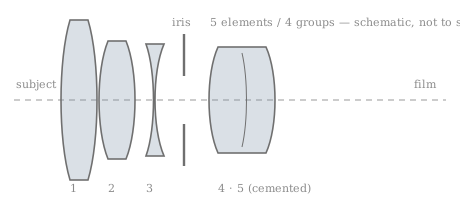
History
Released in 1957 — or 1958, depending on which published account you trust — the Komura 80mm f/1.8 was the boldest lens the small Tokyo maker Sankyo Koki had yet attempted: its first large-aperture design and one of the initial four lenses the company offered in Nikon rangefinder mount. Optically it is a five-element, four-group Ernostar with a cemented rear group, and it draws exactly the way that pedigree promises. Where Nippon Kogaku’s own Sonnar-formula Nikkor-P·C 8.5cm f/2 renders with classical discipline, the Komura wide open wraps its subject in a low-contrast, dream-like glow, and its out-of-focus highlights deform toward the frame edges and dissolve softly — a signature the Japanese reviewer koiWide affectionately calls “jellyfish bokeh.” Stop the preset diaphragm down a few clicks and it sharpens up into a well-behaved portrait telephoto.
Sankyo Koki was founded in 1951 and began selling lenses under the Komura name in 1955, staying in business until 1980. Its Nikon-mount line ran from the late 1950s into the early 1960s: a first-hand Japanese account puts the initial four at 35mm f/2.8, 80mm f/1.8, 105mm f/2.8, and 135mm f/3.5, with more telephotos following into the early 1960s. Like fellow third-party maker Tanaka, the company marked its Nikon-mount lenses with an “N” on the barrel, though some late lenses went unmarked. The 80mm f/1.8 was not an S-mount exclusive — it was also sold in Leica screw, M42, Contax, and Exakta mounts — and an f/1.8 short telephoto was genuinely adventurous territory for a small independent lens-maker in the late 1950s. koiWide’s verdict is that the ambition went largely unrewarded — the lens sold poorly against the pull of camera-makers’ own glass — which is one reason every mount of it is scarce today.
The Nikon-mount lens is finished in black with wide chrome stripes, carries the “N” barrel engraving, and was supplied with a dedicated external finder. The aperture is a twelve-blade preset unit stopping down to f/16, and the filter thread is a slightly awkward 48mm. At least two versions exist, one distinguished by a silver aperture ring, but no serial ranges have been worked out for them, and no production figures survive for any mount. Even the original price is lost: the only surviving Komura price list, EPOI’s 1965 sheet, covers the Leica-screw and SLR lines, and no S-mount list has ever surfaced. What remains is the lens itself — rare in every mount, and the first of the Ernostar portrait lenses Sankyo Koki would bring to the Nikon rangefinder system, with the Ernostar-type 105mm f/2 following the same recipe a few years later.
This history is AI-written, from the sources listed at the foot of the page. Where the record is silent it says so rather than filling the gap — but no human wrote these sentences.
Example photos
More sample photos elsewhere
- Rangefinderforum: 'Komura 80mm f1.8 by Sankyo Kohki for Nikon RF' — dedicated thread with aperture-series samples (f/1.8–f/8) from the Nikon S-mount lens
- Rangefinderforum: 'The Definitive Komura & Acall thread, post your photos!' — member samples incl. an 80/1.8 zoo set on page 2 (that copy is the LTM rangefinder version, shot on a Leica M4-P)
- Charles Edouard TOWO (towo.charles) on Flickr — 'Komura 80mm 1.8' film samples, Jan 2026 (mount version unverified; all rights reserved, link-out only)
These photographers keep all rights to their work — enjoy it at the source.
Sample photo wanted — shot with a Komura 80mm f/1.8? We'd love to feature it (with credit).
Live listings
Asking price, USD: a median of $600 across 13 fixed-price listings on 2026-09-11 (middle half $550–$750). Tracked since 2026-09-06, 2 days: unchanged from $600.
By day
| Date | Median | Middle half | Listings |
|---|---|---|---|
| 2026-09-11 | $600 | $550–$750 | 13 |
| 2026-09-06 | $600 | $550–$750 | 13 |
Asking prices from the listings scanned, not sales; junk-flagged rows and auction lots excluded; other currencies are not converted.
- Komura 80mm f1.8 Sankyo Koki Tokyo Lens for M39 Mount #008 (LTM)
- Komura 80mm f/1.8 (Sankyo Koki Tokyo) M39, Good — SN 2551008 (LTM)
- 【 RARE N MINT w/ Finder 】 Sankyo Koki Komura 80mm f/1.8 L39 LTM Leica lens Japan
- Komura 80mm F1.8 Leica L39 Mount Lens e3399
- Rare!! CLA'd [MINT] Sankyo Koki Komura 80mm f/1.8 Lens L39 LTM Leica L Mount
- Komura 80mm F1.8 Lens
- Komura 80Mm F1.8 Leica L39 Mount Lens E3399
- *RARE COLLECTION* SANKYO KOKI TOKYO KOMURA 80MM F1.8 MF PORTRAIT L39 MOUNT LENS
- Komura 80mm F1.8 Leica L Mount Lens Super Rare
- EXCELLENT Sankyo Koki KOMURA- 80mm F/1.8 Prime Lens
- Sankyo Koki Komura 80mm F/1.8 Lens for Leica L39 #54125 C2
- Komura 80mm f1.8 Leica SM lens #230722 111-93-3 Very Rare !!
- Sankyo Koki Komura 80mm F/1.8 Leica L39 Mount Used Lens, Optics OK
- Komura 80mm F1.8 Leica L39 Mount Lens e3399
- EXCELLENT Sankyo Koki KOMURA- 80mm F/1.8 Prime Lens
- Rare!! CLA'd [MINT] Sankyo Koki Komura 80mm f/1.8 Lens L39 LTM Leica L Mount
- RARE COLLECTION SANKYO KOKI TOKYO KOMURA 80MM F1.8 MF PORTRAIT L39 MOUNT LENS
- Komura 80mm F1.8 Leica L Mount Lens Super Rare
- Sankyo Koki Komura 80mm F/1.8 Lens for Leica L39 #54125 C2
- Sankyo Koki Komura 80mm F/1.8 Leica L39 Mount Used Lens, Optics OK
Show 8 more listings
- Komura 80mm F1.8 Leica L39 Mount Objektiv e3399
- Objectif SLR Téléobjectif KOMURA- Sankyo Koki 80mm f/1.8 M42 Manuel 48mm
- Selten Sammlung SANKYO KOKI Tokyo Komura 80MM F1.8 Mf Portrait L39 Mount Linse
- Komura 80mm F1.8 Leica L Mount Objektiv Super Rare
- EXCELLENT Komura Sankyo Koki 80mm f/1.8 Teleobjektiv SLR M42
- EXCELLENT Sankyo Koki KOMURA- 80mm F/1.8 Prime Lens
- RARE COLLECTION SANKYO KOKI TOKYO KOMURA 80MM F1.8 MF PORTRAIT L39 MOUNT LENS
- Sankyo Koki KOMURA- 80mm F/1.8 単焦点レンズ
eBay links are affiliate links. If you buy through one, Glass Bodies earns a small commission from eBay at no cost to you. It does not change which listings appear, their prices or their order — those come from the search and the sort described above.
Listings updated 2026-09-11. Links go to the shop or marketplace that carries the item.