Nikkor-P·C 10.5cm f/2.5
Nippon Kogaku · Nikon S + LTM · 1953 · Sonnar
Also known as: Nikkor 10.5cm f/2.5 · Nikkor 105mm f/2.5 · Nikkor-P·C 10.5cm f/2.5 · Nikkor-P.C 10.5cm f/2.5 · Nikkor-P C 10.5cm f2.5 · Nikkor-P 10.5cm f/2.5 · Nikkor 105mm f/2.5 rangefinder · Nikkor-P·C 105mm f/2.5 · NIKKOR-P・C 10.5cm F2.5 · 10.5cm f2.5
Variants & identification
| Variant | Mount | Years | Serial ranges | Production |
|---|---|---|---|---|
| Nikon S | Nikon S | 1953 | — | ~22,000 (Rotoloni via 35mmc) — the volume S-mount tele; per-mount split not stated |
| Leica screw mount | LTM | 1956 | — | — |
How to tell them apart
Nikon S:
- Nikon S bayonet with its own focusing helicoid and rangefinder-coupling cam
- Chrome-and-black 'panda' finish only — unlike the older 8.5cm/13.5cm teles it never came all-chrome
- Early barrels have two small lugs securing the hood; later barrels are smooth at the front
Leica screw mount:
- Leica thread mount — the only difference from the S version is the mount itself
- No 105mm frame lines on Leica bodies — Haw considers an external finder mandatory (Mendes de Almeida shot it using the 135mm lines)
- Leica screw mount: The LTM version dates to about 1956; no source pins the year more precisely.
Specifications
- Formula
- Sonnar
- Construction
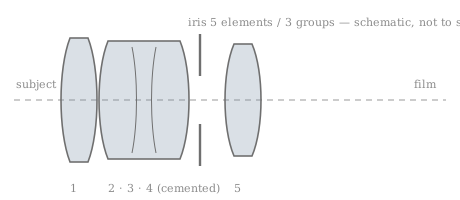
- 5 elements / 3 groups
- Aperture range
- f/2.5
- Min. focus
- 1.2 m
- Filter
- 52 mm
- Years manufactured
- 1953
- Country
- Japan
What reviewers say
- Richard Haw (blog) — Sharp already at f/2.5 with bokeh he calls "exquisite" — to him among the best bokeh of any S-mount Nikkor — but wide-open vignetting of more than two stops is its biggest weakness; highly recommended, a must for Nikon RF shooters.
- José Mendes de Almeida (EMULSIVE) (blog) — Beautiful, solid and easy to focus if a little heavy; often filed as a collector's item, but he shoots the LTM version on a Leica M7 in the street with great results — much less expensive than the Leica equivalent.
- Haruo Sato (佐藤治夫) — Nikon's own 1001-Nights essay, Tale 45 (blog) — Wakimoto left spherical aberration slightly under-corrected for the sake of the background blur: good resolution and contrast wide open across all but the extreme edges, with rich tonality — a best-seller that split the era's popularity with the 8.5cm f/2, beloved by Ken Domon. via machine translation — corrections welcome
- Taku Hayashi (smart tutor) (blog) — A hidden gem with soft, characterful Sonnar rendering and beautiful bokeh — and because so many were made, clean examples cost far less than the celebrated 8.5cm f/2. via machine translation — corrections welcome
Optical formula — Sonnar
History
Zenji Wakimoto (脇本善司) computed the optics for the 10.5cm f/2.5 in 1949, but the lens took the slow road to market: production drawings were only finalized in the spring of 1953, and sources split on the launch — December 1953 per the Japanese Wikipedia, late summer 1954 in Nikon’s own account. It arrived to fill the awkward gap between the 8.5cm and 13.5cm Nikkors, and its slightly odd f/2.5 aperture was no accident: in an era when Nikon counted every fraction of a stop against its rivals, f/2.5 made this the fastest lens in the 100mm class at the time. The design is a classic Sonnar — five elements in three groups, with a thick cemented triplet buried in the rear — and Wakimoto made one deliberately “wrong” choice that defined its character: he left the spherical aberration slightly under-corrected, trading a hair of clinical bite for background blur that reviewers still reach for words like “exquisite” to describe.
The gamble paid off. The 10.5cm became a best-seller — by Nikon’s own account it split the era’s popularity evenly with the celebrated 8.5cm f/2 — favored by Ken Domon (土門拳) among other photographers, with production around 22,000 units (Rotoloni, via 35mmc) making it the volume telephoto of the S system. Today it sits in the shadow of the more glamorous 8.5cm f/2, and because it was made in such numbers, clean examples remain the affordable entry into Nikon rangefinder telephotos. A Leica screw-mount version followed around 1956, differing only in its mount; Richard Haw notes the barrel itself evolved once, from early examples with two small hood-securing lugs to a later smooth-fronted version, and that the lens only ever wore the “new” chrome-and-black panda scheme — it arrived too late for the all-chrome dress of the older teles.
Its real legacy, though, is longevity. When Nikon pivoted to the SLR, Wakimoto’s computation crossed over almost intact — the rear element was shaved by roughly a millimeter to clear the Nikon F’s mirror (Haw; Nikon’s essay cites the same 1.0mm reduction), and that was essentially that. The same 1949 Sonnar soldiered on in the F-mount 105mm f/2.5 until 1971, a run of about 17 years, when Yoshiyuki Shimizu’s (清水義之) Xenotar-type (Gauss-derived) redesign — drawn up in the winter of 1966 — finally replaced it from serial 407301. Few lens designs of any era can claim their optical formula outlived the camera system it was born into.
This history is AI-written, from the sources listed at the foot of the page. Where the record is silent it says so rather than filling the gap — but no human wrote these sentences.
Example photos
More sample photos elsewhere
- count_basil's LTM 10.5cm f/2.5 samples on a Leica M9 (Flickr)
- Ashwin Rao's 10.5cm LTM portrait set (Flickr)
These photographers keep all rights to their work — enjoy it at the source.
Sample photo wanted — shot with a Nikkor-P·C 10.5cm f/2.5? We'd love to feature it (with credit).
Live listings
Asking price, USD: a median of $280 across 38 fixed-price listings on 2026-09-11 (middle half $200–$350). Tracked since 2026-09-06, 2 days: unchanged from $280.
By day
| Date | Median | Middle half | Listings |
|---|---|---|---|
| 2026-09-11 | $280 | $200–$350 | 38 |
| 2026-09-06 | $280 | $200–$350 | 38 |
Asking prices from the listings scanned, not sales; junk-flagged rows and auction lots excluded; other currencies are not converted.
- [Near MINT] Nikon Nikkor-P.C 105mm 10.5cm f/2.5 for S Mount From JAPAN
- Nippon Kogaku Black Nikkor- P. C 105mm 10.5cm f2.5 S Lens S#: 817xxx w/Cap
- Nippon Kogaku NIKKOR-P.C 10.5cm F2.5 for Nikon S-Mount #013 – Read Description
- [MINT] Nippon Kogaku NIKKOR-P.C 10.5cm f2.5 Lens for Nikon S Lens From JAPAN
- Nikon Nikkor-P C 10.5cm 105mm f/2.5 S Mount Lens From JAPAN【MINT】
- [Near MINT] Nikon P.C Nikkor 10.5cm f/2.5 For S Mount MF Lens From JAPAN
- [Top MINT] Nikon Nikkor-P.C 10.5cm / 2.5 From JAPAN #1010
- [Near MINT] Nikon Nikkor-P.C 10.5cm 105mm f/2.5 Portrait Lens S Mount JAPAN
- [Near MINT] Nikkor-P Nippon Kogaku 10.5cm f/2.5 Tele-Portrait Lens From JAPAN
- [N.MINT] Nikon Nippon Kogaku Nikkor-P.C 10.5cm 105mm f2.5 S Mount L39 Lens JAPAN
- Nikon Nikkor P.C 10.5cm f2.5
- Nikon NIKKOR-P C 10.5cm 105mm F2.5 Black S-Mount
- [Mint] Nippon Kogaku NIKKOR-P.C 10.5cm 105mm f/2.5 Nikon S Mount Lens Japan #a2
- Nikon NIKKOR-P C 10.5cm F2.5 S-mount, fully functional, E428
- Exc Nippon Kogaku Nikon NIKKOR P.C 10.5cm 105mm f/2.5 Lens w/ Case from JP #2725
- [MINT] Nippon Kogaku Nikon Nikkor-P.C 10.5cm 105mm f/2.5 For Nikon S From JAPAN
- Japan Nikon NIKKOR-P・C 10.5cm/2.5 (S) Rangefinder Lens
- Exc++ Nippon Kogaku Nikon NIKKOR-P 10.5cm F2.5 f/2.5 Lens for Nikon S Mount
- 🎦👀✨Top MINT✨ Nikon Nikon Nikkor-P.C PC 10.5cm 105mm f2.5 S Mount Lens JAPAN
- Nippon Kogaku Nikkor P.C 10.5CM 105mm f/2.5 L39 Screw Mount Lens #814404
Show 42 more listings
- [No extra costs]Nippon Kogaku Nikkor P 10.5cm f/2.5 Lens Nikon S mount Exc +++++
- Nikon NIKON NIKKOR-P C 10.5cm F2.5 S-mount Fully Working #E428
- VERY GOOD Nikon Nikkor P.C 10.5cm 105mm F/2.5 For Leica LTM L39 Prime Lens
- [Opt TOP MINT] Nikon Nikkor-P.C 10.5cm 105mm f/2.5 Portrait Lens for S JAPAN
- Nikon Nikkor P.C 10.5cm 105mm F2.5 S Mount Lens from JAPAN [N Mint]2573005
- Nikon NIKKOR-P C 10.5cm 105mm f/2.5 Leica LTM L39 lens #913982 240918
- Nikon Nikkor-P.C 10.5cm 105mm f2.5 L39 screw mount
- Nikon Black Nikkor P. C 10.5cm 105mm f2.5 LTM Lens S#:912xxx for Leica 3F/3G SM
- Nikkor P 10.5cm 105mm f2.5 Nippon Kogaku Japan Black Rangefinder S mount Lens
- Rare 'C' [Near MINT] Nikon Nikkor-P.C. 10.5cm f/2.5 Contax C Lens From JAPAN
- Nikon Nikkor-P.C 10.5cm F2.5 Telephoto Prime Lens Nikon S Nippon Kogaku Japan
- Nippon Kogaku NIKKOR-P 10.5cm F2.5 lens cased Beautiful
- Nikon LTM Nikkor 10.5cm/2.5 #815305, black 10.5cm Bright Line Finder, filters, caps, case, Ex
- Nikon NIKKOR-P.C 10.5cm f2.5 S Mount Rangefinder Lens Vintage Condition
- Nikon NIKKOR-P.C 10.5cm F2.5 LTM Leica L39 Mount Telephoto Lens from Japan E0705
- Nikon Nikkor-P.C 10.5cm 105mm f2.5 Telephoto Prime Lens For Nikon S [EXC+]
- Nikon Nikkor-P.C 10.5cm 105mm f2.5 Telephoto Prime Lens For Nikon S [EXC+]
- Nikon LTM/M Nikkor P.C 10.5cm f/2.5 L#916461
- [Near MINT] Nikon Nikkor-P.C 105mm 10.5cm f/2.5 for S Mount From JAPAN
- [Near MINT] Nikon Nikkor-P.C 10.5cm 105mm f/2.5 Portrait Lens S Mount JAPAN
- [MINT] Nippon Kogaku NIKKOR-P.C 10.5cm f2.5 Lens for Nikon S Lens From JAPAN
- [N.MINT] Nikon Nippon Kogaku Nikkor-P.C 10.5cm 105mm f2.5 S Mount L39 Lens JAPAN
- Nikon Nikkor-P C 10.5cm 105mm f/2.5 S Mount Lens From JAPAN【MINT】
- [Near MINT] Nikon P.C Nikkor 10.5cm f/2.5 For S Mount MF Lens From JAPAN
- [Mint] Nippon Kogaku NIKKOR-P.C 10.5cm 105mm f/2.5 Nikon S Mount Lens Japan #a2
- [Almost Unused] Nippon Kogaku Nikon Nikkor-P.C 10.5cm f/2.5 for S Mount JAPAN
- VERY GOOD Nikon Nikkor P.C 10.5cm 105mm F/2.5 For Leica LTM L39 Prime Lens
- [MINT] Nippon Kogaku Nikon Nikkor-P.C 10.5cm 105mm f/2.5 For Nikon S From JAPAN
- 🎦👀✨Top MINT✨ Nikon Nikon Nikkor-P.C PC 10.5cm 105mm f2.5 S Mount Lens JAPAN
- Nikon Nikkor-P C 10.5cm F2.5 Leica L Mount Lens Rare
- Rare 'C' [Near MINT] Nikon Nikkor-P.C. 10.5cm f/2.5 Contax C Lens From JAPAN
- [Opt TOP MINT] Nikon Nikkor-P.C 10.5cm 105mm f/2.5 Portrait Lens for S JAPAN
- Nikon Nikkor-P.C 10.5cm F2.5 Telephoto Prime Lens Nikon S Nippon Kogaku Japan
- Nikon Nikkor-P C 10.5cm F2.5 Leica L Mount Objektiv Selten
- Nikon Nikkor-P.C 10.5cm F2.5 Tele Prime Objektiv Nikon S Nippon Kogaku Japan
- Sehr Gut Nikon Nikkor P.C 10.5cm 105mm F/2.5 For Leica Ltm L39 Prime Objektiv
- Nikkor-P.C 2.5/10.5cm black
- VERY GOOD Nikon Nikkor P.C 10.5cm 105mm F/2.5 For Leica LTM L39 Prime Lens
- EXCELLENT Nikon Nikkor P.C 10.5cm 105mm f2.5 For Leica LTM L39 Prime Lens
- Nippon Kogaku Nikkor-P.C 105mm F2.5 - Nikon S Mount — SN 812928
- Nikkor-P.C Nippon Kogaku 105mm F/2.5(LTM Mount)
- Nikon Nikkor P.C 10.5cm 105mm F/2.5 For Leica LTM L39 単焦点レンズ
eBay links are affiliate links. If you buy through one, Glass Bodies earns a small commission from eBay at no cost to you. It does not change which listings appear, their prices or their order — those come from the search and the sort described above.
Listings updated 2026-09-11. Links go to the shop or marketplace that carries the item.