Distagon 50mm f/4
Carl Zeiss · Hasselblad V · 1964 · Distagon (retrofocus)
Also known as: Zeiss Distagon 50mm f/4 · Carl Zeiss Distagon T* 50mm f/4 · Distagon 4/50 · Distagon 50/4 · Hasselblad 50mm Distagon · Hasselblad 50mm f/4 · Hasselblad 50mm f4 · Distagon T* 4/50 CFi · Distagon CF 50mm FLE · Distagon C 50mm · Distagon 50mm f4 C T* · Distagon 50mm ZV
Variants & identification
| Variant | Mount | Years | Serial ranges | Production |
|---|---|---|---|---|
| Distagon C 4/50, chrome (1964 baseline) · Synchro-Compur, 1s–1/500 and B | Hasselblad V | 1964–1970 | — | — |
| Distagon C 4/50, black (non-T*) · Synchro-Compur, 1s–1/500 and B | Hasselblad V | 1970–1973 | — | — |
| Distagon C T* 4/50 · Synchro-Compur, 1s–1/500 and B | Hasselblad V | 1973–1982 | — | — |
| Distagon CF T* 4/50 (non-FLE) · Prontor CF, 1s–1/500 and B, plus F setting | Hasselblad V | 1982–1989 | — | — |
| Distagon CF T* 4/50 FLE · Distagon, new computation — 9 elements in 8 groups, floating front group (elements 1–4) · Prontor CF, 1s–1/500 and B, plus F setting | Hasselblad V | 1989–1998 | — | — |
| Distagon CFi T* 4/50 FLE · Prontor CFi, 1s–1/500 and B, plus F setting | Hasselblad V | 1998–2013 | — | — |
| Distagon T* 4/50 ZV Classic (Zeiss-branded, 2006) · leaf shutter in the lens, 1s–1/500 and B (Zeiss sheet does not state the shutter maker) | Hasselblad V | 2006 | — | — |
- Element and group counts, weights, closest focus, exact focal lengths and filter series are from the Zeiss data sheets hosted by Hasselblad Historical (C50, CF50FLE, CFi50, ZV50). No sheet for the non-FLE CF 50 was found.
- Generation start years follow the barrel/shutter families (CF 1982, CFi 1998, ZV 2006); the 1964 launch and the 1989 FLE date come from review and dealer chronologies, and the black and T* changeovers are undated for the 50 specifically.
How to tell them apart
- Two optical designs under one name: 7 elements in 7 groups from 1964 through the first CF (to 1989); 9 in 8 with a floating front group in the CF FLE, CFi and ZV
- A front click-stop ring with four distance ranges means FLE; a single focusing ring means the older 7/7 lens, whether C or CF
- Filter mount sorts C from later: bayonet 63 on every C lens; bayonet 60 on CF, CF FLE and CFi per dealer descriptions (the Zeiss sheets print 93 and 70 — unconfirmed); 67 mm thread with a 60-series bayonet on the ZV
- Red T* on the name ring from 1973; chrome barrels are always pre-T*
- Only the CF, CF FLE and CFi have the green F setting for open-shutter use on a 2000/200-series body; the 50/2.8 F and FE are a different lens
Distagon C 4/50, chrome (1964 baseline):
- Satin-chrome barrel, engraved Carl Zeiss / Distagon 1:4 f=50mm; no T* mark; single coating
- Synchro-Compur with the EV interlock lever — aperture and speed rings move together until the cross-coupling lever is pressed
- Bayonet-63 filter mount (Zeiss data sheet: 'adapter ring for Hasselblad series 63'); 0.5 m closest focus; about 885 g
- Red-ink Zeiss date code inside the rear mount — pre-1980 the last two digits are the month and the leading digit(s) plus 1957 the year
Distagon C 4/50, black (non-T*):
- Black-anodised barrel with the same C-type engraving, EV lever and bayonet-63 mount as the chrome lens; no red T*
- Same 7/7 optics and 885 g as the chrome lens — finish only
Distagon C T* 4/50:
- Red T* after the Distagon name; black barrel; bayonet-63 filter mount; EV interlock lever
- Zeiss data sheet: cat. no. 104148, 7 elements in 7 groups, 885 g, 0.5 m, Compur size 0 with automatic diaphragm
Distagon CF T* 4/50 (non-FLE):
- Single focusing ring — no front click-stop ring — on a Prontor CF barrel with rubber grip, green F on the speed ring and push-button EV interlock
- Bayonet-60 filter mount, as dealers describe every CF and CFi 50 (KEH)
- Hasselblad Historical lists it separately from the 'CF (FLE)' lens; no Zeiss data sheet for this version was found
Distagon CF T* 4/50 FLE:
- Two focusing rings: a front ring with four click-stopped ranges (∞–4 m, 4–1.2 m, 1.2–0.8 m, 0.8–0.5 m) that shifts elements 1–4, and the usual rear ring ∞–0.5 m (Zeiss data sheet)
- FLE engraved on the barrel; aperture scale now to f/32 where the C and non-FLE CF stop at f/22
- Exact focal length 52 mm; about 800 g; reproduction to 1:6.3 (data sheet, cat. no. 10 49 08)
- Filter mount: the Zeiss sheet prints 'bayonet for Hasselblad series 93', but dealers (KEH) and the ZV sheet's 60-series outer bayonet point to bayonet 60 — treat the sheet's 93 as unconfirmed
Distagon CFi T* 4/50 FLE:
- CFi after the focal length; no databus contacts — the 50 was made as CFi, not CFE (Hasselblad Historical)
- Same two-ring FLE focusing; 9 elements in 8 groups; exact focal length 51.9 mm; 800 g; 1:6.3 at 0.5 m; f/4–32 (Zeiss data sheet, cat. no. 10 49 49)
- Filter mount: the sheet text reads 'series 70', which matches no dealer description (bayonet 60) and is carried here as a sheet-reading to be checked
Distagon T* 4/50 ZV Classic (Zeiss-branded, 2006):
- Sold by Zeiss under its own name, not Hasselblad's — ZV after the focal length; 67 mm filter thread plus a 60-series outer bayonet (Zeiss data sheet)
- Half-stop aperture clicks, f/4–32; 790 g; ø 80 mm × 92.3 mm; same 9/8 FLE optics and 0.5 m / 1:6.3 as the CFi
- Distagon C 4/50, chrome (1964 baseline): The first computation: 7 elements in 7 groups, exact focal length 51.3 mm, diagonal field 75°, f/4–22 (Zeiss data sheet, cat. no. 104148). The launch year is contested — 1964 (Christian Schroeder's review and most dealer chronologies), 1965 in some lists, 1963 in Japanese Wikipedia — and no dated Zeiss document consulted settles it. The end year is the chrome-to-black changeover, undated for this focal length; ~1969/70 is the C-line figure.
- Distagon C 4/50, black (non-T*): A short transitional finish. Christian Schroeder's 35mmc review is of a black 1970 example, which fixes at least one black non-T* lens to that year. Start and end follow the C line (black ~1969/70, T* 1973); no serial boundary is published.
- Distagon C T* 4/50: The multicoated C lens, optically unchanged from 1964. The data sheet says the lens is 'corrected for large object distances' and 'should be stopped down further when it is used for close-range work' — the shortcoming the 1989 FLE recomputation addressed. Replaced by the CF in 1982.
- Distagon CF T* 4/50 (non-FLE): The C lens's 7/7 optics moved into the 1982 Prontor CF barrel. Christian Schroeder's review treats the pre-1989 lenses, C and CF alike, as the same optical design and the FLE as 'a totally different beast' that 'commands prices that are way higher'. Weight and exact focal length for this version are not given by any sheet consulted.
- Distagon CF T* 4/50 FLE: The second computation, dated 1989 by Schroeder and by dealer chronologies. Zeiss's sheet says that 'despite the addition of further lens elements' the lens stays light and compact, that distance performance is very good and that the floating element 'has given a considerable improvement in the near range'. It borrows the two-ring arrangement from the 40 CF FLE of 1982 but with four ranges rather than three.
- Distagon CFi T* 4/50 FLE: The 1989 FLE optics in the 1998 CFi barrel — improved shutter mechanics, new focusing grip, matte internal finish. Zeiss's sheet calls distortion 'remarkably low, qualifying the lens for both professional architecture and product photography' and lists it as an all-purpose landscape and travel lens. Production ended with the V system in 2013.
- Distagon T* 4/50 ZV Classic (Zeiss-branded, 2006): Zeiss's ZV Classic line of 2006 (some lists say 2007/08) reissued three V-mount lenses — this Distagon, the Makro-Planar 120 and the Sonnar 180 (Hasselblad Historical) — for the 500-series after Hasselblad's own catalogue thinned. The sheet's marketing line calls it 'The Classic Wide-Angle Lens … the industry standard'. No end date or production figure is published.
Serial-range notes
- red-ink code inside the rear mount, pre-1980
- Zeiss stamped a date code inside the rear of every generation: before 1980 the last two digits are the month and the leading digit(s) plus 1957 the year, so 705 = May 1964 and 1611 = November 1973. Lens serials are Zeiss's running numbers; no block-to-year table for the 50 was found.
- red-ink code inside the rear mount, 1980 onward
- From 1980 the code is two reversed year digits and a month letter, A = January — so a CF 50 reading 98B was made in February 1989, and a lens with an FLE front ring should read 98x or later.
Specifications
- Formula
- Distagon (retrofocus)
- Construction
- 7 elements / 7 groups
- Aperture range
- f/4–f/22
- Shutter
- In the lens on every version — Synchro-Compur (C) or Prontor (CF, CFi), 1s–1/500 and B, flash sync at every speed; the shutterless f/2.8 F and FE lenses are a separate family
- Min. focus
- 0.5 m
- Weight
- 885 g
- Years manufactured
- 1964
- Country
- West Germany
- Coating
- Single-coated until T* multicoating on the C lens (1973); every later generation is T*
What reviewers say
- Christian Schroeder (35mmc) (blog) — A 1970 black C example bought for €300 that he calls a fantastic piece of gear — a wide that still gives a medium-format look when focused close, with noticeable flare from point sources and cumbersome coupled aperture/speed rings, redeemed by depth of field that makes scale focusing easy.
Optical formula — Distagon (retrofocus)
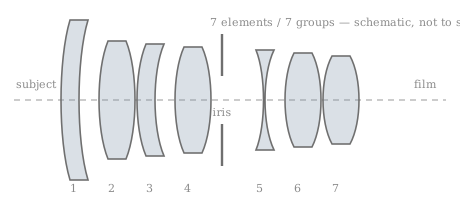
- Zeiss data sheet — C T* (cross-section, MTF)
- Zeiss data sheet — CF FLE, 9-element (cross-section, MTF)
- Zeiss data sheet — CFi (cross-section, MTF)
- Zeiss data sheet — ZV Classic (cross-section, MTF)
ⓘ What these charts mean
MTF (modulation transfer function) shows how much contrast the lens keeps at a given fineness of detail, from the center of the frame to the corner — the coarse curves track punch, the fine ones resolving power, and a gap between solid and dashed lines means astigmatism. Relative illumination (falloff) shows how much darker the corners are than the center at each aperture. Manufacturers only began publishing these for modern lenses; no 1950s maker issued them, which is why older families here cite period magazine bench tests instead.
History
The 50mm f/4 Distagon was the Hasselblad V system’s everyday wide-angle from the mid-1960s to the end of the line, and for most of that time the lens behind the name was one of two quite different designs. The launch year itself is unsettled: Christian Schroeder’s 35mmc review and most dealer chronologies say 1964, some lists say 1965, and Japanese Wikipedia’s product list gives 1963. Zeiss’s data sheet for the C T* version (cat. no. 104148) describes the first design — 7 elements in 7 groups, no cemented surfaces, exact focal length 51.3 mm, diagonal field 75°, f/4 to f/22, closest focus 0.5 m, about 885 g, a Compur size 0 shutter and a filter adapter for Hasselblad’s series 63. The sheet is candid about the design’s limit: the lens “is corrected for large object distances” and “should be stopped down further when it is used for close-range work”.
The barrel followed the C line’s changes without the optics moving. Chrome gave way to black around 1969/70 — Schroeder’s own lens is a black, non-T* example from 1970 — and the red T* multicoating mark arrived in 1973. In 1982 the same 7/7 glass went into Prontor’s CF shutter with a rubber focusing grip, a push-button EV interlock and the green F setting for open-shutter use on the 2000-series bodies. Hasselblad Historical’s lens index lists this “Distagon f/4 50 mm CF” as its own row, separate from the FLE lens that followed; no Zeiss data sheet for the non-FLE CF was found, so its weight is not given here.
The second design is the 1989 FLE. Zeiss’s sheet (cat. no. 10 49 08) gives 9 elements in 8 groups, exact focal length 52 mm, an aperture scale extended to f/32, and about 800 g — lighter than the C despite “the addition of further lens elements”. Like the 40mm CF FLE of 1982 it has two focusing rings, but with four ranges rather than three: the front ring clicks between ∞–4 m, 4–1.2 m, 1.2–0.8 m and 0.8–0.5 m and moves elements 1–4 relative to the rest, after which the rear ring focuses normally. The sheet says distance performance stayed very good and the floating element “has given a considerable improvement in the near range”. Schroeder calls the FLE “a totally different beast” that “commands prices that are way higher” than the older lens.
From 1998 the FLE optics were sold as the CFi (cat. no. 10 49 49) — improved shutter mechanics and grip, no databus contacts, since the 50 was made as CFi rather than CFE — and in 2006 Zeiss reissued them under its own name as the Distagon T* 4/50 ZV Classic, with a 67 mm filter thread inside a 60-series bayonet and half-stop aperture clicks (Zeiss ZV sheet; Hasselblad Historical lists three ZV lenses). One detail the data sheets leave untidy is the filter mount: the CF FLE sheet text reads “series 93” and the CFi sheet “series 70”, while dealers describe every CF and CFi 50 as bayonet 60 and the ZV sheet confirms a 60-series outer bayonet. The sheet figures are carried here as read, flagged rather than corrected.
What remains open: the launch year (1963, 1964 or 1965) and who at Zeiss Oberkochen computed either design — no source consulted names a designer; the chrome/black and T* boundaries for this focal length; a list price in any currency; the filter-series discrepancy above; when the ZV Classic left the market; and every production figure, which would have to come from Nordin’s compendia.
This history is AI-written, from the sources listed at the foot of the page. Where the record is silent it says so rather than filling the gap — but no human wrote these sentences.
Example photos


Sample photo wanted — shot with a Distagon 50mm f/4? We'd love to feature it (with credit).
Live listings
Asking price, USD: a median of $530 across 50 fixed-price listings on 2026-09-11 (middle half $390–$750). Tracked since 2026-09-06, 2 days: down 2% from $540.
By day
| Date | Median | Middle half | Listings |
|---|---|---|---|
| 2026-09-11 | $530 | $390–$750 | 50 |
| 2026-09-06 | $540 | $390–$780 | 51 |
Asking prices from the listings scanned, not sales; junk-flagged rows and auction lots excluded; other currencies are not converted.
- Hasselblad 50mm f4 Distagon Chrome Trim Ring -Only- [EXC+]
- Hasselblad Zeiss Distagon 50mm f/4 C T* Lens Self Timer Gear Mechanism V59
- [Exc+5 w/ Caps] Hasselblad Carl Zeiss Distagon C 50mm f/4 Chrome Lens From JAPAN
- Hasselblad C 50mm f4 Distagon Wide Angle Lens
- [Exc+5 w/ Case] Hasselblad Carl Zeiss T* Distagon C 50mm f/4 Lens From JAPAN
- ⏯️[Near MINT] Hasselblad Carl Zeiss T* Distagon C 50mm F4 Lens Silver From JAPAN
- Hasselblad 50mm f4 Zeiss Distagon C T* Lens Black #139
- Hasselblad C 50mm f4 Distagon Lens 530
- 【Exc+4】 Hasselblad Carl Zeiss T* Distagon C 50mm f/4 Lens for 500 CM From JAPAN
- Hasselblad 50mm f/4 Distagon C T* Lens for Hasselblad 500 Series V System {63}
- [Near MINT] Hasselblad Carl Zeiss Distagon C 50mm f/4 Lens Silver From JAPAN
- tested [Exc+5] Hasselblad Carl Zeiss Distagon C 50mm f/4 Silver Lens From JAPAN
- [Top MINT w/Case] Hasselblad Carl Zeiss T* Distagon C 50mm f/4 Lens From JAPAN
- [Near MINT] Hasselblad Carl Zeiss Distagon C 50mm f/4 T* Black Lens From JAPAN
- [Top MINT] Hasselblad Carl Zeiss Distagon C 50mm f/4 wide Angle Lens From JAPAN
- [MINT +++] Hasselblad Carl Zeiss T* Distagon C 50mm F/4 Lens Black From JAPAN
- w Caps [MINT] Hasselblad Carl Zeiss T* Distagon C 50mm f4 Lens Chrome
- Hasselblad Carl Zeiss Distagon C 50mm f/4 Wide Angle Lens Leaf Shutter Chrome
- Hasselblad Carl Zeiss Distagon C 50mm F/4 T* Black Lens from JAPAN #237
- [Optical Mint] Hasselblad Carl Zeiss T* Distagon 50mm f/4 Chrome Lens JAPAN
Show 121 more listings
- [MINT] Hasselblad Carl Zeiss T* Distagon C 50mm f/4 Lens 500 CM Japan #H4201
- Hasselblad Carl Zeiss Distagon C T* 50mm f4 Lens 619
- Hasselblad Carl Zeiss C Distagon 50mm f/4 Silver
- Hasselblad Used Carl Zeiss Distagon T* 50mm F4 Lens
- Hasselblad 50mm F/4 Distagon T* Black L#5633114 JBRetro
- Hasselblad 50mm f/4 Distagon CF T* Lens
- Hasselblad Carl Zeiss Distagon 50mm C f/4 T* Lens Exc++++ Mint glass
- Hasselblad 50mm f4 Zeiss Distagon CF FLE T* Lens #974
- Hasselblad 50mm f4 Distagon CF T*
- 【NEAR MINT】 Hasselblad Carl Zeiss Distagon CF 50mm f/4 T* Lens From JAPAN
- [Near MINT] Hasselblad Carl Zeiss Distagon CF 50mm f4 T* Lens from JAPAN
- Hasselblad CF 50mm f/4 Distagon L#6924993 BOS
- Video*[N MINT] Hasselblad Carl Zeiss Distagon CF 50mm f/4 T* Wide Angle JAPAN #1
- Hasselblad Carl Zeiss Distagon T* 50mm F/4 CF Lens #65331 C5
- [ALMOST UNUSED in Box] Hasselblad Carl Zeiss Distagon T* C 50mm F4 Lens JAPAN
- FLE [Exc+5] Hasselblad Carl Zeiss Distagon CF 50mm F/4 T* Lens From JAPAN
- [Near MINT] Hasselblad Carl Zeiss Distagon T* CF 50mm F4 Lens From JAPAN
- ⏯FLE [N MINT +++] Hasselblad Carl Zeiss Distagon CF 50mm F/4 T* Lens From Japan
- FLE Model [MINT] Hasselblad Carl Zeiss CF Distagon T* 50mm F4 Lens from JAPAN
- *Tested* Hasselblad 50mm f4 Zeiss Distagon CF FLE T* Lens for Hasselblad
- [MINT] Hasselblad Carl Zeiss Distagon CF 50mm F/4 T* Wide Lens FLE From JAPAN
- Hasselblad 50mm f4 Zeiss Distagon CF FLE T* Lens - Minty
- Pre-Owned Hasselblad 50mm f4 Distagon CFi T* #8165284
- Hasselblad CF FLE 50mm f/4 Distagon L#7199116 BOS
- Hasselblad Carl Zeiss CF Distagon 50mm f/4 T* 2026.07 Overhauled!!
- Hasselblad 50mm f4 Carl Zeiss Distagon CF FLE T* Lens EX++ Sharp!
- Hasselblad CFi FLE 50mm f/4 Distagon T* GOOD+
- Hasselblad 50mm f4 Zeiss Distagon CFi FLE T* Lens #219
- Hasselblad Zeiss Distagon 50mm f4 CFi FLE T* Wide Angle Prime Lens [MINT-]
- Hasselblad 500CM | 50MM F4 T*
- Hasselblad Distagon C 50mm f4 T* Zeiss Wide Angle Lens. Black. QF Handle. AS-IS!
- Carl Zeiss Distagon 50mm f4 C Hasselblad V series 500c 500cm etc.
- Zeiss Distagon C 50mm f4 für Hasselblad
- Hasselblad Zeiss Distagon 50mm f/4 T* 500cm 501cm 503cw
- Carl Zeiss Distagon C Weitwinkelobjektiv f/4 50mm für Hasselblad
- Hasselblad Carl Zeiss Distagon C 1:4/50 mm T* Nr.5898179 V-System -Text lesen !!
- Hasselblad Carl Zeiss distagon chrom C 50mm f4 V 500c 500cm etc
- Obiettivo manuale Distagon 50mm F4 per Hasselblad
- Hasselblad Zeiss Distagon 50mm f/4 Lens - Excellent Condition
- HASSELBLAD Distagon 50mm f/4,0 T* Carl Zeiss - SNr: 6389430
- HASSELBLAD Distagon 50mm f/4,0 T* Carl Zeiss - SNr: 5967610
- 【Exc+4】 Hasselblad Carl Zeiss T* Distagon C 50mm f/4 Objektiv für 500 CM...
- Manueller Distagon 50mm F4 Objektiv Für Hasselblad
- HASSELBLAD Distagon 50mm f/4,0 T* Carl Zeiss - SNr: 5633283
- [NEUWERTIG +++] Hasselblad Carl Zeiss T* Distagon C 50mm F/4 Objektiv...
- Carl Zeiss Distagon CF 50mm f/4 T Hasselblad V
- Hasselblad Objektiv Carl Zeiss Distagon C 4/50 mm Chrom
- hasselblad Distagon Silver 50mm F4 C
- Hasselblad Distagon 50mm F4 T*
- Hasselblad Carl Zeiss Distagon C 50mm f4 T*Objektiv lens 98646
- Hasselblad Zeiss Distagon T* 50mm f/4 Lens - Excellent Condition, CLA
- Hasselblad ZEISS Distagon T* 50mm f/4 Weitwinkel Objektiv - Sehr Gut, CLA
- Zeiss Distagon 50mm f4 Hasselblad V 500cm501cm
- Carl Zeiss Distagon 50mm f/4 T* Hasselblad V-System - Silber, Weitwinkel, Selten
- Hasselblad Distagon C 50mm f4 T* 20044 Zeiss Lens 99652 near mint
- Hasselblad Objektiv C Distagon 50mm. f4 T*. in der Chromausführung
- Carl Zeiss Distagon 50mm CF T* f/4 Lens For For Hasselblad 500 C / 500 C/M READ
- Hasselblad Distagon 50mm F4 T*
- HASSELBLAD Distagon T* 50mm f/4,0 CF - SNr: 7046298
- HASSELBLAD Distagon T* 50mm f/4,0 CF - SNr: 6924839
- USATO Hasselblad Zeiss Distagon CF 50mm F/4 T*
- Video*[N NEUWERTIG] Hasselblad Carl Zeiss Distagon CF 50mm f/4 T*...
- Hasselblad Carl Zeiss Distagon C 50mm F4 T*
- Obiettivo manuale Hasselblad Distagon CF 50mm F4
- [A NEUWERTIG] mit Haube Hasselblad Carl Zeiss Distagon T* CF 50mm f4 MF...
- 【 NEUWERTIG mit Haube 】 Hasselblad CF 50mm f/4 Carl Zeiss Distagon T*...
- FLE Modell [NEUWERTIG] Hasselblad Carl Zeiss CF Distagon T* 50mm F4...
- Hasselblad 4/50mm C Distagon T* black very clean for 500 Ser.
- Hasselblad Carl Zeiss Distagon T* CF 50mm F/4 T* Weitwinkelobjektiv MINT
- USATO Hasselblad Zeiss Distagon 50mm CF f/4 FLE
- FLE Modell [Top NEUWERTIG] Hasselblad Carl Zeiss Distagon T* CF 50mm f4 MF Ob...
- FLE【NEUWERTIG】Hasselblad Carl Zeiss Distagon T* CF 50mm f/4 Objektiv aus...
- NEAR MINT Hasselblad 50mm f4 CF FLE T* Distagon Lens #2860
- ▶️[Top NEUWERTIG] Hasselblad Carl Zeiss Distagon CF 50mm F/4 T* FLE...
- Hasselblad Carl Zeiss Distagon CF 50mm F/4 T* FLE Weitwinkelobjektiv
- ▶️[ Top Mint ] Hasselblad Carl Zeiss Distagon Cf 50mm F/4 T Fle Lentille De
- Hasselblad 503CX Mittelformat Kamera mit Zeiss Distagon 50mm f/4
- Hasselblad T* Distagon 50mm F4 Front Lens Cell (Front Cell Only) - UK Dealer
- Carl Zeiss Distagon T* 50mm f4 C Hasselblad V Wide Angle Lens (Spares/Repairs)
- Carl Zeiss Distagon T* 50mm f4 C Weitwinkel Festbrennweite Objektiv für Hasselblad V 500 LESEN
- [Exc+5 w/ Case] Hasselblad Carl Zeiss T* Distagon C 50mm f/4 Lens From JAPAN
- ⏯️[Near MINT] Hasselblad Carl Zeiss T* Distagon C 50mm F4 Lens Silver From JAPAN
- 【Exc+4】 Hasselblad Carl Zeiss T* Distagon C 50mm f/4 Lens for 500 CM From...
- [MINT +++] Hasselblad Carl Zeiss T* Distagon C 50mm F/4 Lens Black From JAPAN
- Hasselblad Carl Zeiss Distagon Compur C 50mm F/4 T* Black Lens from JAPAN #237
- [MINT] Hasselblad Carl Zeiss T* Distagon C 50mm F/4 Lens From JAPAN
- Hasselblad ZEISS Distagon T* 50mm f/4 Lens - Excellent CLA
- ⏯️[Near MINT] Hasselblad Carl Zeiss Distagon CF 50mm f/4 T* Lens From JAPAN
- Carl Zeiss Distagon T* 50mm f/4 CF Prime Lens Hasselblad Mount
- Carl Zeiss Distagon T* 50mm f4 C Wide Angle Prime Lens for Hasselblad V
- Hasselblad 50mm f4 CF T* CF Carl Zeiss Distagon Lens
- [Near MINT] Hasselblad Carl Zeiss Distagon CF 50mm f4 T* Lens from JAPAN
- [ALMOST UNUSED in Box] Hasselblad Carl Zeiss Distagon T* C 50mm F4 Lens JAPAN
- Hasselblad Distagon C 50mm f4 für 500C/M 501CM 503CW 553ELX 503CXi 555ELD (5643)
- Hasselblad Distagon C 50mm f4 for 500C/M 501CM 503CW 553ELX 503CXi 555ELD 500C
- FLE [Exc+5] Hasselblad Carl Zeiss Distagon CF 50mm F/4 T* Lens From JAPAN
- Hasselblad 50mm f/4 Distagon CF lens. Virtually mint.
- Hasselblad 50mm f/4 CF Distagon Carl Zeiss Wide Angle Lens for V-Series
- FLE Model [MINT] Hasselblad Carl Zeiss CF Distagon T* 50mm F4 Lens from JAPAN
- Hasselblad 50mm f4 Zeiss Distagon CFi FLE T* Lens | READ DESCRIPTION
- Hasselblad Zeiss Distagon CF 50mm F/4 T FLE Wide Angle Lens MINT From JAPAN
- FLE Model [Top MINT] Hasselblad Carl Zeiss Distagon T* CF 50mm f4 MF Lens JAPAN
- FLE【MINT】Hasselblad Carl Zeiss Distagon T* CF 50mm f/4 Lens From JAPAN
- Hasselblad 50mm f/4 Zeiss Distagon CFi FLE T* Objektiv, V-fit
- Hasselblad Carl Zeiss Distagon CF 50mm F/4 T* FLE Wide Angle Lens
- ▶️[Top MINT] Hasselblad Carl Zeiss Distagon CF 50mm F/4 T FLE Lens From...
- 888xx Top Mint Hasselblad Carl Zeiss Distagon CFi 50mm F4 T* FLE Lens from Japan
- Hasselblad Zeiss Distagon T* 50mm F4 CFI Lens
- Hasselblad 50mm f4 Zeiss Distagon Chrome
- Hasselblad 50mm f4 Zeiss Distagon T* - Black
- Hasselblad 50mm f4 Zeiss Distagon - Black
- Hasselblad 50mm f4 Zeiss Distagon Chrome
- Hasselblad 50mm f4 Zeiss Distagon Black - serviced August 2026
- Hasselblad 50mm f4 Zeiss Distagon T* - Black
- Hasselblad 50mm f4 Zeiss Distagon T* - Black
- Hasselblad 50mm f4 Zeiss Distagon T* Chrome - serviced August 2026
- Hasselblad 50mm f4 Zeiss Distagon T* - Black - cl'a April 2023
- Hasselblad 50mm f4 Distagon CF FLE T*
- Carl Zeiss Distagon 50mm f/4 HFT PQ
- Hasselblad 50mm f/4 CF Distagon T* FLE
- tested [Very Good] Hasselblad Carl Zeiss Distagon C 50mm f/4 Silver Lens
eBay links are affiliate links. If you buy through one, Glass Bodies earns a small commission from eBay at no cost to you. It does not change which listings appear, their prices or their order — those come from the search and the sort described above.
Listings updated 2026-09-11. Links go to the shop or marketplace that carries the item.