Distagon 40mm f/4
Carl Zeiss · Hasselblad V · 1967 · Distagon (retrofocus)
Also known as: Zeiss Distagon 40mm f/4 · Carl Zeiss Distagon T* 40mm f/4 · Distagon 4/40 · Distagon 40/4 · Hasselblad 40mm Distagon · Hasselblad 40mm f/4 · Hasselblad 40mm f4 · Distagon T* 4/40 CFE · Distagon CF 40mm FLE · Distagon C 40mm · Distagon 40mm f4 C T* · Distagon 40mm CFE IF
Variants & identification
| Variant | Mount | Years | Serial ranges | Production |
|---|---|---|---|---|
| Distagon C 4/40, chrome (1967 baseline) · Synchro-Compur, 1s–1/500 and B | Hasselblad V | 1967–1970 | — | — |
| Distagon C 4/40, black (non-T*) · Synchro-Compur, 1s–1/500 and B | Hasselblad V | 1970–1973 | — | — |
| Distagon C T* 4/40 · Synchro-Compur, 1s–1/500 and B | Hasselblad V | 1973–1982 | — | — |
| Distagon CF T* 4/40 FLE · Distagon, new computation — 11 elements in 10 groups, floating front group (elements 1 and 2) · Prontor CF, 1s–1/500 and B, plus F setting | Hasselblad V | 1982–1998 | — | — |
| Distagon CFE T* 4/40 FLE · Prontor CFE, 1s–1/500 and B, plus F setting | Hasselblad V | 1998–2003 | — | — |
| Distagon CFE T* 4/40 IF · Distagon, new computation — 12 elements in 9 groups, internal focusing with continuous correction over the range · Prontor CFE, 1s–1/500 and B, plus F setting | Hasselblad V | 2003–2013 | — | — |
- Element and group counts, weights, closest focus, exact focal lengths and filter series are from the Zeiss data sheets hosted by Hasselblad Historical (C40, CF40, CFE40, CFE40IF).
- Generation start years follow the barrel/shutter families (C 1967 for this focal length, CF 1982, CFE 1998); the black and T* changeovers are undated for the 40 specifically, and the 2003 IF date is from dealer chronologies.
How to tell them apart
- Three optical designs under one name: 10/9 in every C lens (1967–82); 11/10 with a two-ring floating front group in the CF and CFE FLE (1982–2003); 12/9 with internal focusing in the CFE IF (2003–13)
- Filter mount sorts C from later: bayonet 104 on every C lens, bayonet 93 on CF, CFE and CFE IF
- Two focusing rings (rear continuous, front three-position) mean CF or CFE FLE; one ring on a Prontor-shutter 40 means the IF lens; one ring with a Synchro-Compur EV lever means a C
- Red T* on the name ring from 1973/74; chrome barrels are always pre-T*
- Only the CF, CFE and CFE IF have the green F setting and can be used open-shutter on a 2000/200-series body
Distagon C 4/40, chrome (1967 baseline):
- Satin-chrome barrel, engraved Carl Zeiss / Distagon 1:4 f=40mm; no T* mark; single coating
- Synchro-Compur with the EV interlock lever — aperture and speed rings move together until the cross-coupling lever is pressed
- Bayonet-104 filter mount, the largest in the C line (Zeiss data sheet: 'bayonet for Hasselblad series 104'); about 1375 g
- Click stop on the distance ring at 0.9 m that has to be pushed past to reach 0.5 m — the data sheet says it is there to remind the user to stop down at close range
- Red-ink Zeiss date code inside the rear mount — pre-1980 the last two digits are the month and the leading digit(s) plus 1957 the year
Distagon C 4/40, black (non-T*):
- Black-anodised barrel with the same C-type engraving, EV lever and bayonet-104 mount as the chrome lens; no red T*
- Same 10/9 optics and 1375 g as the chrome lens — the change is finish only
Distagon C T* 4/40:
- Red T* after the Distagon name; black barrel; bayonet-104 filter mount; EV interlock lever; 0.9 m click stop retained
- Zeiss data sheet: cat. no. 104163, 10 elements in 9 groups, 1375 g, 0.5 m closest focus, Compur size 0 with automatic diaphragm
Distagon CF T* 4/40 FLE:
- Two focusing rings: the rear one runs ∞–0.5 m continuously, the front one has three click stops (∞–2 m, 2–0.9 m, 0.9–0.5 m) that reposition the front pair — the FLE (Zeiss data sheet)
- Prontor CF shutter in a black barrel with rubber focusing grip; green F on the speed ring; EV interlock as a push-button
- Bayonet-93 filter mount replaces the C lens's bayonet 104; front diameter down from 104 to 90 mm; 915 g against 1375 g (data sheet, cat. no. 10 48 78)
- Aperture scale ends at f/22, where the C lens ran to f/32
Distagon CFE T* 4/40 FLE:
- CFE after the focal length; four databus contacts on the bayonet plate for the 200-series meters; F setting retained
- Same two-ring FLE focusing as the CF; bayonet-93 filter mount; 890 g; exact focal length 41 mm; 1:8.3 at 0.5 m (Zeiss data sheet, cat. no. 10 49 35)
- Zeiss's sheet names 'digital chip backs' and 'NASA astronauts' among the users — the CF sheet names neither
Distagon CFE T* 4/40 IF:
- IF engraved after the focal length; a single, wider focusing ring — the front FLE click-stop ring is gone (Zeiss data sheet)
- 1130 g, heavier than the 890 g FLE lens; exact focal length 40.8 mm; diagonal field 87°; bayonet-93 filter mount; 1:8.3 at 0.5 m (data sheet, cat. no. 10 49 66)
- Four databus contacts and the F setting, as on every CFE
- Distagon C 4/40, chrome (1967 baseline): The first computation: 10 elements in 9 groups, exact focal length 40.9 mm, diagonal field 88°, aperture scale to f/32 (Zeiss data sheet, cat. no. 104163). Introduction is given as 1967 by the Zeiss/Hasselblad Historical line and as 1966 by Japanese Wikipedia; no dated document consulted fixes the month. The end year is the chrome-to-black changeover, which no source dates for this focal length — 1969/70 is the usual figure for the C line as a whole.
- Distagon C 4/40, black (non-T*): A short transitional finish between the chrome barrel and the T* lens. Start and end years follow the C line generally (black from ~1969/70, T* from 1973/74); the worldofdecay review gives the single-coated 40 as 1967–1973 without splitting chrome from black. No serial boundary is published.
- Distagon C T* 4/40: The multicoated C lens, optically unchanged from 1967. The data sheet for this version says the lens 'covers almost the same object field as the Biogon for the Hasselblad Superwide Camera' and that despite the long back focus 'the distortion could be kept remarkably small'. Zeiss dated T* on the Hasselblad line to 1973; the worldofdecay review has the 40 T* from 1974. Replaced by the CF FLE in 1982.
- Distagon CF T* 4/40 FLE: The first optical redesign. Zeiss's sheet says the weight fell by one third and the length by about 20% while image quality 'has been surpassed' — 'to attain this goal, an additional element has been introduced', which 'posed no problems due to the extreme anti-reflection effect of the T* coating'. Exact focal length 40.9 mm, diagonal field 88.7°, reproduction to 1:6.3. Hasselblad Historical lists the lens as 'Distagon f/4 40 mm CF (FLE)'; there was no non-FLE CF 40.
- Distagon CFE T* 4/40 FLE: The CF FLE optics (11/10) in the 1998 CFi/CFE barrel with databus contacts. The 40 was made as CFE rather than CFi, so every 1998-on 40 carries contacts (Hasselblad Historical lists it as 'Distagon f/4 40 mm CFE (FLE)'). The end year is the arrival of the IF lens; whether the two overlapped in the catalogue is not stated by any source consulted.
- Distagon CFE T* 4/40 IF: The third and last computation. Zeiss's sheet calls it improved over its predecessor 'in several aspects': corner performance 'significantly higher at all apertures', resolution 'up to 200 lp/mm reachable', and close-up flatness 'much better especially at large apertures', with 'internal focusing and automatic optimisation of correction over the entire focusing range'. The sheet recommends it 'particularly' for digital backs. Hasselblad Historical's label 'CFE (IF FLE)' reflects that floating correction is built into the internal focus. The 2003 start comes from dealer and review chronologies, not from a dated Zeiss document; production ended with the V system in 2013.
Serial-range notes
- red-ink code inside the rear mount, pre-1980
- Zeiss stamped a date code inside the rear of every generation: before 1980 the last two digits are the month and the leading digit(s) plus 1957 the year, so 1005 = May 1967 and 1611 = November 1973. Lens serials are Zeiss's running numbers; no block-to-year table for the 40 was found.
- red-ink code inside the rear mount, 1980 onward
- From 1980 the code is two reversed year digits and a month letter, A = January — a CF FLE 40 reading 58F was made in June 1985.
Specifications
- Formula
- Distagon (retrofocus)
- Construction
- 10 elements / 9 groups
- Aperture range
- f/4–f/32
- Shutter
- In the lens on every version — Synchro-Compur (C) or Prontor (CF, CFE, CFE IF), 1s–1/500 and B, flash sync at every speed; no shutterless F or FE 40 was made
- Min. focus
- 0.5 m
- Weight
- 1375 g
- Years manufactured
- 1967–2013
- Country
- West Germany
- Coating
- Single-coated until T* multicoating on the C lens (1973/74); every later generation is T*
What reviewers say
- mediumformatphotography.com (blog) — A purposeful ultra-wide that pulls foregrounds into a composition with authority — distortion well controlled, vignetting gone by f/8 — and the separate FLE ring is a minor, largely automatic habit whose optical payoff justifies the inconvenience.
Optical formula — Distagon (retrofocus)
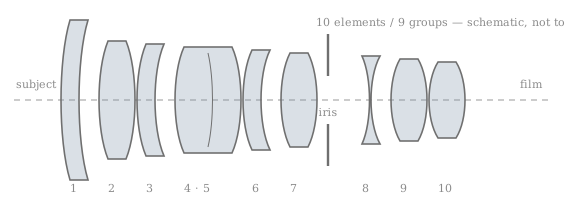
- Zeiss data sheet — C T* (cross-section, MTF)
- Zeiss data sheet — CF FLE, 11-element (cross-section, MTF)
- Zeiss data sheet — CFE FLE (cross-section, MTF)
- Zeiss data sheet — CFE IF, 12-element (cross-section, MTF)
ⓘ What these charts mean
MTF (modulation transfer function) shows how much contrast the lens keeps at a given fineness of detail, from the center of the frame to the corner — the coarse curves track punch, the fine ones resolving power, and a gap between solid and dashed lines means astigmatism. Relative illumination (falloff) shows how much darker the corners are than the center at each aperture. Manufacturers only began publishing these for modern lenses; no 1950s maker issued them, which is why older families here cite period magazine bench tests instead.
History
The 40mm f/4 Distagon arrived a decade after the 500C, in 1967 by the Zeiss and Hasselblad Historical chronology (Japanese Wikipedia says 1966), as the widest lens a reflex Hasselblad could take. Until then the only way to an 88° field was the Superwide’s fixed Biogon; Zeiss’s own data sheet for the C T* version makes the comparison, saying the Distagon “covers almost the same object field as the Biogon for the Hasselblad Superwide Camera” while keeping the mirror clearance a retrofocus design demands. The sheet (cat. no. 104163) gives 10 elements in 9 groups, an exact focal length of 40.9 mm, a diagonal field of 88°, an aperture scale to f/32, closest focus 0.5 m and a weight of about 1375 g — by far the heaviest lens in the C range — on a Compur size 0 shutter behind a bayonet-104 filter mount that no other V lens shared.
Two details of the C lens are worth knowing on the bench. The distance ring has a click stop at 0.9 m that must be pushed past to reach 0.5 m; the data sheet says the stop “is meant to remind the user that he must stop down at distances below 0.9 m”, since the lens is corrected for distance and has no close-range compensation. And the finish changed twice without the glass changing: chrome gave way to black around 1969/70 for the C line generally, and the red T* multicoating mark appeared from 1973/74 — the worldofdecay review gives the single-coated 40 as 1967–1973 and the T* as 1974–1982, without a month or serial for either.
The 1982 CF lens was a new computation, not a rebarrel. Zeiss’s sheet for it (cat. no. 10 48 78) says that against the “time-honoured” 40 the weight fell by one third to 915 g, the length by about 20% and the front from 104 to 90 mm, yet image quality “has been surpassed” because “an additional element has been introduced” — 11 elements in 10 groups — a step the sheet credits to T* coating making the extra glass-air surfaces harmless. The lens has two focusing rings: the rear one continuous from infinity to 0.5 m, the front one with three click stops (∞–2 m, 2–0.9 m, 0.9–0.5 m) that move elements 1 and 2 relative to the rest — the floating element, FLE, that “substantially improves image quality in the close range”. The filter mount shrank to bayonet 93 and the aperture scale now ended at f/22. Hasselblad Historical lists the lens as “Distagon f/4 40 mm CF (FLE)”; unlike the 50, there was no non-FLE CF 40.
The 1998 CFE (cat. no. 10 49 35) put the same 11/10 optics in the new barrel with four databus contacts for the 200-series meters, at 890 g; the 40 was made only as CFE, never CFi (Hasselblad Historical). Zeiss’s sheet for it adds that the lens was a “preferred lens in studios using digital chip backs” and that it “excels in aerial photography … at extremely high altitudes with NASA astronauts”. The third design followed in 2003, a date that rests on dealer and review chronologies rather than a dated Zeiss document: the CFE IF (cat. no. 10 49 66), 12 elements in 9 groups, 1130 g, with internal focusing and, per the sheet, “automatic optimisation of correction over the entire focusing range”, corner performance “significantly higher than predecessor at all apertures” and resolution “up to 200 lp/mm reachable”. The two-ring FLE arrangement disappeared into a single wider focusing ring. Production ended with the V system in 2013.
What remains open: who at Zeiss Oberkochen computed the 1967, 1982 and 2003 designs — no source consulted names anyone; the month of the 1967 launch and the chrome/black and T* boundaries for this focal length; any list price in any currency, since the 1973 and 1980 American dealer lists that price the 80mm Planar could not be read here for the 40; whether the CFE FLE and CFE IF overlapped in the catalogue; and every production figure, which would have to come from Nordin’s compendia.
This history is AI-written, from the sources listed at the foot of the page. Where the record is silent it says so rather than filling the gap — but no human wrote these sentences.
Example photos
Sample photo wanted — shot with a Distagon 40mm f/4? We'd love to feature it (with credit).
Live listings
Asking price, USD: a median of $1,600 across 32 fixed-price listings on 2026-09-11 (middle half $900–$2,300). Tracked since 2026-09-06, 2 days: unchanged from $1,600.
By day
| Date | Median | Middle half | Listings |
|---|---|---|---|
| 2026-09-11 | $1,600 | $900–$2,300 | 32 |
| 2026-09-06 | $1,600 | $900–$2,300 | 32 |
Asking prices from the listings scanned, not sales; junk-flagged rows and auction lots excluded; other currencies are not converted.
- Objectif Parasoleil pour Zeiss Distagon C 40mm f4 Hasselblad 500 Objectif
- Objectif Parasoleil + 105mm Filtre Adaptateur pour Distagon C 40mm F/4 Bayonet
- Objectif Parasoleil pour Zeiss Distagon C 40mm f4 Hasselblad 500 + Avant
- Hasselblad Distagon 40mm F4 Lens Case Wide Angle Objektiv Köcher
- USATO Hasselblad 40mm F4
- Hasselblad Carl Zeiss 40mm f/4 Distagon T* C - sehr gut
- Hasselblad Carl Zeiss 40mm f/4 Distagon T* C - zeer goed
- [Top NEUWERTIG] Hasselblad Distagon C 40mm F4 Carl Zeiss Objektiv für 500C/M ...
- Hasselblad Oberkochen „Carl Zeiss“ T* 1:4/40mm Opton Di „Distagon“ Rarität !!!
- Hasselblad Carl Zeiss Distagon C 1:4/40 mm T* für das V-System
- CARL ZEISS DISTAGON 1:4 / 40mm T* OBJEKTIV für HASSELBLAD (172)
- Hasselblad Distagon 40mm f4 Objektiv lens Carl Zeiss 98852
- Hasselblad V-System Carl Zeiss Distagon C 1:4/40 mm T*
- Hasselblad Zeiss Distagon C 4/40mm Near MINT
- [NEUWERTIG + mit Etui] Carl Zeiss Distagon 40mm f/4 C Weitwinkelobjektiv V...
- Carl Zeiss Distagon 4/40mm T* / f. Hasselblad
- Carl Zeiss Distagon C 40mm F4 per Hasselblad 500 Series
- Objectif Carl Zeiss Distagon 40mm f/4 Grand Angle Manuel Hasselblad V
- Carl Zeiss Distagon 40mm F/4 Objektiv für Hasselblad V System Aus Japan E0903
- Hasselblad Distagon 40mm f4 Objektiv lens Carl Zeiss 98852
Show 108 more listings
- Hasselblad C 4/40mm Distagon T* Zeiss lens w. caps
- Carl Zeiss Distagon C 40mm F4 Objektiv Für Hasselblad 500 Series
- Carl Zeiss Distagon C 40mm F4 pour Hasselblad 500 Série
- Carl Zeiss Distagon C 40mm F4 Lens For Hasselblad 500 Series
- Carl Zeiss Distagon C 40mm F4 Objektiv Für Hasselblad 500 Series
- Carl Zeiss Distagon C 40Mm F4 Pour Hasselblad 500 Série
- Obiettivo manuale Hasselblad Distagon CF 40mm F4
- Manuelles Objektiv Hasselblad Distagon CF 40mm F4
- Objectif Manuel Hasselblad Distagon Cf 40mm F4
- Hasselblad Manual Focus Distagon CF 40mm F4 Lens
- Manuelles Objektiv Hasselblad Distagon CF 40mm F4
- Objectif Manuel Hasselblad Distagon CF 40mm F4
- Hasselblad C Distagon 40mm F4 Spiegelobjektiv gebraucht Sammlerzustand
- Hasselblad Zeiss Distagon 4/40 CF FLE für Hasselblad V
- [TOP NEUWERTIG] Hasselblad Carl Zeiss T* Distagon CF 40mm F/4 FLE Objektiv...
- Carl Zeiss Distagon 40mm/4,0 CF FLE | Hasselblad V-System | Weitwinkel | A+
- [NEUWERTIG gereinigt] Hasselblad Carl Zeiss T* Distagon CF 40mm F/4 FLE MF...
- Carl Zeiss Distagon CFE 40mm f4 Hasselblad Mittelformat Objektiv gebraucht
- Obiettivo manuale Hasselblad Distagon CF 40mm F4 -leggi-
- Carl Zeiss Distagon 40mm f/4 – Hasselblad – CLA les victors (900€ Facture)
- Hasselblad Distagon CF 40Mm F4 Manuelles Objektiv - Lesen -
- Objectif Manuel Hasselblad Distagon Cf 40mm F4 -leggi
- Hasselblad Distagon CF Manual Focus Lens 40mm F4
- Hasselblad Distagon CF 40Mm F4 Manuelles Objektiv - Lesen -
- Objectif Manuel Hasselblad Distagon CF 40MM F4 -Lisez-
- Hasselblad Zeiss Distagon CF 4 / 40mm mit Zubehör Mittelformat Rollfilm
- Hasselblad CF Distagon 4/40 T* Carl Zeiss Black Wide Angle Lens f/4 40mm
- Hasselblad 500 EL/M + Carl Zeiss Distagon 4/40mm t* und Zubehör
- Hassell CF Distagon 40mm F4 Kamera Objektiv guter Zustand, gebraucht
- Hasselblad CF Distagon 4/40 T* Carl Zeiss Black Lens f/4 40mm Weitwinkelobjektiv
- Hasselblad CF Distagon 4/40 T* Carl Zeiss Black Wide Angle Lens f/4 40mm
- Seltenes CLA’d【EXC+5】OBERKOCHEN OPTON DI 40mm F4 T* für HASSELBLAD V Objektiv...
- Hasselblad CFE Distagon 4/40 T* Carl Zeiss Weitwinkel Lens Objektiv
- Obiettivo manuale Zeiss Hasselblad CFE 40mm IF F4 Distagon BELLISSIMO
- Hasselblad CFE Distagon 4/40 IF T* Carl Zeiss Wide Angle Lens 40mm f/4
- Objectif Manuel Zeiss Hasselblad Cfe 40mm If F4 Distagon Belle
- Manuelles Objektiv Zeiss Hasselblad CFE 40mm IF F4 Distagon WUNDERSCHÖN
- Zeiss Hasselblad CFE Manual Focus Lens 40mm IF F4 Distagon BELLISSIMO
- Manuelles Objektiv Zeiss Hasselblad CFE 40mm IF F4 Distagon WUNDERSCHÖN
- Objectif Manuel Zeiss Hasselblad CFE 40Mm IF F4 Distagon Magnifique
- Hasselblad Hard Leather Lens Case 40mm f4 Distagon C
- Hasselblad Zeiss 40mm f4 CF Distagon T Lens Ugly Bad Water Damaged Project READ
- Hasselblad 40mm f4 Zeiss Distagon C Lens *Read notes #881
- Rare[Almost Unused]Hasselblad Distagon C 40mm f4 Wide Angel Lens For 503CX JAPAN
- Hasselblad 500cm Zeiss Distagon-C 40mm f4 lens for Hasselblad V cameras. CLA'd
- [Almost Mint+] Hasselblad Distagon C 40mm f4 Carl Zeiss For 500C/M 503CX JAPAN
- Hasselblad CARL ZEISS 40mm f4 Distagon For V System Cameras With Case
- Hasselblad ZEISS Distagon 40mm f/4 T* Lens - MINT with Caps
- Hasselblad Zeiss Distagon C 4/40mm Near MINT
- [MINT+ w/Case] Carl Zeiss Distagon 40mm f/4 C Wide Angle Lens V Mount From JAPAN
- Carl Zeiss Distagon 40mm f/4 Lens for Hasselblad V System from Japan E0903
- [Excellent+++++] HASSELBLAD distagon C 40mm f4 T* lens for medium format camera
- Hasselblad C 4/40mm Distagon T* Zeiss lens w. caps
- Hasselblad C Distagon 40mm f4 T* Lens Wide Angle for V System V-Mount Japan
- Hasselblad Carl Zeiss T* Distagon CF 40mm f/4 FLE MF Lens
- [Near MINT] Hasselblad Carl Zeiss T* Distagon CF 40mm F/4 FLE MF Lens From JAPAN
- Hasselblad C Distagon 40mm F4 Mirror Lens Used Collector's Condition
- [ TOP MINT ] Hasselblad Carl Zeiss T* Distagon CF 40mm F/4 FLE Lens From JAPAN
- Hasselblad Carl Zeiss Distagon CF T* 40mm f/4 FLE Lens #3405 Wide Angle
- [MINT cleaned] Hasselblad Carl Zeiss T* Distagon CF 40mm F/4 FLE MF From JAPAN
- CLA'd FLE [Top MINT] Hasselblad Carl Zeiss T* Distagon CF 40mm f/4 Lens Japan
- Carl Zeiss Distagon CFE 40mm f4 Hasselblad Medium Format Lens Used
- Hasselblad CFE Distagon 40mm F/4 T* Lens *MINT-*
- Hassell CF Distagon 40mm F4 Camera Lens Good Condition, Used
- [MINT] Hasselblad Carl Zeiss Distagon T* CFE 40mm f/4 FLE MF Lens From JAPAN
- 888xxxx [Top MINT] HASSELBLAD CARL ZEISS T* DISTAGON CFE 40mm F/4 FLE Lens JAPAN
- [Unused+++] Hasselblad Carl Zeiss T* Distagon CFE 40mm F/4 Wide Lens From JAPAN
- [888xxxx TOP MINT] Hasselblad CFE 40mm f/4 FLE Lens Zeiss T* Distagon Lens Japan
- Rare CLA’d【EXC+5】OBERKOCHEN OPTON DI 40mm F4 T* For HASSELBLAD V Lens From JAPAN
- Hasselblad Lens CARL ZEISS T DISTAGON CFE 40mm F/4 FLE 280675
- HASSELBLAD Distagon CFE 40mm F4 4956
- CARL ZEISS 40MM F4 DISTAGON T* CFE IF FOR HASSELBLAD V SYSTEM 3020039 #4930
- Hasselblad 40mm f/4 Distagon C T* Lens for Hasselblad 500 Series V AS-IS
- Hasselblad 40mm f4 Carl Zeiss T* Distagon Compur Lens for V System
- Gehäuse Hasselblad 40mm f4 Carl Zeiss T* Distagon Objektiv für V System 500CM etc.
- [Almost Mint+] Hasselblad Distagon C 40mm f4 Carl Zeiss For 500C/M 503CX JAPAN
- [Top MINT] Hasselblad Distagon C 40mm F4 Carl Zeiss Lens For 500C/M 503CX JAPAN
- Hasselblad Zeiss Distagon C 4/40mm Near MINT
- [MINT+ w/Case] Carl Zeiss Distagon 40mm f/4 C Wide Angle Lens V Mount From JAPAN
- Carl Zeiss Distagon 40mm f/4 Lens for Hasselblad V System from Japan E0903
- Hasselblad C Distagon 40mm F4 Mirror Lens Used Collector's Condition
- [Near MINT] Hasselblad Carl Zeiss T* Distagon CF 40mm F/4 FLE MF Lens From JAPAN
- [ TOP MINT ] Hasselblad Carl Zeiss T* Distagon CF 40mm F/4 FLE Lens From JAPAN
- Hasselblad Carl Zeiss Distagon 40mm f/4 T* CFE FLE Lens Kit - COLLECTION ONLY
- Hasselblad 40mm F4 CFE FLE Zeiss Distagon T* Lens - STK: 42443
- Hasselblad Carl Zeiss CF 40MM F4 Distagon T* Hasselblad V System
- [MINT cleaned] Hasselblad Carl Zeiss T* Distagon CF 40mm F/4 FLE MF From JAPAN
- Carl Zeiss Distagon CFE 40mm f4 Hasselblad Medium Format Lens Used
- Hasselblad 40mm f4 Distagon CFE FLE T* lens, virtaully mint
- Hassell CF Distagon 40mm F4 Camera Lens Good Condition, Used
- 888xxxx [Top MINT] HASSELBLAD CARL ZEISS T* DISTAGON CFE 40mm F/4 FLE Lens JAPAN
- [Unused+++] Hasselblad Carl Zeiss T* Distagon CFE 40mm F/4 Wide Lens From JAPAN
- Rare CLA’d【EXC+5】OBERKOCHEN OPTON DI 40mm F4 T* For HASSELBLAD V Lens From JAPAN
- Hasselblad CFE 40mm f/4 Distagon T* Wide Lens for V System cameras UK Seller
- HASSELBLAD Distagon CFE 40mm F4 4956
- Carl Zeiss Distagon 40mm f4 C Weitwinkelobjektiv für Hasselblad V - Ersatzteile/Reparatur
- Hasselblad 40mm f4 T*
- Carl Zeiss for Hasselblad 40mm f4 C Distagon
- Hasselblad 40mm f4 CF
- Hasselblad Carl Zeiss Distagon 40mm f/4 T* CFE Lens, fr 500CM 503CW 501 503
- Hasselblad Carl Zeiss Distagon 40mm f/4 IF T* CFE Lens, fr 500CM 503CW 501 503
- Hasselblad Carl Zeiss Distagon 40mm f/4 IF T* CFE Lens, fr 500CM 503CW 501 503
- Hasselblad 40mm f4 Zeiss Distagon CF FLE lens Excellent Condition.
- NEAR MINT Hasselblad Carl Zeiss Distagon CFE 40mm F/4 FLE T* Lens
- Hasselblad 40mm f/4 CF Distagon T*
- Hasselblad 40mm f/4 CFE Distagon T*
- Hasselblad Carl Zeiss Distagon f/4 40mm T* Lens
- Hasselblad Carl Zeiss Distagon f/4 40mm T* Lens
eBay links are affiliate links. If you buy through one, Glass Bodies earns a small commission from eBay at no cost to you. It does not change which listings appear, their prices or their order — those come from the search and the sort described above.
Listings updated 2026-09-11. Links go to the shop or marketplace that carries the item.