Biogon 38mm f/4.5
Carl Zeiss · Hasselblad V · 1954 · Biogon
Known as “the Superwide lens”
Also known as: Zeiss Biogon 38mm f/4.5 · Carl Zeiss Biogon T* 4.5/38 · Biogon 4.5/38 · Biogon 38/4.5 · Biogon 38mm f4.5 · Hasselblad 38mm Biogon · Hasselblad Biogon 38mm f/4.5 · Biogon C 38mm · Biogon CF 38mm · Biogon CFi 38mm · Biogon T* 4.5/38 CF · Biogon T* 4.5/38 CFi · SWC Biogon 38mm
Variants & identification
| Variant | Mount | Years | Serial ranges | Production |
|---|---|---|---|---|
| Biogon 4.5/38, pre-C barrel (SWA and SW, 1954) · Synchro-Compur, reached through a cutout in the barrel — cocking trigger and speed ring are on the lens, not the body | Hasselblad V (fixed to the Supreme Wide Angle / Super Wide body) | 1954–1958 | Zeiss Oberkochen numbers in the 1,07x,xxx region on the first deliveries (a documented SWA lens is 1073722) | — |
| Biogon C 4.5/38, chrome · Synchro-Compur, 1s–1/500 and B, V-X-M lever, EV interlock | Hasselblad V (fixed to the SWC body) | 1959–1969 | — | — |
| Biogon C 4.5/38, black (non-T*) · Synchro-Compur, 1s–1/500 and B, V-X-M lever, EV interlock | Hasselblad V (fixed to the SWC body) | 1969–1973 | — | — |
| Biogon C T* 4.5/38 · Synchro-Compur, 1s–1/500 and B, V-X-M lever, EV interlock | Hasselblad V (fixed to the SWC and early SWC/M bodies) | 1973–1982 | — | — |
| Biogon CF T* 4.5/38 · Prontor CF, 1s–1/500 and B; X sync only, no self-timer | Hasselblad V (fixed to the SWC/M and 903SWC bodies) | 1982–2001 | — | — |
| Biogon CFi T* 4.5/38 · Biogon, 8 elements in 5 groups — the same layout recomputed for lead- and arsenic-free glass · Prontor CFi, 1s–1/500 and B; improved leaf-shutter mainspring and flash PC contact | Hasselblad V (fixed to the 905SWC body) | 2001–2006 | — | — |
| Biogon 4.5/38 on the MKWE metric camera | Hasselblad V (fixed to the MKWE photogrammetric body) | — | 6888731 on the MKWE Leitz Auction sold in 2022 — a mid-1980s Oberkochen number, which would point to a CF barrel | — |
- Element and group counts, exact focal length, fields, close focus, filter mounts, back focal distances and principal-plane data are from the Zeiss data sheets hosted by Hasselblad Historical (C38, CF38, CFi38).
- Generation years follow Hasselblad Historical's model table for the camera each lens is fixed to; the black-barrel start date is disputed (1969 per Hasselblad Historical, 1972 per Japanese Wikipedia and Emulsive) and no serial boundary is published.
How to tell them apart
- One optical design for 47 years, recomputed once: 8 elements in 5 groups throughout, with the CFi of 2001 a new prescription in the same layout for lead- and arsenic-free glass
- Filter mount sorts the generations at a glance — Series 63 drop-in discs on every pre-C and C lens, metal Bay 60 on the CF, Makrolon Bay 60 on the CFi
- An EV cross-coupling lever and a fluted metal focusing ring mean a Synchro-Compur C lens; rubber grips and a cross-coupling push-button mean Prontor CF or CFi
- The lens is never sold on its own by the factory: it is fixed to the SWA, SW, SWC, SWC/M, 903SWC, 905SWC and the MKWE, and its rear vertex sits 18.8 mm from the film, which is why no reflex Hasselblad can take it
Biogon 4.5/38, pre-C barrel (SWA and SW, 1954):
- Chrome barrel with aperture, speed and depth-of-field scales and a cocking trigger; no EV cross-coupling lever and no body-mounted release — both arrive with the SWC of 1959
- Series 63 filter discs behind a retaining ring; the lens has no filter thread and the 90° field rules out a hood (Super Wide C instruction book)
- No red T*; no red-ink Zeiss date code is to be expected — Hasselblad Historical puts the code in 'all but the very earliest C lenses'
Biogon C 4.5/38, chrome:
- Satin-chrome C barrel matching the 500C lenses — coupled linear speed and aperture scales with the exposure-value interlock, V-X-M synchro lever, automatic depth-of-field indicators
- Release moved off the lens to the camera top plate; the barrel now carries only the shutter and focusing controls
- Series 63 drop-in filters; no T*; red-ink Zeiss date code inside the rear mount from this generation on
Biogon C 4.5/38, black (non-T*):
- Black-anodised C barrel with the same EV interlock, Series 63 filter mount and single coating as the chrome lens — the change is finish only
- No red T* on the name ring; a black barrel with T* is the next generation
Biogon C T* 4.5/38:
- Red T* after the Biogon name; otherwise the black C barrel unchanged — fluted metal focusing ring, Synchro-Compur with green V self-timer, Series 63 filters
- Emulsive's guide records silver-barrel T* lenses made in 1973 before black became permanent, so a chrome barrel does not by itself rule out T*
Biogon CF T* 4.5/38:
- Rubberised grip rings on focusing and aperture, printed rather than engraved scales, a push-button to cross-couple shutter and aperture instead of the C lens's EV lever
- Bayonet 60 filter mount in metal replaces the Series 63 drop-in ring — the clearest single tell against any C lens
- Zeiss data sheet Cat. No. 10 48 67: 8/5, 38.6 mm, 72° × 72° and 91° diagonal, 0.3 m, 1:4.7, back focal distance 18.8 mm, focusing-screen adapter 41057
Biogon CFi T* 4.5/38:
- CFi barrel styling: blocky rubber grips, feet and metre scales printed in one colour, PC flash terminal on the lens
- Bay 60 filter mount moulded in Makrolon rather than metal (Ken Rockwell)
- Zeiss data sheet Cat. No. 10 49 42, printed 16 August 2001; focusing-screen adapter is now 41050, not the CF lens's 41057
Biogon 4.5/38 on the MKWE metric camera:
- Distinguished by the camera, not the lens: an MKWE body has a réseau plate numbered to it and an electric winder underneath, neither of which touches the optics
- Biogon 4.5/38, pre-C barrel (SWA and SW, 1954): The first production Biogons came in 1954 — a 21mm for Contax and the 38mm for Hasselblad (English Wikipedia, Zeiss Biogon). The barrel was strengthened when the SWA became the SW in 1956, which Hasselblad Historical's model table records as the only change. Zeiss serials carry no date; camera-wiki's table places 1,100,000–2,600,000 in 1953–1959, so a 1,07x,xxx lens belongs to the first deliveries.
- Biogon C 4.5/38, chrome: Zeiss's data sheet for the C lens (Cat. No. 104117, print code X/73) gives 8 elements in 5 groups, exact focal length 38.6 mm, a diagonal field of 90° and 72° on the side, an aperture scale of 4.5-5.6-8-11-16-22, closest focus 0.3 m, about 560 g, and states that "because of the extremely short distance of the last lens vertex from the film plane" the lens "cannot be used in the Hasselblad 500 C/M – 500 EL/M" and "is therefore assembled in its own special camera body, the Superwide C". Hasselblad Historical dates the chrome C lens 1959–1969.
- Biogon C 4.5/38, black (non-T*): A short transitional finish whose start year is contested: Hasselblad Historical gives black from 1969, Japanese Wikipedia and Emulsive's guide to the C lenses give 1972. Nothing found sets a serial boundary, and the run is between one and four years long depending on which date is taken.
- Biogon C T* 4.5/38: T* multicoating reached the Hasselblad line in 1973 (Hasselblad Historical; Japanese Wikipedia agrees for the Biogon). The optics did not change: the C sheet's 8/5, 38.6 mm and 0.3 m carry through. This is the lens carried by the SWC to 1979 and by the first SWC/M bodies until the CF barrel arrived in 1982.
- Biogon CF T* 4.5/38: A rebarrel, not a redesign: element and group counts, focal length, field and close focus are those of the C sheet. The sheet adds the number that explains the whole Superwide programme — the last vertex sits 18.8 mm from the film, so "no viewfinder mirror fits between Biogon and film" and "Biogon lenses cannot be used on SLR cameras". It also notes that with focusing-screen adapter 41057 the lens focuses to 20 cm in front of the front element.
- Biogon CFi T* 4.5/38: The one generation where the glass genuinely changed, and for a reason outside photography: Hasselblad Historical's model table says of the 905SWC that "the Biogon had to be recalculated for new environmentally friendly lens materials", and Japanese Wikipedia records it in one word, 無鉛化 — made lead-free. Zeiss's two sheets show the result as a new prescription in the old layout: back focal distance 18.8 mm becomes 19.0 mm, the principal planes move from 23.5/19.9 mm to 23.9/19.6 mm, the exit pupil from 21.6 to 21.9 mm and the vertex length from 76.2 to 76.1 mm, while 8/5, 38.6 mm, 72°/72°/91° and 0.3 m are unchanged.
- Biogon 4.5/38 on the MKWE metric camera: Listed separately because dealers and auction houses do, not because any source states a difference. Japan Camera Hunter, handling one in 2012, calls the MKWE's lens "the same lens you would find on an SWC Hasselblad", and what is calibrated on a metric camera is the réseau plate at the film plane, which carries the body's serial. Whether Hasselblad Engineering AB selected or individually calibrated these Biogons — and whether the barrel is C or CF — is not stated anywhere consulted.
Serial-range notes
- red-ink code inside the rear mount, pre-1980
- Zeiss stamped a date code inside the rear of the mount: before 1980 the last two digits are the month and the leading digit(s) plus 1957 the year, so 1611 reads November 1973. Hasselblad Historical says the code is present in all but the very earliest C lenses, so a pre-C Biogon on an SWA or SW is not expected to carry one.
- red-ink code inside the rear mount, 1980 onward
- From 1980 the code is two reversed year digits followed by a month letter, A = January — a lens reading 58F was made in June 1985.
- Zeiss running numbers, 1,07x,xxx
- The lens serial itself carries no date. Camera-wiki's Zeiss table places 500,000–1,100,000 in 1951–1953 and 1,100,000–2,600,000 in 1953–1959; a 1,07x,xxx Biogon therefore belongs to the first Supreme Wide Angle deliveries of 1954.
Specifications
- Formula
- Biogon
- Construction
- 8 elements / 5 groups
- Aperture range
- f/4.5–f/22
- Shutter
- In the lens on every version — Synchro-Compur on the pre-C and C barrels, Prontor CF from 1982 and Prontor CFi from 2001, 1s–1/500 and B, flash sync at every speed. No shutterless F or FE version exists: the lens has no reflex body to go on
- Min. focus
- 0.3 m
- Weight
- 560 g
- Years manufactured
- 1954–2006
- Country
- West Germany (Carl Zeiss, Oberkochen); Germany from 1990
- Coating
- Single-coated until T* multicoating in 1973; every later generation is T*
What reviewers say
- Richard Forrester (EMULSIVE), 903 SWC (blog) — "This camera is all about the insanely sharp ZEISS BIOGON CF 38mm f/4.5 lens": corner-to- corner sharpness with no distortion on Delta 100 and Portra 400, and depth of field that makes zone and hyperfocal focusing the working method. Soft frames until the technique is learned, and one focal length for life.
- Matt Osborne (Leica Blog), SWC (blog) — "The Biogon renders better than the Japanese optics": solid, well built, and forgiving of hyperfocal focusing for candid work. No rangefinder, so critical focus is a technique rather than a mechanism, and the lens never comes off.
- Ken Rockwell, SWC and 903 SWC (blog) — A simplified eight-element Biogon from Bertele's 1952 patent, "very little mechanical vignetting, no significant distortion and it's sharp out to the corners even wide-open" — designed to be shot at f/4.5. The same camera and lens from 1954 with minor changes; the 2001 switch to unleaded glass he calls a dumbing-down.
Optical formula — Biogon
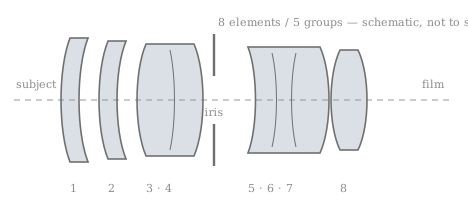
- Zeiss data sheet — C (cross-section, MTF)
- Zeiss data sheet — CF (cross-section, MTF)
- Zeiss data sheet — CFi (cross-section, MTF)
ⓘ What these charts mean
MTF (modulation transfer function) shows how much contrast the lens keeps at a given fineness of detail, from the center of the frame to the corner — the coarse curves track punch, the fine ones resolving power, and a gap between solid and dashed lines means astigmatism. Relative illumination (falloff) shows how much darker the corners are than the center at each aperture. Manufacturers only began publishing these for modern lenses; no 1950s maker issued them, which is why older families here cite period magazine bench tests instead.
History
The Biogon 38mm f/4.5 is the reason there is such a thing as a Hasselblad without a mirror. Ludwig Bertele’s 90° Biogon of 1951 — U.S. patent 2,721,499, eight elements in five groups in a near-symmetrical arrangement of large negative menisci around a compact positive core — puts its rear vertex so close to the film that nothing can be swung behind it; the CF data sheet gives the figure as 18.8 mm and says flatly that “no viewfinder mirror fits between Biogon and film”, so “Biogon lenses cannot be used on SLR cameras” and this one “is worth a camera body of its own”. The first production Biogons were delivered in 1954, a 21mm for Contax and the 38mm for Hasselblad (English Wikipedia), and Hasselblad built a flat, mirrorless box around the 38 and showed it at Photokina that autumn as the Supreme Wide Angle. Every later Superwide is a revision of that box; the lens on the front stayed the same design for fifty-two years.
The C data sheet (Cat. No. 104117) is the spec of record for the first three decades: 8 elements in 5 groups, exact focal length 38.6 mm, a diagonal field of 90° with 72° on the side, an aperture scale from f/4.5 to f/22, closest focus 0.3 m and about 560 g. Zeiss’s own explanation of the arrangement is worth quoting because it names the trade the lens exists to make — “for compactness and performance it cannot be beaten by any retrofocus system” — and the sheet’s distortion curve holds within a few tenths of a per cent, which is what a retrofocus wide-angle of the period could not do. The later sheets restate the same optics with the diagonal field printed as 91° rather than 90°; nothing consulted explains the change, and the focal length, counts and close focus are identical, so it appears to be a difference in how the field was reckoned rather than in the lens.
Three of the four generation changes are barrel changes. The pre-C lens of 1954 carries its Synchro-Compur behind a cutout in the barrel, with the cocking trigger and the release on the lens itself. The C barrel of 1959 brings the Biogon into line with the 500C lenses — coupled linear speed and aperture scales with the exposure-value interlock, V-X-M lever, automatic depth-of-field indicators — and moves the release to the camera’s top plate. Chrome gives way to black, on a date the sources will not agree on: Hasselblad Historical says 1969, Japanese Wikipedia and Emulsive’s guide to the C lenses say 1972, and no serial boundary is published either way. T* multicoating arrives in 1973, Emulsive noting that some silver-barrel T* lenses were made that year before black became permanent. In 1982 the Prontor CF barrel replaces the Synchro-Compur, the EV lever becomes a push-button, and the Series 63 drop-in filter ring becomes a Bay 60 bayonet — the quickest way to sort a CF from any C lens on a shelf.
The fourth change is real. Hasselblad Historical’s table says of the 905SWC that “the Biogon had to be recalculated for new environmentally friendly lens materials”; Japanese Wikipedia puts it in one word, 無鉛化, made lead-free. Zeiss’s two sheets show what that cost: against the CF’s back focal distance of 18.8 mm, principal planes at 23.5 and 19.9 mm, exit pupil 21.6 mm and vertex length 76.2 mm, the CFi sheet of 16 August 2001 gives 19.0, 23.9, 19.6, 21.9 and 76.1 mm. Element and group counts, focal length, field and close focus are untouched. It is a new prescription in Bertele’s layout, not a new design — and the last one, since the 905SWC ended in 2006 and took the Biogon with it.
Open: who at Oberkochen carried out the 1982 and 2001 work, which no source names; whether the pre-C, C and CF lenses were ever sold apart from a body, since the factory catalogued them only as part of a camera; the true year of the black barrel; whether the MKWE’s Biogon was individually calibrated or simply a stock lens on a calibrated body; and any production figure at all, which would have to come from Nordin’s compendia.
This history is AI-written, from the sources listed at the foot of the page. Where the record is silent it says so rather than filling the gap — but no human wrote these sentences.
Example photos
Sample photo wanted — shot with a Biogon 38mm f/4.5? We'd love to feature it (with credit).
Live listings
Asking price, USD: a median of $2,800 across 27 fixed-price listings on 2026-09-11 (middle half $2,400–$3,800). Tracked since 2026-09-06, 2 days: unchanged from $2,800.
By day
| Date | Median | Middle half | Listings |
|---|---|---|---|
| 2026-09-11 | $2,800 | $2,400–$3,800 | 27 |
| 2026-09-06 | $2,800 | $2,400–$3,800 | 27 |
Asking prices from the listings scanned, not sales; junk-flagged rows and auction lots excluded; other currencies are not converted.
- [ Opt MINT ] Hasselblad SWC Super Wide C Biogon 38mm f/4.5 A12 II Japan #2305
- Hasselblad SWC SUPER WIDE C 6x6 Medium Film camera Biogon 38mm f4.5 Silver JAPAN
- Hasselblad SWC Super Wide C w/Biogon 38mm f4.5, A24 Film Back, AMAZING KIT
- Film Tested [Near MINT] Hasselblad SWC SUPER WIDE C Biogon 38mm f4.5 A12II JAPAN
- [MINT+] Hasselblad Super Wide C SWC Camera Biogon C 38mm f/4.5 A12 II From JAPAN
- Hasselblad SW Super Wide w/ Zeiss Biogon 38mm f/4.5 Lens A12 Film Back
- Hasselblad SWC Super Wide C w/Biogon 38mm f4.5, A24 Film Back, AMAZING KIT
- [Excellent+5] Hasselblad 903 SWC Camera + CF Biogon 38mm f4.5 Lens from JAPAN
- [ MINT w/ Finder ] Hasselblad SWC Super Wide C Biogon 38mm f4.5 Lens From JAPAN
- [MINT] Hasselblad SWC/M Biogon C 38mm f/4.5 T* Lens A12 Film Back JAPAN #825
- Hasselblad SWC/M with Carl Zeiss Biogon 38mm f/4.5 T* Lens #419
- [Top MINT] Hasselblad SWC/M with Carl Zeiss Biogon 38mm f/4.5 T* Lens From JAPAN
- HASSELBLAD SWC/M 38mm Biogon f/4.5 T* and A12 Back
- Hasselblad Super Wide C w/38mm f4.5 Biogon Lens, Finder, A12 Back, more #185
- Hasselblad Super Wide C w 38mm f4.5 Biogon T* Lens, 12 Back, Optical Finder CLA'
- HASSELBLAD SWC 38mm Biogon f/4.5 C12 Rare 3rd SWC Built at the Factory CEW 3003
- Black [MINT+++ in BOX ] Hasselblad SWC/M Carl Zeiss Biogon 38mm f/4.5 From JAPAN
- [ MINT+++]Hasselblad SWC/M Black Biogon CF 38mm f/4.5 T 1984 Matching Box JAPAN
- Hasselblad 903 SWC Biogon 38mm f/4.5 T* Vintage camera Tested #161
- RARE Black [Near MINT+] Hasselblad 903 SWC w/ Biogon 38mm f/4.5 T* A12 III JAPAN
Show 42 more listings
- [MINT w/ A12 III] Hasselblad 903SWC Body CF BIogon 38mm f4.5 T* lens From JAPAN
- Late Finder [MINT] Hasselblad SWC/M Black Biogon CF 38mm f/4.5 T* Lens JAPAN
- [Top MINT] Hasselblad 903 SWC Camera + CF Biogon 38mm f4.5 Lens from japan
- [Exc+++++] hasselblad SWC/M Biogon 38mm f/4.5 Finder from Japan silver color
- Hasselblad SWC/M CF Biogon 38mm F4.5 T* Finder A12 Back from Japan E0706
- EX+ Hasselblad 905swc silver w/ biogon 38mm f/4.5 CFi
- HASSELBLAD SWC 38mm Biogon f/4.5 C12 Rare Factory Prototype TA 814
- [Opt NEUWERTIG] Hasselblad SWC Super Wide C Biogon 38mm f/4.5 A12 II Japan #2305
- Hasselblad SWC SUPER WIDE C 6x6 Medium Film Camera Biogon 38mm f4.5 Silver JAPAN
- Frühe Hasselblad SWC Super Wide C Zeiss OPTON Biogon 38mm f/4.5 Oberkochen - A12
- Hasselblad SWC/M Kamera + Biogon C 38mm F/4.5 T* Chrome + Sucher + Magazin
- [Near MINT] Hasselblad SWC Super Wide C mit Biogon 38mm f/4.5 A12 III aus JAPAN
- [NEUWERTIG mit Sucher] Hasselblad SWC Super Wide C Biogon 38mm f4.5...
- Hasselblad SWC Super Large C Zeiss OPTON Biogon 38Mm F/4.5 Oberkochen - A12
- Early Hasselblad SWC Super Wide C Zeiss OPTON Biogon 38Mm F/4.5 Oberkochen - A12
- Primi Hasselblad SWC Super Wide C Zeiss OPTON Biogon 38mm f/4.5 Oberkochen - A12
- ⭐PROFESSIONALLY SERVICED⭐ Hasselblad SWC/M Carl Zeiss Biogon T 38mm f/4.5 Lens
- RARE BLACK [MINT] Hasselblad SWC Super Wide C Biogon 38mm F4.5 A12 II From JAPAN
- [NEUWERTIG] Hasselblad SWC/M mit Carl Zeiss Biogon 38mm F4.5 + A12 II...
- [NEUWERTIG+++] Hasselblad SWC/M Black Biogon CF 38mm f/4.5 T 1984 Matching Bo...
- RARE Black [Near MINT+] Hasselblad 903 SWC w/ Biogon 38mm f/4.5 T* A12 III JAPAN
- Late Finder [NEUWERTIG] Hasselblad SWC/M Black Biogon CF 38mm f/4.5 T*...
- [NEUWERTIG mit A12 III] Hasselblad 903SWC Body CF BIogon 38mm f4.5 T*...
- [Top NEUWERTIG] Hasselblad 903 SWC Kamera + CF Biogon 38mm f4.5 Objektiv...
- Hasselblad SWC/M CF Biogon 38mm F4.5 T* Sucher A12 Rückteil E0706
- Hasselblad Wide MKWE with Biogon 4.5/38mm Yellow leather RARE
- [ Opt MINT ] Hasselblad SWC Super Wide C Biogon 38mm f/4.5 A12 II Japan #2305
- Hasselblad SWC/M mit Carl Zeiss Biogon T 38mm f/4.5 Objektiv + Rückseite
- Hasselblad SWC SUPER WIDE C 6x6 Medium Film camera Biogon 38mm f4.5 Silver JAPAN
- Hasselblad Super Wide C with Carl Zeiss Biogon 38mm f/4.5
- Hasselblad SWC/M Camera with 38mm f/4.5 CF T* Carl Zeiss Super Wide Biogon Lens
- [MINT+] Hasselblad Super Wide C SWC Camera Biogon C 38mm f/4.5 A12 II From JAPAN
- [MINT] Hasselblad SWC/M Biogon C 38mm f/4.5 T* Lens A12 Film Back JAPAN #825
- [ MINT+++]Hasselblad SWC/M Black Biogon CF 38mm f/4.5 T 1984 Matching Box JAPAN
- Black [MINT+++ in BOX ] Hasselblad SWC/M Carl Zeiss Biogon 38mm f/4.5 From JAPAN
- RARE Black [Near MINT+] Hasselblad 903 SWC w/ Biogon 38mm f/4.5 T* A12 III JAPAN
- Late Finder [MINT] Hasselblad SWC/M Black Biogon CF 38mm f/4.5 T* Lens JAPAN
- [MINT w/ A12 III] Hasselblad 903SWC Body CF BIogon 38mm f4.5 T* lens From JAPAN
- [Top MINT] Hasselblad 903 SWC Camera + CF Biogon 38mm f4.5 Lens from japan
- Hasselblad SWC/M CF Biogon 38mm F4.5 T Finder A12 Back from Japan E0706
- Hasselblad SWC 38mm f4.5 Biogon with finder - RENTAL ONLY
- Hasselblad SWC Super Wide C Black with 38mm f4.5 Zeiss Biogon and finder - cl'a May 2024
eBay links are affiliate links. If you buy through one, Glass Bodies earns a small commission from eBay at no cost to you. It does not change which listings appear, their prices or their order — those come from the search and the sort described above.
Listings updated 2026-09-11. Links go to the shop or marketplace that carries the item.