Biogon 60mm f/5.6 (NASA Data Camera / MK70)
Carl Zeiss · Hasselblad V · 1969 · Biogon
Also known as: Zeiss Biogon 60mm f/5.6 · Carl Zeiss Biogon 5.6/60 · Biogon 5.6/60 · Biogon 60/5.6 · Hasselblad 60mm Biogon · Biogon 60mm MK · Hasselblad MK70 Biogon 60mm · NASA Biogon 60mm · Data Camera 60mm Biogon
Variants & identification
| Variant | Mount | Years | Serial ranges | Production |
|---|---|---|---|---|
| Biogon 5.6/60 for the Hasselblad Data Camera (HDC / HEDC) | Hasselblad V (Data Camera bodies only — the rear group enters the mirror box) | 1969–1972 | — | — |
| Biogon 5.6/60 MK (MK70 photogrammetric camera) | Hasselblad V (MK70 only — no other body clears the rear group) | — | 5198308, on the 1974 MK70 (body UIE21534) Leitz Auction sold in 2013 — a Zeiss Oberkochen running number, which carries no date | — |
- Focal length, weight, closest focus, filter series and the réseau specification come from Zeiss's own data sheet for the lens (Cat. No. 10 48 00), read through the Internet Archive.
- The Apollo material is from NASA's Apollo 11 Hasselblad page and Zeiss's fiftieth-anniversary page; the MK material from Hasselblad's lens guide and an auction catalogue. No Zeiss sheet in the Hasselblad Historical LDS series covers this lens.
How to tell them apart
- A Biogon that will not fit a normal Hasselblad: the rear group passes through the bayonet into the body, so the lens is found only on Data Camera bodies (HDC/HEDC) and on the MK70
- Zeiss's data sheet restricts it explicitly to réseau cameras — the 500EL Data Camera and the MK70 — and specifies the 4 mm réseau plate with its 25 crosses as part of the system
- Exact focal length 61.1 mm, about 740 g, closest focus 0.9 m, Series 63 filters
- No T* marking is reported by any consulted source, and no C, CF or CFi barrel generation exists — this lens was never in the consumer catalogue
Biogon 5.6/60 for the Hasselblad Data Camera (HDC / HEDC):
- Carried on a silver-finished 500EL rebuilt as the Data Camera — the silver was for thermal stability, and the réseau plate behind the lens has a conductive coating to bleed off static (NASA Apollo 11 Hasselblad page)
- A detachable polarizing filter was part of the lunar-surface kit (same source)
- The lens was calibrated in the camera it would fly in: 'careful calibration tests were performed with the lens fitted in the camera in order to ensure high-quality, low-distortion images'
Biogon 5.6/60 MK (MK70 photogrammetric camera):
- Hasselblad's own lens guide lists it with the 100mm f/3.5 MK Planar as being 'for the MK70 photogrammetric camera only', and notes that a special body was needed for both
- Leitz Auction describes the MK70's lens as a 'Biogon 5.6/60 with auto diaphragm control'
- Closest focus 0.9 m (Hasselblad lens guide; Zeiss data sheet)
- Biogon 5.6/60 for the Hasselblad Data Camera (HDC / HEDC): NASA's Apollo 11 Hasselblad page says the Data Camera made its first flight on that mission for lunar-surface work, "fitted with a new Zeiss lens, a Biogon f-5.6/60 mm, specially designed for NASA, which later became available commercially". The réseau plate it works against sits close to the film plane, engraved with crosses 10 mm apart "and accurately calibrated to a tolerance of 0.002 mm", so that angular distances can be measured off the negative afterwards. Zeiss's own fiftieth-anniversary page confirms the Biogon f/5.6-60 mm in the Hasselblad EL Data Camera on Apollo 11. Whether every lunar-surface camera from Apollo 11 to Apollo 17 carried this lens is not stated by the sources consulted; the 1972 end here is the last landing, not a documented production date.
- Biogon 5.6/60 MK (MK70 photogrammetric camera): The commercial lens NASA's page anticipates. It is the same optic in the civilian metric camera Hasselblad Engineering AB built from the 500EL/M, and the reason that camera cannot be treated as an EL/M with an unusual lens on it: the rear group reaches through the bayonet into the mirror box, so no ordinary 500-series body will take it. No introduction date for the MK version has been found; the earliest dated MK70 is a 1974 body.
Serial-range notes
- Zeiss running numbers (5198308 observed)
- Zeiss Oberkochen lens serials carry no year. The red-ink date code stamped inside the rear mount is the way to date one — before 1980 the last two digits are the month and the leading digit(s) plus 1957 the year — but no consulted source reports the code from a 60mm Biogon.
Specifications
- Formula
- Biogon
- Aperture range
- f/5.6
- Shutter
- In the lens, as on every leaf-shutter Hasselblad — the MK70 and the Data Camera have no shutter in the body. No consulted source names the type; Leitz Auction's MK70 catalogue entry describes the lens as having 'auto diaphragm control'
- Min. focus
- 0.9 m
- Weight
- 740 g
- Years manufactured
- 1969
- Country
- West Germany
What reviewers say
No reviews aggregated yet — this family is still in the research queue. Written one? We'd love to index it.
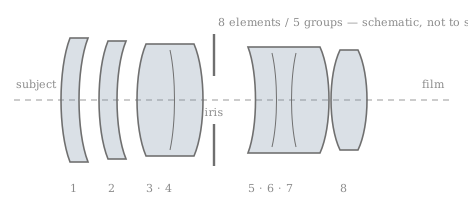
Optical formula — Biogon
History
The 60mm f/5.6 Biogon exists because NASA wanted to measure the Moon. From Apollo 11 the lunar-surface camera was a 500EL rebuilt as the Data Camera — silver-finished for thermal stability, with a glass réseau plate close to the film plane engraved with crosses 10 mm apart “and accurately calibrated to a tolerance of 0.002 mm”, so that film shrinkage and residual distortion could be taken out of the picture in the measuring room. NASA’s own Apollo 11 Hasselblad page says the camera was “fitted with a new Zeiss lens, a Biogon f-5.6/60 mm, specially designed for NASA, which later became available commercially”, and that “careful calibration tests were performed with the lens fitted in the camera in order to ensure high-quality, low-distortion images” — lens and body calibrated as one instrument, not as a lens that happens to be mounted. Zeiss’s own fiftieth-anniversary page names the same combination on Apollo 11.
Why a Biogon rather than a Distagon is the whole point. Bertele’s design is a double-ended reversed telephoto — a compact positive core with large negative menisci at each end, near enough symmetrical — and symmetry is what suppresses distortion, which is the one aberration a photogrammetric lens cannot tolerate. Zeiss had already proved the type at 38mm on the Superwide and, before that, in the Wild Aviogon aerial mapping lens of 1950. The 60 is the same idea at a focal length that covers the 55×55 mm frame comfortably rather than at the extreme.
The price is that the lens does not fit an ordinary camera. Its rear group reaches through the bayonet into the space a mirror would occupy, so it can be mounted only on a Data Camera body or on the MK70, the civilian metric camera Hasselblad Engineering AB built from the 500EL/M — the commercial availability NASA’s page mentions. Hasselblad’s own lens guide is blunt about the restriction, listing the 60mm f/5.6 MK Biogon and the 100mm f/3.5 MK Planar as being “for the MK70 photogrammetric camera only” and noting that a special body was needed for both. Zeiss’s data sheet (Cat. No. 10 48 00) says the same from the optical side: the lens is for réseau cameras — the 500EL Data Camera and the MK70 — and specifies the 4 mm réseau plate with its 25 crosses as part of the system rather than as an accessory. The sheet gives an exact focal length of 61.1 mm, about 740 g, closest focus 0.9 m and Series 63 filters.
The element count is the one specification that cannot be settled here. The Zeiss sheet prints its cross-section as a silhouette and no count beside it; the outline reads as the eight-element, five-group arrangement of the Bertele Biogons, and the schematic drawn for this page follows that pattern, but no consulted source states a figure and sources that quote one disagree. That absence is worth taking seriously for a lens whose whole purpose was metric precision: the numbers Zeiss chose to publish are the ones a surveyor needs, and the optical prescription is not among them.
Open: the element and group count; how many lenses were made in either form, which no source gives; whether the flown lenses differ from the MK lenses in anything but calibration; whether every Apollo landing mission carried this lens or only some; what shutter the barrel holds, which no consulted source names; and whether Nordin’s compendia or Hasselblad Engineering AB’s own literature carry a table for the MK optics. The Club Hasselblad museum pages on the NASA MK 70 refused an automated fetch and remain unread.
This history is AI-written, from the sources listed at the foot of the page. Where the record is silent it says so rather than filling the gap — but no human wrote these sentences.
Example photos
Sample photo wanted — shot with a Biogon 60mm f/5.6 (NASA Data Camera / MK70)? We'd love to feature it (with credit).
Live listings
The listings collector hasn't run for this family yet — check back soon, or search the marketplaces directly meanwhile.