F-Distagon 30mm f/3.5
Carl Zeiss · Hasselblad V · 1972 · F-Distagon (full-frame fisheye)
our own findingAlso known as: Zeiss F-Distagon 30mm f/3.5 · Carl Zeiss F-Distagon T* 3.5/30 · F-Distagon 3.5/30 · F-Distagon 30/3.5 · F-Distagon 30mm f3.5 · Hasselblad 30mm Fisheye · Hasselblad 30mm f/3.5 Fisheye · Distagon 30mm fisheye Hasselblad · F-Distagon C 30mm · F-Distagon CF 30mm · F-Distagon CFi 30mm · Zeiss Fisheye 30mm Hasselblad
Variants & identification
| Variant | Mount | Years | Serial ranges | Production |
|---|---|---|---|---|
| F-Distagon C T* 3.5/30 · Compur interchangeable reflex shutter size 0 with automatic iris diaphragm | Hasselblad V | 1972–1982 | — | No factory figure. A claim that no more than 1,000 C lenses were made between 1972 and 1982 circulates in dealer copy and was seen here only in a search summary; it has not been traced to any source and is not relied on. |
| F-Distagon CF T* 3.5/30 · Prontor CF, 1s–1/500 and B, plus F setting; focusing mount with bayonet and automatic-diaphragm coupling | Hasselblad V | 1982–1998 | — | — |
| F-Distagon CFi T* 3.5/30 · Prontor CFi, 1s–1/500, B and F | Hasselblad V | 1998–2013 | — | — |
- Element and group counts, exact focal length, fields, weights, close focus and filter thread are from the Zeiss data sheets hosted by Hasselblad Historical (C30, CF30, CFi30).
- Generation years follow the barrel families (C from the 1972 introduction, CF 1982, CFi 1998) and lens-db's dating; no Zeiss document consulted carries a month, and no production figure is published for any generation.
How to tell them apart
- One optical design for 41 years: 8 elements in 7 groups, 30.6 mm, 180° diagonal and 112° on the side, unchanged from the C sheet of 1972 to the CFi sheet of 1998
- A filter is always in the lens: four discs are supplied (neutral glass and three colour), they screw into an M 24 × 0.5 thread behind the front component, and Zeiss's sheets say one must always be fitted because the filter 'is part of the optical system'
- The permanent, non-removable hood is unique in the V line — every other Hasselblad lens takes a separate shade
- Compur size 0 with the EV interlock means a C lens; a Prontor with rubber grips and the green F setting means CF; blocky grips, one-colour scales and a PC socket on the barrel mean CFi
F-Distagon C T* 3.5/30:
- C barrel with the exposure-value interlock and a Compur size 0 shutter; aperture scale 3.5-4-5.6-8-11-16-22, which no later generation prints in full
- Fixed, non-removable hood shaped to the 180° field — dealer descriptions call it the one Hasselblad lens with a permanent shade
- Front component comes off on a bayonet to change the M 24 × 0.5 filter; four filters supplied (neutral glass and three colour), one always fitted
- About 1370 g, the heaviest of the three generations by a few grams
F-Distagon CF T* 3.5/30:
- Prontor CF barrel: rubberised grip rings, printed scales, cross-coupling push-button, green F setting on the speed ring for open-shutter use on a 2000- or 200-series body
- Same 8/7 optics, 30.6 mm, 180°/112° and 0.3 m as the C lens; 1365 g against 1370 g (Zeiss data sheet, Cat. No. 104877)
- Same M 24 × 0.5 filter behind the removable front component, and the same rule that one of the four must always be in place
F-Distagon CFi T* 3.5/30:
- CFi barrel styling — blocky rubber grips, one-colour printed scales, PC flash terminal on the lens
- Zeiss data sheet Cat. No. 10 49 41: 8/7, 30.6 mm, 112° × 112° and 180° diagonal, 0.3 m, 1:4.2 with a close-limit field of 338 × 338 mm and a working distance of 0.1 m from the front of the barrel, 1360 g
- No CFE version exists — the fisheye never gained databus contacts
- F-Distagon C T* 3.5/30: Zeiss's data sheet (Cat. No. 104813) gives 8 elements in 7 groups, exact focal length 30.6 mm, 180° on the diagonal and 112° on the side, closest focus 0.3 m, and explains the filter arrangement: the four filters "are built into the lens and are fixed to the front component, because even the largest attachment filter would occlude the 180° angular field. The filter is part of the optical system." Whether the earliest examples carried T* is unresolved — the C sheet's title has no T* in it, and Hasselblad Historical dates T* on the Hasselblad line to 1973, a year after this lens appeared, while dealer and lens-db listings call the C a T* lens throughout.
- F-Distagon CF T* 3.5/30: A rebarrel. Emulsive's V-system guide calls the CF "nearly optically identical" to the C and repeats the constraint that a compensation glass or filter "must be used in order for the lens to be useable". The Zeiss sheets bear this out: element and group counts, exact focal length, angular field and close focus are identical across C, CF and CFi, and the only published differences are five grams of weight and the shutter.
- F-Distagon CFi T* 3.5/30: The CFi sheet is the most explicit of the three about what the lens is for. It calls it a "fast ultra wide angle lens of 'fisheye' type" whose "distortion characteristic and focal length are chosen so that the complete frame is utilized for information recording, including the corners", designed "as a special lens for scientific and technical documentation", and it states the geometry plainly: "straight lines through the image center remain straight; circles around the center remain circles; tangential lines become bent." Production ended with the V system in 2013.
Serial-range notes
- red-ink code inside the rear mount, pre-1980
- Zeiss stamped a date code inside the rear of the mount: before 1980 the last two digits are the month and the leading digit(s) plus 1957 the year, so 1509 reads September 1972 — the first months of this lens.
- red-ink code inside the rear mount, 1980 onward
- From 1980 the code is two reversed year digits and a month letter, A = January; a CF fisheye reading 28C was made in March 1982, the first year of the CF barrel.
Specifications
- Formula
- F-Distagon (full-frame fisheye)
- Construction
- 8 elements / 7 groups
- Aperture range
- f/3.5–f/22
- Shutter
- In the lens on every version — Compur size 0 with automatic iris on the C, Prontor CF from 1982 and Prontor CFi from 1998, 1s–1/500 and B, flash sync at every speed. No shutterless F or FE fisheye was made
- Min. focus
- 0.3 m
- Weight
- 1370 g
- Filter
- 24 mm (0.5 mm pitch)
- Years manufactured
- 1972–2013
- Country
- West Germany (Carl Zeiss, Oberkochen); Germany from 1990
- Coating
- T* multicoating on the CF and CFi; whether the 1972 C lenses left the factory with T*, which reached the Hasselblad line in 1973, is not settled by the sources consulted
What reviewers say
No reviews aggregated yet — this family is still in the research queue. Written one? We'd love to index it.
Optical formula — F-Distagon (full-frame fisheye)
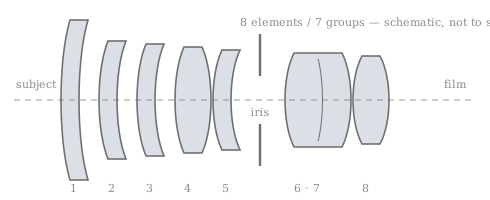
- Zeiss data sheet — C (cross-section, MTF)
- Zeiss data sheet — CF (cross-section, MTF)
- Zeiss data sheet — CFi (cross-section, MTF)
ⓘ What these charts mean
MTF (modulation transfer function) shows how much contrast the lens keeps at a given fineness of detail, from the center of the frame to the corner — the coarse curves track punch, the fine ones resolving power, and a gap between solid and dashed lines means astigmatism. Relative illumination (falloff) shows how much darker the corners are than the center at each aperture. Manufacturers only began publishing these for modern lenses; no 1950s maker issued them, which is why older families here cite period magazine bench tests instead.
History
The F in F-Distagon stands for fisheye, and the 30mm f/3.5 is the only one Hasselblad ever put in the V-system catalogue. It arrived in 1972 (lens-db) and stayed until the system ended in 2013, which makes it one of the longest-lived designs Zeiss built for the mount — and one of the least changed. Zeiss’s three data sheets, for the C of 1972 (Cat. No. 104813), the CF of 1982 (104877) and the CFi of 1998 (10 49 41), print the same eight elements in seven groups, the same exact focal length of 30.6 mm, the same 180° across the diagonal and 112° on the side, and the same 0.3 m closest focus. The only published differences across 41 years are the shutter and ten grams of weight, from 1370 g to 1360 g.
It is a full-frame fisheye rather than a circular one: the C sheet says that “with its angular field of 180° of the image field diagonal, this fisheye lens covers the entire 6 × 6 cm format”, so the corners are filled and the picture is a square, not a disc in a black surround. The CFi sheet describes the geometry more usefully than any adjective could — “straight lines through the image center remain straight; circles around the center remain circles; tangential lines become bent” — and says the distortion characteristic and focal length were “chosen so that the complete frame is utilized for information recording, including the corners”. Zeiss lists the intended users as documentation, industrial, advertising and nature work, and calls it “a special lens for scientific and technical documentation” before it calls it anything else.
The filter arrangement is the lens’s real peculiarity and the source of most confusion about it. There is no front filter thread and no attachment ring, because at 180° “even the largest attachment filter would occlude the angular field”; instead four filters — neutral glass and three colour — screw into an M 24 × 0.5 thread inside the barrel, reached by taking off the front component on its own bayonet, and one of them must always be in the lens. Zeiss’s reason is stated flatly on all three sheets: “the filter is part of the optical system.” Emulsive’s V-system guide repeats the warning for owners, noting that a compensation glass “must be used in order for the lens to be useable”. The same logic explains the permanently attached hood, shaped to the field, which is the only fixed shade on a V lens.
That fixed glass is probably also why the element count is contested. Japanese Wikipedia’s Hasselblad product list gives nine elements for the C and CF and eight for the CFi; Zeiss gives eight for all three and never changes it. Since the filter is a mandatory glass element in the light path by Zeiss’s own account, a count that includes it lands on nine — a reading offered here as the likeliest explanation rather than as anything a source says.
Open: whether the 1972 lenses were T* from the start, since T* reached the Hasselblad line in 1973 and the C sheet’s title omits it while dealers and lens-db call the C a T* lens; who computed the design at Oberkochen, whom no source names; any production figure for any generation, including the uncited claim of no more than 1,000 C lenses that circulates in dealer copy; a list price in any currency; and whether the four supplied filters changed specification across the three barrels.
This history is AI-written, from the sources listed at the foot of the page. Where the record is silent it says so rather than filling the gap — but no human wrote these sentences.
Example photos
Sample photo wanted — shot with a F-Distagon 30mm f/3.5? We'd love to feature it (with credit).
Live listings
Asking price, USD: a median of $2,500 across 8 fixed-price listings on 2026-09-11 (middle half $1,500–$3,100). Tracked since 2026-09-06, 2 days: unchanged from $2,500.
By day
| Date | Median | Middle half | Listings |
|---|---|---|---|
| 2026-09-11 | $2,500 | $1,500–$3,100 | 8 |
| 2026-09-06 | $2,500 | $1,500–$3,100 | 8 |
Asking prices from the listings scanned, not sales; junk-flagged rows and auction lots excluded; other currencies are not converted.
- Front Block Glass For Lens Hasselblad Carl Zeiss T* F Distagon 30mm f/3.5
- Hasselblad 3.5/30mm F-Distagon Dummy Display Model with Zeiss Prototype Ser. No
- Rare 【NEAR MINT】 Hasselblad Carl Zeiss T* F Distagon 30mm f3.5 Lens from JAPAN
- Hasselblad F-Distagon CF 30mm F3.5 Lens Model r80055
- 30mm F3.5 HASSELBLAD CARL ZEISS F-DISTAGON T* EISHEYE LENS DISTAGON FISH EYE
- CARL ZEISS 30MM F3.5 F-DISTAGON CF FOR HASSELBLAD V SYSTEM 3020177 #5858
- Rare !!【 MINT+ 】 Hasselblad Carl Zeiss F-Distagon CF 30mm f/3.5 Lens From JAPAN
- Hasselblad CFI 3.5/30mm F-Distagon near mint condition ZEISS
- Hasselblad 3.5/30mm F-Distagon Dummy Display Model with Zeiss Prototype Ser. No.
- Seltenes 【NEAR MINT】 Hasselblad Carl Zeiss T* F Distagon 30mm f3.5 Objektiv a...
- Hasselblad CF 30mm F3.5 F-Distagon Fisheye Objektiv (lesen) #IHI6586945
- CARL ZEISS 30MM F3.5 F-DISTAGON CF FOR HASSELBLAD V SYSTEM 3020177 #5858
- Hasselblad F-Distagon 3,5/30 T* Carl Zeiss Lens 30mm 3.5 Fish Eye Objektiv MINT
- Hasselblad CFI 3.5/30mm F-Distagon near mint condition ZEISS
- Rare 【NEAR MINT】 Hasselblad Carl Zeiss T* F Distagon 30mm f3.5 Lens from JAPAN
eBay links are affiliate links. If you buy through one, Glass Bodies earns a small commission from eBay at no cost to you. It does not change which listings appear, their prices or their order — those come from the search and the sort described above.
Listings updated 2026-09-11. Links go to the shop or marketplace that carries the item.