Nikkor 85mm f/1.4
Nippon Kogaku · Nikon F · 1981 · Modified Gauss, then inner-focus
our own findingAlso known as: Ai-S Nikkor 85mm f/1.4 · AI-S Nikkor 85mm F1.4 · AI Nikkor 85mm f/1.4S · Nikkor 85mm f/1.4 Ai-S · AF Nikkor 85mm f/1.4D IF · AF Nikkor 85mm f/1.4D · Nikon 85mm f/1.4 · NIKKOR 85mm 1:1.4 · ニッコール 85mm F1.4
Variants & identification
| Variant | Mount | Years | Serial ranges | Production |
|---|---|---|---|---|
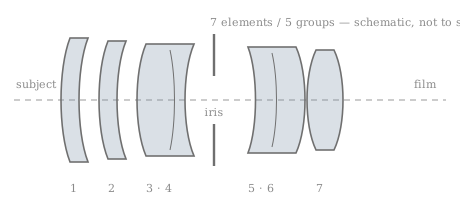
| Ai-S Nikkor 85mm f/1.4 · Modified Gauss borrowing Sonnar structure in the front group, 7 elements in 5 groups, with Close-Range Correction | Nikon F (Ai-S) | 1981–2005 | 179091 – 245723 (66,633) — from March 1981 in Vink's dating, September 1981 in Nikon's | 66,633 |
| AF Nikkor 85mm f/1.4D IF — new optical design · 9 elements in 8 groups, inner focus — a fixed front convex converter, a moving middle group carrying the diaphragm, and a fixed rear compensator; patented in Japan and the United States | Nikon F (AF-D) | 1995–2010 | 200001 – 228679 (28,679) — from November 1995 in Vink's dating, December 1995 in Nikon's 300001 – 303107 (3,107) — 2005 400001 – 471619 (71,619) — 2006 to July 2010 | ~103,405 across three blocks (28,679 + 3,107 + 71,619 — arithmetic, not a published total)¹ |
- Vink's quantity column is derived from serial numbers collected rather than from factory records. The 103,405 total for the AF-D is arithmetic performed here; no published figure exists for it.
- Release dates disagree by six months on the manual lens. Nikon's own essay says "the AI Nikkor 85mm f/1.4S was released in September, 1981"; Vink's serial record begins in March 1981, and lens-db likewise gives a March 1981 announcement. An announcement in March and a release in September would reconcile them, and no source consulted says that in so many words.
- The autofocus lens shows the same kind of discrepancy on a smaller scale: Vink's first block starts in November 1995, Nikon's essay gives December 1995.
- Nikon's essay describes the construction of the manual lens group by group but never states the element and group count in one sentence. The 7 elements in 5 groups given here is Vink's figure.
- No list price has been found for either version. Nikon's own account of the autofocus lens says only that "a large amount of expensive glass" pushed manufacturing costs past what had been expected, and that "the launch price was low, making this a bargain Nikkor lens" — an assessment without a number attached.
How to tell them apart
- Filter size separates the two at a glance: 72mm on the manual lens, 77mm on the autofocus lens. The hoods differ with them, HN-20 against HN-31
- Both focus to 0.85m and both use nine blades, but the Ai-S blades are straight and the AF-D's are rounded
- The manual lens is the heavier of the two at 620g against 550g, despite having two fewer elements — the autofocus design spends its weight budget on glass rather than brass
Ai-S Nikkor 85mm f/1.4:
- 72mm filter and the HN-20 hood; 620g; nine straight aperture blades; minimum aperture f/16
- Close-Range Correction — a floating group, so the focus ring is 125° end to end and the front element does not extend
- Five cross-head mount screws (Vink)
- Sold alongside its autofocus successor for a decade: production runs to 2005, ten years after the AF-D arrived
AF Nikkor 85mm f/1.4D IF — new optical design:
- 77mm filter and the HN-31 hood; 550g; nine rounded blades
- Nothing moves at the front: the middle group focuses, so the barrel length is fixed
- Longer than the manual lens at 72.5mm against 64.5mm, and 70g lighter
- AF Nikkor 85mm f/1.4D IF — new optical design: A different lens under a continuous name. Nikon's own account describes it as a departure from Gauss construction altogether, and Vink separates it from the Ai-S with the rule he reserves for a new optical design.
Serial-range notes
- 179091
- Vink gives the same start number for the 85mm f/1.4 and the 105mm f/1.8 Ai-S. The two were designed as a pair for the F3 and released in the same month; whether the shared number is a Nikon convention or an artifact of the list is not something the source settles.
- 228679 → 300001
- A gap of roughly 71,000 numbers between the first AF-D block and the second. Vink's blocks restart at round figures rather than running on, so the numbers in between do not appear on this lens anywhere in his record.
- 245723
- The last recorded Ai-S, in 2005. The manual lens outlived the introduction of its own replacement by a decade — for ten years both were in the catalogue at once.
Specifications
- Formula
- Modified Gauss, then inner-focus
- Construction
- 7 elements / 5 groups
- Aperture range
- f/1.4–f/16
- Diaphragm blades
- 9
- Min. focus
- 0.85 m
- Dimensions
- 80.5 × 64.5 mm
- Weight
- 620 g
- Filter
- 72 mm
- Years manufactured
- 1981–2010
- Country
- Japan
- Coating
- Nikon Integrated Coating
What reviewers say
- Nikon — NIKKOR: The Thousand and One Nights, Tale 89 (blog) — Nikon's account puts the achievement in one place: "Sagittal coma, which is a major drawback of fast Gauss lenses, was dramatically reduced by incorporating aspects of the Sonnar structure." The front group abandons the cemented triplet for a separated convex element, an air lens and a doublet, and the lens was built to partner the F3.
- Richard Haw (blog) — Strong wide open with a little veiling flare taking contrast off, considerably better by f/2 and peaking at f/4 to f/5.6; colour error nicely controlled and better than the autofocus successor's; ghosting when shot into strong light, which stopping down makes worse rather than better. He rates it among the best lenses he has used.
- Fredrik A. Rasmussen (momentcorp.com) (blog) — "A perfect portrait lens, with a sweet Bokeh" — possibly the best background rendering he has seen, a trace of colour fringing wide open that is gone by f/2, and the usual caveat that manual focus at f/1.4 needs a subject that holds still.
Optical formula — Modified Gauss, then inner-focus
History
Nippon Kogaku built an 85mm f/1.5 in 1953. It went on the rangefinder bodies, and when the F replaced them in 1959 nothing that fast came with it. The fastest 85mm in the F mount was f/1.8 until 1977, and then f/2 until 1981 — a slower lens than the company had been selling twenty-eight years earlier. The 85mm f/1.4 closed that gap, and it took a long time to arrive.
Takashi Takiguchi did the basic design; prototype drawings and trial production began in January 1978, the optical report was filed in 1979, and mass production started at Sagamihara in September 1979. Daijiro Fujie, whom Nikon describes as an Academy Award recipient, carried it to production drawings. The lens did not go on sale for another two years. Nikon’s own essay puts the release in September 1981; Vink’s serial record starts in March, and lens-db gives a March announcement, so the six-month difference is probably the distance between announcing a lens and shipping it, though nothing consulted here says so.
The design is a Gauss with a Sonnar graft. Rather than the cemented triplet a fast Gauss usually carries at the front, Takiguchi split the group into a separated convex element, a convex meniscus air lens and a convex-concave doublet. Nikon states the purpose plainly: sagittal coma, the failure mode that ruins fast Gauss lenses on point sources at the edges, “was dramatically reduced by incorporating aspects of the Sonnar structure”. Close-Range Correction — a floating group — handles the aberration drift that would otherwise appear at portrait distances. Seven elements in five groups, 620g of them, behind a 72mm filter.
What photographers actually talk about is the out-of-focus rendering, and the reviewers converge: possibly the best one had seen, in one account; on a level with the 105mm f/1.8 in another. Sharpness is real at f/1.4 with a veil of flare over it, better by f/2, at its peak from f/4. Ghosting into a strong light is the lens’s one bad habit, and it gets worse stopped down rather than better.
Vink records 66,633 Ai-S lenses. The autofocus replacement of 1995 is a different optical system with the same name on it — nine elements in eight groups, focused by moving a middle group rather than the whole cell, patented in Japan and the United States, and described by Nikon as a departure from Gauss construction altogether. About 103,405 of those were built to July 2010, half again as many as the manual lens managed in twenty-four years. The two overlapped for a decade: the Ai-S stayed in the catalogue until 2005, ten years after its successor arrived, which is not what a superseded lens usually does.
The open question is what either cost. Nikon’s essay on the autofocus lens says a great deal of expensive glass drove manufacturing costs past what had been envisaged, and that the launch price was nevertheless low — a judgement with no figure behind it. No list price for either version has been found in any source consulted here.
This history is AI-written, from the sources listed at the foot of the page. Where the record is silent it says so rather than filling the gap — but no human wrote these sentences.
Example photos


Sample photo wanted — shot with a Nikkor 85mm f/1.4? We'd love to feature it (with credit).
Live listings
The listings collector hasn't run for this family yet — check back soon, or search the marketplaces directly meanwhile.