Nikkor 105mm f/1.8
Nippon Kogaku · Nikon F · 1981 · Xenotar type — 5 elements in 5 groups
Also known as: Ai-S Nikkor 105mm f/1.8 · AI-S Nikkor 105mm F1.8 · Nikkor 105mm f/1.8 Ai-S · Nikon 105mm f/1.8 · NIKKOR 105mm 1:1.8 · AI Nikkor 105mm f/1.8S · ニッコール 105mm F1.8
Variants & identification
| Variant | Mount | Years | Serial ranges | Production |
|---|---|---|---|---|
| Ai-S Nikkor 105mm f/1.8 | Nikon F (Ai-S) | 1981–2005 | 169091 — prototype, August 1980, a single recorded lens 179091 – 223497 (44,407) — March 1981 onward | 44,407 recorded, plus one prototype |
- Vink's quantity column is derived from serial numbers collected, not from factory records, so 44,407 is a floor rather than a total.
- The two sources disagree about how long the lens was sold. Nikon's own account says it "sold for roughly twelve years", which puts the end at 1993 and matches the arrival of the AF DC Nikkor 105mm f/2D in September 1993. Vink's serial record and Richard Haw both run the lens to 2005. A catalogue withdrawal in 1993 and a build-to-order tail to 2005 would reconcile them, but no source consulted says so.
- Design and release are also four to five years apart in Nikon's own telling: optics designed 1975 to early 1976, trial-production drawings June 1976, mass production autumn 1979, release September 1981. Vink's first production block starts in March 1981.
- No list price has been found for this lens in any source consulted.
How to tell them apart
- A 105mm lens with a 62mm filter and a hood that pulls out of the barrel is this one; the f/2.5 Ai-S also has a built-in hood but takes 52mm filters and weighs 145g less
- Five elements at f/1.8 is the whole point: a Gauss design of that speed would normally need seven, and Nikon's essay treats the element count as the achievement
Ai-S Nikkor 105mm f/1.8:
- Built-in sliding hood, 62mm filter, 580g — the barrel is the twin of the 85mm f/1.4 Ai-S in everything but diameter
- Nine aperture blades, minimum aperture f/22, close focus 1m
- Five cross-head mount screws (Vink)
- There is no other 105mm f/1.8 in the F mount: no pre-AI, no Ai, no autofocus version was ever built
Serial-range notes
- 169091
- The single recorded prototype, dated August 1980 — thirteen months before Nikon's stated release and seven before the first production block.
- 179091
- Vink gives the same start number, 179091, for this lens and for the 85mm f/1.4 Ai-S. The two were designed as a pair for the F3 era and released in the same month; whether the shared number is a numbering convention or a transcription of one list into two rows is not something the source settles.
Specifications
- Formula
- Xenotar type — 5 elements in 5 groups
- Designed by
- Tsunashima Teruyoshi — optical design, 1975 to early 1976
- Construction
- 5 elements / 5 groups
- Aperture range
- f/1.8–f/22
- Diaphragm blades
- 9
- Min. focus
- 1 m
- Dimensions
- 78.5 × 80.5 mm
- Weight
- 580 g
- Filter
- 62 mm
- Years manufactured
- 1981–2005
- Country
- Japan
- Coating
- Nikon Integrated Coating
What reviewers say
- Nikon — NIKKOR: The Thousand and One Nights, Tale 59 (blog) — Nikon's own essay treats Tsunashima's five-element solution as the achievement — "He really did achieve f/1.8 optics with a 5-element design" — and credits it with little astigmatism, good close-distance blur and a natural rendering for portraits, with a slight softness from characteristic flare.
- Richard Haw (blog) — Bokeh he calls second-to-none, with clean even discs and no onion rings; resolution good but lacking at close range wide open, right by f/2.8 and peaking at f/5.6; heavy vignetting at f/1.8 that is nearly gone by f/4, and colour fringing that traces away by f/4. Built to the Ai-S standard, which he rates below the earlier Ai and New-Nikkor barrels.
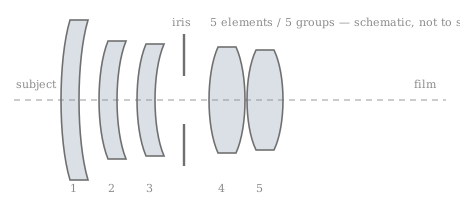
Optical formula — Xenotar type — 5 elements in 5 groups
History
Nikon released the F3 in 1980 and then, in September 1981, two fast portrait lenses to sit on it: the 85mm f/1.4 and this one. They look alike, they were sold as a pair, and Roland Vink’s database gives them the same starting serial number, 179091. Only one of the two is remembered.
Teruyoshi Tsunashima designed the optics between 1975 and early 1976, and the interesting fact about them is how few there are. Five elements in five groups, Xenotar type, at f/1.8 — a Gauss design of that speed would normally run to seven. Nikon’s own essay on the lens spends most of its length on that point and ends with something close to an exclamation: the author writes that Tsunashima “really did achieve f/1.8 optics with a 5-element design”. Everything downstream follows from the choice. The lens is large — 580g, 62mm filters, a hood that slides out of the barrel — because five elements at that aperture need to be big ones, and its aberration behaviour is that of a design with nothing spare: heavy vignetting wide open, colour fringing that clears by f/4, resolution that is merely good at close range until f/2.8.
What survives all of that is the blur. Richard Haw, who has taken the lens apart, calls the bokeh second to none, with clean evenly-lit discs and no onion rings in them, and rates it level with the 85mm f/1.4 on that count alone. The nine-bladed iris helps; so does the fact that Tsunashima was correcting for a portrait distance rather than a test chart.
Vink records 44,407 lenses from March 1981, plus a single prototype from August 1980. Against the 163,938 Ai-S 105mm f/2.5s built in the same window, that is roughly one f/1.8 for every four f/2.5s — the slower lens was smaller, lighter, cheaper and nearly as good, and most photographers bought it instead.
Two things remain open. Nikon says the lens “sold for roughly twelve years”, which ends it in 1993 when the AF DC Nikkor 105mm f/2D arrived; Vink and Haw both run it to 2005. Nothing consulted here reconciles the twelve-year figure with the twenty-four-year serial record. And no list price has surfaced for it at all, in yen or dollars, at any point in that run.
This history is AI-written, from the sources listed at the foot of the page. Where the record is silent it says so rather than filling the gap — but no human wrote these sentences.
Example photos
Sample photo wanted — shot with a Nikkor 105mm f/1.8? We'd love to feature it (with credit).
Live listings
Asking price, USD: a median of $420 across 50 fixed-price listings on 2026-09-11 (middle half $380–$450). Tracked since 2026-09-06, 2 days: unchanged from $420.
By day
| Date | Median | Middle half | Listings |
|---|---|---|---|
| 2026-09-11 | $420 | $380–$450 | 50 |
| 2026-09-06 | $420 | $380–$450 | 50 |
Asking prices from the listings scanned, not sales; junk-flagged rows and auction lots excluded; other currencies are not converted.
- Nikon Nikkor Ai-s 105mm f1.8 Lens AIS *Read #901
- Nikon AI Nikkor 105mm F1.8S SLR Lens From Japan Tested [Read Cond]
- Nikon Nikkor Ai-s 105mm f1.8 Lens AIS *Read #391
- [Exc+5] Nikon Ai-s Nikkor 105mm f/1.8 MF Lens From JAPAN
- Nikon 105mm f/1.8 MF Portrait AI-s Telephoto Nikkor Lens F3 FM2 FM3 Very Clean!!
- Nikon NIKKOR 105mm f/1.8 AIS Telephoto Prime Lens - Serial No. 212338
- S/N186xxx [Almost MINT] Nikon Ai-S NIKKOR 105mm f/1.8 MF Portrait Lens JAPAN
- Nikon Nikkor Ai-s 105mm f1.8 Lens AIS #533
- Nikon Ai-s Ais Nikkor 105mm f/1.8 MF Lens From JAPAN [Excellent++++] #1005
- SP Price[Near MINT+++] Nikon Ai-s Ais Nikkor 105mm f/1.8 MF Portrait Lens From J
- US duty paid Nikon Ai-s Ais Nikkor 105mm f/1.8 Telephoto Portrait Lens
- [Near MINT] Nikon Ai-s Nikkor 105mm f/1.8 MF Telephoto Portrait Lens From JAPAN
- [Near MINT] Nikon Ai-s Ais Nikkor 105mm f/1.8 Telephoto Portrait MF Lens JAPAN
- S/N 205xxx [MINT] Nikon Ai-s Nikkor 105mm f/1.8 MF Telephoto Lens F Mount JAPAN
- [Opt. MINT] Nikon Ai-s Ais Nikkor 105mm f/1.8 Portrait SLR MF Lens From Japan
- [MINT] Nikon Ai-s AIS Nikkor 105mm f/1.8 MF Telephoto Lens From JAPAN
- Nikon 105mm f/1.8 Manual Focus Telephoto Lens Nikon F Mount 62mm Japan
- [Exc+5] Nikon Ai-s Nikkor 105mm f/1.8 MF Portrait Telephoto Lens From JAPAN
- RARE【Near Mint】Nikon Ai-s Ais Nikkor 105mm f/1.8 Portrait Lens From JAPAN #2722
- 【NEAR MINT】 Nikon Ai-s Nikkor 105mm f1.8 AIS MF Portrait Prime Lens From JAPAN
Show 109 more listings
- [ MINT ] Nikon Ai-s Nikkor 105mm f/1.8 MF AIS Telephoto Lens For SLR From Japan
- SIC S/N 204xxx [Mint+++] Nikon Ai-s Nikkor 105mm F/1.8 MF Prime Lens JAPAN
- Nikon Ai-s AIS Nikkor 105mm f1.8 MF Portrait Lens From JAPAN Near MINT #1554
- Nikon Ai-s AIS Nikkor 105mm f1.8 MF Portrait Lens From JAPAN Near MINT+ #8467
- [Serviced & Tested]Nikon Nikkor Ai-S 105mm F1.8 Vintage Portrait 460
- [Serviced & Tested]Nikon Nikkor Ai-S 105mm F1.8 Vintage Portrait 596
- RARE SIC S/N204xxx [Near MINT] Nikon Ai-s 105mm F1.8 Portrait Lens from JAPAN
- [Near Mint+] Nikon AI-S NIKKOR 105mm f1.8 Fast MF Telephoto Portrait Lens Japan
- SIC S/N 187xxxx [MINT] Nikon Ai-s Nikkor 105mm f/1.8 MF Portrait Lens From JAPAN
- Nikon Ai-S Nikkor 105mm f/1.8 MF Portrait Lens [Mint] From Japan
- Video*[MINT] Nikon Nikkor Ai-s Ais 105mm f/1.8 Telephoto Portrait JP #1 day ship
- [Serviced & Tested]Nikon Nikkor Ai-S 105mm F1.8 Vintage Portrait 145
- [Pristine] Nikon Nikkor Ai-s 105mm f1.8 Lens
- Nikon Ai-S NIKKOR 105mm f/1.8
- Nikon Ai-S NIKKOR 105mm f/1.8 MF Portrait Lens Caps [Tested w/ Sample Photos]
- [Top MINT] Nikon Ai-s Ais Nikkor 105mm f/1.8 MF Portrait Lens From JAPAN
- [MINT] Nikon Ai-s Nikkor 105mm f/1.8 Portrait MF Lens From JAPAN
- --THE LEGEND-- Nikon Nikkor AI-S 105mm f1.8 Portrait, Japan,TESTED[N.Mint] #1044
- Nikon NIKKOR 105mm f/1.8 AI-S MF Portrait Lens w/Original AI-S Instruction Sheet
- SIC Late S/N 222xxx[MINT] Nikon Ai-s Nikkor 105mm f/1.8 Portrait Lens From JAPAN
- Great Value!! [Almost Unused] Nikon Ai-s Ais Nikkor 105mm f/1.8 MF Portrait Lens
- [MINT] Nikon Nikkor Ai-s 105mm f/1.8 Tele-Portrait Lens for F mount From Japan
- [Almost Unused] Nikon Ai-s Ais Nikkor 105mm f/1.8 MF Lens F Mount From JAPAN
- Nikon Ai-S NIKKOR 105mm f/1.8
- [MINT+++] Nikon Ai-s Ais Nikkor 105mm F1.8 MF Lens Portrait From JP US Duty Incl
- Nikon Ai-S NIKKOR 105mm f/1.8
- Nikon Ai-s Nikkor 105mm F1.8 Lens Excellent Condition for Portrait Photography
- Nikon Ai-s Nikkor 105mm F1.8 Lens Tested Excellent Condition Photography
- NIKON Nikkor 105mm f/1.8 AIs lens Nikon USA OPEN BOX MINT in box & packaging
- Rare Late [ Unused in Box] Nikon Nikkor Ai-s Ais 105mm f/1.8 Portrait Lens JAPAN
- NIKON AIS NIKKOR 105mm f1.8 PRIME LENS - DAMAGED / SPARES / REPAIR / FAULTY
- Nikon AI Nikkor 105mm F1.8S SLR Lens From Japan Tested [Read Cond]
- [Exc+5] Nikon Ai-s Nikkor 105mm f/1.8 MF Lens From JAPAN
- [Near MINT] Nikon Ai-s Nikkor 105mm f/1.8 Portrait MF Lens From JAPAN
- S/N186xxx [Almost MINT] Nikon Ai-S NIKKOR 105mm f/1.8 MF Portrait Lens JAPAN
- Nikon Ai-s Ais Nikkor 105mm f/1.8 MF Lens From JAPAN [Excellent++++] #1005
- [Exc+5] Nikon Ai-S NIKKOR 105mm f/1.8 Telephoto Lens From Japan #5025
- 【NEAR MINT】 Nikon NIKKOR Ai-s 105mm f/1.8 AIS Vintage Standard Lens From JAPAN
- SP Price[Near MINT+++] Nikon Ai-s Ais Nikkor 105mm f/1.8 MF Portrait Lens From J
- S/N 205xxx [MINT] Nikon Ai-s Nikkor 105mm f/1.8 MF Telephoto Lens F Mount JAPAN
- Nikon Ai-s AIS Nikkor 105mm f1.8 MF Portrait Lens From JAPAN Near MINT #1554
- Nikon Ai-S NIKKOR 105mm f/1.8
- [Near MINT] Nikon Ai-s Nikkor 105mm f/1.8 MF Telephoto Portrait Lens From JAPAN
- [Near MINT] Nikon Ai-s Ais Nikkor 105mm f/1.8 Telephoto Portrait Lens From JAPAN
- [Top MINT] Nikon Nikkor Ai-s AIS 105mm f/1.8 Manual Focus Prime Lens From JAPAN2
- Nikon Ai-s AIS Nikkor 105mm f1.8 MF Portrait Lens From JAPAN Near MINT+ #8467
- @ SakuraDo @ Excellent & Rare! @ Nikon Nikkor 105mm f1.8 Ai-S Portrait MF Lens
- [ MINT ] Nikon Ai-s Nikkor 105mm f/1.8 MF AIS Telephoto Lens For SLR From Japan
- [Exc+5] Nikon Ai-s Nikkor 105mm f/1.8 MF Portrait Telephoto Lens From JAPAN
- SIC S/N 187xxxx [MINT] Nikon Ai-s Nikkor 105mm f/1.8 MF Portrait Lens From JAPAN
- [MINT] Nikon Ai-S Nikkor 105mm f/1.8 MF Lens Manual Focus from Japan
- Nikon Ai-s Nikkor 105mm f/1.8 MF Telephoto Lens F-mount AIS [Near MINT] JAPAN
- RARE SIC S/N204xxx [Near MINT] Nikon Ai-s 105mm F1.8 Portrait Lens from JAPAN
- NIKON F NIKKOR 105mm f/1.8 AI S Prime Portrait Telephoto Lens 62mm
- Nikon Ai-S NIKKOR 105mm f/1.8 MF Portrait Lens Caps [Tested w/ Sample Photos]
- Nikon Ai-S Nikkor 105mm f/1.8 MF Portrait Lens [Mint] From Japan
- Video*[MINT] Nikon Nikkor Ai-s Ais 105mm f/1.8 Telephoto Portrait JP #1 day ship
- Nikon Ai-S NIKKOR 105mm f1.8 Prime Telephoto MF Lens [Near Mint] Japan #26106
- [Near Mint+] Nikon AI-S NIKKOR 105mm f1.8 Fast MF Telephoto Portrait Lens Japan
- Nikon AI-S NIKKOR 105mm F1.8 Black Lens AIS F-Mount MF Manual Focus Exc++
- [Top MINT] Nikon Ai-s Ais Nikkor 105mm f/1.8 MF Portrait Lens From JAPAN
- S/N 190xxx [MINT] Nikon Ai-s Ais Nikkor 105mm f/1.8 MF Lens From JAPAN
- S/N 208xxx [Top MINT] Nikon Ai-s Nikkor 105mm f/1.8 MF Lens From JAPAN
- [MINT+++] Nikon Ai-s Ais Nikkor 105mm F1.8 MF Lens Portrait From JP US Duty Incl
- Nikon Nikkor 105mm f/1.8 AI-S Manual Focus Lens
- Great Value!! [Almost Unused] Nikon Ai-s Ais Nikkor 105mm f/1.8 MF Portrait Lens
- [Exc+5]Nikon Nikkor Ai-s 105mm f1.8 Lens From JAPAN # v3366
- SIC Late S/N 222xxx[MINT] Nikon Ai-s Nikkor 105mm f/1.8 Portrait Lens From JAPAN
- [MINT] Nikon Nikkor Ai-s 105mm f/1.8 Tele-Portrait Lens for F mount From Japan
- Nikkor Nikon 105mm F1.8 AIS Vintage Objektiv
- Nikon Ai-S NIKKOR 105mm f/1.8
- NIKON OBJEKTIV AI-S NIKKOR 105MM f1.8 gebraucht
- Late [MINT S/N 221xxx] Nikon Ai-s Nikkor 105mm f/1.8 MF Portrait Lens AIS JAPAN
- *Almost Unused in Box* Nikon Ai-s Nikkor 105mm f/1.8 MF Portrait Lens From JAPAN
- RARE!!【Top Mint】Nikon Ai-s Ais Nikkor 105mm f/1.8 Portrait Lens From Japan...
- Rare Late [ Unused in Box] Nikon Nikkor Ai-s Ais 105mm f/1.8 Portrait Lens JAPAN
- Nikon AI Nikkor 105mm F1.8S SLR Objektiv aus Japan getestet [Zustand lesen]
- [Exc+5] Nikon Ai-S NIKKOR 105mm f/1.8 Teleobjektiv aus Japan #5025
- SP Preis [Near MINT+++] Nikon Ai-s Ais Nikkor 105mm f/1.8 MF Portrait Objekti...
- S/N 205xxx [NEUWERTIG] Nikon Ai-s Nikkor 105mm f/1.8 MF Teleobjektiv F...
- [NEUWERTIG] Nikon Nikkor Ai-s AIS 105mm f/1.8 Manueller Fokus Porträtobjektiv...
- [Top NEUWERTIG] Nikon Nikkor Ai-s AIS 105mm f/1.8 Manueller Fokus Prime...
- [Exc+5] Nikon Ai-s Nikkor 105mm f/1.8 MF Porträt Teleobjektiv Aus Japan
- @ SakuraDo @ Excellent & Rare! @ Nikon Nikkor 105mm f1.8 Ai-S Portrait MF Obj...
- [ EXC+ 5] Nikon Ai-S Nikkor 105mm F/1.8 Mf Portrait Téléobjectif Photo De Japon
- Obiettivo Teleobiettivo Nikon Ai-s Nikkor 105mm F/1.8 MF Ritratto Da GIAPPONE
- Nikon Ai-s Nikkor 105mm f/1.8 MF Teleobjektiv F-Mount AIS [Near MINT] JAPAN
- [NEUWERTIG] Nikon Ai-S Nikkor 105mm f/1.8 MF Objektiv manueller Fokus aus Japan
- SELTENES SIC S/N204xxx [Near MINT] Nikon Ai-s 105mm F1.8 Portrait Objektiv...
- Video*[NEUWERTIG] Nikon Nikkor Ai-s Ais 105mm f/1.8 Tele Portrait JP #1 Tag...
- Nikon Ai-S NIKKOR 105mm f1.8 Prime Tele MF Objektiv [Near Mint] Japan #26106
- [Near Mint+] Nikon AI-S NIKKOR 105mm f1.8 Fast MF Tele Photo Portrait Lens Japan
- NIKON Nikkor 105mm 1:1.8 Ai-s
- NIKON F NIKKOR 105mm f/1.8 AI S Prime Portrait Telephoto Lens 62mm
- [NEUWERTIG] Nikon Nikkor Ai-s 105mm f/1.8 Tele-Portrait Objektiv für...
- Nikon Ai-s Nikkor 105mm F1.8 Tele Prime Objektiv Nikon F Excellent aus Japan
- Nikon Nikkor Ai/S 1,8/105 Tele Lens - AiS 105mm F/1.8 Tele MF Objektiv
- Late [MINT S/N 221xxx] Nikon Ai-s Nikkor 105mm f/1.8 MF Portrait Lens AIS JAPAN
- Nikon Ai/S Nikkor 1,8/105 Tele Lens - AiS 105mm F/1.8 Tele MF Objektiv
- RARE【Near Mint】Nikon Ai-s Ais Nikkor 105mm f/1.8 Portrait Lens From JAPAN...
- Nikon AI-S Nikkor 105mm F1.8 Objektiv gebraucht guter Zustand, inklusive Kappe
- Nikon Ai-S Nikkor 105mm F1.8 Objektiv gebraucht guter Zustand
- RAR!!【Top Neuwertig】Nikon Ai-s Ais Nikkor 105mm f/1.8 Portrait Objektiv aus...
- [Exc+5] Nikon Ai-s Nikkor 105mm f/1.8 MF Portrait Telephoto Lens From JAPAN
- Nikon Ai-S Nikkor 105mm f/1.8 MF Telephoto Portrait Lens
- Nikon 105mm f1.8 AIS
- Nikon 105mm F1.8 AIS
- NIKON LENS AI-S NIKKOR 105MM f1.8 Used
- Nikon Nikkor 105mm f/1.8 Ai-S MF Telephoto Prime Lens AIS for Nikon F Mount
eBay links are affiliate links. If you buy through one, Glass Bodies earns a small commission from eBay at no cost to you. It does not change which listings appear, their prices or their order — those come from the search and the sort described above.
Listings updated 2026-09-11. Links go to the shop or marketplace that carries the item.