Nikkor 24mm f/2
Nippon Kogaku · Nikon F · 1977 · Retrofocus, 11 elements in 10 groups, with CRC
our own findingAlso known as: Ai Nikkor 24mm F2 · Ai Nikkor 24mm F2S · Nikkor 24mm f/2 Ai-S · AI-S Nikkor 24mm 1:2 · Nikon 24mm f/2 · ニッコール 24mm F2
Variants & identification
| Variant | Mount | Years | Serial ranges | Production |
|---|---|---|---|---|
| Ai prototype | Nikon F | — | 104291 (the only example Vink has recorded) | One known example |
| Ai | Nikon F | 1977–1981 | 176021–193501 (Aug 1977 – Nov 1981) | 17,481 (Vink) |
| Ai-S (Ai Nikkor 24mm F2S) | Nikon F | 1981–2005 | 200001–247547 (Oct 1981 – 2005) | 47,547 (Vink) |
- Quantities are Vink's, derived from serial-block spans. Nikon has published no production figure for either version.
- Nikon's own account dates the release to October 1977; Vink's Ai serial block opens in August 1977. The gap is consistent with production preceding sale, but no source states that outright.
- ¥83,000 is the price Nikon lists on the discontinued-product page for the Ai Nikkor 24mm F2S — the Ai-S, on sale from 1981. No dated price for the 1977 Ai lens has been found.
How to tell them apart
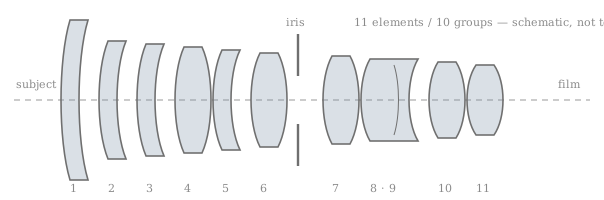
- Eleven elements in ten groups — nine of the ten are singlets, an unusually uncemented design
- A 52mm filter thread on an f/2 wide-angle: the constraint that shaped the whole computation
- 0.3m minimum focus, 1:8.6, and a front element that barely moves — close-range correction doing the work
Ai prototype:
- A six-digit 1042xx number, in the block Nikon used for Ai pre-production lenses
Ai:
- Depth-of-field marks engraved on the black barrel, not on a chrome ring
- 160° focus throw — twice the Ai-S, and the clearest handling difference between them
Ai-S (Ai Nikkor 24mm F2S):
- Depth-of-field marks on a chrome ring
- 80° focus throw; the scale is compressed against the Ai
- Aperture ring notched for shutter-priority and program metering on the FA and after
- Ai-S (Ai Nikkor 24mm F2S): Same eleven-in-ten computation as the Ai. The change is mechanical: the Ai-S coupling that lets a body drive the diaphragm itself.
Serial-range notes
- 176021–180202
- Earliest confirmed Ai run; Vink publishes no separate quantity for it inside the 17,481 total.
- 200001
- The Ai-S restarts the sequence in a fresh 2xxxxx block rather than continuing the Ai numbers.
Specifications
- Formula
- Retrofocus, 11 elements in 10 groups, with CRC
- Designed by
- Tsunashima Teruyoshi — optical design
- Construction
- 11 elements / 10 groups
- Aperture range
- f/2–f/22
- Diaphragm blades
- 7
- Min. focus
- 0.3 m
- Dimensions
- 63.5 × 51.5 mm
- Weight
- 300 g
- Filter
- 52 mm
- Years manufactured
- 1977–2005
- Country
- Japan
- Original price
- ¥83,000 (Ai Nikkor 24mm F2S, Nikon's own listing; year not stated)
What reviewers say
- Bjørn Rørslett (blog) — Mixed feelings: very good in the centre with well-controlled light fall-off, but corners stay soft until f/8 and residual colour aberrations rob the depth-of-field zone of detail — a pattern he found on three separate samples, so he takes it as typical of the design.
- Martin (phillipreeve.net) (blog) — A very good lens on film provided nothing important sits in the corners — coma is obvious at f/2 and practically gone by f/4, spherical aberration clears by f/2.8, and flare resistance is better than many modern lenses.
Optical formula — Retrofocus, 11 elements in 10 groups, with CRC
History
Nikon has told this lens’s development story itself, in the ninety-eighth of the Thousand and One Nights essays, and the story is mostly one of failure. Tsunashima Teruyoshi began the design around 1973 and finished the computation in 1974. The first prototype was built that summer and did not perform. The curvatures were reworked, a second prototype went up in spring 1975 and passed, the mass-production order followed in January 1976, and the lens went on sale in October 1977 — four years from first sketch to shop shelf, for a lens with eleven elements in ten groups.
The reason it was hard is stated in the same essay, and it is a constraint rather than a limitation of skill. Nikon wanted the 24mm f/2 to accept a 52mm filter, the thread shared by almost every prime in the manual-focus catalogue, which meant the front elements had to be kept small and given short radii. Short radii on a fast retrofocus wide produce sagittal coma flare — the effect that turns a point of light near the frame edge into something with wings. Nikon ranked its three fast wide-angles by how much of it they produced: the 24mm f/2 worst, the 35mm f/1.4 next, the 28mm f/2 least, and observed that the ranking is a fair index of how difficult each was to design.
Reviewers have been reading the same aberration ever since. Rørslett rates the lens 3.5 and reports that the centre is very good while the corners stay soft until f/8, with residual colour aberrations flattening the depth-of-field zone; he saw the pattern on three samples and concluded it is the design, not the copies. Phillip Reeve’s review reaches a gentler verdict — coma obvious at f/2 and effectively gone by f/4, spherical haze clearing at f/2.8, and flare resistance better than a good deal of modern glass — and advises keeping anything important out of the corners.
The mount history is short because the optics never changed. The Ai ran from August 1977 to November 1981, 17,481 lenses by Vink’s serial span, with depth-of-field marks on the black barrel and a long 160° focus throw. The Ai-S took over in October 1981 in a fresh serial block and ran to 2005, 47,547 lenses, with the marks moved to a chrome ring, the throw halved to 80°, and the Ai-S aperture coupling that let an FA or an F4 set the diaphragm in shutter-priority and program. Nikon announced the discontinuation in January 2006, twenty-nine years after launch.
It never autofocused, and no source explains why. Nikon put an AF motor behind the 24mm f/2.8 in 1986 and behind almost every other prime in the line, but the f/2 stayed manual to the end of its run, and the gap it left at 24mm was not filled until the AF-S 24mm f/1.4G ED of 2010 — eleven elements in ten groups replaced by twelve in ten, two ED and two aspherical, a 77mm filter and twice the weight. The two things still missing from the record here are a factory production figure and any statement of what the Ai lens cost in 1977; the ¥83,000 Nikon publishes belongs to the Ai-S.
This history is AI-written, from the sources listed at the foot of the page. Where the record is silent it says so rather than filling the gap — but no human wrote these sentences.
Example photos

.jpg)
Sample photo wanted — shot with a Nikkor 24mm f/2? We'd love to feature it (with credit).
Live listings
Asking price, USD: a median of $270 across 36 fixed-price listings on 2026-09-11 (middle half $230–$320). Tracked since 2026-09-06, 2 days: unchanged from $270.
By day
| Date | Median | Middle half | Listings |
|---|---|---|---|
| 2026-09-11 | $270 | $230–$320 | 36 |
| 2026-09-06 | $270 | $230–$320 | 36 |
Asking prices from the listings scanned, not sales; junk-flagged rows and auction lots excluded; other currencies are not converted.
- [ Exc+5 ] Nikon Ai Nikkor 24mm f/2 MF Wide Angle Lens Nikon F From Japan
- [Exc+4] Nikon Ai NIKKOR 24mm f/2 MF Wide Angle Lens From Japan #2228
- [EXC+5] Nikon Ai-s NIKKOR 24mm f2 MF Camera Lens AIS Wide Angle Japan #296
- Nikon Ai Nikkor 24mm f2
- [Exc+5] Nikon Ai Nikkor 24mm f/2 MF Wide Angle Prime Lens F Mount from JAPAN
- Nikon Ai Nikkor 24mm f/2 MF Wide Angle Lens Nikon F From Japan [Exc+5] #1878
- [Almost MINT]Nikon Ai Nikkor 24mm f/2 MF Wide Angle Lens Nikon F Mount JAPAN
- Nikon NIKKOR 24mm f/2 AI-S Wide Angle Manual Focus Lens - Both Caps
- 【MINT】 Nikon Ai Nikkor 24mm f/2 Wide Angle MF Lens for F Mount from JAPAN #25148
- SIC [Exc+5- w/Caps] Nikon Ai-s Ais Nikkor 24mm f/2 Wide Angle Lens From JAPAN
- [SIC OPT MINT] Nikon AI-S Nikkor 24mm f/2 Wide Angle MF Lens SN:242xx From JAPAN
- SIC 229xxx [MINT] Nikon Ai-s Ais Nikkor 24mm f/2 Wide Angle Lens From JAPAN
- [TOP MINT] Nikon Ai Nikkor 24mm f/2 MF Wide Angle Lens for F Mount from JAPAN
- [Tested] Nikon Ai-s NIKKOR 24mm f2 Wide Angle Lens From JAPAN #0910
- [Serviced & Tested] Nikon AI-S Nikkor 24mm f/2 Wide Angle Prime Lens 850
- [Top MINT] Nikon Ai-s AIS Nikkor 24mm f/2 MF Wide Angel From JAPAN
- SIC [Top MINT w/ Cap] Nikon Ai-s Nikkor 24mm f/2 MF Wide Angle Lens From JAPAN
- [MINT] Nikon Ai-s Ais Nikkor 24mm f/2 Wide Angle Prime Lens JAPAN FAST! Tested!
- [Exc+++] Nikon Ais Ai-s Nikkor 24mm f/2 MF Wide Angle Lens JAPAN #4166A
- Nikon Nikkor 24mm f2 AI-S (Ais) Manual Lens (217xxx) in Excellent+ Condition
Show 33 more listings
- [Near Mint ] Nikon Ai-s AIS Nikkor 24mm f/2 MF Wide-Angle Lens, Made in Japan
- [ MINT w/Box/Case ] Nikon Ai Nikkor 24mm f/2 Wide Angle MF Lens From JAPAN
- [Near Mint] Nikon Ai-s Nikkor 24mm f/2 MF Wide Angle Lens F Mount JAPAN #4536A
- SIC 233xxx [N MINT] Nikon Ai-s NIKKOR 24mm f/2 MF AIS Wide Angle Lens Japan #814
- Nikon Ai-s Nikkor 24mm f/2 Wide Angle Lens [Exc++] US Stock
- Nikon Ai-S Ais Nikkor 24mm f/2 Wide Angle MF Prime Lens Tested w/ Caps for Nikon
- SIC [Top MINT] Nikon Ai-s Ais Nikkor 24mm f/2 MF Wide Angle Lens From JAPAN
- SIC [Top MINT] NIKON Ai-s Ais NIKKOR 24mm F2 MF SLR Wide Angle Lens From JAPAN
- Near MINT+++ Nikon Ai-s AIS Nikkor 24mm f/2 MF Wide Angle Prime Lens JAPAN
- Nikon Ai-S NIKKOR 24mm f/2 SIC #235638 MF Wide Angle Lens [MINT in Box] JAPAN
- Nikon Ai-S NIKKOR 24mm F/2 [MINT] Manual Focus Wide Angle Prime Lens AIS
- Nikon Ai-S NIKKOR 24mm F2S Lens Excellent Condition Great Image Quality
- SIC! 211xxx 【Almost Unused】 Nikon Ais Nikkor 24mm F2 Wide Angle Lens From Japan
- [MINT] Nikon Ai-S Nikkor 24mm f/2 AIS S/N 23xxxx MF Prime Wide Angle Lens JAPAN
- SIC Ver [MINT] Nikon Ai-s Nikkor 24mm F2 Wide Angle MF Lens w/ HN-2 From JAPAN
- SIC [Unused in Box] Nikon Ai-s Nikkor 24mm f/2 Wide Angle Ais MF Lens From JAPAN
- Nikon Nikkor 2,8/24 Ai Nikon F Weitwinkel Lens f/2,8 24mm Wide Angle Lens
- [Exc+4] Nikon Ai NIKKOR 24mm f/2 MF Weitwinkelobjektiv aus Japan #2228
- [NEUWERTIG] Nikon Ai-S AIS NIKKOR 24mm f/2 MF Weitwinkelobjektiv F Mount...
- [Exc+++] Nikon Ais Ai-s Nikkor 24mm f/2 MF Weitwinkelobjektiv JAPAN #4166A
- [Near Mint] Nikon Ai-s Nikkor 24mm f/2 MF Weitwinkelobjektiv F Mount JAPAN #4...
- Nikon F Ai-S Nikkor 24mm 1:2 Objektiv + 1 Jahr Gewährleistung
- Nikon Ai Nikkor 24mm F/2
- [SIC OPT MINT] Nikon AI-S Nikkor 24mm f/2 Wide Angle MF Lens SN:242xx From JAPAN
- EXCELLENT 【Serviced】 Nikon Ai NIKKOR 24mm F/2 Prime Lens
- [Exc+++] Nikon Ais Ai-s Nikkor 24mm f/2 MF Wide Angle Lens JAPAN #4166A
- [EXC+] Nikon Ai-S AIS Nikkor 24mm f/2 MF Wide Angle Lens F Mount Japan #212
- SIC [Near MINT] Nikon Ai-S Ais Nikkor 24mm f/2 Wide Angle Lens From JAPAN #8225
- EXCELLENT 【Serviced】 Nikon Ai-S NIKKOR 24mm F/2 Prime Lens
- 【Serviced】 Nikon Ai-S NIKKOR 24mm F/2 単焦点レンズ
- 【Serviced】 Nikon Ai-S Nikkor 24mm F/2 単焦点レンズ
- 【Serviced】 Nikon Ai-S NIKKOR 24mm F/2 単焦点レンズ
- Kiron 24mm f2 for nikon
eBay links are affiliate links. If you buy through one, Glass Bodies earns a small commission from eBay at no cost to you. It does not change which listings appear, their prices or their order — those come from the search and the sort described above.
Listings updated 2026-09-11. Links go to the shop or marketplace that carries the item.