Nikkor 135mm f/2
Nippon Kogaku · Nikon F · 1975 · Ernostar, then modified Gauss
our own findingAlso known as: Ai Nikkor 135mm f/2 · Ai-S Nikkor 135mm f/2 · New Nikkor 135mm f/2 · AF DC-Nikkor 135mm f/2D · Ai AF DC Nikkor 135mm f/2S · Nikon 135/2 DC · ニッコール 135mm F2
Variants & identification
| Variant | Mount | Years | Serial ranges | Production |
|---|---|---|---|---|
| New Nikkor 135mm f/2 (K) · Variant Ernostar, six elements in four groups, the second and third cemented | Nikon F | 1975–1977 | 175011–179793 | 4,783 (Vink) — the rarest version by a wide margin |
| Ai Nikkor 135mm f/2 · Variant Ernostar, six elements in four groups, the second and third cemented | Nikon F | 1977–1981 | 190001–197527 | 7,527 (Vink) |
| Ai-S Nikkor 135mm f/2 · Variant Ernostar, six elements in four groups, the second and third cemented | Nikon F | 1981–2005 | 201001–233286 | 32,286 (Vink) — more than the K and Ai together, four times over |
| AF DC-Nikkor 135mm f/2 · Modified Gauss, seven elements in six groups, with a cemented front group; focusing moves the rear three elements only | Nikon F | 1990–1995 | 200001–213258 | 13,258 (Vink) |
| AF DC-Nikkor 135mm f/2D · Modified Gauss, seven elements in six groups, with a cemented front group; focusing moves the rear three elements only | Nikon F | 1995–2020 | 300001–307902 400001–400688 500001–524397 | 32,987 across three serial series (Vink) |
- Vink's quantity column is derived from serial numbers he has collected, not from Nikon records. Nikon has published no production figure for any version.
- Construction and specification by version, from Vink's specification table: K, Ai and Ai-S, 6 elements in 4 groups, f/22, 1.3m, 9 blades, 860g, 93.5–94mm long; AF DC, 7 in 6, f/16, 1.1m, 9 rounded blades, 870g, 120mm; AF DC D, the same optics at 815g. Filter size is 72mm on all of them.
- The launch year is disputed. Nikon's own history says the NEW Nikkor Auto 135mm f/2 was released in 1976 and reached the Ai system in 1977; Vink dates the K block from December 1975. Both are recorded here and neither is preferred.
- Nikon's account of the DC lens declines to name its designer, describing him only as a direct senior of the author, Ohshita Kouichi, and as the man who had designed the AF 85mm f/1.8. The manual 135mm f/2 is credited plainly to Matsui Sei in the tale before it.
How to tell them apart
- 72mm filters on every version, manual and autofocus — unusually large for a 135mm, and the tell against the 52mm f/2.8
- Nine blades throughout; rounded ones only on the DC lenses
- A DC ring marked F and R means an autofocus lens and a different optical design; no manual version has one
New Nikkor 135mm f/2 (K):
- Rubber-inlaid focusing ring, and the pre-Ai aperture prong with no Ai ridge
- LENS MADE IN JAPAN in white; five cross-head screws in the mount
- Takes Ai conversion kit 41
Ai Nikkor 135mm f/2:
- Ai ridge and the second, small aperture scale read by the finder
- A short sliding lens shade — shorter than the Ai-S hood that followed
- The engraving changes mid-run from LENS MADE IN JAPAN to MADE IN JAPAN
Ai-S Nikkor 135mm f/2:
- Depth-of-field scale on a chrome band
- A longer hood than the Ai
- Ai-S: the minimum-aperture index is orange and the lens meters in programmed and shutter-priority modes
AF DC-Nikkor 135mm f/2:
- A second ring behind the focusing ring marked F and R, graduated to f/5.6
- Rounded diaphragm blades
- Focuses to 1.1m and stops at f/16, where the manual lens reaches f/22
AF DC-Nikkor 135mm f/2D:
- D — the lens reports focused distance to the body
- 815g against the 870g of the first autofocus version
- Ai Nikkor 135mm f/2: Optically identical to the K version. Rørslett, who has used both, says the optics are the same and only the barrel differs — a shorter sliding shade and stiffer focusing on the Ai.
- AF DC-Nikkor 135mm f/2: A different lens that happens to share the specification. Nikon's own history calls it the first autofocus 135mm f/2 and dates it 1991; Vink's serial block opens in October 1990.
Serial-range notes
- 170101–170103
- Three lenses engraved 13.5cm f/2 H Auto, which Vink dates to 1962 or thereabouts and marks a prototype. H means six elements, so the count matches the production lens of 1975, but Vink separates it as a distinct optical design. Nothing came of it for thirteen years.
- 103783
- A single K-type prototype seen at 1975, outside the 175011 production block.
- 190001–197527, 201001–233286
- The Ai and Ai-S blocks do not overlap, so the manual-focus versions can be added: 4,783 plus 7,527 plus 32,286, or 44,596 lenses across thirty years.
- 300001, 400001, 500001
- The D lens restarts its numbering three times — a run from November 1995, 688 lenses in a 4-series ending 2005, then a 5-series from 2006 running to 2020. The 105mm DC and the 180mm f/2.8D restart in the same two years.
Specifications
- Formula
- Ernostar, then modified Gauss
- Construction
- 6 elements / 4 groups
- Aperture range
- f/2
- Diaphragm blades
- 9
- Min. focus
- 1.3 m
- Weight
- 860 g
- Filter
- 72 mm
- Years manufactured
- 1975–2020
- Country
- Japan
What reviewers say
- Bjørn Rørslett (blog) — A hefty piece of glass with a brilliant finder image, good at distance and disappointing close up on the two samples he tried — flare he attributes to undercorrected coma softens it wide open, and f/5.6 is the optimum. Retesting on a D2X pleased him more than the first round had.
- Bjørn Rørslett (blog) — On the DC version: beefy and sturdily built, derived from the normal 135mm f/2 in scope and size though the optics differ, and a better performer at wide apertures. He finds the defocus control subtle enough to need a lot of experimenting.
- Ohshita Kouichi (Nikon, Thousand and One Nights, Tale 30) (blog) — The Ernostar layout is more prone to focus-dependent aberration than a Gauss, and the design uses that: sharp at distance, with spherical aberration and coma left in at close range so the edges of the blur melt. He recommends it for portraits.
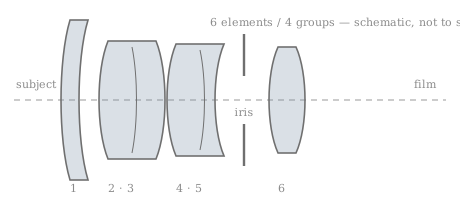
Optical formula — Ernostar, then modified Gauss
History
Nikon prototyped a 13.5cm f/2 in about 1962 and built three of them. Vink has seen two, at 170101 and 170103, engraved Nikkor-H — six elements, the same count the production lens would eventually carry — and then nothing happened for thirteen years. The fast medium telephoto arrived in December 1975, or in 1976 if Nikon’s own history is preferred, as the New Nikkor Auto 135mm f/2.
Matsui Sei, who had designed the 180mm f/2.8 five years earlier, laid it out as a variant Ernostar: six elements in four groups, with the second and third cemented together. An Ernostar is what a Sonnar becomes when the cemented triplet is split into a convex and a concave element, and it suits a fast telephoto because the layout is asymmetrical and short. The lens is compact for an f/2, and it is also — deliberately — not corrected flat across its focusing range.
That was the point. Nikon’s account of the design is unusually direct about it: the 85mm f/1.8 had existed to be brighter than a standard lens, but the 135mm f/2 was drawn with the emphasis on the character of its defocus, as a short-focal-length member of the family that included the 180mm f/2.8 and the 300mm f/2.8. An Ernostar’s aberrations move more with focus than a Gauss’s do, so the lens is sharp at distance and leaves spherical aberration and coma in at close range, where the edges of out-of-focus detail melt instead of ringing. Rørslett, testing two samples on film, found the close-range softness a fault rather than a feature and rated it 3 to 3.5 out of 5 before a later retest on a D2X raised his opinion.
The manual line ran three deep and almost all of it is Ai-S. Vink counts 4,783 K-type lenses in fourteen months, 7,527 Ai over four years, and 32,286 Ai-S between December 1981 and 2005 — 44,596 in all, of which the first two versions are a tenth. A K-type 135mm f/2 is the scarce one, and its only functional difference from the Ai is the mount ring.
What replaced it in 1990 is not this lens. The AF DC-Nikkor 135mm f/2 is a modified Gauss of seven elements in six groups that focuses by moving its rear three elements, because a screwdriver drive cannot swing a six-element block at speed; the front group is cemented, which improves longitudinal chromatic aberration; and a second ring on the barrel varies the spherical aberration on purpose, softening the background at R and the foreground at F. Nikon’s designers had found that the distance between the front cemented group and the elements behind it changes spherical aberration alone, leaving astigmatism and chromatic aberration untouched, and the DC ring is that discovery made into a control. Set at centre, spherical aberration is corrected to near zero and the lens is at its sharpest.
Two things about the DC lens stay unresolved. Nikon dates it to 1991 and Vink’s serial block opens in October 1990, which is more than a rounding difference. And Nikon’s own history, which names Matsui for the manual lens in the previous tale, refuses to name the DC designer at all — he appears only as the author’s senior, the man behind the AF 85mm f/1.8, credited with the idea and not with a name.
This history is AI-written, from the sources listed at the foot of the page. Where the record is silent it says so rather than filling the gap — but no human wrote these sentences.
Example photos


.jpg)
Sample photo wanted — shot with a Nikkor 135mm f/2? We'd love to feature it (with credit).
Live listings
Asking price, USD: a median of $450 across 53 fixed-price listings on 2026-09-11 (middle half $380–$550). Tracked since 2026-09-06, 2 days: unchanged from $450.
By day
| Date | Median | Middle half | Listings |
|---|---|---|---|
| 2026-09-11 | $450 | $380–$550 | 53 |
| 2026-09-06 | $450 | $380–$550 | 54 |
Asking prices from the listings scanned, not sales; junk-flagged rows and auction lots excluded; other currencies are not converted.
- Nikon Nikkor 135mm F2 Ai-S Lens *** READ ***
- Nikon Nikkor Ai-s 135mm F/2 #10662 From Japan Prime Telephoto AIS Manual Lens MF
- Nikon Nikkor 135mm F2 AI Lens manual focus
- Nikon Nikkor 135mm F/2 AI Lens Japan Bright Fast f2.0 135/2 for DSLR Read Well
- Rare! Nikon Nikkor Non-Ai 135mm f2 MF Lens [Near MINT] From JAPAN
- [Near MINT+++] Nikon Ai-s Ais Nikkor 135mm F2 MF Telephoto Lens From JAPAN
- [Almost MINT] Nikon Ai-s Nikkor 135mm f/2 MF Lens From JAPAN #1054
- Video*[Exc+3 Read] Nikon AF DC Nikkor 135mm f/2 D Telephoto JAPAN 01 #1 day ship
- [Optics Mint] Nikon Ai Nikkor 135mm f2 Telephoto MF Lens From JAPAN
- Nikon Nikkor 135mm F2 AI Lens manual focus
- Nikon Ai-S NIKKOR 135mm f/2
- Nikon AIS ai-s NIKKOR 135mm f/2 MF Portrait Lens with Case
- EXCELLENT Nikon Ai NIKKOR 135mm F/2 Prime Lens
- [Near Mint+++] Nikon Ai Nikkor 135mm f/2 MF Telephoto Lens from Japan #8223
- Nikon Ai-S NIKKOR 135mm f/2 MF Portrait Camera Lens [Near MINT] From JAPAN
- Nikon Nikkor 135mm F/2 Ais Lens 194905
- RARE [MINT in/Box] Nikon NIKKOR 135mm f/2 Non-Ai MF Lens From JAPAN #689
- 【Exc+3】 Nikon Ai-s AIS Nikkor 135mm f/2 MF Prime Telephoto Lens from Japan #0856
- [Mint+++ w/ Caps] Nikon Nikkor Ai-s Ais 135mm f/2 MF Portrait Lens Japan
- Nikon Ai-s NIKKOR 135mm F2 Lens [Near Mint] From Japan sam5234
Show 57 more listings
- NoShip2US[MINT+ w/Caps]Nikon AF DC NIKKOR DEFOCUS IMAGE CONTROL 135mm f/2 D Lw74
- [Near Mint] Nikon Ai-S NIKKOR 135mm f/2 MF Telephoto Lens AIS Tested From Japan
- SIC [Top MINT] Nikon Ai-s Ais Nikkor 135mm F2 MF Telephoto Lens From JAPAN
- [MINT] Nikon Ai Nikkor 135mm f2 MF Telephoto Portrait Lens From JAPAN
- [MINT] Nikon Ai-s AIS Nikkor 135mm F2 Telephoto Prime Lens MF From JAPAN
- Nikon AF DC-NIKKOR 135mm f/2 D Defocus Lens from Japan *Exc+5* #5347
- [Top MINT] Nikon AF DC Nikkor 135mm f/2 D Telephoto from Japan #2977452
- [Near MINT+++] Nikon AF DC-Nikkor 135mm f/2 Telephoto Auto Focus Lens From JAPAN
- S/N 225xxx [Top MINT ] Nikon Ai-s Nikkor 135mm f/2 MF Telephoto Lens From JAPAN
- Nikon AF DC Nikkor 135mm f/2 D Telephoto Lens F Mount From JAPAN GOOD CONDITION
- Nikon AF DC NIKKOR 135mm f/2D MINT IN BOX Defocus Control Portrait Lens F-Mount
- SIC [TOP MINT] Nikon Ai-S Ais Nikkor 135mm f/2 Telephoto Prime Lens from JAPAN
- [MINT+++] Nikon AF DC Nikkor 135mm f/2 Telephoto Prime Lens F Mount From JAPAN
- Nikon AF DC-NIKKOR 135mm f/2 D Autofocus Telephoto Lens, with Caps
- [Top MINT] Nikon Ai-s Nikkor 135mm f/2 MF Lens From JAPAN
- SIC Late S/N [Top MINT] Nikon Ai-s Nikkor 135mm F/2 Portrait Lens MF from Japan
- NIKON AF DC-NIKKOR 135mm F/2 D LENS Excellent Mint Caps
- Nikon AF DC-Nikkor 135mm f2 Portrait Lens for Nikon AF-D [EXC+]
- [ MINT +++] Nikon AF DC Nikkor 135mm f/2 D Defocus Image Control Lens From JAPAN
- Nikon Nikkor AF 135mm f2 D DC Defocus Lens
- Nikon Nikkor AF 135mm f2 D DC Defocus Lens #598
- [Almost Unused] Nikon AF DC Nikkor 135mm f2 D Telephoto Portrait Lens From JAPAN
- Nikon Nikkor 135mm f2 AI Fast Telephoto Prime Lens [EXC]
- Video*[MINT] Nikon AF DC Nikkor 135mm f/2 D Telephoto from JAPAN 1day shipping 2
- [Almost MINT] Nikon AF DC Nikkor 135mm f/2 Portrait Prime Camera Lens JAPAN 1168
- [Top MINT] Nikon AF DC Nikkor 135mm f/2 D Telephoto Lens For F Mount From JAPAN
- Nikon Nikkor AF 135mm f2 D DC Defocus Lens #551
- Nikon AF DC-Nikkor 135mm f2 Portrait Lens for Nikon AF-D [EXC+]
- Nikon Ai-S NIKKOR 135mm F/2 [Near MINT] MF Fast Telephoto Prime Lens AIS #224516
- Nikon Nikkor AF 135mm f2 D DC Defocus Lens #185
- SIC 231xxx [ Top MINT w/ Case ] Nikon Ai-s Ais Nikkor 135mm f/2 Lens From JAPAN
- SIC [Unused in Box] Nikon Nikkor Ai-s Ais 135mm f/2 Telephoto MF Lens From JAPAN
- SIC Ver. [Unused] Nikon Ai-s Nikkor 135mm f/2 MF Telephoto Prime Lens From JAPAN
- Nikon Nikkor Ai-s 135mm F/2 #10662 From Japan Prime Telephoto AIS Manual Lens MF
- EXCELLENT Nikon Ai NIKKOR 135mm F/2 Prime Lens
- Nikon Ai-S NIKKOR 135mm f/2
- Nikon Ai NIKKOR 135mm F2 Black Lens MF F mount Fast Smooth Indoor Portrait
- Nikon AI-S NIKKOR 135mm F2 Black Lens AIS F-Mount MF Manual Focus Exc++
- Nikon Ai-s NIKKOR 135mm F2 Lens [Near Mint] From Japan sam5234
- [Near Mint] Nikon Ai-S NIKKOR 135mm f/2 MF Telephoto Lens AIS Tested From Japan
- Nikon Nikkor 135mm f/2 AI Manual Focus Lens F-Mount READ DESC
- Nikon AF DC-NIKKOR 135mm f/2 D Defocus Lens from Japan *Exc+5* #5347
- [Almost Unused] Nikon AF DC Nikkor 135mm f/2 Telephoto Prime Lens F Mount JAPAN
- [Top MINT] Nikon AF DC Nikkor 135mm F/2 Telephoto Lens for F Mount From JAPAN
- SIC Late S/N [Top MINT] Nikon Ai-s Nikkor 135mm F/2 Portrait Lens MF from Japan
- [Almost Unused] Nikon AF DC Nikkor 135mm f2 D Telephoto Portrait Lens From JAPAN
- Nikon AF DC-Nikkor 135mm f/2D Prime Objektiv - getestet top
- [Unused in Box] Nikon Nikkor Ai-s Ais 135mm f/2 Telephoto MF Lens From JAPAN
- NIKON NIKKOR AI 2,8/135mm Bitte lesen!!
- Nikon Nikkor 135mm f2,8 Nikon F Non AI (Nikon F2 F3 FM F2 Nikkormat)
- Nikon Nikkor 2,8/135mm Ai Objektiv Nikon F Mount 135mm 2.8
- Nikon Ai-S NIKKOR 135mm f/2 MF Teleobjektiv getestet kein Pilz gebraucht Japan
- SIC [Top NEUWERTIG] Nikon Ai-s Ais Nikkor 135mm F2 MF Teleobjektiv aus JAPAN
- SIC Late S/N [Top NEUWERTIG] Nikon Ai-s Nikkor 135mm F/2 Portrait Objektiv...
- Nikon AF DC-Nikkor 1:2 / 135 mm Autofocus lens - DEFOCUS IMAGE CONTROL
- Video*[NEUWERTIG] Nikon AF DC Nikkor 135mm f/2 D Tele aus JAPAN 1 Tag Versand 2
- Nikon 135mm f2 AF DC-Nikkor
eBay links are affiliate links. If you buy through one, Glass Bodies earns a small commission from eBay at no cost to you. It does not change which listings appear, their prices or their order — those come from the search and the sort described above.
Listings updated 2026-09-11. Links go to the shop or marketplace that carries the item.