AF DC-Nikkor 105mm f/2D
Nikon · Nikon F · 1993 · Modified Gauss, with defocus control
our own findingAlso known as: AF DC-Nikkor 105mm f/2D · Ai AF DC Nikkor 105mm f/2D · Nikon 105mm f/2 DC · Nikkor 105/2 DC · DC-Nikkor 105mm · ニッコール AF DC 105mm F2D
Variants & identification
| Variant | Mount | Years | Serial ranges | Production |
|---|---|---|---|---|
| AF DC-Nikkor 105mm f/2D | Nikon F | 1993–2020 | 200001–214195 300001–303501 400001–416070 | 33,766 across three serial series (Vink) |
- Vink's quantity column is derived from the serial numbers he has collected, not from Nikon records. Nikon has published no production figure for this lens.
- The weight is given as 640g by Vink and as 625g by Phillip Reeve's review, which weighed a copy. Both are recorded; the difference is within what a measured sample and a catalogue figure normally differ by.
- Nikon's Thousand and One Nights has no tale for this lens. Tale 32 covers the 135mm f/2 DC, describes the defocus-control principle in full, and mentions the 105mm only as the successor released in 1993. Everything said here about how DC works is therefore said about the 135mm and applied to this lens.
- The designer is not named anywhere on the record. Nikon's own account of the DC concept describes him only as a senior colleague of the author, Ohshita Kouichi, and as the designer of the AF 85mm f/1.8 whose rear-focusing layout DC was built on.
How to tell them apart
- DC on the front ring: only two Nikkors ever carried it, this and the 135mm f/2
- 72mm filters, where the 105mm f/2.5 and the 105mm f/1.8 take 52mm and 62mm
- The DC ring is not a focusing ring and not an aperture ring — turning it changes the aberration, not the exposure or the plane of focus
AF DC-Nikkor 105mm f/2D:
- A second ring behind the focusing ring marked F and R, graduated to f/5.6
- Nine rounded blades
- Crinkle-finish metal barrel with printed, not engraved, markings
- A sliding built-in hood that screws down to lock
- The barrel does not change length when focused: only the rear group moves
- AF DC-Nikkor 105mm f/2D: One optical design and one mount version for the whole twenty-seven-year run. Unlike the 135mm f/2 DC, which spent five years as a non-D lens before gaining the distance chip, this lens was a D from its first day.
Serial-range notes
- 200001–214195
- The original run, opening September 1993. 14,195 lenses by Vink's count.
- 300001–303501
- 3,501 lenses in a single year, 2005 — a short block between the two long ones.
- 400001–416070
- A fresh series from 2006, which Vink annotates as the 2006 serial number scheme. 16,070 lenses, running to 2020. The 135mm f/2 DC and the 180mm f/2.8D restart in the same two years, so 2005 and 2006 mark a renumbering across the telephoto primes rather than anything about this lens.
Specifications
- Formula
- Modified Gauss, with defocus control
- Construction
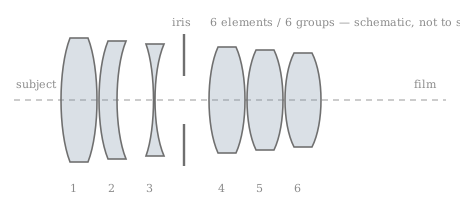
- 6 elements / 6 groups
- Aperture range
- f/2–f/16
- Diaphragm blades
- 9
- Min. focus
- 0.9 m
- Dimensions
- 79 × 111 mm
- Weight
- 640 g
- Filter
- 72 mm
- Years manufactured
- 1993–2020
- Country
- Japan
What reviewers say
- Bjørn Rørslett (blog) — He calls it possibly the better of the two DC lenses and one of the finest Nikkors ever made, stellar at f/2 and stunning from f/2.8 to f/4, with near-zero distortion and very low flare — but he downrates it on the D3X, where the rear focusing shows red and green fringing unless focus is perfect. He mostly shoots it with the defocus control switched off.
- BastianK (Phillip Reeve) (blog) — Well balanced with no outstanding flaw, and he enjoyed it more than expected; strong longitudinal chromatic aberration at f/2 that persists to f/2.8, poor flare resistance against the light, and a defocus control he judges subtle at useful settings and mainly a feature for tinkerers, since every adjustment requires refocusing.
Optical formula — Modified Gauss, with defocus control
History
Autofocus nearly killed the fast medium telephoto. A screw drive turning from the camera body could not swing six or seven elements of glass quickly or accurately, and Nikon’s own account of the period says the class was on the verge of extinction. The escape was rear-group focusing, proved on the AF 85mm f/1.8 of 1988: move three elements at the back and leave the heavy front where it is. The designer who worked that out then asked a different question — if the front elements are no longer doing the focusing, what else could moving them do?
The answer was spherical aberration. It had been understood for decades that a lens with slightly undercorrected spherical aberration throws a softer background, and that the price is a foreground that goes ringy and a plane of focus that loses bite. Nikon’s designer found that in a Gauss layout the distance between the front group and the elements behind it changes spherical aberration and almost nothing else — astigmatism and chromatic aberration stay put. That is a control. Turn it one way and the background softens; turn it the other and the foreground blurs away; leave it in the middle and the correction is near zero and the lens is sharper than a conventional portrait lens, which would have been left undercorrected on purpose.
Defocus image Control appeared first on the 135mm f/2 DC and reached this lens in September 1993. The 105 is the shorter of the pair and, in Bjørn Rørslett’s judgement, the better one — he rates it 5 out of 5, calls it one of the finest Nikkors ever made, and notes that the front element sits deep enough that it barely flares. BastianK, shooting it on digital, disagrees about the flare and reports strong longitudinal chromatic aberration at f/2. On the control itself the two reviewers converge: it is subtle at the settings that keep the image sharp, it demands refocusing after every adjustment, and both of them mostly leave it alone.
The differences from the 135 are worth stating precisely, because the two lenses are usually described as a pair. This one is six elements in six groups against seven in six; the 135’s front pair is cemented and nothing here is. It focuses to 0.9m rather than 1.1m, weighs 640 grams rather than 815, and — the point that gets missed — it never existed in a non-D form. The 135 spent five years reporting no distance to the body before it gained the chip in November 1995; the 105 arrived with it.
Vink’s serial blocks give 14,195 lenses from September 1993, 3,501 in 2005, and 16,070 more from 2006 to 2020: 33,766 in all, from collected serial numbers rather than any factory record. Nikon has published no figure. It has also published no tale for this lens — the design story in the Thousand and One Nights is the 135’s, and the 105 appears in it as a single clause about a successor. So the two questions that would settle what this lens actually is have no published answer: why the cemented front group of the 135 was dropped, and who drew either of them. Nikon’s own historian names the designer of the manual 135mm f/2 in the preceding tale and then declines, for four pages, to name the man who invented DC.
This history is AI-written, from the sources listed at the foot of the page. Where the record is silent it says so rather than filling the gap — but no human wrote these sentences.
Example photos

Sample photo wanted — shot with a AF DC-Nikkor 105mm f/2D? We'd love to feature it (with credit).
Live listings
Asking price, USD: a median of $730 across 21 fixed-price listings on 2026-09-06 (middle half $660–$900). First day tracked.
Asking prices from the listings scanned, not sales; junk-flagged rows and auction lots excluded; other currencies are not converted.
- [Exc+5] Nikon AF DC Nikkor 105mm F2 D Portrait Lens for F Mount From JAPAN
- Nikon AF DC Nikkor 105mm f/2 D Telephoto Lens from JAPAN [Near Mint w/cap]
- Nikon AF DC-NIKKOR 105mm f/2D Portrait Lens Auto/Manual Focus Black Used
- Nikon AF DC Nikkor 105mm f/2 D Telephoto Lens - Only Used Once for Test Purpose
- "NEAR MINT- Full Tested"Nikon AF DC NIKKOR 105mm f2 D For Nikon F Mount #6191
- Nikon AF DC-NIKKOR 105mm f/2 D Portrait Telephoto Lens Nikon F Mount A/MF
- NIKON AF DC-NIKKOR 105MM 1:2D Lens for Portraits
- [Exc] Nikon 105mm f/2 DC - F mount - Best Portrait Lens
- [Top MINT] Nikon AF DC NIKKOR 105mm f/2 D Film Camera Lens From JAPAN
- Near Mint Nikon AF DC Nikkor 105mm f2 D Telephoto Lens For F Mount From JAPAN
- Nikon Single Focus Lens Ai AF DC Nikkor 105mm f/2D Full size compatible
- Nikon Single Focus Lens Ai AF DC Nikkor 105mm f/2D Full size compatible
- Nikon AI AF DC-Nikkor 105mm F2 D Telephoto Lens for F Mount from Japan E0705
- Nikon AF DC-NIKKOR 105mm F2 D Lens with Defocus Control Excellent Condition
- Nikon AF FX DC-NIKKOR 105mm f/2D Telephoto Lens +Auto Focus for Nikon DSLR Camer
- Nikon AF DC Nikkor 105mm f/2 2.0 D Prime Lens F Mount
- Nikon AF DC-NIKKOR 105mm f/2D Lens- MINT
- Nikon DC-NIKKOR 105mm f/2 D RF AF M/A Lens
- NIKON AF DC NIKKOR 105mm f/2 D Portrait Defocus Control
- USED Nikon DC-NIKKOR 105mm f/2 D RF AF M/A Lens FREESHIPPING
Show 15 more listings
- Nikon AI AF DC-Nikkor 105mm F2D D-mount Lens Used 1-Year Warranty Excellent
- [N MINT] Nikon AF DC Nikkor 105mm F2 D Portrait Lens for F Mount From JAPAN
- Nikon AF DC-Nikkor 105mm f/2D AF PrimePortrait Objektiv Nikon F + Box Beispielfotos
- NIKON AF DC-NIKKOR 105MM 1:2D Lens for Portraits
- [Top MINT] Nikon AF DC NIKKOR 105mm f/2 D Film Camera Lens From JAPAN
- Nikon 105mm F2 D AF DC - Defocus Image Control Lens STK: 42592
- US DUTY PAID | Nikon AF DC-Nikkor 105mm f/2D Lens for F-Mount Full Frame | Japan
- Nikon AF DC Nikkor 105mm f/2 2.0 D Prime Lens F Mount
- Nikon AF DC-Nikkor 105mm f/2D Objektiv für Nikon F Mount - Defocus Portrait Prime
- Nikon AI AF DC-Nikkor 105mm F2D D-mount Lens Used 1-Year Warranty Excellent
- [N NEUWERTIG] Nikon AF DC Nikkor 105mm F2 D Portrait Objektiv für F Mount...
- Nikon AF DC-NIKKOR 105mm f/2 D Defocus Image Control Portrait Lens
- Nikon Single Focus Objektiv Ai AF DC Nikkor 105mm f/2D Full Size kompatibel
- Nikon AI AF DC-Nikkor 105mm F2D D-Mount Objektiv Gebraucht 1 Jahr Garantie Top
- EX+ NIKON AF DC NIKKOR 105mm f/2 D Portrait Defocus Control
eBay links are affiliate links. If you buy through one, Glass Bodies earns a small commission from eBay at no cost to you. It does not change which listings appear, their prices or their order — those come from the search and the sort described above.
Listings updated 2026-09-05. Links go to the shop or marketplace that carries the item.