Komura 105mm f/2.8
Sankyo Koki · Nikon S + LTM · 1958 · Ernostar type (from the period brochure diagram)
our own findingAlso known as: Komura 105mm F2.8 · KOMURA- 105mm f/2.8 · Sankyo Koki Komura 105mm f/2.8 · Sankyo Kohki Komura 105mm F2.8 · コムラー 105mm F2.8
Variants & identification
| Variant | Mount | Years | Serial ranges | Production |
|---|---|---|---|---|
| Nikon S | Nikon S | — | 4340244 · 4345339 (photographed examples) | — |
| Leica screw mount | LTM | 1958–1964 | — | — |
- Sankyo Koki published no production figures for this lens, and no S-mount price list survives.
How to tell them apart
- Click-stopped aperture, f/2.8 to f/22 — the rangefinder version clicks where the later SLR-mount Komura 105s are preset
- Sold as an outfit: viewfinder and leather case, with a matching Komura hood, 48mm Komura UV filter and script-engraved caps
- The bezel engraving dates it, as across the Komura line: earlier lenses read 105mm with the maker as Sankyo Kōki Tokyo, later ones f=105mm with Sankyo Kōki Japan
Nikon S:
- 'N' engraved on the barrel on marked examples, following the Sankyo Koki convention for Nikon-mount lenses
- Some examples carry no 'N'/'C' marking anywhere — not on the barrel, not on the rear of the mount — plausibly late production, after the Contax versions were dropped
- Nikon S: One of the initial four Komura lenses offered for the Nikon mount, alongside the 35mm f/2.8, 80mm f/1.8, and 135mm f/3.5. First year undocumented; the late-1950s window of the initial four is the best available dating.
- Leica screw mount: Discontinued in 1964, when the Komura 105mm f/2.5 replaced it.
Serial-range notes
- 4340244
- Photographed Nikon-mount example, carrying no N or C marking anywhere on the barrel or the rear of the mount. Bezel in the earlier style — 105mm, Sankyo Kōki Tokyo.
- 4345339
- Photographed Nikon-mount example in the later bezel style — f=105mm, Sankyo Kōki Japan — placing the engraving change between this number and 4340244.
Specifications
- Formula
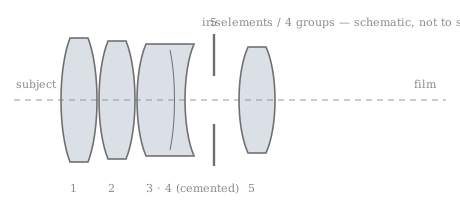
- Ernostar type (from the period brochure diagram)
- Construction
- 5 elements / 4 groups
- Aperture range
- f/2.8–f/22
- Diaphragm blades
- 16
- Min. focus
- 1.52 m
- Filter
- 48 mm
- Years manufactured
- 1958–1964
- Country
- Japan
What reviewers say
No reviews aggregated yet — this family is still in the research queue. Written one? We'd love to index it.
Optical formula — Ernostar type (from the period brochure diagram)
History
Sankyo Koki’s Komura 105mm f/2.8 is the lens the reference literature forgot: it appears nowhere on camera-wiki’s Nikon rangefinder page, and its existence in the S mount rests entirely on collector evidence — a Rangefinderforum thread documenting a physical example with photographs and a period brochure, and a first-hand Japanese account of the Komura lineup. That account places it among the initial four lenses Sankyo Koki offered for the Nikon mount, alongside the 35mm f/2.8, 80mm f/1.8, and 135mm f/3.5, and in period it sold as the affordable alternative to Nippon Kogaku’s own Nikkor-P·C 10.5cm f/2.5.
Sankyo Koki (三協光機) was founded in 1951 and adopted the Komura brand name in 1955, building a business on third-party lenses before ceasing operations in 1980. Its S-mount line ran from the late 1950s into the early 1960s and followed the same convention as Tanaka Kogaku’s Tanar lenses: an “N” marked on the barrel to distinguish Nikon-mount examples from their Contax counterparts — though some examples carry no mount marking at all, possibly production from after the Contax versions were dropped. For the 105mm f/2.8, the Leica-screw version is the one the record dates: introduced in 1958 and discontinued in 1964, when the 105mm f/2.5 replaced it, per Japanese Wikipedia citing Classic Camera Senka No.50. No document dates the S-mount version specifically, but its membership in the initial four points to the same late-1950s window.
Sankyo Koki’s own brochure page for the lens survives, and it settles most of what the reference books never recorded. Five elements in four groups, sixteen blades behind a 48mm screw-in filter, click stops from f/2.8 to f/22, five feet to infinity, a 23-degree angle of view, and a viewfinder and leather case in the box. The click stops are worth dwelling on, because the brochure names them as a rangefinder feature — the later SLR-mount Komura 105s use a preset ring instead, so the aperture action alone separates an RF lens from its SLR namesake on a dealer’s shelf. The printed optical diagram also narrows the one question that had stayed open. It shows a substantial front group and, past a wide air space, two small elements near the rear — the asymmetric layout of an Ernostar derivative rather than the mirrored halves a Planar would show. That matches how most sources describe Komura’s fast telephotos, and sits awkwardly with the one collector reading that called the diagram Planar-like.
What the brochure does not give is a number. Sankyo Koki published no production figures, no S-mount price list survives, and no dedicated review of the rangefinder-era lens in either mount has yet surfaced. For a lens that sold as the budget answer to one of Nikon’s best-loved telephotos, it remains one of the quieter mysteries of the system — though it is no longer quite the blank it was: a photographed example, serial 4340244, carries no N or C marking anywhere, which is exactly what you would expect of late production made after the Contax versions were dropped. A second Nikon-mount example, 4345339, carries a smaller but more portable fact on its face: the bezel reads f=105mm over Sankyo Kōki Japan, where 4340244 reads 105mm over Sankyo Kōki Tokyo. The same two styles, in the same order, appear on the 135mm f/3.5 — early lenses giving the bare focal length and Tokyo, later ones the f= prefix and Japan. No published source consulted records that records this, and offer it as an observation rather than a citation: it emerged from laying photographed examples side by side while building this catalogue. If it holds across the rest of the line, a Komura can be roughly dated from its bezel alone, without any serial table — and on this lens it puts the changeover between those two numbers. It rests on a handful of lenses, so more examples could sharpen it, or break it.
This history is AI-written, from the sources listed at the foot of the page. Where the record is silent it says so rather than filling the gap — but no human wrote these sentences.
Example photos
More sample photos elsewhere
- micronar — five Provia 100F frames on a Canon VT, shot with the Leica-screw version of this lens (Flickr)
- byaporn na nagara — coneflowers, the Leica-screw version adapted to a Leica M9 (Flickr)
These photographers keep all rights to their work — enjoy it at the source.
Sample photo wanted — shot with a Komura 105mm f/2.8? We'd love to feature it (with credit).
Live listings
Asking price, USD: a median of $190 across 4 fixed-price listings on 2026-09-11 (middle half $26–$510). Tracked since 2026-09-06, 2 days: unchanged from $190.
By day
| Date | Median | Middle half | Listings |
|---|---|---|---|
| 2026-09-11 | $190 | $26–$510 | 4 |
| 2026-09-06 | $190 | $26–$510 | 4 |
Asking prices from the listings scanned, not sales; junk-flagged rows and auction lots excluded; other currencies are not converted.
- Rare près De Mint ] Sankyo Koki Komura 105mm F/2.8 L39 Vis Support Lentille
- Rare NEAR MINT] Sankyo Koki Komura 105mm f/2.8 L39 screw Mount Lens JAPAN
- Rara Quasi Mint] Sankyo Koki Komura 105mm F/2.8 L39 Vite Obiettivo Giappone
- Sankyo Koki Komura 2.8/105mm lens Leica Screw Mount
- Sankyo Koki Komura Lens for Contax RF 2.8/105mm Komura Lens very rare!
- Komura 48mm Lens Dust Cap Metal - - slip on type - (fits 105mm f/ 2.8)
- Rare! [NEAR MINT] Sankyo Koki Komura 105mm f/2.8 L39 screw Mount Lens JAPAN
- Sankyo Koki Komura 2.8/105mm lens Leica Screw Mount
- Sankyo Koki Komura Lens for Contax RF 2.8/105mm Komura Lens very rare!
- Rare NEAR MINT] Sankyo Koki Komura 105mm f/2.8 L39 screw Mount Lens JAPAN
- KOMURA Old Lens 105MM f2.8 Junk Used
- Rare NEAR MINT] Sankyo Koki Komura 105mm f/2.8 L39 screw Mount Lens JAPAN
- KOMURA altes Objektiv 105MM f2.8 Trödel gebraucht
eBay links are affiliate links. If you buy through one, Glass Bodies earns a small commission from eBay at no cost to you. It does not change which listings appear, their prices or their order — those come from the search and the sort described above.
Listings updated 2026-09-11. Links go to the shop or marketplace that carries the item.