W-Nikkor·C 2.8cm f/3.5
Nippon Kogaku · Nikon S + LTM · 1952 · Orthometar type, 6e/4g
Also known as: W-Nikkor.C 2.8cm f/3.5 · W-Nikkor·C 2.8cm f3.5 · W-Nikkor C 2.8cm f/3.5 · W-Nikkor 2.8cm f/3.5 · W-Nikkor·C 28mm f/3.5 · W-Nikkor 28mm f/3.5 · Nippon Kogaku 2.8cm f/3.5 · Nippon Kogaku 28mm f/3.5 · 2.8cm f3.5
Variants & identification
| Variant | Mount | Years | Serial ranges | Production |
|---|---|---|---|---|
| Nikon S (1952) | Nikon S | 1952 | 346xxx–349xxx (early chrome batches; LTM examples interleaved in 346001–349220) 712xxx+ (later batches, S-mount only) | ~10,000 sold (family total across S and LTM; no per-mount split published) |
| Leica screw mount | LTM | — | 3 pre-production examples Interleaved within 346001–349220 (early chrome batches) 716316 (observed example in the later run, 2026-08-25) | Unpublished — LTM examples were long recorded only within the early chrome batches (3 pre-production + interleaved in 346001–349220), with the later 712xxx batches held to be S-only; an observed LTM example at 716316 shows screw-mount units exist in the later run too. Per NHS / Rotoloni, only the 3.5cm f/1.8 ever received its own LTM serial sequence. |
How to tell them apart
Nikon S (1952):
- 43mm screw-in filter thread (vs 34.5mm on the LTM)
- Chrome-over-brass early; construction lightened over the run (light-alloy from July 1956), with a black-barrel facelift late
Leica screw mount:
- 34.5mm filter thread
- Own helicoid with infinity lock
- Nikon S (1952): MFD 0.9m (focuses via the body helicoid); weight roughly 97–142g depending on finish (Camera no Naniwa).
- Leica screw mount: MFD 1m, ~180° focus throw; the 35mmc example shows eight straight aperture blades stopping to f/22.
Serial-range notes
- 346xxx–349xxx
- Early chrome-over-brass batches; all confirmed LTM examples sit interleaved in the 346001–349220 span, alongside 3 pre-production LTM lenses.
- 712xxx+
- Later batches, long recorded as S-mount only — but an observed LTM example at 716316 shows screw-mount units exist here too; along the run the chrome-over-brass build gives way to lightened construction (light-alloy from July 1956) and finally a black-barrel facelift.
Specifications
- Formula
- Orthometar type, 6e/4g
- Construction
- 6 elements / 4 groups
- Aperture range
- f/3.5–f/22
- Diaphragm blades
- 8
- Min. focus
- 0.9 m
- Weight
- 150 g
- Filter
- 43 mm
- Years manufactured
- 1952
- Country
- Japan
What reviewers say
- Richard Haw (blog) — Sharp from wide open with excellent distortion control — lines stay mostly straight even at the frame edges, something few wide lenses manage — against heavy vignetting that never fully clears and terrible flare and ghosting from the era's coatings; he highly recommends it to everyone shooting a Nikon or Zeiss rangefinder.
- Agata Urbaniak (35mmc) (blog) — Image quality exceeds its 3.5cm sibling in most regards — sharpness more uniform across the frame and distortion nowhere to be found — and despite nervous bokeh and weak flare resistance she calls it by far her favourite 28mm lens, ahead of the Voigtländer Ultron and MS-Optical Perar.
- Tetsuya Wada (和田哲哉, LowPowerStation) (blog) — An ideal pancake on the Nikon Zf with honest vintage character — pronounced vignetting from f/3.5 to about f/5.8 but modest distortion — though he remains ambivalent about needing a focal length his iPhone already covers, and points anyone who shoots people to the 3.5cm instead. via machine translation — corrections welcome
- Camera no Naniwa (カメラのナニワ 梅田買取センター) (blog) — An "exemplary student" of a lens — faithful, natural rendering with adequate resolution and vignetting that clears by f/8–f/11 — a reliable, affordable wide for the S-mount system, its only real frustration the near-unobtainable original hood. via machine translation — corrections welcome
- Gigantoptik (기간트옵틱) (blog) — A frequently mounted favorite that "quietly delivered good photos" — excellent resolution even wide open, distortion superbly restrained thanks to its aerial-lens ancestry, at its best kept between f/5.6 and f/8. via machine translation — corrections welcome
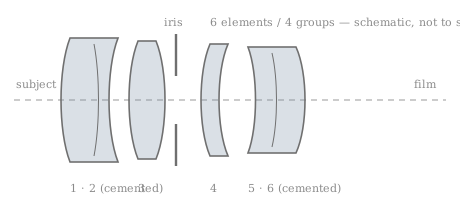
Optical formula — Orthometar type, 6e/4g
History
The W-Nikkor·C 2.8cm f/3.5 began life as an f/4. Masaki Isshiki (一色真幸) submitted the design report for a symmetrical Orthometar-type wide-angle — six elements in four groups — in January 1952, with production drawings issued the same month; by March 1952 the lens had been reworked to f/3.5, and the f/4 prototypes are believed to have been scrapped. Nikon’s own retrospective suggests the last-minute speed bump was likely competitive pressure — a rival Serenar 2.8cm f/3.5 had appeared exactly a year earlier — and notes that Isshiki’s design carried enough margin in its aberration correction to absorb the extra speed without significant degradation. Released in September 1952, it became the widest lens in the S-mount catalog, a title it held until the 2.5cm f/4 arrived the following year.
Roughly 10,000 were sold, across serial blocks that run 346xxx–349xxx before jumping to 712xxx and beyond. The barrel followed the familiar arc of the early wide Nikkors: heavy chrome-over-brass at first, lightened construction as light-alloy parts came in from July 1956, and eventually a black-barrel facelift — Camera no Naniwa’s figures put the spread at roughly 97 to 142 grams depending on finish. The S-mount version takes 43mm screw-in filters and focuses via the body helicoid; the Leica-thread version, with its own helicoid and infinity lock, takes 34.5mm.
That Leica-screw-mount version is confirmed, but its production count was never published — and unusually, it seems never to have had a run of its own. The known LTM examples amount to three pre-production lenses plus copies interleaved within the early chrome batches (346001–349220); the later 712xxx batches are S-mount only. Per NHS and Rotoloni, only one lens in the system — the 3.5cm f/1.8 — ever received its own LTM serial sequence. And Nikon’s essay concedes the design’s one fault, the very thing nearly every modern reviewer notices first: peripheral illumination ran a little lower than its classmates’, so the pronounced corner darkening that defines the lens’s look today was there from the very start.
This history is AI-written, from the sources listed at the foot of the page. Where the record is silent it says so rather than filling the gap — but no human wrote these sentences.
Example photos


More sample photos elsewhere
- Flickr — maddoc2003jp, W-Nikkor 28mm f/3.5 LTM album (the screw-mount lens, 4 photos)
- Agata Urbaniak's 491-photo album "Nippon Kogaku W-Nikkor.C 2.8cm f/3.5 LTM" — the lens on a Leica M Monochrom typ 246 (Flickr, all rights reserved)
- Flickr tag page "wnikkorc28cmf35" — dozens of genuine samples from this lens, mainly by In Memoriam: Tim Robinson (architecture, north-east England) and p_jennings
- p_jennings' 11 photos tagged with the lens — W-Nikkor·C 2.8cm f/3.5 on a Nikon SP, incl. Gyeongbokgung Palace on Fuji C200 (Flickr, all rights reserved)
These photographers keep all rights to their work — enjoy it at the source.
Sample photo wanted — shot with a W-Nikkor·C 2.8cm f/3.5? We'd love to feature it (with credit).
Live listings
Asking price, USD: a median of $680 across 13 fixed-price listings on 2026-09-11 (middle half $560–$800). Tracked since 2026-09-06, 2 days: unchanged from $680.
By day
| Date | Median | Middle half | Listings |
|---|---|---|---|
| 2026-09-11 | $680 | $560–$800 | 13 |
| 2026-09-06 | $680 | $560–$800 | 13 |
Asking prices from the listings scanned, not sales; junk-flagged rows and auction lots excluded; other currencies are not converted.
- Nikon W-Nikkor C 2.8cm f3.5 28mm Lens. Rare black in case.
- 【 Near MINT 】Nikon Nippon Kogaku W Nikkor C 28mm 2.8cm f/3.5 Lens From JAPAN
- [MINT] Nikon W-Nikkor C 2.8cm f3.5 Wide Angle Prime Lens Nippon Kogaku S From JP
- Nippon Kogaku W-NIKKOR C 2.8cm 28mm f3.5 Rangefinder Lens Nikon S Mount Case
- Nippon Kogaku W-Nikkor.C 2.8cm 28mm f3.5 Chrome Nikon S Lens
- Nikon W-Nikkor C 2.8cm F3.5 Wide Angle Prime Lens Nikon S Nippon Kogaku Japan
- Nippon Kogaku W-Nikkor.C 2.8cm 28mm f3.5 Chrome Nikon S Lens
- Nikon W-NIKKOR 2.8cm F3.5 Lens for Nikon S Manual Focus from Japan E0726
- Rare [MINT CLA'd] Nikon W Nikkor C 2.8cm 28mm f3.5 Lens L39 LTM Screw From JAPAN
- Nippon Kogaku W-Nikkor.C 2.8cm 28mm f3.5 Black Nikon S Lens [EXC+]
- [Near MINT] Nikon W-Nikkor C 2.8cm f/3.5 L39 LTM Leica Mount Lens From Japan
- [MINT] Nippon kogaku W-Nikkor C 2.8cm F3.5 for L39 Leica Lens From JAPAN
- Nippon Kogaku W-Nikkor.C 2.8cm 28mm f3.5 Black Nikon S Lens [EXC+]
- 【 Near MINT 】Nikon Nippon Kogaku W Nikkor C 28mm 2.8cm f/3.5 Lens From JAPAN
- [MINT] Nikon W-Nikkor C 2.8cm f3.5 Wide Angle Prime Lens Nippon Kogaku S From JP
- Nikon W-Nikkor C 2.8cm F3.5 Wide Angle Prime Lens Nikon S Nippon Kogaku Japan
- [MINT] Nippon kogaku W-Nikkor C 2.8cm F3.5 for L39 Leica Lens From JAPAN
- [Near MINT] Nikon W-Nikkor C 2.8cm f/3.5 L39 LTM Leica Mount Lens From Japan
- Obiettivo Nikkor Z 12-28mm f/3.5-5.6 DX
- [NEUWERTIG] Nikon W-Nikkor C 2.8cm f3.5 Weitwinkel Festbrennweite Objektiv...
Show 2 more listings
eBay links are affiliate links. If you buy through one, Glass Bodies earns a small commission from eBay at no cost to you. It does not change which listings appear, their prices or their order — those come from the search and the sort described above.
Listings updated 2026-09-11. Links go to the shop or marketplace that carries the item.