W-Nikkor(·C) 2.5cm f/4
Nippon Kogaku · Nikon S + LTM · 1953 · Topogon
Also known as: W-Nikkor 2.5cm f/4 · W-Nikkor·C 2.5cm f/4 · Nikkor 25mm f/4 · 2.5cm f4
Variants & identification
| Variant | Mount | Years | Serial ranges | Production |
|---|---|---|---|---|
| Nikon S | Nikon S | 1953 | 402530–403598 (chrome ·C, infinity marked INF.) 403628–404066 (black ·C, infinity marked ∞) 404123–404787 (late, ·C dropped — plain W-Nikkor) | 1,924 per Old Lens Junkies, 2,287 by Vink's serial spans, ~2,500 per Pacific Rim — whose own quoted range, 402500 to about 403500, covers only a thousand numbers |
| Leica screw mount | LTM | 1953 | 502537–502998 503612–503630 | 950 per Old Lens Junkies against ~528 by Vink's serial spans — the two nearly double each other |
How to tell them apart
Nikon S:
- No focusing ring at all — body-wheel focusing only
- Series VII filters sandwich into the bayonet hood; no filter thread
Leica screw mount:
- Own helicoid (focusing ring present), and the heaviest of the three barrels at 133.56 g
- 34.5mm screw-in filter thread
Serial-range notes
- ~403500 onward
- Chrome-over-brass gives way to black over light alloy, part of the standardisation programme Nikon dates to around March 1956. The chrome lens is 125 g; sources put the black one at 88.85 g or at 75 g.
Specifications
- Formula
- Topogon
- Designed by
- Azuma Hideo (東秀夫)
- Construction
- 4 elements / 4 groups
- Aperture range
- f/4
- Min. focus
- 0.9 m
- Weight
- 125 g
- Years manufactured
- 1953
- Country
- Japan
What reviewers say
- Agata Urbaniak (35mmc) (blog) — The quirkiest of Nikon's tiny LTM gems: very soft wide open and about a stop behind its 2.8cm/3.5cm siblings stopped down, but sharp enough at working apertures with superbly corrected distortion — "not just a collectors' piece."
- Richard Haw (blog) — A historically fascinating "Japanese Topogon" and a must-have for hardcore Nikon/Contax rangefinder users, but its famously dark corners never fully clear up — casual shooters should buy a modern Voigtländer instead.
- Bryan Garris (Valdosta in Film) (blog) — Despite harsh corner vignetting and a slightly low-contrast look, superb stopped-down resolution and virtually nonexistent flare make it "definitely a stellar lens" he is happy to own.
- Haruo Sato (佐藤治夫 · Nikon's own 1001-Nights essay) (blog) — Soft and halo-laden wide open from residual spherical aberration and under-corrected coma, best at f/11 — yet the symmetrical Topogon design renders with no "wide-angle character" at all. via machine translation — corrections welcome
- Gigantoptik (기간트옵틱) (blog) — His beloved "true pancake" — perfectly suppressed distortion, strong contrast and resolution make it a wide-angle that renders like a standard lens, and its absurd compactness turns a Nikon SP into a go-anywhere camera. via machine translation — corrections welcome
Optical formula — Topogon
History
Haruo Sato (佐藤治夫) went back to the design data to write this lens up for Nikon’s Thousand and One Nights series, and the figure that stopped him was a thickness. The two concave elements at the centre of the design are 0.45mm. Their curvature is close to hemispherical, the front and rear radii differ barely at all, and the tolerance attached to them demanded that decentering stay inside sixty seconds of arc. Shrinking a lens, he explains, is not a discount but a tax: reduce every dimension to a tenth and the tolerances shrink to a tenth along with them, so a pancake asks for ten times the ordinary precision. The assembly benches paid that tax in full. An air gun could break an element or blow it away; alcohol could break one too, chilled by its own evaporation; the glass could not be held with any force. So the factory had a cleaning tool made out of feathers and built the lens with that. What it bought was a 25mm barrel about ten millimetres long — Agata Urbaniak’s figure for the screw-mount version, which then pushes roughly five millimetres more back past the mount into the body.
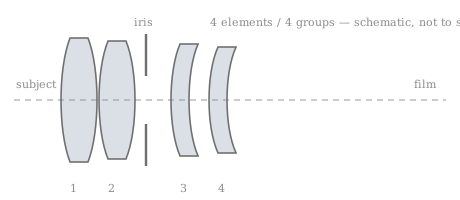
The formula came out of the map room. In 1900 Goerz built the Hypergon, two convex meniscus elements sharing the same radius of curvature, covering 135 degrees at f/22 — the widest angle of field of its day, with distortion, field curvature and lateral colour all remarkably small. Composed of only two convex elements, it could correct neither spherical aberration nor longitudinal colour, so in 1933 Zeiss added a pair of concave elements without disturbing the symmetry of the system and arrived at the Topogon: 100 degrees at f/6.3, a dark lens, but second only to the Hypergon in covering power. Then came the war, and the qualities that make a dull photographic lens make an excellent cartographic one. Sato writes that the lack of an accurate map of enemy territory meant certain defeat in those years, that optical designers in many countries threw all their energies at the distortion-free wide angle of the Topogon type, and that Nippon Kogaku was reportedly studying it hard as well. The 2.5cm is what that research became once there was peace to spend it on. A rangefinder has no mirror box to clear, so nothing forced a retrofocus design on Nikon, and the symmetrical four-element type was available for a lens this flat in a way it never would be once the SLR arrived.
Nikon credits the optical design to Hideo Azuma (東秀夫), completed in the autumn of 1953; a trial lens followed, and the drawings for mass production were released in September 1954. Azuma was a senior manager in the Optical Design Section with extensive experience of S- and L-mount Nikkors behind him, credited by the company with laying the foundation for its aberration balancing, and he was one of the teachers of Zenji Wakimoto (脇本善司), whose symmetrical concave-convexo-concave configuration would appear in Nikon’s 2.1cm f/4. That teaching line runs straight through this catalog: Wakimoto is the designer who inherited the 8.5cm f/1.5 and carried it to completion, so the man who worked out how to build a lens 0.45mm thick at its centre had taught the man who finished Nikon’s fastest rangefinder telephoto. Nikon states each half of that separately, in essays written decades apart; the join is ours. Azuma’s own 3.5cm f/1.8 was finished in the winter of 1955. The dates do not quite reconcile: Pacific Rim Camera and Roland Vink’s serial database both place the first lenses in November 1953, ten months before Nikon’s own chronology releases the production drawings. One measurement shows where Azuma spent his effort. A Topogon has no way of raising aperture efficiency to 100 per cent or higher, so dark corners are structural to the type rather than a defect in any one example; Sato records this lens holding about 13 per cent brightness even at the outermost periphery, and calls that sufficient for a Topogon. The corners never clear because the formula will not let them, and Azuma got a better price than the formula usually charges.
The published counts disagree, and the disagreement is the useful part. Old Lens Junkies gives 1,924 S-mount and 950 screw-mount, 2,874 in all. Pacific Rim Camera puts about 2,500 against the rangefinder version alone, from serial numbers starting at 402500. Roland Vink, whose quantities come from serial numbers collected rather than factory ledgers, tracks the S-mount run out to 404787 for 2,287, and finds the screw-mount lenses in two separate blocks totalling 528 — little more than half what Old Lens Junkies prints. Vink’s listing also splits the S-mount barrel three ways: the chrome lens at 125 grams, with infinity engraved INF.; the black lens that succeeds it, alloy where the first was chrome over brass; and a late run marked plain W-Nikkor with the ·C dropped. The 125 grams is Robert Rotoloni’s figure, which Old Lens Junkies quotes; on the black lens the two sources part company, 88.85 grams against Vink’s 75. The screw-mount version is the heaviest of them all at 133.56 grams, since it carries the helicoid the S-mount lens does without — that one has no focusing ring at all and is focused from the wheel on the camera. The accessories are harder to find than the lens: there is nothing on the S-mount barrel to screw a filter into, so Series VII filters ride in a combined holder and shade that bayonets onto two studs on the front rim, and Old Lens Junkies notes that those hoods are inclined to detach easily. Urbaniak calls the hood extremely rare. Sato’s own contribution to that scarcity is the best story in the essay. As a new hire he was handed two cardboard boxes of apparent junk and told to sort them and throw away anything unnecessary; he saved what looked like finished products and discarded what looked like debris, and only later found out that one scratched piece had been the 2.5cm hood. His superior smiled it off. The Nikon enthusiast he later confessed to did not, which taught him that enthusiasts are much stricter than management.
The rendering follows from the construction. Every element is a meniscus, a shape chosen to keep off-axis rays from generating conspicuous aberration, but the aberration the front and rear convex elements induce is not fully corrected by the central concave pair, so under-corrected coma survives, and the flexibility left over for correcting the axis is low — hence the residual spherical aberration and a trace of longitudinal colour. Sato had once assumed that no Topogon, Nikkor or not, could give satisfactory imaging characteristics; he went to the spot diagrams and found the opposite. The point images deform in complicated ways, but each has a core wrapped in a large flare, and that combination is the secret of real resolution with contrast that never turns harsh. The flare almost disappears by f/8, the aperture most users work at; f/11 gives the best image quality; f/16 to f/22 surrender the image to diffraction. Set beside the Carl Zeiss Jena 25mm Topogon it improves on its ancestor in two plain respects, as Richard Haw points out: the German lens has a rigid fixed-focus barrel, while the Nikkor focuses and couples to the rangefinder, and its octagonal iris replaces the German pentagon. That iris never opens fully even at the marked f/4, and Haw reads the restriction as deliberate — anything wider would perform very poorly, the corners worst of all. Urbaniak notes that Nikon never made another 25mm and finds it difficult to say why. The drawings suggest an answer: nothing about this lens was ever going to be easy to build twice.
This history is AI-written, from the sources listed at the foot of the page. Where the record is silent it says so rather than filling the gap — but no human wrote these sentences.
Example photos
More sample photos elsewhere
- Gigantoptik (기간트옵틱) — sample frames shot with the 2.5cm f/4 on a Nikon SP, in his review of the lens
These photographers keep all rights to their work — enjoy it at the source.
Sample photo wanted — shot with a W-Nikkor(·C) 2.5cm f/4? We'd love to feature it (with credit).
Live listings
Asking price, USD: a median of $2,000 across 9 fixed-price listings on 2026-09-11 (middle half $1,800–$2,600). Tracked since 2026-09-06, 2 days: unchanged from $2,000.
By day
| Date | Median | Middle half | Listings |
|---|---|---|---|
| 2026-09-11 | $2,000 | $1,800–$2,600 | 9 |
| 2026-09-06 | $2,000 | $1,800–$2,600 | 9 |
Asking prices from the listings scanned, not sales; junk-flagged rows and auction lots excluded; other currencies are not converted.
- [Near MINT] Nikon Nippon Kogaku W-NIKKOR 2.5cm 25mm f/4 Nikon S Lens Japan
- RARE! Nikon W-Nikkor c 2.5cm 25mm f/4 f/4.0 Lens S Mount+ finder From JAPAN
- Nikon RF Chrome Nippon Kogaku Japan 2.5cm f4 W-NIKKOR.C #402613 EXCELLENT
- [VTG. Mint] Nikon Nippon Kogaku W-Nikkor. C 2.5cm 25mm F4 S Mount Lens Japan
- Rare!! CLA'd [MINT w/Finder Case] Nikon W Nikkor C 25mm f/4 Lens Leica L L39 LTM
- Nikon Nippon Kogaku W-Nikkor.C 2.5cm 25mm f/4 Lens w/ Finder Two Cap
- Nikon W-Nikkor-C 2.5cm F4 LTM Leica Mount Lens Clean with Finder [Good]
- Nikon W-Nikkor-C 2.5cm F4 LTM Leica Mount Lens Clean with Finder [Good]
- Nikon Nippon Kogaku W-Nikkor Black 2.5cm 25mm F4 Lens S Mount w/ case, finder, h
- [Near MINT] Nikon Nippon Kogaku W-NIKKOR 2.5cm 25mm f/4 Nikon S Lens Japan
- RARE! Nikon W-Nikkor c 2.5cm 25mm f/4 f/4.0 Lens S Mount+ finder From JAPAN
- Rare!! CLA'd [MINT w/Finder Case] Nikon W Nikkor C 25mm f/4 Lens Leica L L39 LTM
- [Fast neuwertig] Nikon Nippon Kogaku W-NIKKOR 2,5 cm 25 mm f/4 Nikon S...
- ジャンク W-NIKKOR・C 2.5cm F4 ニコンS カビあり
eBay links are affiliate links. If you buy through one, Glass Bodies earns a small commission from eBay at no cost to you. It does not change which listings appear, their prices or their order — those come from the search and the sort described above.
Buying from Yahoo! Auctions outside Japan. It is a domestic marketplace: sellers ship within Japan, and most will not register an overseas buyer. A proxy service bids on your behalf, receives the item and forwards it, for a fee and a wait. Buyee, Jauce and ZenMarket each accept a Yahoo auction number directly. Listed alphabetically for information — none is recommended over another, and none of these is an affiliate link.
Listings updated 2026-09-11. Links go to the shop or marketplace that carries the item.