Noct-Nikkor 58mm f/1.2
Nippon Kogaku · Nikon F · 1977 · Modified Double Gauss
our own findingKnown as “the Noct”
Also known as: Noct-Nikkor 58mm f/1.2 · Ai Noct Nikkor 58mm f/1.2 · Ai-S Noct Nikkor 58mm f/1.2 · Nikkor 58mm f1.2 Noct · Nocf 58mm f/1.2 · ノクトニッコール 58mm F1.2
Variants & identification
| Variant | Mount | Years | Serial ranges | Production |
|---|---|---|---|---|
| Prototype | Nikon F | 1976–1976 | 104111–104112 | 2 |
| Ai Noct-Nikkor 58mm f/1.2 | Nikon F | 1977–1981 | 172011–174472 | ~2,460¹ |
| Ai-S Noct-Nikkor 58mm f/1.2 | Nikon F | 1981–1998 | 185001–193951 | ~8,950¹ |
- Quantities are Roland Vink's per-block figures, from collected serial numbers rather than factory records.
- Three sources give three end dates and three totals. Nikon says production was terminated in 1997, a year after the F5 arrived. Vink's serial table runs the Ai-S block to 1998. Van Dijk writes that "until 1999, some 10,000 lenses were made," which is both a later date and a lower figure. Summing Vink's blocks gives about 11,415; a published review states approximately 11,500 for 1977–1998. None of these is a factory figure and none of the sources shows its working.
- Nikon's tale on this lens itself calls the OP Fisheye-Nikkor 10mm f/5.6 of 1968 "the first aspherical SLR lens," and Vink's database says the same. The claim sometimes made for the Noct — that it was Nikon's first lens with a hand-polished aspherical element — is therefore too broad. Nikon's own distinction is between an aspherical surface used to control distortion, as on the fisheye, and one used to control spherical aberration and coma, as here, where the precision required is "by far severer."
- Nikon's English translations name the designer twice and differently. The tale on the 55mm f/1.2 gives "Mr. Yoshiyuki Shimizu, the originator of the Nikkor Auto who often appears in Nikkor — The Thousand and One Nights"; the tale on this lens gives "Mr. SHIMIZU, Yoshiaki, who has often appeared in this serial." Both describe a recurring normal-lens designer and both almost certainly mean one man, but this project has not established the kanji for the Noct credit, so no name_ja is carried on it.
- No list price is recorded here. Nikon states only that the price was triple that of the Ai Nikkor 50mm f/1.2S, and attributes the multiple to the polishing of the aspherical surface and to per-lens aberration measurement on a special instrument, over and above the routine resolution test.
How to tell them apart
- 58mm, not 50mm or 55mm — the only Nikkor standard lens so marked after 1962, and unrelated to the 5.8cm f/1.4 of 1959
- A 52 mm filter thread on a 74 mm barrel, which Nikon treated as a selling point
- The front element is aspherical and polished, not moulded; nothing on the outside of the lens shows this
Prototype:
- Vink records one pre-Ai and one Ai example
Ai Noct-Nikkor 58mm f/1.2:
- Seven aperture blades
- Depth-of-field scale on black
- 480 g
Ai-S Noct-Nikkor 58mm f/1.2:
- Nine aperture blades rather than seven
- Depth-of-field scale on chrome
- 465 g
- Lenses between about 192811 and 192981 are engraved Nocf rather than Noct
- Prototype: Shown to the public at Photokina in 1976, a year before production began.
- Ai Noct-Nikkor 58mm f/1.2: Production begins February 1977. Fewer than 2,500 in four and a half years, against about 913,000 Ai 50mm f/1.4s over the same period.
- Ai-S Noct-Nikkor 58mm f/1.2: Optically identical to the Ai version according to van Dijk; the change is the mount standard, the blade count and the barrel finish.
Serial-range notes
- 192811–192981
- Engraved Nocf. A factory error in the name ring, recorded by Vink, running roughly 170 lenses deep inside the Ai-S block.
- 174472 / 185001
- The Ai block ends and the Ai-S block begins. There is no overlap and no transitional version.
Specifications
- Formula
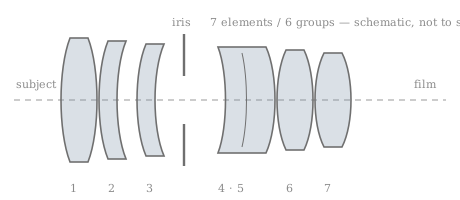
- Modified Double Gauss
- Designed by
- Shimizu Yoshiyuki — optical design
- Construction
- 7 elements / 6 groups
- Aperture range
- f/1.2–f/16
- Min. focus
- 0.5 m
- Dimensions
- 74 × 51.5 mm
- Filter
- 52 mm (0.75 mm pitch)
- Years manufactured
- 1977–1998
- Country
- Japan
- Coating
- Nikon Integrated Coating, with matte-black internal metalwork against internal reflection
What reviewers say
- BastianK (phillipreeve.net) (blog) — Higher contrast and smoother bokeh at f/1.2 than any other f/1.2 F-mount lens, with coma correction genuinely better than its 1970s contemporaries though still visible on corner stars, undercorrected spherical aberration and real focus shift up close, and poor flare resistance wide open — not a lens he can recommend buying except to a collector.
- Kouichi Ohshita (Nikon, NIKKOR — The Thousand and One Nights No.16) (blog) — Nikon's own comparison shoots Ginza at night against the Ai Nikkor 50mm f/1.2S and finds the wing-shaped flare around peripheral streetlights, obvious on the 50mm, scarcely visible on the Noct; its signature is high contrast and edge sharpness at full aperture.
Optical formula — Modified Double Gauss
History
The Noct-Nikkor exists to fix an aberration that almost nobody sees. Sagittal coma flare spreads a point of light near the edge of the frame into what Nikon’s own description calls a bird spreading its wings. It is weak, it is invisible in front-lit subjects, and it disappears two or three stops down — so on an ordinary lens it does not matter. It matters at full aperture on a point source against a dark ground, which is to say a night street or a star field, which is to say the only situation where a photographer would open an f/1.2 lens all the way in the first place. The fault therefore attacks fast lenses precisely where they are supposed to earn their price.
Shimizu’s answer was two moves. High refractive index glass let him weaken the curvature of every element, and the largest element, at the front, was given an aspherical surface. That second move was expensive in a way the barrel does not advertise. Nikon distinguishes between an aspherical surface used to control distortion — the OP Fisheye-Nikkor 10mm f/5.6 of 1968, which Nikon’s own tale calls the first aspherical SLR lens — and one used to control spherical aberration and coma, where the accuracy demanded is, in Nikon’s translation, by far severer. The surface was polished by a method taken from astronomical telescope mirrors: high precision, and dependent on a skilled technician. Each finished lens then had its aspheric measured for surface shape, and the assembled lens had its aberrations measured on a special instrument, on top of the routine resolution test. Nikon’s explanation for the price, which it says was triple that of the 50mm f/1.2, is simply that list of steps.
Production began in February 1977 and never became volume manufacture. About 2,460 Ai lenses to November 1981, about 8,950 Ai-S after — call it eleven thousand in twenty-one years, against nearly a million Ai 50mm f/1.4s in the first four of them. The Ai-S is the same optics with nine aperture blades instead of seven and the depth-of-field scale moved onto chrome. Somewhere around serial 192811 the factory shipped roughly 170 lenses whose name rings read Nocf.
The performance holds up in the one place it was aimed at and nowhere else in particular. Nikon’s own comparison, shot handheld in Ginza at night against the Ai Nikkor 50mm f/1.2S, shows the winged flare around peripheral streetlights on the 50mm and almost none on the Noct. Independent testing agrees that its coma correction beats every fast lens of its decade and adds that this is not the same as beating it: corner stars still flare at f/1.2. Elsewhere the lens behaves like the 1970s design it is — undercorrected spherical aberration, visible focus shift at close range, weak flare resistance wide open, and about 2.4 EV of vignetting. The bokeh, which is not what it was designed for, is the thing most reviewers end up praising.
The record disagrees about when it stopped. Nikon says 1997. Vink’s serial table runs to 1998. Van Dijk says 1999, and puts total production at some 10,000, where summing Vink’s blocks gives about 11,400. The spread is not large but it is unresolved, and it points at the same absence as every other Nikkor in this catalog: no factory production document has been published, so every figure here is an inference from serial numbers that collectors happened to write down.
This history is AI-written, from the sources listed at the foot of the page. Where the record is silent it says so rather than filling the gap — but no human wrote these sentences.
Example photos
Sample photo wanted — shot with a Noct-Nikkor 58mm f/1.2? We'd love to feature it (with credit).
Live listings
Asking price, USD: a median of $3,600 across 19 fixed-price listings on 2026-09-11 (middle half $3,000–$4,100). Tracked since 2026-09-06, 2 days: unchanged from $3,600.
By day
| Date | Median | Middle half | Listings |
|---|---|---|---|
| 2026-09-11 | $3,600 | $3,000–$4,100 | 19 |
| 2026-09-06 | $3,600 | $3,000–$4,100 | 19 |
Asking prices from the listings scanned, not sales; junk-flagged rows and auction lots excluded; other currencies are not converted.
- Nikon AI Noct-NIKKOR 58mm F1.2 Manual Focus Prime Lens Japan
- Rare! [Exc+5 w/Case] Nikon Ai Noct Nikkor 58mm f/1.2 MF Vintage Lens From JAPAN
- [OPT MINT] Nikon Ai Noct-Nikkor 58mm f/1.2 Prime Lens From JAPAN
- Nikon Ai-S Nikkor Noct LENS 58mm 1:1.2 58mm F/1.2 EXPRESS SHIPPING
- [MINT] Nikon Ai-S AIS Noct Nikkor 58mm f/1.2 standard Manual Lens From JAPAN
- Rare S/N 191xxx [MINT+++] Nikon Ai-s Ais Noct Nikkor 58mm f/1.2 MF Lens JAPAN
- Nikon Nikkor AI-s 58mm f1.2 Noct Lens AIS
- Nikon AiS Noct-Nikkor 58mm f/1.2 (Manual Focus) Lens [MINT] #Z-86509
- RARE! [Almost Unused] Nikon Ai-s Ais Noct Nikkor 58mm f/1.2 MF Lens
- ⏯️Rare!!"Ai"[Top MINT SN:174xxx] Nikon Ai Noct Nikkor 58mm f/1.2 Lens From JAPAN
- Nikon Noct-Nikkor 58mm f/1.2 Ai-S MF Lens - Used, Very Good
- NIKKOR AI Noct 58mm F1.2 Manual Focus Lens - Used, Cosmetic Wear
- 🎦S/N matched [Top MINT in Box] Nikon Ai-S Noct-Nikkor 58mm f/1.2 MF Lens JAPAN
- Nikon Ai-S Noct-Nikkor 58mm f/1.2 Manual Focus Lens Nikon F Mount Used H0620
- Noct-NIKKOR 58mm 1:1.2 rare Nikon fast lens f1.2 f58mm SLR camera lens
- Nikon Ai-S 1.2/58mm Noct-Nikkor Noct Nikkor very clean
- Nikon AI Noct NIKKOR 58mm f/1.2 Manual Focus Lens F Mount from Japan E0603
- Nikon Ai-S Noct-NIKKOR 58mm F1.2 Lens Near Mint Cleaned Tested Japan
- Nikon AI Noct NIKKOR 58mm f/1.2 Manual Focus Prime Lens F Mount Japan Used H0730
- Nikon Noct-NIKKOR 58mm f/1.2 Mechanical Not Complete
Show 11 more listings
- [OPT MINT] Nikon Ai Noct-Nikkor 58mm f/1.2 Prime Objektiv aus JAPAN
- Seltenes S/N 191xxx [NEUWERTIG+++] Nikon Ai-s Ais Noct Nikkor 58mm f/1.2 MF...
- 🎦S/N abgestimmt [Top NEUWERTIG in Box] Nikon Ai-S Noct-Nikkor 58mm f/1.2 MF...
- Nikon Ai-S 1.2/58mm Noct-Nikkor Noct Nikkor very clean
- [NEUWERTIG IN BOX] Nikon Ai Noct-Nikkor 58mm F1.2 NOCT AIS mit HS-7 Haube...
- Rare! [Exc+5 w/Case] Nikon Ai Noct Nikkor 58mm f/1.2 MF Vintage Lens From JAPAN
- [OPT MINT] Nikon Ai Noct-Nikkor 58mm f/1.2 Prime Lens From JAPAN
- Rare S/N 191xxx [MINT+++] Nikon Ai-s Ais Noct Nikkor 58mm f/1.2 MF Lens JAPAN
- 🎦S/N matched [Top MINT in Box] Nikon Ai-S Noct-Nikkor 58mm f/1.2 MF Lens...
- Nikon Ai-S 1.2/58mm Noct-Nikkor Noct Nikkor very clean
- Nikon ai Noct-NIKKOR 58mm f1.2 [F]
eBay links are affiliate links. If you buy through one, Glass Bodies earns a small commission from eBay at no cost to you. It does not change which listings appear, their prices or their order — those come from the search and the sort described above.
Listings updated 2026-09-11. Links go to the shop or marketplace that carries the item.