Ai AF Nikkor 28mm f/1.4D
Nikon · Nikon F · 1993 · Retrofocus, aspherical
Also known as: Ai AF Nikkor 28mm f/1.4D · AF Nikkor 28mm f/1.4D · Nikon 28mm f/1.4D · Nikkor 28mm 1:1.4 D Aspherical · 28/1.4D · ニッコール 28mm F1.4D
Variants & identification
| Variant | Mount | Years | Serial ranges | Production |
|---|---|---|---|---|
| AF-D · 11 elements in 8 groups, one precision-ground aspherical element, double floating focus | Nikon F | 1993–2005 | 200001–207333 (Sep 1993 – 2005) | 7,333 (Vink) |
- The 7,333 figure is Vink's, the span of a single serial block from 200001 to 207333. Nikon has published no production total. BastianK, reviewing the lens for phillipreeve.net, puts it at about 7,000 and sets it against more than 11,000 Noct-Nikkor 58mm f/1.2 and more than 100,000 AF 85mm f/1.4D of the same era.
- Two dates are on the record. Nikon's own Thousand and One Nights essay says the lens reached the market in 1994 after roughly ten years of development; Vink's serial block opens in September 1993. Nothing found reconciles them, and the difference is the usual one between production start and announcement — but no source says so.
- ¥238,000 is the price on Nikon's discontinued-product page, undated — nearly three times what the same page asks for the Ai Nikkor 28mm F2S.
How to tell them apart
- Physically unmistakable among 28mm Nikkors: 520g and 88mm overall, against 345g and 68.5mm for the 28mm f/2
- The first F-mount Nikkor 28mm with an aspherical element; the next was the AF-S f/1.8G of 2012
AF-D:
- 72mm filter and the HK-7 slip-on hood, shared with the Ai and Ai-S 25-50mm f/4 zoom
- Nine aperture blades, where almost every Nikkor prime of the period has seven
- 0.35m minimum focus, the longest close limit of any fast Nikkor 28mm
- Yellow-green Super Integrated Coating from serial 2025xx
Serial-range notes
- 2025xx
- Vink marks the change to the yellow-green Super Integrated Coating here — roughly a third of the way through the run, so about 2,500 lenses carry the earlier coating.
Specifications
- Formula
- Retrofocus, aspherical
- Construction
- 11 elements / 8 groups
- Aperture range
- f/1.4–f/16
- Diaphragm blades
- 9
- Min. focus
- 0.35 m
- Dimensions
- 75 × 77.5 mm
- Weight
- 520 g
- Filter
- 72 mm (0.75 mm pitch)
- Years manufactured
- 1993–2005
- Country
- Japan
- Coating
- Super Integrated Coating; the yellow-green formulation from serial 2025xx
- Original price
- ¥238,000 (Nikon's own listing; year not stated)
What reviewers say
- BastianK (phillipreeve.net) (blog) — Optically it still holds up, with excellent bokeh and unusually good close-focus performance, but it lacks the contrast and aberration correction of modern designs — mediocre flare resistance, obvious longitudinal chromatic aberration, and significant lateral CA in the corners.
- Bjørn Rørslett (blog) — Sharp and contrasty between f/4 and f/11 with pleasant bokeh, but soft, flary and low in contrast wide open with visible field curvature — a verdict he says he has been told is too harsh, and which he has repeated across several samples on film and digital.
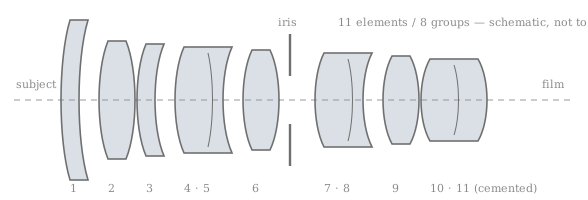
Optical formula — Retrofocus, aspherical
History
Nikon’s own essay on this lens is a sequel to the essay on the Noct-Nikkor, and it says what the 28mm f/1.4 was for: a wide-angle version of the same idea, a lens whose point light sources near the frame edge stay points at full aperture instead of spreading into the winged smear opticians call sagittal coma flare. The essay also explains why the project did not follow straight on from the 35mm f/1.4. Nikon had already computed the 35mm f/1.4 and the 28mm f/2, and knew from both that the flare gets worse as the aperture opens and worse again as the angle widens. Going to 28mm at f/1.4 was expected to be very hard, and it was.
It took about ten years and four optical designers in succession — Nikon normally assigns one designer to a lens, and says so in the essay, which also records that after an early prototype failed quality-assurance testing the work was handed on to younger colleagues. What finally made it possible was manufacturing rather than mathematics: a precision-ground aspherical element with an unusually large departure from a sphere, placed with a strongly curved double-convex element immediately in front of the diaphragm. Focusing moves several groups at once, changing four internal spacings, which is why Nikon describes it as a double floating system rather than close-range correction.
The result is not a small lens. Eleven elements in eight groups, 520g, 88mm long overall, a 72mm filter, nine aperture blades where a Nikkor prime of the period almost always has seven, and a 0.35m close limit — longer than the 0.25m of the 28mm f/2 it sits above. The list price Nikon publishes is ¥238,000.
Whether it delivers on the premise depends on who is asked, and the disagreement is on the record rather than a matter of taste. Bjørn Rørslett tested several samples on film and digital bodies and found flare, low contrast and soft corners at the widest apertures, with everything coming right between f/4 and f/11; he notes that people have told him the rating is too harsh and declines to change it. The phillipreeve.net review by BastianK agrees the lens is soft on contrast and shows both kinds of chromatic aberration, while rating the bokeh and the close-range work highly. Nobody argues that the sagittal coma is bad — which is the one thing the lens was built to fix, and the one thing both reviewers largely leave alone.
Roughly 7,333 were made between 1993 and 2005, a single serial block from 200001 to 207333, which is what makes it scarce: fewer than the 11,000-odd Noct-Nikkors and a small fraction of the 100,000-plus AF 85mm f/1.4D lenses Nikon sold over the same years. A successor came in May 2017, the AF-S 28mm f/1.4E ED, and it is a different lens rather than a new mount on this one — fourteen elements in eleven groups with three aspherical and two ED elements, 645g, a 77mm filter, focusing to 0.28m.
Two things stay unresolved. Nikon has never named any of the four designers, unusually for the essay series, which normally credits people by name. And the launch date does not agree with itself: Nikon says 1994, Vink’s serial block opens in September 1993, and no source found here states which is production and which is sale.
This history is AI-written, from the sources listed at the foot of the page. Where the record is silent it says so rather than filling the gap — but no human wrote these sentences.
Example photos
Sample photo wanted — shot with a Ai AF Nikkor 28mm f/1.4D? We'd love to feature it (with credit).
Live listings
Asking price, USD: a median of $2,000 across 3 fixed-price listings on 2026-09-06 (middle half $1,100–$2,000). First day tracked.
Asking prices from the listings scanned, not sales; junk-flagged rows and auction lots excluded; other currencies are not converted.
- Rare Nikon AF Nikkor 28mm f1.4D Wide Angle Lens Top Condition USA Version
- Nikon AF Nikkor 28mm f1.4D Wide Angle Lens (B38-28-078C)
- Nikon AF Nikkor 28mm f1.4D Lens Used Crack in A/M Ring, Scratches, Dust Read
eBay links are affiliate links. If you buy through one, Glass Bodies earns a small commission from eBay at no cost to you. It does not change which listings appear, their prices or their order — those come from the search and the sort described above.
Listings updated 2026-09-05. Links go to the shop or marketplace that carries the item.