Hasselblad 30mm f/5.6 (XPan)
Hasselblad · XPan · 1999
Also known as: Hasselblad 30mm f/5.6 · XPan 30mm · Fujinon TX 30mm · Super EBC Fujinon TX 30mm f/5.6
Variants & identification
| Variant | Mount | Years | Serial ranges | Production |
|---|---|---|---|---|
| Hasselblad badge | XPan | 1999–2006 | — | — |
| Fujinon TX (Japanese market) | XPan | 1999–2006 | — | — |
How to tell them apart
Hasselblad badge:
- Engraved Hasselblad; catalogue number 24013
Fujinon TX (Japanese market):
- Engraved SUPER EBC FUJINON TX 30mm — the same lens under Fujifilm's badge, sold in Japan alongside the TX-1 and TX-2 bodies
- Fujinon TX (Japanese market): Discontinued November 2006, as the Hasselblad-badged lens was.
Specifications
- Construction
- 10 elements / 8 groups
- Aperture range
- f/5.6–f/22
- Min. focus
- 0.7 m
- Weight
- 310 g
- Filter
- 58 mm
- Country
- Japan
- Coating
- Super EBC multicoating
What reviewers say
- Andrew Morang (35mmc), in Mississippi (blog) — A photo essay more than a test: "through the viewfinder, there it is; you can see what the frame will include," and the lens is at its best when the photographer stands inside the subject. Ordinary landscapes carry too much foreground, and he worries about repair if the electronics fail.
- Michael Reichmann (Luminous Landscape) (blog) — Shot straight into low winter sun: "There isn't a hint of flare!" and 3,200 dpi scans resolve to the grain. f/5.6 becomes f/11 with the mandatory centre filter, which ends handheld low light, and shooting means juggling the accessory finder, the camera finder and the LCD. "This lens is wide, and that's what makes it unique."
Optical formula
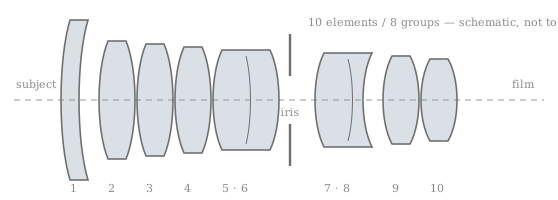
History
The 30mm arrived after the other two, in 1999, and it is the lens that pushes the XPan to its limit: 97.1° across the 24×65mm diagonal, a field no other rangefinder of the period covered on that frame. Hasselblad’s brochure describes two aspherical surfaces in a ten-element, eight-group retrofocus design, and Fujifilm’s page for the Japanese-market Super EBC Fujinon TX 30mm says the same, adding that the aspheric is a glass-moulded element.
It does not behave like the other two. The lens is too wide for the camera’s own viewfinder, so it ships with an accessory finder that mounts in the shoe, and it needs a centre filter — supplied, not optional — because a 97° field on a 65mm-wide frame falls off at the edges by an amount no coating can fix. The filter costs light, which is part of why the maximum aperture reads f/5.6 rather than something faster: this is a lens designed to be used stopped down, on a tripod, at the wide end of what the format can do.
The measured focal length is 30.4mm, minimum focus 0.7m, filter thread 58mm — larger than the 49mm shared by the 45 and 90 — and weight 310g by Hasselblad’s figure, 295g by Fujifilm’s, the difference being what each counts as part of the lens.
It is the scarcest of the three today and the most expensive, though as with its siblings no production figure has ever been published. It was discontinued with the rest of the system in November 2006.
This history is AI-written, from the sources listed at the foot of the page. Where the record is silent it says so rather than filling the gap — but no human wrote these sentences.
Example photos
Sample photo wanted — shot with a Hasselblad 30mm f/5.6 (XPan)? We'd love to feature it (with credit).
Live listings
Asking price, USD: a median of $3,000 across 3 fixed-price listings on 2026-09-11 (middle half $280–$3,000). Tracked since 2026-09-06, 2 days: unchanged from $3,000.
By day
| Date | Median | Middle half | Listings |
|---|---|---|---|
| 2026-09-11 | $3,000 | $280–$3,000 | 3 |
| 2026-09-06 | $3,000 | $280–$3,000 | 3 |
Asking prices from the listings scanned, not sales; junk-flagged rows and auction lots excluded; other currencies are not converted.
- Hasselblad XPan 30mm f/5.6 Aspherical
- Hasselblad 30mm f/5.6 ASPHERICAL for XPAN
- Hasselblad 30mm f/5.6 ASPHERICAL for XPAN
- Hasselblad Xpan 30mm +0.5 correction lens 54485 Mint glass
- Hasselblad XPan 30mm f 5.6 ASPH Lens both caps EXCELLENT
- Hasselblad ⁉️ XPan 30mm f/5.6 ASPH Lens, amazing condition, priced to sell fast!
- Hasselblad Xpan 30mm f5.6 - RENTAL ONLY
eBay links are affiliate links. If you buy through one, Glass Bodies earns a small commission from eBay at no cost to you. It does not change which listings appear, their prices or their order — those come from the search and the sort described above.
Listings updated 2026-09-11. Links go to the shop or marketplace that carries the item.