Nikkor-Q(·C) 13.5cm f/4
Nippon Kogaku · Nikon S + LTM · 1946
Also known as: Nikkor 13.5cm f/4 · Nikkor 135mm f/4 · Nikkor-Q·C 13.5cm f/4 · Nikkor-Q.C 13.5cm f/4 · Nikkor-QC 13.5cm f4 · Nikkor-Q 13.5cm f/4 · Nikkor-Q 135mm f/4 · Nippon Kogaku 13.5cm f/4 · 13.5cm f4 · Nikkor-Q 135mm f/4 Bellows · Nikkor-Q 135mm f/4 Short Mount
Variants & identification
| Variant | Mount | Years | Serial ranges | Production |
|---|---|---|---|---|
| Rigid rangefinder-coupled, Nikon S (1948) · Telephoto Sonnar type, 4e/3g (close derivative of the Zeiss Sonnar 13.5cm f/4) | Nikon S | 1948–1951 | 6111–611232 (first block, 611 prefix + sequence; S mount, from November 1948) 9041–904766 (shared with the Leica-thread lens, from December 1949) 523711–524028 (shared with the Leica-thread lens, December 1950–1951) | ~1,300 serial-derived (232 + 766 + 318 across the three blocks) |
| Rigid rangefinder-coupled, Leica screw mount (1947) · Telephoto Sonnar type, 4e/3g — the same optical unit as the S-mount lens | LTM | 1947–1951 | 9041–904766 (December 1949 onward; Leica-thread lenses sit inside the S-mount block, not in a run of their own) 523711–524028 (December 1950–1951, likewise shared) | No figure: the Leica-thread lenses were numbered inside the S-mount blocks, so the ~1,300 serial-derived total covers both fits. The 1947 lenses that preceded the 611 block have no serial record here. |
| Bellows short mount (1958/59) · Tessar type, 4e/3g | Nikon S | 1959–1968 | 578001–579054 (engraved 13.5cm) 579082–580610 (engraved 135mm) | ~2,600 serial-derived (1959–1968) |
How to tell them apart
Rigid rangefinder-coupled, Nikon S (1948):
- Q = four elements, ·C = coated in the Nikkor lettering scheme; all blocks marked Nippon Kogaku Tokyo
- 'Made in Occupied Japan' engraved on the rangefinder-coupling cam of S-mount examples — hidden inside the barrel
- Tripod foot under the barrel; no click-stops on the aperture ring
Rigid rangefinder-coupled, Leica screw mount (1947):
- Leica thread with a rangefinder-coupling cam; the whole front barrel turns with the focusing ring, so the aperture is set before focusing (Richard Haw)
- Nippon Kogaku Tokyo lettering, Q·C designation; 'Made in Occupied Japan' on the coupled examples
- Heavy brass barrel, tripod foot, no click-stops — the S lens's build in a Leica fit
Bellows short mount (1958/59):
- No helicoid or rangefinder coupling — a preset short-mount head focused entirely by the bellows on a Nikon rangefinder body
- Rear thread is Leica screw, but that is how it seats in the bellows — it will not focus on a Leica-thread camera
- 43mm attachment size
- Early barrels engraved 13.5cm (triangle infinity index, later a dot); final block engraved 135mm
- Rigid rangefinder-coupled, Nikon S (1948): One of the postwar 'original six', and the S-mount lens is the younger of the two fits: Leica-thread sales from 1947 preceded it, the S version arriving with the Nikon I in 1948, and the lens was advertised by October 1949. 'Made in Occupied Japan' is engraved on the coupling cam inside the barrel.
- Rigid rangefinder-coupled, Leica screw mount (1947): The first fit the lens was sold in. When it appeared there was no Nikon camera to mount it on, so the earliest lenses went out in Leica thread from 1947, a year before the Nikon I; Vink's serial data only catches the thread-mount lenses from the second block. Optically identical to the S-mount lens, and rangefinder-coupled like it — unlike the later bellows head, whose Leica thread is only how it seats in the bellows. Richard Haw's teardown of one is the fullest account of the barrel.
- Bellows short mount (1958/59): A different optical design from the rigid lens — Tessar rather than Sonnar — sharing only the catalog designation; whether it ultimately deserves its own family page is an open call. Introduced 1958/59, with confirmed serials from June 1959. Built for the Nikon S bellows attachment (itself ~200 made, serials 56001–56200, late 1957–early 1959); the reflex housings otherwise took nothing shorter than 180mm. Succeeded in September 1968 by an F-mount bellows version with built-in tube (serials 890001–890838, ~838 made).
Serial-range notes
- 6111–611232
- First block, S mount, from November 1948; serials read as the 611 prefix plus a sequence number.
- 9041–904766
- Second block, December 1949 onward, where the Leica-thread lenses join the record alongside the S-mount ones — one numbering for both fits.
- 523711–524028
- Final rigid block, December 1950 into 1951; production ended when the 13.5cm f/3.5 replaced it in January 1951.
- 578001–580610
- Bellows short-mount run, June 1959–1968: earliest batch shiny chrome with triangle infinity index (to 578191), dull chrome front ring after 578302, dot index from 578435, and the final block (579082–580610) engraved 135mm rather than 13.5cm.
- 890001–890838
- F-mount bellows successor with built-in tube, September 1968 – c.1969; listed for lineage completeness, not an S/LTM variant.
Specifications
- Construction
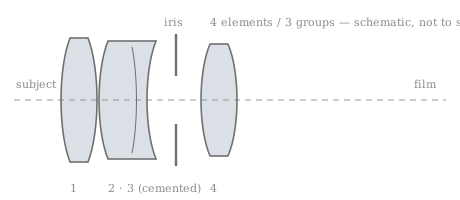
- 4 elements / 3 groups
- Aperture range
- f/4
- Min. focus
- 1.5 m
- Weight
- 560 g
- Filter
- 40.5 mm
- Years manufactured
- 1946–1968
- Country
- Japan
What reviewers say
- Richard Haw (blog) — Really sharp from wide open, with high resolution and corners that hold up — he rates it possibly the best of all the vintage Nikkors and excellent at every distance — but too rare to recommend to shooters, whom he points to the 13.5cm f/3.5 instead: in his view a superior lens at a fraction of the price.
- Richard Haw (LTM version) (blog) — The Leica-thread version, optically identical: a dense brass collector's piece every collector of the period should own — support the whole setup by the lens, never the camera, and set the aperture before focusing since the front barrel rotates — with about $400 the fair ballpark for a typical example.
Optical formula
History
Nippon Kogaku’s first telephoto for the 35mm frame was calculated in the rubble year of 1946: Saburo Murakami (村上三郎) of the optical research section completed the design that autumn, and production began in October — making the Nikkor-Q·C 13.5cm f/4 one of the postwar “original six” with which the company entered consumer photography. It is a telephoto Sonnar, four elements in three groups, closely modeled on the Zeiss Sonnar 13.5cm f/4 — though Nikon’s 1001 Nights retrospective is at pains to point out that Japanese optical glass of the day was far below German grade, forcing an independent recomputation rather than a straight copy. The same retrospective hands the lens its best story: when David Douglas Duncan projection-tested Nikkors in 1950 — he had come for the 8.5cm he’d already fallen for — it was this telephoto’s performance against the German competition that convinced him, and Nikkors went with him when the Korean War broke out months later.
The mount history mirrors the company’s own: when the lens appeared there was no Nikon camera to put it on. The earliest examples were Leica-screw, sold from 1947; the native S-mount version followed alongside the Nikon I in 1948, and the lens was being advertised by October 1949. It rangefinder-couples in both fits — and the S-mount coupling cam is where “Made in Occupied Japan” hides, engraved on a part no owner ever sees without a teardown. Roland Vink’s serial data catches three blocks: 6111–611232, S-mount, from November 1948; 9041–904766 from December 1949, where Leica-screw examples join the record; and a final 523711–524028 spanning December 1950 into 1951 — roughly 1,300 lenses all told, every block ringed “Tokyo.”
That final block marks the ending. In January 1951 Murakami’s own recalculation, the Nikkor-Q·C 13.5cm f/3.5, took over — a third of a stop faster, vastly more numerous, and destined to carry the design through the whole S-mount era and onward into the F-mount 135mm f/3.5 Auto. The f/4 was left as something genuinely scarce: the root of the entire medium-telephoto Nikkor line, produced for only a few years, and by modern accounts a startlingly good performer for its circumstances — sharp from wide open, at every distance, from a factory working with scarce materials and war-worn machinery.
The designation then had a strange afterlife. In 1959 Nippon Kogaku issued a second 13.5cm f/4 Nikkor that shares nothing with the first but the name: a Tessar-type four-in-three short-mount head with no helicoid at all, its rear threaded Leica-screw, built for the Nikon S bellows attachment — itself a roughly 200-unit accessory — and the only route below 180mm in the S system’s close-up arsenal, since the reflex housings took nothing shorter. The short-mount lens far outlived both the bellows unit and the rangefinder system: about 2,600 were made through 1968, the engraving shifting from 13.5cm to 135mm along the way, until an F-mount bellows version with built-in tube closed the line in 1968–69. Two optical designs, one catalog name — and an open question of whether they are really one lens at all.
This history is AI-written, from the sources listed at the foot of the page. Where the record is silent it says so rather than filling the gap — but no human wrote these sentences.
Example photos
.jpg)
.jpg)
More sample photos elsewhere
- Hiro.Morison (oki_tokyo) — 95 botanical macro photos shot with the bellows NIKKOR-Q 1:4 f=13.5cm (photostream search, ARR)
- Hiro.Morison — "Stachyurus praecox": notable sample on Nikon D7100 + PB-4 bellows with a 1959 earliest-type NIKKOR-Q 1:4 f=13.5cm (ARR)
- Hiro.Morison — "Hippeastrum 'Mrs. Garfield'": sample with NIKKOR-Q 1:4 f=13.5cm bellows lens on Nikon PB-2 (ARR)
These photographers keep all rights to their work — enjoy it at the source.
Sample photo wanted — shot with a Nikkor-Q(·C) 13.5cm f/4? We'd love to feature it (with credit).
Live listings
Asking price, USD: a median of $300 across 3 fixed-price listings on 2026-09-11 (middle half $200–$300). Tracked since 2026-09-06, 2 days: unchanged from $300.
By day
| Date | Median | Middle half | Listings |
|---|---|---|---|
| 2026-09-11 | $300 | $200–$300 | 3 |
| 2026-09-06 | $300 | $200–$300 | 3 |
Asking prices from the listings scanned, not sales; junk-flagged rows and auction lots excluded; other currencies are not converted.
- [EXC+5] Nikon Nikkor-Q 13.5cm f/4 Short Mount Bellows Lens From Japan #12334
- Vintage Nikon Nikkor-Q 135mm f/4 Bellows Lens w/Original Nikon Bubble Case & Box
- Nikon Nikkor-Q 13.5cm F4 For RF & F Mount w/ BR1 L#578899 JLM
- Nippon Kogaku Nikkor-Q.C 135mm F4 LTM - Occupied Type 2 / 904 Batch — SN 904441
eBay links are affiliate links. If you buy through one, Glass Bodies earns a small commission from eBay at no cost to you. It does not change which listings appear, their prices or their order — those come from the search and the sort described above.
Listings updated 2026-09-11. Links go to the shop or marketplace that carries the item.