Nikkor 5cm f/3.5 (Hansa Canon)
Nippon Kogaku · Canon Hansa · 1936 · Tessar
Also known as: Nikkor 5cm f/3.5 · Nikkor 50mm f/3.5 · Nippon Kogaku Nikkor 5cm f3.5 Hansa · Hansa Canon Nikkor
Variants & identification
| Variant | Mount | Years | Serial ranges | Production |
|---|---|---|---|---|
| Canon Hansa bayonet | Canon Hansa (Nippon Kogaku bayonet) | 1935–1940 | — | Unrecorded. About 1,100 Hansa Canon bodies were built in all, and each was sold with this lens, so the two figures are close to the same number |
How to tell them apart
- The lens that came with every Hansa Canon: only the 5cm was ever sold for the mount, so an unmarked Hansa Canon lens is this one
Canon Hansa bayonet:
- Uncoated — the lens predates Nippon Kogaku's coating by a decade
- No focusing helix on the lens: the helix belongs to the camera's mount, and the wheel that drives it is on the body
- "Nippon Kogaku" engraved beside the mount serial on the earliest examples, a practice that stops before number 800
Serial-range notes
- mount numbers, separate from the camera's
- The lens and its mount were numbered by Nippon Kogaku in a sequence of their own, unrelated to the serial on the camera body. The two never correspond, and the mount sequence has large gaps — attributed to mounts scrapped in manufacture rather than to lost cameras.
Specifications
- Formula
- Tessar
- Construction
- 4 elements / 3 groups
- Aperture range
- f/3.5
- Country
- Japan
- Coating
- None — uncoated
What reviewers say
No reviews aggregated yet — this family is still in the research queue. Written one? We'd love to index it.
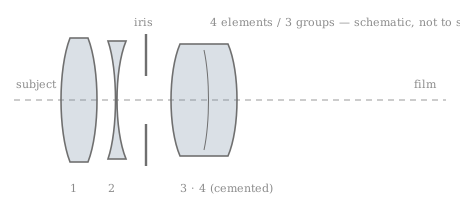
Optical formula — Tessar
History
Nippon Kogaku had been making optics for thirty years before any of it reached a shop counter. The company was assembled in 1917 out of three smaller firms at the government’s urging, and it spent the interwar decades on rangefinders, periscopes and binoculars for the navy. The Nikkor 5cm f/3.5 of 1936 is the point at which that work turned outward: the first Nippon Kogaku lens sold on a camera anyone could buy, more than ten years before the company made a camera of its own.
It was not sold on its own terms. The Precision Optical Instruments Laboratory — Canon, in all but name — could build a body and a focal-plane shutter but had no optical division, and the arrangement the two firms reached gave Nippon Kogaku the whole optical half of the Hansa Canon: this lens, the bayonet mount it sits in, the focusing helix inside that mount, the rangefinder mechanism and the viewfinder optics. Canon’s own museum sets out the division of labour without embarrassment. It is why the camera’s focusing wheel is on the body rather than the lens, and why a Hansa Canon carries two unrelated serial numbers.
The optics are four elements in three groups — a Tessar arrangement, and described as Tessar-like in every account consulted, though no cross-section has been published and Nippon Kogaku’s design papers for it have not surfaced. It is uncoated, as everything of its date is; Nippon Kogaku’s coating work belongs to the following decade. Collectors who use one report it as sharp, which is the extent of what the record says about how it draws.
Only the 5cm was ever offered for the mount. A 3.5cm f/3.5 Nikkor was prototyped for the Hansa Canon and never went into production, so an owner of one of these cameras had a fixed choice of one lens, and the lens and camera are found together almost by definition. About 1,100 Hansa Canons were built between roughly October 1935 and June 1940, and since each left with a lens, that number stands in for a production figure nobody has published.
Two cautions for anyone shopping. The mount fits nothing else — it resembles the Contax internal bayonet from the outside and is interchangeable with neither Contax nor the Leica-thread mount Canon adopted in 1947 — so this lens is useful only on the camera it was made for, or on a modern body through a purpose-made adapter. And the name it shares with a later, commoner lens has caused real confusion in the trade: Nippon Kogaku made a collapsible Nikkor-Q·C 5cm f/3.5 for the Nikon rangefinder and Leica-thread systems from 1945, a different design with its own page here, and prewar Hansa Canon lenses are periodically listed as though they were that lens or the reverse. The mount settles it, and the coating settles it: this one has none.
This history is AI-written, from the sources listed at the foot of the page. Where the record is silent it says so rather than filling the gap — but no human wrote these sentences.
Example photos

Sample photo wanted — shot with a Nikkor 5cm f/3.5 (Hansa Canon)? We'd love to feature it (with credit).
Live listings
Asking price, USD: a median of $510 across 14 fixed-price listings on 2026-09-11 (middle half $180–$2,500). Tracked since 2026-09-06, 2 days: down 9% from $570.
By day
| Date | Median | Middle half | Listings |
|---|---|---|---|
| 2026-09-11 | $510 | $180–$2,500 | 14 |
| 2026-09-06 | $570 | $180–$3,300 | 17 |
Asking prices from the listings scanned, not sales; junk-flagged rows and auction lots excluded; other currencies are not converted.
- Read Nikon Nikkor H 5cm f 3.5 f/3.5 50mm Bronica S SE Lens *72930
- Nikon NIKKOR Z 16-50mm f3.5-6.3 Lens
- Zenza Bronica Nikkor-H 50mm f/3.5 Lens - Clean, Working Aperture
- [MINT] Nikon Nikkor-H 50mm 5cm f3.5 Lens for Bronica
- [MINT] Nikon Nikkor-H 50mm 5cm f3.5 Lens for Bronica EC TL S2 From JAPAN
- NIKKOR-Q C 50mm 5cm F3.5 L-mount fully functional K146
- 【MINT w/Case】Zenza Bronica S2 late black NIKKOR-H 5cm f3.5 from Japan #A001
- Nikon Rangefinder 50mm 5cm f3.5 Micro-Nikkor-C lens-EARLY 7 Blade head+READ+RARE
- Rare Nippon Kogaku Tokyo Nikkor QC 5cm F3.5 Lens Cleaned Vintage Glass
- 【Near MNT】Nikon Micro-NIKKOR-C 5cm f/3.5 (S-Mount) From Japan
- Canon J-II Seiki Kogaku Early Post-War Camera w/ Nippon Nikkor 5cm f3.5 Lens
- RARE 1946 Canon Seiki-Kogaku J-II No. 8110 + Nikkor 5cm f/3.5 No. 460041 Case
- Vintage [Near MINT] Canon Seiki Kogaku Camera Nikkor 5cm f/3.5 Lens From JAPAN
- Ultra Rare!CLA’d [Top MINT] Canon J-II Seiki w/ early Nikkor 5cm f3.5 Lens JAPAN
- Nikon NIKKOR-H 5cm f/3.5 Lens for Bronica S, S2, S2A & EC [AS IS/READ] #Z-75840
- Read Nikon Nikkor H 5cm f 3.5 f/3.5 50mm Bronica S SE Lens *72930
- [MINT] Nikon Nikkor-H 50mm 5cm f3.5 Lens for Bronica EC TL S2 From JAPAN
- Nikon S2 Rangefinder Outfit + 3 Nikkor Lenses 5cm f/1.4 5cm f/2 3.5cm f/3.5 Case
- Ultra Rare!CLA’d [Top MINT] Canon J-II Seiki w/ early Nikkor 5cm f3.5 Lens...
- [NEUWERTIG] Nikon Nikkor-H 50mm 5cm f3.5 Objektiv für Bronica EC TL S2 aus JAPAN
Show 2 more listings
eBay links are affiliate links. If you buy through one, Glass Bodies earns a small commission from eBay at no cost to you. It does not change which listings appear, their prices or their order — those come from the search and the sort described above.
Listings updated 2026-09-11. Links go to the shop or marketplace that carries the item.