Nikkor 50mm f/1.2
Nippon Kogaku · Nikon F · 1978 · Modified double Gauss, 7 elements in 6 groups
our own findingAlso known as: Ai Nikkor 50mm f/1.2 · Ai-S Nikkor 50mm f/1.2S · Nikkor 50mm 1:1.2 · Nikon 50mm f/1.2 AIS · NIKKOR 50mm F1.2S · ニッコール 50mm F1.2
Variants & identification
| Variant | Mount | Years | Serial ranges | Production |
|---|---|---|---|---|
| Ai | Nikon F | 1978–1981 | 177051–250513 | 73,463 (Vink, counted from serials — not a factory figure) |
| Ai-S | Nikon F | 1981–2020 | 250001–391172 (1981–2005) 400001–427017 (2006 series, to 2020) | 141,172 + 27,017 = 168,189 across the two blocks (Vink, serial-derived) |
| Ai-S "Classic" | Nikon F | 1982–1982 | 5000001–5000100 (its own seven-digit block) | 100 (Vink, serial-derived) |
- Serial blocks and quantities are Roland Vink's. His Qty column is "Number of lenses made based on serial numbers collected" and his dates "may not be accurate" — these are counts derived from serial numbers, not factory records. Nikon has published no production figure.
- Summing Vink's blocks gives 241,752 lenses across forty-two years: 73,463 Ai, 168,189 Ai-S, 100 in the F3/T block. For scale, his figures for the Noct-Nikkor 58mm f/1.2 — the same speed, one aspherical surface, the same years — total 11,413.
- Nikon's own NIKKOR essay series has no tale on this lens. It covers the 55mm f/1.2 that preceded it and the Noct-Nikkor 58mm f/1.2 that ran alongside it; the 50mm f/1.2 appears only as the successor named in the closing lines of the 55mm story.
- The Ai-S date is not settled. Vink dates it from June 1981; Photography in Malaysia says September 1981.
- Weights disagree. Vink gives 390g for the Ai and 360g for the Ai-S. Photography in Malaysia gives 420g for the Ai, 380g for the early Ai-S and 360g for a 2002 catalogue listing, and says the discrepancy has never been explained to its author's satisfaction. Nobody suggests the optics changed.
How to tell them apart
- Engraved NIKON, not NIPPON KOGAKU: by 1978 the barrels carried the brand and the company still carried the old name
- 52mm filter thread on a 70mm barrel — the front element is huge and the accessory standard survives it
- Minimum aperture is f/16, not the f/22 of the slower fifties
- Seven elements: fewer than the 55mm f/1.2 needed, and fewer than most f/1.2 designs of any make
Ai:
- Seven aperture blades
- Distance and depth-of-field data outside the filter ring, not on the focus ring
- 180° focus throw — twice the Ai-S, and the reason some users prefer it
- Three cross-head screws in the mount ring
Ai-S:
- Nine aperture blades
- Distance and depth-of-field data moved onto the focus ring
- Minimum aperture printed in orange on the ring and the readout scale
- Focus throw cut from 180° to 110°
Ai-S "Classic":
- A seven-digit serial beginning 50000 — nothing else in the family numbers this way
- Ai: Born Ai. There is no pre-Ai and no New-Nikkor 50mm f/1.2: the lens arrives after the 1977 mount change, and takes over from the 55mm f/1.2 with a month's overlap.
- Ai-S: Same seven elements in six groups as the Ai. The Ai-S serial block opens at 250001 while the Ai block was still running towards 250513, so the two overlap.
- Ai-S "Classic": Vink records this hundred-lens block as supplied with an F3/T limited edition. He gives no other distinguishing feature, and no source consulted describes what, if anything, differs optically or cosmetically from an ordinary Ai-S.
Serial-range notes
- 104592
- A single Ai prototype, 1978.
- 250001–250513
- The Ai and Ai-S blocks overlap here: the Ai-S opens at 250001 while the Ai run is still finishing.
Specifications
- Formula
- Modified double Gauss, 7 elements in 6 groups
- Construction
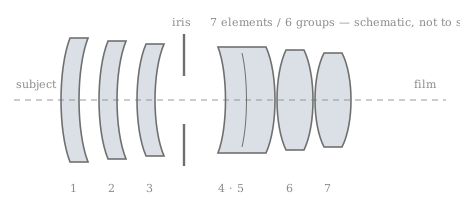
- 7 elements / 6 groups
- Aperture range
- f/1.2–f/16
- Diaphragm blades
- 7
- Min. focus
- 0.5 m
- Dimensions
- 70 × 59 mm
- Weight
- 390 g
- Filter
- 52 mm (0.75 mm pitch)
- Years manufactured
- 1978–2020
- Country
- Japan
What reviewers say
- Richard Haw (blog) — Wide open it is a spherical-aberration lens — painterly, with bokeh he calls beautiful, coma he calls terrible until about f/2, and resolving power he still rates decent and more than usable; it beats the 55mm f/1.2 it replaced and does not reach the Noct, and he prefers the Ai to the Ai-S for its longer focus throw. single source, unconfirmed
Optical formula — Modified double Gauss, 7 elements in 6 groups
History
A reflex mirror has to swing, and the space it swings through has to sit between the last glass and the film. That is the whole problem. Nippon Kogaku could build a 50mm f/1.4 for a rangefinder in 1950, but on an SLR the same speed at the same focal length meant pushing the rear group forward into the mirror’s path, and the faster the lens the worse the squeeze. Nikon’s answer in 1965 was to move the focal length instead of solving the problem: the Nikkor-S Auto 55mm f/1.2. Five extra millimetres of focal length bought the back focus, and the lens sold for thirteen years.
The 50mm arrived in March 1978. Nikon’s own history is direct about what it represented — the long-sought 50mm f/1.2, arriving to end the 55mm’s run — and the 55mm f/1.2 Ai stops in April 1978, one month later. Seven elements in six groups, a modified double Gauss, and still a 52mm filter thread on a 70mm barrel.
It never existed in any other mount generation. There is no pre-Ai 50mm f/1.2 and no New Nikkor version, because the lens was designed after the 1977 Ai change; and there is no autofocus version, because Nikon never made one. The Ai-S of 1981 swapped seven blades for nine, moved the engraving from the barrel to the focus ring, printed the minimum aperture in orange, and halved the focus throw from 180 degrees to 110 — Richard Haw prefers the older lens for exactly that reason. The optics did not move. That state of affairs held for thirty-nine more years. When Nikon finally built another f/1.2 fifty it was the Z 50mm f/1.2 S of September 2020, seventeen elements, 1,090 grams, for a mount with no mirror in it at all — and the same year the Ai-S left the catalogue.
Wide open the lens is not a corrected instrument and was never meant to be one. Spherical aberration dominates, coma is bad until about f/2, vignetting and flare are both easy to provoke, and the bokeh is the reason people buy it. Haw rates its resolution wide open as usable rather than impressive, better than the 55mm it replaced, and short of the Noct-Nikkor 58mm f/1.2 — which is the point of the Noct, and which cost far more. Vink’s serials imply about 242,000 of these against about 11,000 Nocts.
Two things are missing from the record. No designer has been credited: Nikon’s essay series gave the 55mm f/1.2 a full tale under Shimizu Yoshiyuki’s name and gave the Noct another, but the 50mm f/1.2 appears in neither except as a sentence about succession, and no list price or production figure has been published for it either. And the hundred lenses in the 5000001 block remain unexplained — Vink ties them to an F3/T limited edition and nothing consulted here says what makes them different.
This history is AI-written, from the sources listed at the foot of the page. Where the record is silent it says so rather than filling the gap — but no human wrote these sentences.
Example photos


.jpg)
Sample photo wanted — shot with a Nikkor 50mm f/1.2? We'd love to feature it (with credit).
Live listings
Asking price, USD: a median of $340 across 46 fixed-price listings on 2026-09-11 (middle half $290–$380). Tracked since 2026-09-06, 2 days: unchanged from $340.
By day
| Date | Median | Middle half | Listings |
|---|---|---|---|
| 2026-09-11 | $340 | $290–$380 | 46 |
| 2026-09-06 | $340 | $290–$380 | 46 |
Asking prices from the listings scanned, not sales; junk-flagged rows and auction lots excluded; other currencies are not converted.
- Nikon Nikkor-H Auto 50mm f/1.2 Prime Objektiv - getestet gut
- [Near MINT+++] Nikon Ai Nikkor 50mm f/1.2 MF Standard Lens F Mount From JAPAN
- "EXC +5" Nikon Ai Nikkor 50mm f/1.2 Standard Prime Lens for Nikon F JAPAN 4742
- [Near MINT+++] Nikon Ai Nikkor 50mm f1.2 Standard Lens for F Mount From JAPAN
- VERY GOOD Nikon Ai NIKKOR 50mm F/1.2 Prime Lens
- EXCELLENT Nikon Ai NIKKOR 50mm F/1.2 Prime Lens
- Nikon Ai-S NIKKOR 50mm f/1.2 MF Lens Nikon F Mount From Japan Fungus Haze #42
- Nikon Nikkor 50mm f/1.2 AI lens
- EXCELLENT Nikon Ai NIKKOR 50mm F/1.2 Prime Lens
- Nikon Ai Nikkor 50mm f1.2 MF Standard Prime F Mount Lens [OPT MINT+] JAPAN #391
- EXCELLENT Nikon Ai NIKKOR 50mm F/1.2 Prime Lens
- CLA'd[MINT] Nikon Ai Nikkor 50mm f/1.2 Lens MF F Mount Standard Prime From JAPAN
- Nikon NIKKOR 50mm F1.2 AI-S Excellent Manual Focus F-Mount Prime Lens MF Japan
- Tested [MINT] Nikon Ai-s Ais Nikkor 50mm F1.2 Standard Manual Forcus Lens JAPAN
- Near Mint- Nikon Nikkor Ai-s AIS 50mm f/1.2 Standard Prime MF Lens Japan #0132
- Nikon Nikkor Ai-s Ais 50mm F/1.2 MF Prime Standard Lens *Near Mint* #5463
- Nikon Ai Nikkor 50mm f/1.2 Standard MF Lens From JAPAN [Near MINT] #0904
- [Top MINT] Nikon Ai Nikkor 50mm f/1.2 MF Standard Prime Lens F Mount From JAPAN
- CLA'd [MINT] Nikon AI-S AIS Nikkor 50mm f/1.2 MF Lens F Mount From JAPAN
- [MINT] Nikon Nikkor 50mm f1.2 AI-Converted Manual Focus Lens From JAPAN
Show 114 more listings
- Nikon Ai-s Nikkor 50mm F/1.2 Standard Prime Lens From Japan [Near Mint] #2696
- Nikon Ai Nikkor 50mm f1.2 MF Standard Prime F Mount Lens [MINT+] From JAPAN #599
- [MINT] Nikon Ai-s Nikkor 50mm f/1.2 Standard Prime Lens From JAPAN A242
- Late SIC Ver. [Near MINT] Nikon Ai-S Nikkor 50mm f/1.2 Prime Lens F from Japan
- Nikon Ai-S NIKKOR 50mm f/1.2 MF Lens Nikon F Mount From Japan Near Mint #43
- Nikon Ai-s AIS Nikkor 50mm f/1.2 MF Standard Lens From JAPAN [Near Mint] #0114
- [Near MINT] Nikon Ai-s Nikkor 50mm f/1.2 MF Prime F Mount Lens From JAPAN
- 🎦[Near MINT] Nikon Ai-S NIKKOR 50mm F/1.2 MF Standard Fast Prime Lens AIS...
- Nikon AIS Nikkor 50mm f/1.2 Great Condition
- 【N MINT+++】Nikon Ai Nikkor 50mm f/1.2 Standard MF Lens
- [ Top MINT ] Nikon Ai-s Ais Nikkor 50mm f/1.2 MF Standard Prime Lens From JAPAN
- Nikon Ai-S NIKKOR 50mm f/1.2
- EXCELLENT 【Serviced】 Nikon Ai-S NIKKOR 50mm F/1.2 Prime Lens
- EXCELLENT Nikon Ai-S NIKKOR 50mm F/1.2 Prime Lens
- [Near MINT++ Nikon Ai-s Nikkor 50mm f/1.2 MF Standard Lens From JAPAN
- 【N NEUWERTIG】Nikon Ai-s AIS Nikkor 50mm f/1.2 Standard MF Objektiv
- [Top MINT] Nikon Nikkor Ai-s AIS 50mm f/1.2 Standard Prime MF Lens From JAPAN
- EXCELLENT Nikon Ai-S NIKKOR 50mm F/1.2 Prime Lens
- Nikon AI-S AIS Nikkor 50mm f/1.2 MF Standard Prime Lens
- 【MINT-】Nikon Ai-s AIS Nikkor 50mm f/1.2 Standard MF Lens
- [Mint] Nikon NIKKOR AIS Ai-s 50mm f/1.2 MF Prime Standard Lens From JAPAN #0543
- Nikon Nikkor 50mm f/1.2 Ais Standard Prime Manual Focus Lens
- Nikon Nikkor 50mm f/1.2 Ai-s lens
- Nikon Nikkor 50mm F/1.2 AIS LENS *Authorised Nikon UK Dealer*
- Nikon 50mm f/1.2 Nikkor - Nikon AiS
- Nikon Ai-s Nikkor 50mm f1.2 MF Lens S/N 409XXX [ Almost Unused in Box ] C922
- Nikon AI-S AIS Nikkor 50mm f1.2 MF Late Model Lens Japan
- Late [TOP MINT] Nikon Ai-S Nikkor 50mm f/1.2 AIS S/N 417xxx MF Lens w/ Box JAPAN
- "EXC +5" Nikon Ai Nikkor 50mm f/1.2 Standard Prime Lens for Nikon F JAPAN 4742
- [Near Mint] Nikon Ai Nikkor 50mm f/1.2 MF Standard Prime Lens from Japan #8150
- Nikon Ai-S NIKKOR 50mm F1.2 Manual Focus Prime Lens Japan
- [Near MINT+++] Nikon Ai Nikkor 50mm f/1.2 MF Standard Lens F Mount From JAPAN
- [MINT] Nikon Ai Nikkor 50mm f/1.2 MF Standard Prime Lens from Japan #8112
- [Near MINT+++] Nikon Ai Nikkor 50mm f1.2 Standard Lens for F Mount From JAPAN
- [Opt Top MINT] Nikon Ai Nikkor 50mm F1.2 MF Standard Prime Lens From JAPAN
- Nikon Ai NIKKOR 50mm F1.2 MF Prime Lens Near Mint Tested From Japan
- [MINT] Nikon AI-S Nikkor 50mm f/1.2 Manual Focus Lens F Mount From JAPAN
- Nikon Ai Nikkor 50mm f1.2 MF Standard Prime F Mount Lens [OPT MINT+] JAPAN #391
- Nikon Ai-S NIKKOR 50mm F1.2 MF Lens Near Mint Tested From Japan
- [Near MINT] Nikon Ai Nikkor 50mm f/1.2 Standard Lens for F Mount From JAPAN
- [Near MINT++] Nikon Ai-s Ais Nikkor 50mm f/1.2 Prime Standard MF Lens From JAPAN
- Nikon NIKKOR 50mm F/1.2 Lens - W/Carrying Case
- Nikon NIKKOR 50mm f/1.2 Ai Manual Focus Prime Lens - Original Caps - Excellent
- Nikon NIKKOR 50mm F/1.2 Ai-S AIS Standard Prime MF Lens US Duty Paid #4900
- [N MINT] Nikon Nikkor Ai 50mm f1.2 MF Standard Prime Lens for F Mount from Japan
- Tested [MINT] Nikon Ai-s Ais Nikkor 50mm F1.2 Standard Manual Forcus Lens JAPAN
- Nikon Nikkor Ai-s Ais 50mm F/1.2 MF Prime Standard Lens *Near Mint* #5463
- [MINT] Nikon Ai-s AIS Nikkor 50mm f/1.2 MF Standard Prime Lens W/Caps From JAPAN
- Nikon Ai-S NIKKOR 50mm f/1.2 MF Lens Nikon F Mount From Japan Fungus Haze #42
- Nikon Ai Nikkor 50mm f/1.2 Standard MF Lens From JAPAN [Near MINT] #0904
- Nikon Ai Nikkor 50mm f1.2 MF Standard Prime F Mount Lens [MINT+] From JAPAN #599
- Late SIC Ver. [Near MINT] Nikon Ai-S Nikkor 50mm f/1.2 Prime Lens F from Japan
- [ Top MINT ] Nikon Ai-S Nikkor 50mm f/1.2 Manual Focus MF Lens From JAPAN
- EXCELLENT Nikon Ai NIKKOR 50mm F/1.2 Prime Lens
- [MINT] Nikon Ai-s Nikkor 50mm f/1.2 Standard Prime Lens From JAPAN A242
- [Top MINT] Nikon Ais Ai-s Nikkor 50mm F/1.2 MF Prime Standard Lens From JAPAN
- Nikon Nikkor AI-S 50mm f1.2 Lens AIS #575
- [Almost UNUSED] Nikon Ai-S AIS Nikkor 50mm f/1.2 MF Standard Prime Lens Japan
- Nikon Ai-S Nikkor 50mm f/1.2 SLR MF Standard Lens US Seller With Caps
- Nikon Ai-S AIS Nikkor 50mm f/1.2 F Mount MF Lens [S/N:376xxx MINT+++] JAPAN #021
- Nikon AI-S FX NIKKOR 50mm F/1.2 Lens
- Nikon Ai-S NIKKOR 50mm F/1.2 (Nikon F mount) #161
- [Top MINT] Nikon Nikkor Ai-s AIS 50mm f/1.2 Standard Prime MF Lens From JAPAN
- Nikon Nikkor AI-S 50mm f1.2 Lens AIS - Near Mint
- Nikon Ai-S NIKKOR 50mm f/1.2
- Nikon Ai-S NIKKOR 50mm f/1.2 MF Lens Nikon F Mount From Japan Near Mint #43
- Nikon Nikkor AI-S 50mm f1.2 Lens AIS #643
- Nikon 50mm f/1.2 NIKKOR AIS Manual Focus Lens (with Added Caps)
- [Top MINT w/Box] Nikon Ai-s Nikkor 50mm f/1.2 MF Lens From JAPAN
- Nikon nikkor 50mm F1.2 MF ais Lens
- SIC 38xxx [Top MINT] Nikon Ai-S Nikkor 50mm f1.2 Standard SLR MF Lens JAPAN
- SIC 360xxx 【MINT in Box】 Nikon Ais Nikkor 50mm F1.2 MF Standard Lens From Japan
- Nikon Ai-s NIKKOR 50mm f/1.2 SIC MF Lens Serial 420xxx Tested w/ Sample Photos
- SIC 411XXX [Almost Unused in Box] Nikon AIS Ai-s Nikkor 50mm f/1.2 MF Lens JAPAN
- Gehäuse Nikon Nikkor 50mm f1.2 Ai-s F Mount Bitte lesen!
- Très Bon Nikon Ai NIKKOR Objectif Principal 50mm F/1.2
- Objectif Prime Nikon Ai NIKKOR 50mm F/1.2 52mm Manuel Standard
- Objectif Prime Nikon Ai NIKKOR 50mm F/1.2 52mm Manuel Standard
- Nikon Ai Nikkor 50mm f1.2 MF Standard Prime F Mount Objektiv [OPT MINT+]...
- Objectif Prime Nikon Ai NIKKOR 50mm F/1.2 52mm Manuel Standard
- Nikon NIKKOR 50mm F1.2 AI-S Excellent Manual Focus F-Mount Prime Lens MF Japan
- Getestet [NEUWERTIG] Nikon Ai-s Ais Nikkor 50mm F1.2 Standard Manual Forcus...
- Nikon Ai Nikkor 50mm f/1.2 MF Prime MF Standard Objektiv [OPT/Top...
- 【TOP NEUWERTIG】Nikon Ai Nikkor 50mm F/1.2 Standard F Mount Prime Objektiv...
- Nikon Nikkor 50mm 1.2 Ai - Declicked - Sehr gut
- Nikon Ai Nikkor 50mm f1.2 MF Standard Prime F Mount Objektiv [NEUWERTIG+]...
- Nikon NIKKOR 50mm f/1.2 AI-S
- Nikon Ai-S NIKKOR 50mm f/1.2 MF Objektiv Nikon F Mount aus Japan Near Mint #43
- Nikon Ai-S AIS Nikkor 50mm f/1.2 F Mount MF Objektiv [S/N:376xxx...
- Nikon F Ai-S Nikkor 50mm 1:1.2 Objektiv
- Nikon Ai-S NIKKOR 50mm f/1.2 Objectif Photo SLR Manuel 52mm
- [Near MINT+++] Nikon Ai-s Nikkor 50mm f/1.2 MF Standardobjektiv Aus Japan
- Nikon Ai-S NIKKOR 50mm f/1.2 Objectif Photo SLR Manuel 52mm
- [Top NEUWERTIG] Nikon Nikkor Ai-s AIS 50mm f/1.2 Standard Prime MF Objektiv...
- Nikon Nikkor AI-S 50mm f/1.2 MF Objektiv – TOP Zustand
- Objectif Fixe Nikon Ai-S NIKKOR 50mm F/1.2 Manuel SLR 52mm
- Nikon F Ais Nikkor 50mm 1:1.2 Objektiv *neuwertig* + 1 Jahr Gewährleistung
- [NEUWERTIG] Nikon Ai Nikkor 50mm f1.2 Standardobjektiv für F-Mount getestet...
- Nikon Ai Nikkor 1,2/50 Standard Objektiv - MF Standard Lens - 50mm F/1.2
- Nikon Nikkor 50mm F/1.2 ais in excellent working order
- Nikon Nikkor 50mm 1.2 Ai-S AIS
- Nikon Nikkor 50mm 1.2 wie neu, Nikon-Fachhändler #49656*
- Nikon Ai-s Nikkor 50mm f1.2 MF Objektiv S/N 409XXX [fast unbenutzt im...
- [TOP MINT] Nikon Ai-S Nikkor 50mm f/1.2 AIS MF Lens Late Model S/N 416xxx JAPAN
- Nikon F4 inkl. Nikkor 50mm 1:1.2
- Nikon Nikkor 50mm Z F /1.2 S (Wie NEU)
- Fast Neuwertige Nikon F3/T HP SN:850xxxx mit Nikkor 50mm F/1.2
- EXCELLENT Nikon Ai NIKKOR 50mm F/1.2 Prime Lens
- EXCELLENT Nikon Ai NIKKOR 50mm F/1.2 Prime Lens
- EXCELLENT 【Serviced】 Nikon Ai-S NIKKOR 50mm F/1.2 Prime Lens
- [Near MINT++ Nikon Ai-s Nikkor 50mm f/1.2 MF Standard Lens From JAPAN
- Nikon Ai NIKKOR 50mm F/1.2 単焦点レンズ
- Nikon Ai NIKKOR 50mm F/1.2 単焦点レンズ
- Nikon Ai NIKKOR 50mm F/1.2 単焦点レンズ
eBay links are affiliate links. If you buy through one, Glass Bodies earns a small commission from eBay at no cost to you. It does not change which listings appear, their prices or their order — those come from the search and the sort described above.
Listings updated 2026-09-11. Links go to the shop or marketplace that carries the item.