Nikkor 35mm f/2
Nippon Kogaku · Nikon F · 1965 · Retrofocus, 8 elements in 6 groups
Also known as: Nikkor-O Auto 35mm f/2 · Nikkor-O·C Auto 35mm f/2 · NIKKOR-O.C Auto 35mm 1:2 · New Nikkor 35mm f/2 · Ai Nikkor 35mm f/2 · Ai-S Nikkor 35mm f/2S · AF Nikkor 35mm f/2D · Nippon Kogaku Nikkor-O 35mm f/2
Variants & identification
| Variant | Mount | Years | Serial ranges | Production |
|---|---|---|---|---|
| Nikkor-O Auto (Nippon Kogaku) | Nikon F | 1965–1971 | 690101–731412 (280g, Ai conversion kit 34) 741311–778785 (285g, Ai conversion kit 33) | 41,312 + 37,475 = 78,787 across the two blocks (Vink, counted from serials) |
| Nikkor-O Auto (Nikon) | Nikon F | 1971–1973 | 790001–833213 | 43,213 (Vink, serial-derived) |
| Nikkor-O·C Auto | Nikon F | 1973–1975 | 835001–871141 | 36,141 (Vink, serial-derived) |
| New Nikkor ("K") | Nikon F | 1975–1977 | 880001–913477 | 33,477 (Vink, serial-derived) |
| Ai | Nikon F | 1977–1981 | 920001–959840 110001–193574 (the block restarts at six digits) | 39,840 + 83,574 = 123,414 across the two blocks (Vink, serial-derived) |
| Ai-S | Nikon F | 1981–2005 | 210001–333418 | 123,418 (Vink, serial-derived) |
| AF Nikkor · 6 elements in 5 groups — a new design, not the 1965 optic in an autofocus barrel | Nikon F | 1989–1995 | 200001–238317 | 38,317 (Vink, serial-derived) |
| AF Nikkor D · 6 elements in 5 groups — the 1989 autofocus design, with distance encoding added | Nikon F | 1995–2020 | 300001–350717 (March 1995 onward) 400001–409397 (2005) 500001–677724 (2006 series, to 2020) | 50,717 + 9,397 + 177,724 = 237,838 across the three blocks (Vink, serial-derived) |
- Serial blocks and quantities are Roland Vink's. His Qty column is, in his words, "Number of lenses made based on serial numbers collected", and his production dates "may not be accurate". Nikon has published no production figure for any version.
- Summing Vink's blocks: about 438,000 manual-focus lenses on the 1965 optic, and about 276,000 autofocus lenses on the 1989 one. The manual line ran forty years, the autofocus line thirty-one, and they overlapped for sixteen.
- Launch year: Nikon's own history essay and Vink both give 1965 (Vink dates production from December). Richard Haw's repair article says 1966.
- Family-level specifications are the lens as launched: eight elements, f/16 minimum, 280g. The New Nikkor of 1975 added an f/22 stop and the autofocus lenses of 1989 changed everything except the focal length, the speed and the filter size.
How to tell them apart
- NIKKOR-O: the O is Nikon's element-count letter for eight, and the manual lens has eight elements
- 52mm filter thread — this lens exists partly to prove a fast wide-angle could keep it
- The manual versions focus to 0.3m and reach 1:5.7; the autofocus versions to 0.25m and 1:4.2
Nikkor-O Auto (Nippon Kogaku):
- Barrel reads NIPPON KOGAKU JAPAN; five slotted screws in the mount ring
- Metal scalloped focus ring
- Minimum aperture f/16 — f/22 does not arrive until the New Nikkor of 1975
Nikkor-O Auto (Nikon):
- Barrel reads NIKON — the corporate rename, not an optical change
Nikkor-O·C Auto:
- ·C added to the name for multicoating
- Five cross-head screws in the mount ring
New Nikkor ("K"):
- Rubber focus grip replaces the metal scallops
- Minimum aperture now f/22
- The element-count letter is gone: the barrel reads NIKKOR, not NIKKOR-O
Ai:
- Meter-coupling ridge and aperture-direct-readout scale
- Mount screws drop from five to three within the run
- Later lenses have a more angular front edge to the focus ring
Ai-S:
- Depth-of-field marks engraved on the chrome band
- Super Integrated Coating from about serial 320xxx
- Focus throw cut from 190° to 120°
AF Nikkor:
- Sliding aperture lock
- Focuses to 0.25m rather than 0.3m, and reaches 1:4.2 rather than 1:5.7
- 215g against the manual lens's 280g
AF Nikkor D:
- D on the barrel: the lens reports focused distance to the body for flash metering
- 205g — the lightest version of the lens ever sold
- AF Nikkor: Two fewer elements and one fewer group. Vink separates it from the manual-focus versions with the line he uses for a different optical variant. It shares the focal length, the maximum aperture and the 52mm filter with the 1965 lens, and not the optics.
- AF Nikkor D: The 2006-series block alone runs to 177,724 lenses, more than any single manual-focus block and more than the entire Ai-S run.
Serial-range notes
- 690012–690013
- Prototypes, 1965 (Vink counts thirteen from the 690001 start number).
- 105022
- A single Ai prototype, 1979, which Vink records as having been found with a prototype Nikon F3.
- 320xxx
- Ai-S lenses from about here carry Super Integrated Coating.
Specifications
- Formula
- Retrofocus, 8 elements in 6 groups
- Construction
- 8 elements / 6 groups
- Aperture range
- f/2–f/16
- Diaphragm blades
- 7
- Min. focus
- 0.3 m
- Dimensions
- 63.5 × 61 mm
- Weight
- 280 g
- Filter
- 52 mm (0.75 mm pitch)
- Years manufactured
- 1965–2020
- Country
- Japan
What reviewers say
- Richard Haw (blog) — Very good already at f/2 and best around f/4 to f/5.6, with smooth bokeh and flare he finds natural rather than destructive, but distortion is high enough to rule out architecture; he treats it as a walk-around lens for street and candid work, and warns that fungus and cemented-edge separation are common in the inner elements. single source, unconfirmed
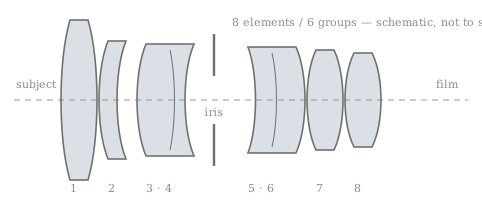
Optical formula — Retrofocus, 8 elements in 6 groups
History
Nippon Kogaku set itself a rule when the Nikon F arrived: every lens for it would take a 52mm filter. A 35mm f/2 for a mirror box is a retrofocus design, which means a large negative group out in front, and a large negative group out in front is exactly what breaks a filter standard. Shimizu Yoshiyuki started on the problem around 1961 and needed three attempts. The lens that reached the market in 1965 has eight elements in six groups, a 63.5mm barrel, and a 52mm thread.
Nikon’s own account of the lens is unusually blunt about what makes it interesting: the optical structure did not change. Five generations of barrel — Nikkor-O Auto in chrome-ringed black, the multicoated ·C of 1973, the rubber-gripped New Nikkor of 1975, the Ai of 1977, the Ai-S of 1981 — all wrap the same eight elements. What changed was coating, the letter on the front ring, the minimum aperture (f/16 became f/22 in 1975), the number of screws holding the bayonet on, and the focus throw, which the Ai-S cut from 190 degrees to 120.
The break comes in 1989. The AF Nikkor 35mm f/2 has six elements in five groups, focuses to 0.25m instead of 0.3m, and weighs 215g instead of 280g. It is not the 1965 lens with a screwdriver coupling added; it is a different lens wearing the same name, and Vink’s database marks it as such. The AF-D of 1995 adds distance encoding to that second design and runs to 2020.
Counting Vink’s blocks gives roughly 438,000 manual-focus lenses and roughly 276,000 autofocus ones — and within the autofocus figure, a single 2006-series block of 177,724, larger than the entire Ai-S run. Richard Haw’s verdict on the original is that it is very good wide open, best at f/4 to f/5.6, and distorts too much for buildings; he also notes that fungus and separation along the cemented edges turn up often enough in the inner elements to look like a manufacturing habit rather than bad luck.
Neither Nikon nor any secondary source consulted gives a list price for any version, in yen or dollars, and the production counts remain arithmetic on serial numbers rather than factory records. The unresolved question is smaller and more specific: what the 1989 redesign was for. Two fewer elements, closer focus and 65g less weight are consistent with cost, with autofocus speed, or with both, and none of the published accounts says which.
This history is AI-written, from the sources listed at the foot of the page. Where the record is silent it says so rather than filling the gap — but no human wrote these sentences.
Example photos


Sample photo wanted — shot with a Nikkor 35mm f/2? We'd love to feature it (with credit).
Live listings
Asking price, USD: a median of $190 across 61 fixed-price listings on 2026-09-11 (middle half $160–$250). Tracked since 2026-09-06, 2 days: unchanged from $190.
By day
| Date | Median | Middle half | Listings |
|---|---|---|---|
| 2026-09-11 | $190 | $160–$250 | 61 |
| 2026-09-06 | $190 | $160–$250 | 61 |
Asking prices from the listings scanned, not sales; junk-flagged rows and auction lots excluded; other currencies are not converted.
- Nikon AF Nikkor 35mm F/2 Name Ring 0
- Nikon Nikkor-O Auto 35mm F2 Lens For Nikon F Needs Cleaning
- Nikon Non Ai NIKKOR 35mm F/2 MF Wide Angle Lens Made In Japan
- [Near MINT]Nikon Nikkor-O Auto 35mm f/2 Non Ai Wide Angle MF Lens From JAPAN
- Nikon Nikkor AI-S 35mm f2 Lens AIS *Read Notes #050
- [Exc+5] Nikon Nikkor-O Auto 35mm f/2 non Ai MF Wide Angle Lens From JAPAN
- [Exc+5] Nikon Ai Nikkor 35mm f/2 Wide Angle MF Prime Lens For F Mount From JAPAN
- [Top MINT] Nikon New Nikkor 35mm f/2 Non-Ai MF Wide Angle Prime Lens From JAPAN
- [Near MINT] NIKON NIKKOR-O Auto 35mm f/2 Ai Converted Wide Angle Lens From JAPAN
- Fine Nikon NIKKOR-O Auto 35mm f/2 Non Ai Wide Angle Lens
- Nikon NIKKOR-O Auto 35mm f/2 Wide Angle MF Lens *Excellent* #5186
- Nikon Ai NIKKOR 35mm F/2 MF Wide Angle Lens From Japan
- Nikon New Nikkor 35mm f/2 MF Wide Angle SLR Camera Lens for Nikon F-mount JAPAN
- Nikon NIKKOR 35mm f/2 AI Manual Focus Prime Lens (Used)
- Nikon Ai Nikkor 35mm F2 EXC+++++ MF Wide Angle Lens From JAPAN #2348
- [Near MINT] Nikon New Nikkor 35mm f/2 Non-Ai MF Prime Lens From JAPAN
- [N MINT w/caps] Nikon New Nikkor 35mm f/2 Non-Ai MF Prime Lens From Jpn #600
- VERY GOOD Nikon NON Ai Nikkor 35mm F/2 Prime Lens
- 【 NEAR MINT- 】Nikon Ai Nikkor 35mm f/2 Wide Angle Prime MF Lens From JAPAN #893
- [MINT] Nikon Auto NIKKOR-O.C 35mm f/2 Non-AI Wide Angle Lens JAPAN FAST Tested!
Show 120 more listings
- Nikon New NIKKOR 35mm f/2 MF Prime Camera Lens Non-Ai [Near MINT] From JAPAN
- Nikon Nikkor Ai 35mm f/2 MF Prime Lens From JAPAN *Exc+5* #5145
- Nikon Ai Nikkor 35mm f/2 Wide Angle Prime MF Lens From JAPAN Near MINT #0628
- [Near MINT] Nikon Nikkor-O.C Auto 35mm f/2 non Ai MF Lens From JAPAN 6F10
- Video*[N MINT] Nikon Nikkor Ai 35mm f/2 Wide Angle MF from JAPAN No2 #1 day ship
- Nikon Nikkor-O Auto 35mm f/2 MF Wide Lens Ai Converted [Near Mint] from Japan
- Tested [Near MINT]Ai Converted Nikon Auto Nikkor-O 35mm f/2 MF Lens From JAPAN
- [Exc+5] Nikon Ai-s Ais Nikkor 35mm f/2 MF Wide Angle Lens For F Mount From JAPAN
- All Works [NEAR MINT+5] Nikon Nikkor Ai 35mm f/2 Wide Angle Prime Lens MF JAPAN
- Nikon New Nikkor 35mm f/2 Non Ai Wide Angle Prime Lens No Fungus Near Mint Japan
- [Exc+4] Nikon AF Nikkor 35mm f/2 Wide Angle Prime Lens = From JAPAN
- Excellent Nikon AF NIKKOR 35mm f/2 D Lens Nikon F Mount
- [Near MINT] Nikon Ai NIKKOR 35mm F2 MF Wide Angle Lens From Japan
- [Near MINT] Nikon Nikkor-O Auto 35mm f/2 non Ai wide Angle MF Lens From JAPAN
- Nikon AF Nikkor 35mm f/2 Lens Wide Angle for F mount - Tested Working- Read!
- VERY GOOD 【Serviced】 Nikon Non-Ai NIKKOR-O.C Auto 35mm F/2 Prime Lens
- [Top MINT] Nikon Ai Nikkor 35mm F2 Wide Angle MF Lens For F Mount From JAPAN
- [MINT] Nikon Ai Nikkor 35mm f/2 Wide Angle Lens For F Mount Fast Shipping JAPAN
- Nikon Nikkor AF 35mm f2 D Lens *Read #006
- [MINT] Nikon AF Nikkor 35mm f/2 Wide Angle Auto Focus Prime Lens From JAPAN
- [MINT] Nikon Ai NIKKOR 35mm f2 MF Wide Angle Camera Lens For F Mount From JAPAN
- Video*[Exc+4] Nikon AF Nikkor 35mm f/2 D Wide Angle Prime from JAPAN 1day ship 3
- [N Mint w/Caps] Nikon Ai Nikkor 35mm f/2 Wide Angle Lens From JPN #488
- SIC [Exc+4+ w/Caps] Nikon Ai-s AIS Nikkor 35mm f/2 Wide Angle MF Lens From JAPAN
- SIC [NEAR MINT] Nikon Nikkor Ai-S Ais 35mm f2 Wide Angle MF Lens S/N321xxx
- CLA'd [Near MINT] Nikon Ai-s AIS Nikkor 35mm f/2 Lens F Mount Camera From JAPAN
- [NEAR MINT] Nikon Ai-S Ais NIKKOR 35mm F2 Wide Angle MF Lens F Mount JAPAN #368
- [Near MINT] Nikon Nikkor Ai-s 35mm F/2 MF Prime Wide Angle Lens From JAPAN
- [Almost MINT] Nikon Ai-s Nikkor 35mm f/2 MF Wide Lens From JAPAN
- CLA'd [Near MINT] Nikon Ai-s Nikkor 35mm f/2 Wide angle lens F mount From Japan
- Near Mint+++ Nikon Nikkor AF 35mm f/2 D Wide Angle Prime Lens Japan #0506
- [Near MINT] Nikon Nikkor-O.C Auto Non Ai 35mm F2 MF Lens From JAPAN
- [Near MINT] Nikon AF Nikkor 35mm f/2 D Wide Angle Lens From JAPAN #1604a
- "D" Lens [Top MINT, CLA'd] Nikon AF Nikkor 35mm f2 D Lens For F Mount From JAPAN
- [Almost Unused] Nikon Ai-s Ais Nikkor 35mm f/2 MF Wide Lens For Nikon F JAPAN
- [Excellent] Nikon AF Nikkor 35mm f/2 D Auto Focus Wide Angle Lens JAPAN #333
- Nikon Ai-s AIS Nikkor 35mm F/2 MF Wide Angle Lens For F Mount JAPAN MINT #7467
- SIC!! [Top MINT] Nikon Ai-s Nikkor 35mm f/2 MF Wide Angle Prime Lens From JAPAN
- SIC:320xxx [Almost MINT] Nikon Ai-s Nikkor 35mm f/2 Lens For Nikon F From JAPAN
- *Almost Unused /Box* Nikon Nikkor Ai 35mm F2 MF Wide Angle Prime Lens From JAPAN
- 【N MINT+++】Nikon S2 Nikkor Black Dial Late Model 35mm Rangefinder 5cm 50mm f/2
- Nikon Ai Nikkor 35mm f/2 *AS IS*
- Nikon Nikkor-O Auto 非Ai 35mm F/2 単焦点レンズ
- Nikon 非Ai Nikkor-O Auto 35mm F/2 単焦点レンズ
- Nikon 非Ai Nikkor-O Auto 35mm F/2 単焦点レンズ
- Nikon 非Ai Nikkor-O Auto 35mm F/2 単焦点レンズ
- Nikon 非Ai Nikkor-O Auto 35mm F/2 単焦点レンズ
- Nikon 非Ai Nikkor 35mm F/2 単焦点レンズ
- Nikon 非Ai Nikkor 35mm F/2 単焦点レンズ
- Nikon 非Ai NIKKOR-O.C Auto 35mm F/2 単焦点レンズ
- Nikon 非Ai Nikkor-O Auto 35mm F/2 単焦点レンズ
- 【Serviced】 Nikon 非Ai Nikkor-O Auto 35mm F/2 単焦点レンズ
- 【Serviced】 Nikon 非Ai NIKKOR-O.C Auto 35mm F/2 単焦点レンズ
- Nikon 非Ai NIKKOR-O.C Auto 35mm F/2 単焦点レンズ
- 【Serviced】 Nikon 非Ai Nikkor 35mm F/2 単焦点レンズ
- 【Serviced】 Nikon 非Ai Nikkor 35mm F/2 単焦点レンズ
- Nikon 非Ai Nikkor-O Auto 35mm F/2 単焦点レンズ
- Nikon 非Ai Nikkor-O Auto 35mm F/2 単焦点レンズ
- Nikon Ai改 Nikkor-O AUTO 35mm F/2 単焦点レンズ
- 【Serviced】 Nikon 非Ai Nikkor-O Auto 35mm F/2 単焦点レンズ
- 【Serviced】 Nikon 非Ai NIKKOR-O.C Auto 35mm F/2 単焦点レンズ
- 【Serviced】 Nikon 非Ai NIKKOR-O.C Auto 35mm F/2 単焦点レンズ
- Nikon 非Ai Nikkor-O Auto 35mm F/2 単焦点レンズ
- 【Serviced】 Nikon 非Ai Nikkor-O Auto 35mm F/2 単焦点レンズ
- 【Serviced】 Nikon 非Ai Nikkor-O Auto 35mm F/2 単焦点レンズ
- 【Serviced】 Nikon Ai Nikkor 35mm F/2 単焦点レンズ
- Nikon Ai Nikkor 35mm F/2 単焦点レンズ
- 【Serviced】 Nikon Ai Nikkor 35mm F/2 単焦点レンズ
- 【Serviced】 Nikon Ai Nikkor 35mm F/2 単焦点レンズ
- 【Overhauled】 Nikon Ai-S NIKKOR 35mm F/2 単焦点レンズ
- 【Serviced】 Nikon Ai-S NIKKOR 35mm F/2 単焦点レンズ
- 【Overhauled】 Nikon Ai-S NIKKOR 35mm F/2 単焦点レンズ
- GOOD Nikon Non Ai Nikkor-O Auto 35mm F/2 Prime Lens
- VERY GOOD Nikon NON Ai Nikkor-O Auto 35mm F/2 Prime Lens
- VERY GOOD Nikon NON Ai Nikkor-O Auto 35mm F/2 Prime Lens
- VERY GOOD Nikon NON Ai Nikkor 35mm F/2 Prime Lens
- Nikon NIKKOR-O Auto 35mm f/2 Wide Angle MF Lens *Excellent* #5186
- [Exc+5] Nikon Nikkor-O Auto 35mm f/2 non Ai MF Wide Angle Lens From JAPAN
- VERY GOOD Nikon Ai Nikkor 35mm F/2 Prime Lens
- Nikon Nikkor Ai 35mm f/2 MF Prime Lens From JAPAN *Exc+5* #5145
- EXCELLENT Nikon Ai Nikkor 35mm F/2 Prime Lens
- Nikon AF NIKKOR 35mm f/2 D Lens for Nikon F Mount Excellent
- EXCELLENT 【Serviced】 Nikon Ai Nikkor 35mm F/2 Prime Lens
- [MINT] Nikon Auto NIKKOR-O.C 35mm f/2 Non-AI Wide Angle Lens JAPAN FAST Tested!
- [Top MINT] Nikon Ai Nikkor 35mm F2 Wide Angle MF Lens For F Mount From JAPAN
- [Exc+] Nikon Ai-S NIKKOR 35mm F2 MF Wide Angle Lens F Mount from JAPAN
- [Near MINT] Nikon Ai-s Nikkor 35mm f/2 Wide Angle MF Lens From JAPAN
- Nikon Nikkor AF 35mm f/2 D Lens
- Video*[Exc+4] Nikon AF Nikkor 35mm f/2 D Wide Angle Prime from JAPAN 1day ship 3
- SIC [Exc+4+ w/Caps] Nikon Ai-s AIS Nikkor 35mm f/2 Wide Angle MF Lens From JAPAN
- [Exc+5] Nikon Nikkor AF 35mm f/2 D Wide Angle Prime Lens Japan 6H12
- CLA'd [Near MINT] Nikon Ai-s AIS Nikkor 35mm f/2 Lens F Mount Camera From JAPAN
- LENS Nikon Nikkor Ai 35mm f/2 wide angle prime lens - F-mount Earlier Version
- CLA'd [Near MINT] Nikon Ai-s Nikkor 35mm f/2 Wide angle lens F mount From Japan
- [Near MINT] Nikon AF Nikkor 35mm f/2 D Wide Angle Lens From JAPAN #1604a
- EXCELLENT 【Serviced】 Nikon Ai-S NIKKOR 35mm F/2 Prime Lens
- [Excellent] Nikon AF Nikkor 35mm f/2 D Auto Focus Wide Angle Lens JAPAN #333
- Nikon Ai-s AIS Nikkor 35mm F/2 MF Wide Angle Lens For F Mount JAPAN MINT #7467
- SIC S/N 328xxx [ MINT +++ ] Nikon Ai-s Ais Nikkor 35mm f/2 MF Lens From JAPAN
- (UK): UNUSED in BOX - Nikon Nikkor 35mm f/2 AF D Wide-Angle Lens (Complete)
- AS IS Nikon Ai Nikkor 35mm F/2 Wide Angle MF Lens From Japan
- NIKON MF 35mm f/2,8 Nikkor (nonAI) - SNr: 923891
- Nikon NIKKOR-O Auto 35mm f/2 Weitwinkel MF Objektiv *Top* #5186
- Nikon Nikkor-O Auto 35mm f/2 MF Wide Lens Ai Converted [Near Mint] from Japan
- Video*[N NEUWERTIG] Nikon Nikkor Ai 35mm f/2 Weitwinkel MF aus JAPAN Nr. 2...
- Nikon AF NIKKOR 35mm f/2D Nikon F
- Nikon NIKKOR-O Auto 35mm f2 Ai Converted【N.MINT+++】JAPAN #772
- [Top NEUWERTIG] Nikon Ai Nikkor 35mm F2 Weitwinkel MF Objektiv für F Mount...
- Nikon Nikkor AF 35mm f/2 D Lens
- Video*[NEUWERTIG] Nikon Nikkor Ai 35mm f/2 Weitwinkel MF aus JAPAN 2 #1...
- Nikon F Photomic + Nikkor-O 35mm f/2
- Frühe Version Nikon Nikkor-S Auto 35mm F/2,8 Nippon, Traumzustand!!!!
- [Exc+5] Nikon Nikkor AF 35mm f/2 D Weitwinkel Prime Objektiv Japan 6H12
- "D" Objektiv [Top NEUWERTIG, CLA'd] Nikon AF Nikkor 35mm f2 D Objektiv für...
- Nikon Nikkor 35mm f2 AI SHP 302277
- SIC S/N 328xxx [NEUWERTIG +++] Nikon Ai-s Ais Nikkor 35mm f/2 MF Objektiv...
- Nikon Nikkor AF 35mm f/2D + HN-3 With Box
- SIC [NEUWERTIG mit Haube] Nikon Ai-S AIS Nikkor 35mm f/2 MF...
- Chiyotax IIIF 35mm Rangefinder camera w. Nippon Kogaku Nikkor HC 2/5cm lens Leica M39 Mount (LTM)
- Nikon S4 rangefinder 35mm camera w. Nikkor-H 2/5cm lens
eBay links are affiliate links. If you buy through one, Glass Bodies earns a small commission from eBay at no cost to you. It does not change which listings appear, their prices or their order — those come from the search and the sort described above.
Listings updated 2026-09-11. Links go to the shop or marketplace that carries the item.